Emphatically: No, Social Security is not a Ponzi scheme.
Social Security is a legally mandated social insurance program operated by the U.S. federal government. It provides retirement, disability, and survivor benefits to tens of millions of Americans and has been doing so for nearly 90 years. It is administered by the Social Security Administration (SSA), funded primarily through payroll taxes, and governed by a defined benefit formula that is public, regulated, and periodically updated.
By contrast, a Ponzi scheme is an illegal, fraudulent investment operation. It promises outsized returns to earlier investors, not from genuine profits or investment earnings, but from the contributions of newer investors. Ponzi schemes inevitably collapse once new investment slows or stops, revealing no actual value creation.
So by definition, Social Security is not a Ponzi scheme. It is legal. It is transparent (in a formal, institutional sense). And it is backed by the full faith and credit of the United States government.
But if we set aside legal status and moral framing for a moment and look only at structure and mechanics, we find a more complicated truth:
Social Security shares more structural features with a Ponzi scheme than most people realize.
Ponzi Schemes: Mechanics and History
The term “Ponzi scheme” originates from Charles Ponzi, who in 1920 promised 50% returns in 90 days to investors by supposedly arbitraging international reply coupons. In reality, he paid earlier investors with the money collected from newer investors, not from actual profits. Ponzi’s scam collapsed once he could no longer recruit enough new participants to cover the payouts. He was arrested and convicted for fraud.
More recently, Bernie Madoff orchestrated the largest Ponzi scheme in history, defrauding investors of over $65 billion over decades. Again, no legitimate investment activity took place; returns were paid with inflows from new participants.
Key features of a Ponzi scheme:
- Pays existing participants using funds from new participants
- Does not invest funds to generate independent returns
- Promises reliable payouts that appear risk-free
- Collapses once new inflows cannot cover existing obligations
- Involves deception or concealment
- Illegal under several US Statutes
Social Security & Ponzi Schemes: The Parallels
If we take an honest look at Social Security though, for many the similarities may make them feel a little more uncomfortable than we may want to admit. The structure of Social Security has many parallels to a Ponzi scheme when viewed through a functional and financial lens. Like a Ponzi scheme, Social Security operates on a pay-as-you-go basis, where current inflows from active participants are used to fund benefits for earlier ones. Meaning, you need new people paying into the scheme to continue it or it collapses. There is no segregated account or investment portfolio tied to individual contributions, nor is it generating returns greater than payouts. Instead, future payouts are contingent on future tax revenues, not on returns from invested principal. This interdependency, reliance on continuous contributions, and absence of asset-backed funding models place Social Security structurally closer to a redistribution mechanism like a Ponzi scheme than a conventional retirement savings system.
| Feature | Ponzi Scheme | Social Security |
|---|---|---|
| Pays earlier participants with new inflows | ✅ | ✅ |
| Not backed by invested assets for each participant | ✅ | ✅ |
| Depends on continued participation to sustain payouts | ✅ | ✅ |
| Participants believe they’re getting back what they put in | ✅ | ✅ |
| Disclosure of risk/shortfall is limited or misunderstood | ✅ | ✅ |
| Legal, government-administered | ❌ | ✅ |
| Transparent formulas and actuarial projections | ❌ | ✅ |
| Collapse avoided via taxation, law, or currency issuance | ❌ | ✅ |
In a private context, a retirement firm that:
- Took your contributions,
- Didn’t invest them,
- Promised future payments from other people’s future contributions,
- Lacked sufficient reserves,
- And failed to clearly disclose this model
This firm would be investigated and likely prosecuted by the Securities & Exchange Commission (SEC), Department of Justice (DoJ), and state attorneys general. That firm would most likely be considered a Ponzi scheme, and prosecuted as such.
How Social Security Actually Works
Social Security is funded primarily through payroll taxes under the Federal Insurance Contributions Act (FICA). Workers and employers each contribute 6.2% of wages up to a wage cap, while the self-employed pay the full 12.4%. These taxes go directly into the trust funds for Old-Age and Survivors Insurance (OASI) and Disability Insurance (DI).
However, these trust funds do not hold traditional investments. Instead, excess revenues are loaned to the federal government in exchange for special-issue Treasury securities. While these earn interest, they are not market-tradable and do not represent real economic assets that can be liquidated to fund future liabilities without affecting overall federal borrowing needs. Additionally, and materially, these funds do not generate enough gains to pay for existing payouts.
As of the mid-2020s, Social Security’s annual tax revenue is less than its benefit payments. The shortfall is covered by redeeming trust fund securities, but those funds are projected to run out by 2034. After that, benefits can only be paid out of current payroll tax revenues, which are expected to cover about 77% of promised benefits.[3]
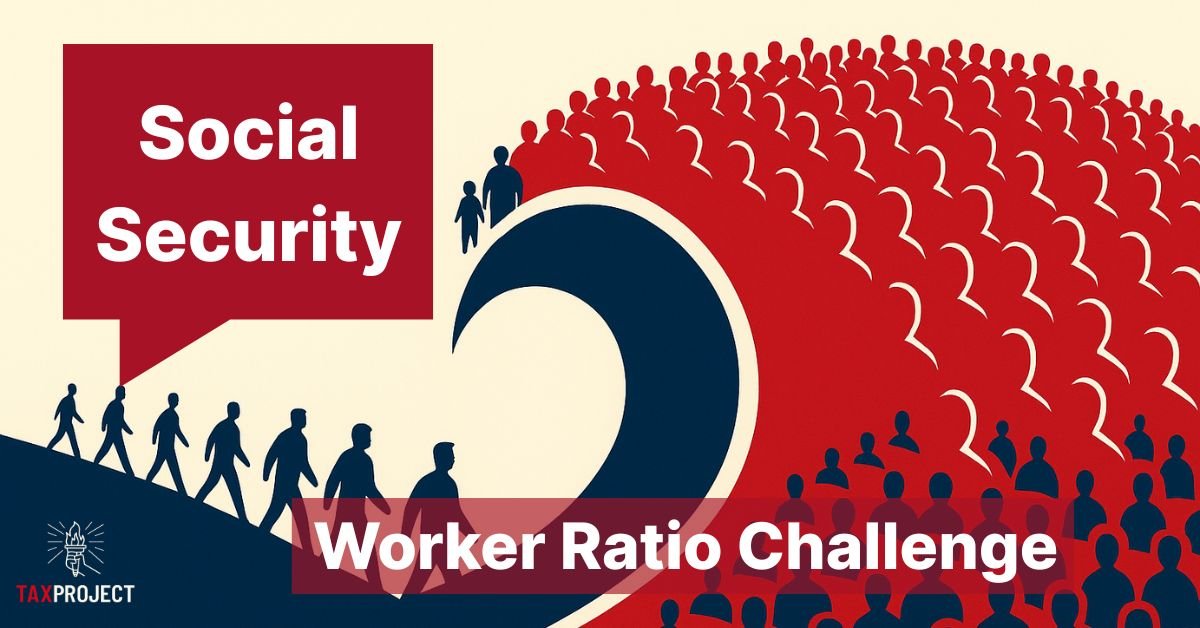
This dynamic underscores the pay-as-you-go nature of Social Security. Contrary to the popular belief that one’s payroll contributions are saved and invested for personal retirement, the program relies on continuous contributions from current and future workers to support today’s retirees. In that sense, it is a form of intergenerational wealth transfer that transfers wealth from one generation to the previous generation rather than a self-funded retirement system.
The Transparency Problem
Technically, Social Security is transparent. The SSA publishes annual Trustees Reports detailing projected income, outflows, actuarial assumptions, and trust fund balances. The legal formulas for calculating benefits are public.
But practical transparency is very different from technical transparency.
Most Americans believe Social Security functions like a personal retirement plan — that their taxes are set aside, invested, and paid back to them. The SSA benefit statements reinforce this illusion, showing how much you’ve “paid in” and what you’ll “receive.” There is no plain-language disclaimer stating:
“Your taxes are used immediately to pay current retirees. No funds are saved or invested on your behalf. Your future benefits depend on future workers paying taxes to fund the system.”
By any standard that applies to private finance, fiduciary duty, or consumer protection law, this would be considered not only misleading by omission, but potentially fraudulent. A private institution presenting such a structure—suggesting that individual contributions are saved or invested for the contributor’s benefit, while actually funding current obligations with no individualized reserve—would likely face charges of deceptive practices, material misrepresentation, and regulatory violations under securities and consumer law. [4]
A study by RAND Corporation on public literacy of Social Security found that nearly half of adults earned a D or F on a basic Social Security knowledge quiz demonstrating significant misunderstandings of system mechanics. [1] Though no direct study was found on the public understanding of the Pay as you Go mechanism of Social Security, the government does little to actively dispel the myth that it is acting as a “trust fund.”
The Unfunded Liability: The Numbers Behind the Structure
The most recent Social Security Trustees Report (2025) projects a 75-year unfunded liability of $25.1 trillion in present-value terms [2]. This means that, over the next 75 years, Social Security is projected to pay $25.1 trillion more in benefits than it will collect in dedicated revenue.
By 2034, the combined OASDI trust fund is projected to be exhausted. After that, unless Congress acts, the system will only be able to pay about 77% of scheduled benefits from incoming payroll taxes alone [3].
Social Security began running a cash-flow deficit in 2010. It has been drawing down its trust fund reserves since 2021. The trust fund peaked at around $2.9 trillion and is now declining.
The trust fund itself is not a savings account. It consists of special-issue Treasury securities — effectively an IOU from the government to itself. These securities are redeemed to pay benefits, but when they run out, there is no dedicated asset base.
Why It Matters
Calling Social Security a Ponzi scheme in the strict sense is inaccurate. But calling it entirely different is also misleading.
The difference lies not in structure, but in enforcement power:
- The U.S. government can tax future workers
- It can borrow in financial markets
- It can print money if necessary
These options allow it to postpone collapse indefinitely. But they do not change the basic fact: today’s taxes fund today’s retirees.
If birth rates fall, if wage growth stalls, if demographics worsen, or if political consensus breaks down, the system will require either:
- Higher taxes
- Lower benefits
- Benefit eligibility reforms
- Or external financing through debt or inflation
A private scheme operating under these conditions would be criminal. Government operation makes it lawful — but it does not make it financially self-sustaining.
Conclusion
Social Security is not a Ponzi scheme in the legal or criminal sense. It is backed by the full faith and credit of the United States and its unlimited ability to tax and issue money. However, it shares many structural characteristics with Ponzi schemes:
- Pay-as-you-go
- Intergenerational transfer reliance
- Lack of individual funding
- Misconceptions about how benefits are financed
It is sustainability is not rooted in economics, but in politics and public trust. Although understanding of how Social Security works, that it functions on many of the same structures of Ponzi Schemes, there is high trust in Social Security if not the full benefits.
The sooner Americans understand the true nature of Social Security — as a government-mandated, intergenerational tax-and-transfer system that acts and behaves very differently than individual retirement plans — the more honest and productive the reform debate will become.
Citations
[1] RAND Corporation, “What do people know about Social Security” 2010 https://www.rand.org/pubs/working_papers/WR792.html#document-details
[2] Social Security Administration, 2025 Trustees Report Summary. https://www.ssa.gov/oact/TR/2025/
[3] Bipartisan Policy Center, “Social Security Trust Fund 2025 Report Summary.” https://bipartisanpolicy.org/blog/2025-social-security-trustees-report-explained/
[4] 18 U.S.C. § 1341 (Mail Fraud); 18 U.S.C. § 1343 (Wire Fraud); 15 U.S.C. § 77q(a) (Securities Act of 1933, antifraud provisions); SEC v. Madoff, No. 09 CV 818 (S.D.N.Y. 2009); U.S. Securities and Exchange Commission, “Ponzi Schemes,” https://www.sec.gov/fast-answers/answersponzihtm.html