Shifting Roles of Tariffs
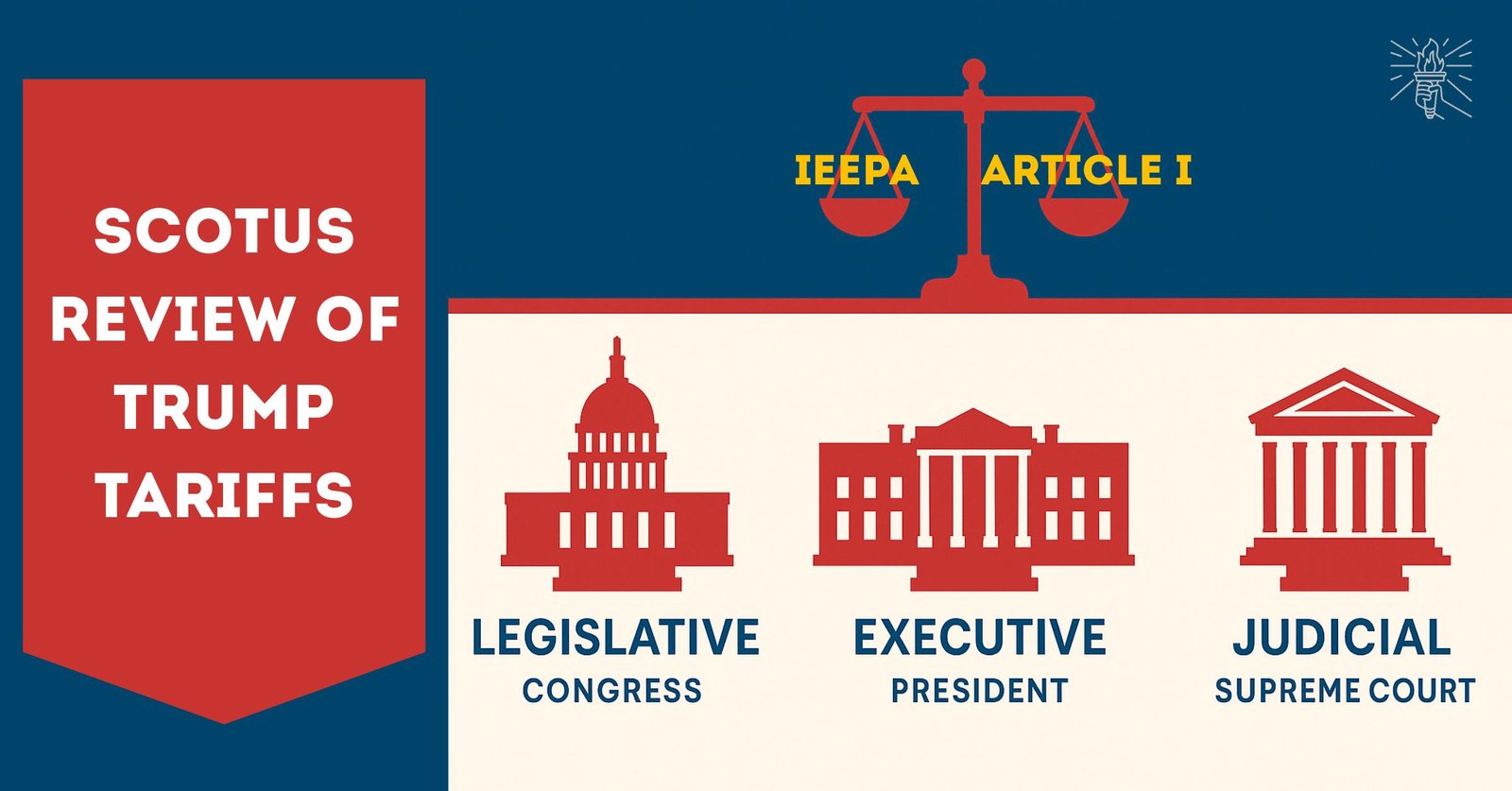
For most of U.S. history, tariffs were Congress’s domain and primarily a way to raise revenue. Article I of the Constitution assigns taxing and tariff powers to Congress, and for half our countries history Tariffs were the Federal government’s main revenue source. Over the 20th century, however, Congress frustrated by the slow, politicized nature of tariff-making began delegating authority to the Executive branch so trade policy could be negotiated dynamically. On Wednesday (11/5/25) the Supreme Court began the review of President Trump’s recent tariff program and the review will test how far that delegation can stretch, especially when tariffs evolve from a revenue instrument to a lever of commerce, national security, and geopolitical bargaining (e.g., fentanyl control or strategic tech limits). [1][2]
Evolving roles of Congress and the White House
Tariffs were the exclusive domain of Congress, composing long schedules with changes occurring over years. The shift the Executive office has occurred progressively and deliberately beginning with the 1934 Reciprocal Trade Agreements Act (RTAA), which let presidents cut or raise tariffs up to 50% (relative to Smoot-Hawley) through executive agreements which proved faster than treaties and more adaptable than statute. The RTAA embedded reciprocity and helped create multi lateral concessions via the General Agreement on Tariffs and Trade (GATT’s) most-favored-nation (MFN) principle, allowing negotiated tariff cuts with one partner to benefit all. This was a conscious design choice: move from static tariff schedules set by statute to a nimble bargaining architecture led by the Executive. [3][4][5]
Congress later layered additional delegations: Section 232 of the 1962 Trade Expansion Act (national security tariffs), Section 201 and 301 of the 1974 Trade Act (safeguards and unfair trade responses), and in 1977 the International Emergency Economic Powers Act (IEEPA), which broadly authorizes the President to regulate economic transactions during national emergencies involving foreign threats. In parallel, the GATT/WTO framework entrenched MFN and reciprocity, reinforcing executive-driven negotiating cycles rather than fixed tariff lawmaking. [6][7]
Courts have mostly OK’d Delegation
Historically, the Court has upheld substantial tariff delegations when Congress set intelligible principles and clear predicates. In Federal Energy Administration v. Algonquin SNG (1976), the Court approved presidential license fees on oil under Section 232, reading the statute as giving the President flexibility to “adjust” imports for national security once the Executive met specific preconditions. Earlier, Field v. Clark (1892) sustained conditional delegation tied to foreign tariff behavior. These cases held decades of deference by the court in trade and delegation by Congress to the Executive branch. [8][9]
The Trump era revived litigation, first around 2018 steel/aluminum actions under Section 232. Challenges like American Institute for International Steel failed; the Supreme Court denied cert, leaving Algonquin intact and the Federal Circuit generally supportive of 232 flexibility, including derivative-product tariffs. [10][11][12]
However, 2025 represents a different question: Can IEEPA (which never mentions “tariffs”) support sweeping, near-global import duties justified by emergency findings (including fentanyl and broader economic security)? The Court’s November 5, 2025 oral argument signaled skepticism from both conservative and liberal justices about reading IEEPA to authorize what looks like taxation, a traditional legislative power. Several justices pressed whether the major questions doctrine which requires explicit congressional authorization for issues of “major national significance” and consequential policy. [13][14][15][16]
That skepticism follows a procedural path: in August 2025, the Federal Circuit affirmed that IEEPA’s grant to “regulate” foreign economic transactions does not stretch to an open-ended tariff regime; the government petitioned for swift Supreme Court reversal. The present case thus squarely tees up whether “regulation” under IEEPA can include customs duties and—if so—whether that would violate the nondelegation principle absent tighter statutory limits. [17][18] (Federal Circuit Court)
From Revenue to Leverage: how purpose may shape the ruling
There is debate if Tariffs are a tax, see our article on Are Tariffs a Tax? Regardless of your opinion on if Tariffs are Taxes, in the SCOTUS review purpose matters. Clearly overtime the role of Tariffs has evolved: began as revenue; then a protection mechanism, to a tool for reciprocity, and to promote global trade. Now, modern presidents often wield them as leverage for Geopolitical positions beyond economics including reducing Fentanyl and putting checks on bad actors like Russia and North Korea, and checking China economically and militarily. Trump’s 2025 program explicitly ties duties to strategic aims: deterring fentanyl flows, reshoring supply chains, and countering adversaries’ economic-military statecraft. In that framing, tariffs function like sanctions, an area where IEEPA routinely operates. The government’s brief argues the measures are regulatory, not fiscal, and thus within IEEPA’s text and tradition. Challengers reply that once the Executive imposes broad, durable duties at the border, it is taxing without Congress. [19][20]
How might the Court sort this?
- A narrow IEEPA reading (most likely): The justices could hold that IEEPA authorizes blocking, freezing, licensing, and transaction bans, but not generalized ad valorem tariffs. That would push the Executive back to Section 232 or 301 (which carry process predicates and narrower aims) and preserve Algonquin’s logic while limiting emergency-based tariff programs. Expect heavy reliance on major-questions reasoning (clear statement needed for tax-like powers). [21][8]
- A middle path: The Court could permit targeted, time-limited IEEPA tariffs tightly tethered to a specific emergency (e.g., proven fentanyl-related supply chains) and subject to renewal findings closer to sanctions than revenue measures. That would salvage some executive agility while preventing “tariffs-as-tax” by proclamation. [13][19]
- A broad approval (least likely given argument): If the Court buys the sanctions analogy fully, it could uphold IEEPA tariffs as “regulation” of import transactions during a declared emergency. Even then, expect a warning against permanent, economy-wide tariff policies without Congress. [13][14]
Interaction with Delegated Statutes
Whatever happens on IEEPA, the Court can reaffirm that Congress remains the constitutional principal in tariff policy and has provided other, more tailored routes. Section 232 remains viable post-Algonquin, though courts have policed timing and scope. Section 301 and 201 remain on the books with procedural guardrails. The question is whether emergencies allow the President to substitute IEEPA for those statutes. A restrictive reading would push the Executive branch back toward statutorily channeled tools – still dynamic, but with predicates that mirror congressional intent. [10][11][6]
How the Tariff Timeline fits
The Tax Project’s Historical Tariff timeline highlights the long arc: from tariffs as revenue (pre-16th Amendment) to tariffs as policy levers intertwined with MFN reciprocity, national security, and global bargaining. The current case is a stress test of that arc: can the delegation designed for emergencies displace the structured delegations of prior statutes and history built for trade bargaining? The Court’s skepticism may suggests corrective guidance: preserve executive agility where Congress outlined (Section 232/301), but require Congress, not emergencies, to authorize tax-like tariffs writ large at least within the major questions doctrine. That outcome would realign tariffs with their statutory channels without stripping the President of short-run leverage for discrete geopolitical threats, and the tactical implementation of negotiating parameters. [2][3][6]
Citations
[1] Brookings Institution, “Why does the executive branch have so much power over tariffs?” Jan 15, 2025. (Brookings)
[2] CRS, “Presidential 2025 Tariff Actions: Timeline and Status,” Sept 16, 2025. (Congress.gov)
[3] U.S. State Dept. Office of the Historian, “Reciprocal Trade Agreements Act (1934).” (Office of the Historian)
[4] House of Representatives History, “The Reciprocal Trade Agreement Act of 1934.” (History, Art & Archives)
[5] Irwin, “From Smoot-Hawley to Reciprocal Trade Agreements,” NBER chapter. (NBER)
[6] CRS, “Presidential Authority to Address Tariff Barriers in Trade Agreements,” Sept 19, 2025. (Congress.gov)
[7] USITC, “The Rise and Fall of the Most-Favored-Nation Clause.” (USITC)
[8] Federal Energy Administration v. Algonquin SNG, 426 U.S. 548 (1976). (Justia Law)
[9] Field v. Clark, 143 U.S. 649 (1892). (Justia Law)
[10] SCOTUSblog, “American Institute for International Steel v. United States” (cert. denied, 2020). (SCOTUSblog)
[11] CAFC, PrimeSource Building Products v. United States, opinion (Feb 7, 2023). (Federal Circuit Court)
[12] CAFC, American Institute for International Steel summary/opinions (2020); see also CIT Slip Op. 19-37. (Federal Circuit Court)
[13] POLITICO, “Justices appear skeptical of Trump’s broad tariffs,” Nov 5, 2025. (Politico)
[14] The Guardian, “US Supreme Court justices express skepticism over legality of Trump tariffs,” Nov 4, 2025. (The Guardian)
[15] ABC News, “Supreme Court hears Trump tariffs case,” Nov 5, 2025. (ABC News)
[16] AP analysis, “A major question for the Supreme Court: Will it treat Trump as it did Biden?” Nov 4, 2025. (AP News)
[17] CAFC, V.O.S. Selections, Inc. v. Trump, opinion (Aug 29, 2025). (Federal Circuit Court)
[18] Washington Post, “Trump officials ask Supreme Court to quickly allow sweeping tariffs,” Sept 4, 2025. (The Washington Post)
[19] U.S. Solicitor General, Opening Brief in Gov’t v. V.O.S. Selections (IEEPA tariffs), No. 24-1287 (Sept 2025). (Supreme Court)
[20] New York Post, “Supreme Court’s conservative justices pummel Trump admin on tariffs,” Nov 5, 2025. (New York Post)