
250 Years of Public Finance in America
Stories of how Americans funded and Built the Nation
The Whiskey Rebellion and Tax Enforcement
Our first attempt to collect an excise tax didn’t go over too well, learn more.
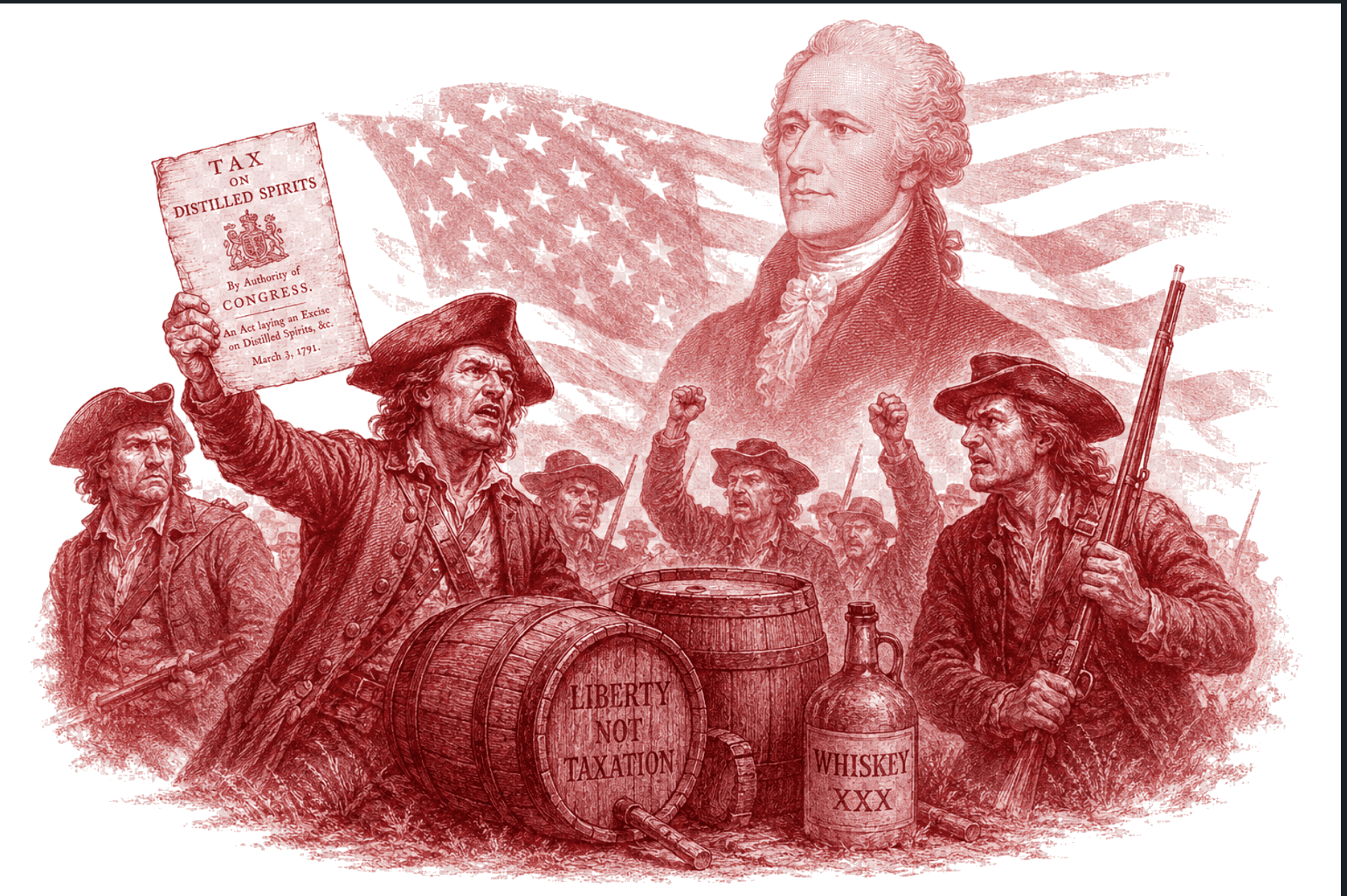
In 1791, Congress approved an excise tax on distilled spirits. To federal officials, the tax was a practical way to raise revenue and support public credit. To many small western distillers, especially in western Pennsylvania, it felt unfair and intrusive. Whiskey was not only a drink. For frontier farmers, it was a way to turn bulky grain into a product that was easier to store, transport, and sell. A tax on whiskey impacted local economies far more directly than taxes on seaports and customs houses. [1]
The public finance issue was simple but difficult: could the new federal government collect an internal tax? Customs duties were collected at ports. An excise tax required revenue officers to operate inside communities, inspect production, assess who owed taxes, and required payment. The Treasury needed money to help fund federal obligations, while taxpayers needed to believe the law was legitimate enough to obey.
The tax structure added to resentment. Federal sources describe rates that varied by production and still size, with smaller producers often feeling they paid more heavily relative to output than larger distillers. Payment rules also mattered. A tax payable in cash looked different in a frontier economy where cash was scarce and barter or local exchange remained common.
Resistance escalated in 1794 when opponents attacked or threatened federal officials. President George Washington called out a militia force of nearly 13,000 men, according to House history materials, to show that federal law would be enforced. The rebellion collapsed before major combat occurred. The government demonstrated that it could enforce revenue laws, but the episode also showed that taxation required more than statutes. It required public acceptance, administrative judgment, political legitimacy, and the will of the governed. [2]
“firm exertions to maintain the Constitution and the laws”
George Washington, proclamation on the Whiskey Rebellion [4]
The Whiskey Rebellion should not be seen as good government versus bad taxpayers, or liberty versus tyranny. It was a real challenge over revenue needs, local economic conditions, tax design, enforcement, and federal authority. The new government had debts to pay and credit to maintain. Western farmers had practical concerns about cash, markets, and representation. [3]
The lesson is that public finance depends on consent and enforcement together. A tax that cannot be collected will not fund public commitments. A tax that feels unfair can create resistance and distrust. The whiskey excise became one of the first major tests of whether federal revenue laws could operate inside local economies. Taxes are never just numbers on a page; they must be collectable, explainable, and viewed as legitimate enough to survive the scrutiny of the public.
Fiscal Facts
- Congress approved an excise tax on distilled spirits in 1791. [1]
- Western farmers often turned grain into whiskey because whiskey was easier to transport and sell than bulky grain.
- Resistance escalated in 1794, and Washington called out a militia force of nearly 13,000 men. [1]
- The episode tested whether federal revenue laws could operate inside local economies.
References
[1] U.S. House of Representatives History, The 1791 Excise Whiskey Tax: https://history.house.gov/Historical-Highlights/1700s/The-1791-Excise-Whiskey-Tax/
[2] Alcohol and Tobacco Tax and Trade Bureau, The Whiskey Rebellion: https://www.ttb.gov/public-information/whiskey-rebellion
[3] Library of Congress, The Whiskey Rebellion: https://guides.loc.gov/this-month-in-business-history/august/whiskey-rebellion
[4] Yale Law School, Avalon Project, George Washington, Proclamation of September 25, 1794: https://avalon.law.yale.edu/18th_century/gwproc10.asp