
250 Years of Public Finance in America
Stories of how Americans funded and Built the Nation
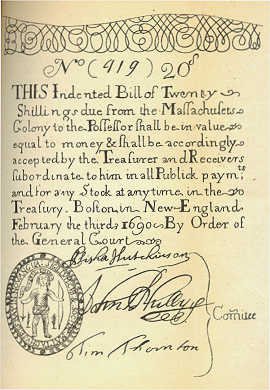
Massachusetts Bills of Credit and Paper Money
How did a Military expedition turn into our first experiment with Paper Money?
In 1690, Massachusetts faced a problem that would return many times in American public finance: the government had promised to pay for a military effort, but it did not have enough hard money on hand. The colony had joined an expedition against Quebec during King William’s War. The expedition failed, soldiers returned expecting pay, and the treasury lacked enough coin. Rather than wait for new taxes to produce cash, Massachusetts issued paper bills of credit. [1]
The idea was simple in form and complicated in practice. The colony gave out paper promises to pay, expecting that future taxes or public revenues would support their value. The bills helped solve an immediate soldier-pay problem and reduced the risk that a cash shortage would become a public crisis. But they also raised a lasting question: what makes paper money valuable? The answer was not the paper itself. It was the government’s promise, future revenue, legal acceptance, public records, and confidence. [1]
The Massachusetts bills are often described as one of the first government-issued paper currencies in the Western world. The exact label is less important than the finance lesson. Cash shortages can force governments to invent tools that bridge the gap between urgent spending and later revenue. In a colony with limited coin, paper obligations became a practical way to buy time. [2]
To make this all work required, above all else, trust. Paper money could lose value if too much was issued, if redemption was delayed, or if people doubted the government’s ability to collect taxes. Later colonial paper-money experiments varied widely. Some helped commerce and public spending; others produced inflation, political conflict, and distrust. The same problem returned on a larger scale during the Revolution with Continental currency. [2]
The story begin with a failed military campaign and ended with a claim on future public revenue. Massachusetts had an immediate obligation to soldiers, but taxes would take time to assess and collect. Paper bills gave the colony something it could deliver quickly. People accepted the notes because they expected the government to redeem them or accept them under public rules.
That made records essential. A bill of credit was a promise, and promises need dates, amounts, signatures, redemption rules, and accounting. If people could not tell what had been issued or how it would be redeemed, trust would fall. Even early paper money required administrative discipline.
The Massachusetts bills were not modern money, but they raised a modern question: how does a government pay for obligations now when revenue arrives later? The answer depended on records, taxes, trust, and the belief that a public promise would be honored. The ability to service needs expeditously is what makes Public Finance so necessary.
Fiscal Facts
- In 1690, Massachusetts issued paper bills of credit after a failed expedition against Quebec. [1]
- The bills helped pay soldiers when coin was scarce and taxes would take time to collect. [1]
- The value of paper money depended on redemption, public records, and confidence in future revenue.
- The same money-and-trust problem returned on a larger scale during the American Revolution. [2]
References
[1] David Goldberg, The Massachusetts Paper Money of 1690, Journal of Economic History: https://www.cambridge.org/core/journals/journal-of-economic-history/article/massachusetts-paper-money-of-1690/5049835E5269260AC1F1BB8619DF6FF2
[2] Federal Reserve Bank of San Francisco, Independence and Continental Currency: https://www.frbsf.org/independence/
[3] History, First paper currency is authorized in the Colonies: https://www.history.com/this-day-in-history/december-10/first-paper-currency-is-issued-in-the-colonies