

250 Years of Public Finance in America
Stories of how Americans funded and Built the Nation
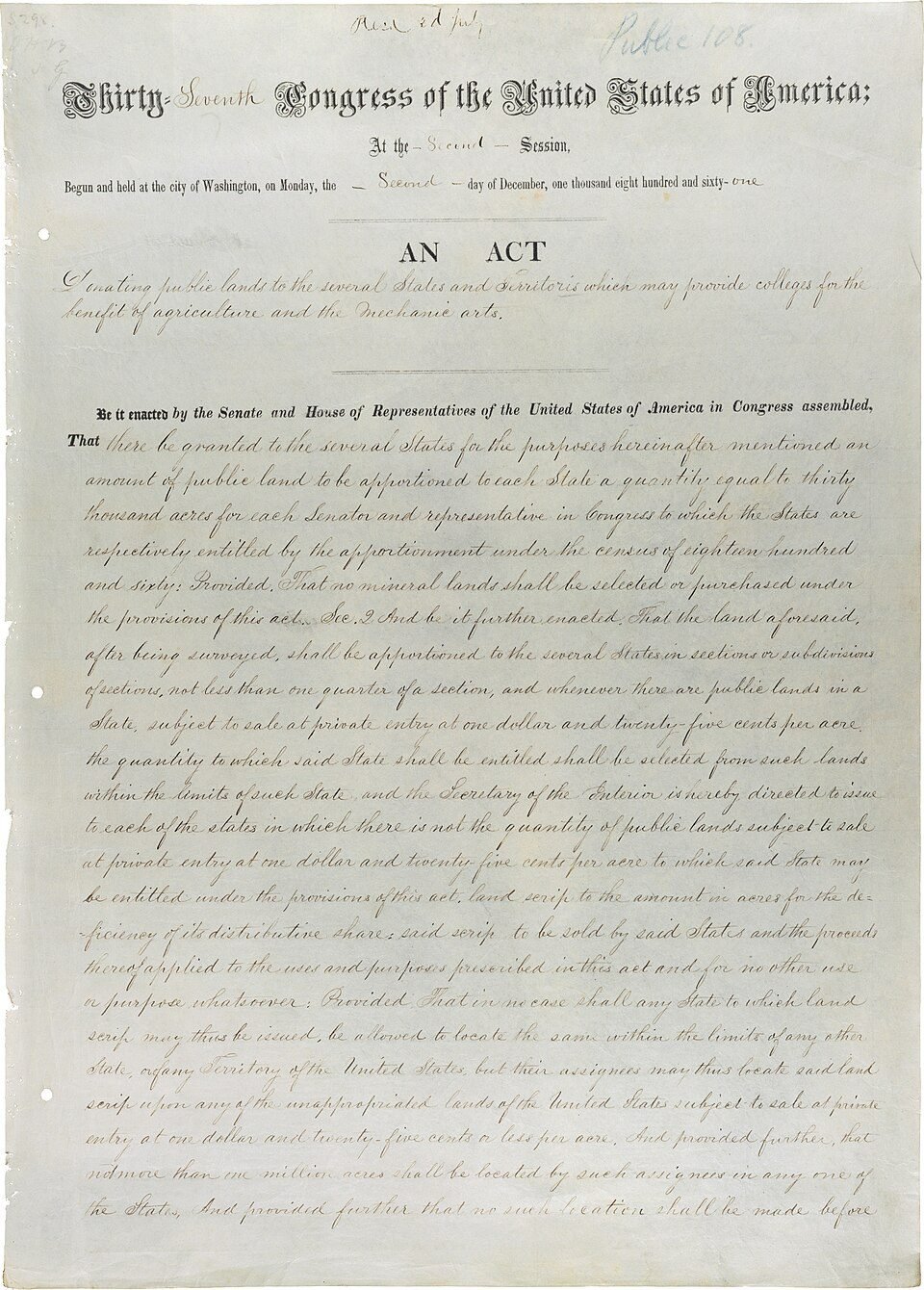
Morrill Act and Land-Grant Colleges
How public land became a finance tool for practical higher education.
The Morrill Act of 1862 used one of the nation’s largest public assets ** land ** to finance education. Instead of sending every state a cash grant from the Treasury, Congress granted public land scrip. Each state received 30,000 acres for each senator and representative in Congress. States could sell the land or scrip and use the proceeds to support colleges focused on agriculture, mechanical arts, and practical education. [1]
The timing matters. The act was signed during the Civil War, when the federal government was also financing armies, debt, taxes, and national banking. Even in wartime, Congress chose to invest in long-term knowledge and skills. The idea was that a growing republic needed more than classical education for a small elite. It needed people trained in farming, engineering, mechanics, science, and applied problem solving. [1]
The scale was large and ambitious. The National Archives notes that land-grant allocations eventually totaled more than 100 million acres. The federal government converted land into an endowment-like resource for states, which then made choices about land sales, investment, college location, and institutional design. [2]
The benefits have lasted to this day, and continue to pay dividends. Land-grant colleges helped expand public higher education and supported agricultural research, engineering, extension work, and practical instruction. Many institutions that began or grew under this system became major public universities.The system linked federal policy to state-level institutions and connected education to economic development. [2]
The tradeoffs were part of the design. Public land was not empty in a moral or historical sense. Much of it had been taken from Native nations through treaties, coercion, war, and federal policy. Some states managed proceeds poorly. Access to the colleges was unequal, especially for women, Minorities, and lower-income residents. Both the educational achievement and the unequal foundations matter.
Land not Cash. Congress granted land scrip, states sold it, and the proceeds supported colleges. The public cost appeared as an asset transfer: land value was converted into education funding. That design helped create institutions that later supported agricultural experiment stations, engineering programs, extension work, and public universities used by generations of students, workers, farmers, and communities. [1]
The Morrill Act shows that public money is not the only way government pays for public goals. Land, credit, guarantees, and legal authority can also be finance tools. In this case, land became a foundation for practical higher education whose effects still shape agriculture, engineering, research, and public universities today. The public investment helped provide the skills and labor pool for a growing nation, and helped the dynamism of the country for generations.
Sampling of Universities that evolved from the Morrill Act:
Ohio State
Michigan State
Purdue
University of Illinois
University of Wisconsin–Madison
University of Minnesota
Iowa State University
University of California, Berkeley
University of Arizona
Washington State University
Colorado State University
Oregon State University
Texas A&M
Auburn University
University of Florida
University of Georgia
Clemson University
University of Tennessee
Pennsylvania State University
Virginia Tech
Rutgers University
University of Maryland, College Park
Cornell University
Massachusetts Institute of Technology (MIT)
Fiscal Facts
- The Morrill Act of 1862 granted 30,000 acres of federal land for each senator and representative. [1]
- States sold land or scrip and used proceeds to support colleges. [1]
- Land-grant allocations eventually totaled more than 100 million acres. [1]
- The system used a public asset – land – to finance practical higher education.
References
[1] National Archives, Morrill Act of 1862: https://www.archives.gov/milestone-documents/morrill-act
[2] U.S. Senate, Morrill Land Grant College Act: https://www.senate.gov/artandhistory/history/common/civil_war/MorrillLandGrantCollegeAct_FeaturedDoc.htm
[3] Library of Congress, Morrill Act primary documents: https://guides.loc.gov/morrill-act/digital-collections