

250 Years of Public Finance in America
Stories of how Americans funded and Built the Nation
Homestead and Land Policy as Public Finance
How federal land policy used public assets to finance opportunity.
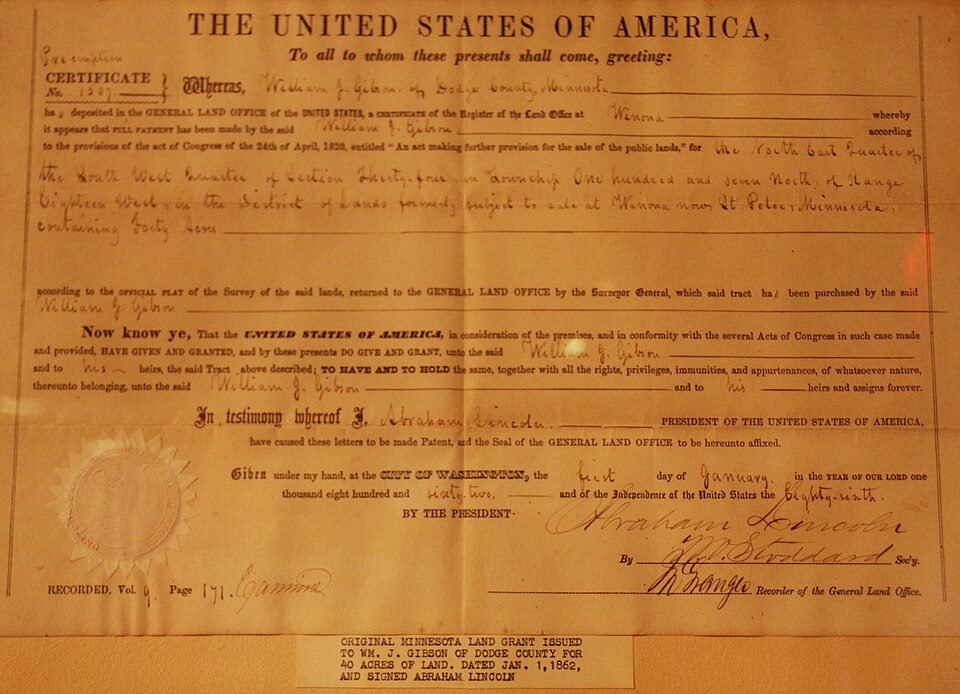
The Homestead Act of 1862 is often remembered as a land law, but it was also a public finance tool. The federal government owned or claimed vast areas of land. Rather than sell all of it for cash, Congress allowed eligible settlers to claim parcels, usually up to 160 acres, if they lived on the land, improved it, and met legal requirements over time. The government used a public asset, land, to encourage settlement, farming, and economic development. [1]
This was not a normal tax-and-spend program. The government did not build a school or road directly with appropriations. Instead, it transferred rights to land under rules. That transfer had economic value. It shaped where people moved, what they built, what crops they grew, which towns formed, and how markets expanded. Land policy became a way to finance a continental economy.
The 160-acre example is easy to understand. It could become a family farm if land, climate, tools, credit, and labor were sufficient. But the promise was often larger than the reality. Farming on the plains could be difficult. Water, soil, weather, transportation, and debt all mattered. Some settlers succeeded; others abandoned claims. Speculators and railroads also shaped land access. [2]
The tradeoffs were enormous. The land used for homesteads was, in part, tied to Native displacement, broken treaties, military conflict, and federal policies that removed Indigenous peoples from their homelands. Eligibility rules and social conditions also affected who could benefit. Some immigrants and formerly enslaved people used land policy to pursue opportunity, while many others faced discrimination, violence, lack of credit, or exclusion.
The money trail began with a public asset and ended in private claims. The federal government used survey systems, land offices, records, and legal rules to transfer parcels to settlers who met requirements. When claims succeeded, farms and towns could create future property tax bases and local markets. But the land itself had value before transfer, and the public gave up possible sale revenue or other uses.
Administration mattered. Land had to be surveyed, claims recorded, improvements verified, and disputes settled. County governments, land offices, surveyors, and courts became part of the finance chain. Once a successful claim became a farm or town lot, it could also become part of a local property tax base that funded roads, schools, and courts.
Homesteading shows how land can function like a public payment tool. The policy helped finance settlement and local tax bases, but it also transferred public assets, displaced Native nations, and made access dependent on rules, resources, and power. The public finance lesson: government investment, be it land, property or resources, can generate growth and opportunity.
Fiscal Facts
- The Homestead Act of 1862 allowed eligible claimants to receive up to 160 acres if they lived on and improved the land. [1]
- Land policy transferred public assets into private hands under federal rules.
- Homesteading helped create farms, towns, local tax bases, and markets.
- The land transfers also involved Native displacement, unequal access, and opportunity costs.
References
[1] National Archives, Homestead Act of 1862: https://www.archives.gov/milestone-documents/homestead-act
[2] National Park Service, Homestead National Historical Park: https://www.nps.gov/home/learn/historyculture/index.htm
[3] Library of Congress, Homestead Act primary sources: https://www.loc.gov/classroom-materials/immigration/homestead-act/