
250 Years of Public Finance in America
Stories of how Americans funded and Built the Nation
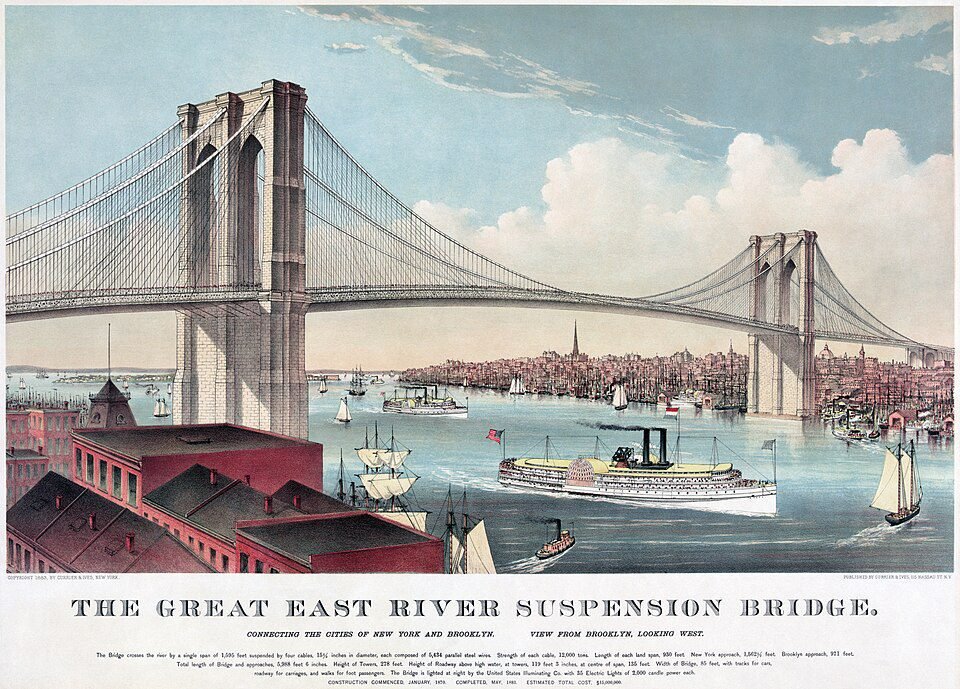
Brooklyn Bridge as Public Finance
How public finance helped build an engineering landmark.
The Brooklyn Bridge is often described as an engineering wonder, but it was also a major public undertaking. Construction began in 1869 and the bridge opened in 1883. It connected Brooklyn and Manhattan across the East River, with a main span that made it the longest suspension bridge in the world at the time. New York City transportation materials report that the bridge cost about $15 million to build. [1]
Before the bridge, movement between Brooklyn and Manhattan depended heavily on ferries. A fixed crossing promised faster travel, more reliable commerce, and a stronger connection between two growing urban centers. The project required legal authority, public planning, engineering expertise, land acquisition, contracts, and financing. It also required confidence that the cost would be worth the benefit over many decades. [1]
Public credit made the project possible. Cities borrow for bridges, water systems, schools, and roads because those assets last longer than one budget year. Borrowing allows a community to build now and repay over time through taxes, fees, tolls, or other public revenues. That does not make infrastructure free. It matches the cost of a long-lived asset to years of public use.
The bridge’s cost makes public credit tangible. Fifteen million dollars in the 1870s and 1880s was a huge sum for local governments. Raising and managing that money required public authority, debt instruments, contracts, and confidence that the bridge would deliver value over time. Civic pride rested on financial structure. [2]
The payoff was not a single revenue line. The bridge produced faster movement, easier commerce, stronger labor connections, and eventually a more integrated metropolitan region. It changed land use, commuting, and the relationship between two cities that would later be consolidated into Greater New York. Infrastructure often pays back through broad economic effects rather than a single cash payoff. [2]
The costs included danger and disruption. Workers faced hazardous conditions. Land and neighborhoods were affected. Political decisions and public-private arrangements shaped the work. And after opening day, maintenance became part of the inheritance. A bridge that opens commerce in one generation becomes an inspection, repair, and rehabilitation obligation in the next.
The Brooklyn Bridge makes infrastructure finance visible. A city borrowed, planned, contracted, and maintained so millions of future crossings could happen. The bridge is made stone and steel, but also is the physical manifestation of the trust, grit, and sacrifice that represents public finance at work.
Fiscal Facts
- Construction of the Brooklyn Bridge began in 1869 and the bridge opened in 1883. [1]
- New York City transportation materials report a construction cost of about $15 million. [1]
- The bridge connected Brooklyn and Manhattan with a fixed crossing over the East River.
- Large infrastructure creates both benefits and long-term maintenance obligations.
References
[1] NYC Department of Transportation, Brooklyn Bridge: https://www.nyc.gov/html/dot/html/infrastructure/brooklyn-bridge.shtml
[2] NYC Department of Transportation, Brooklyn Bridge facts: https://www.nyc.gov/html/dot/html/pr2024/brooklyn-bridge-glow-up.shtml
[3] New York City Municipal Archives, Brooklyn Bridge drawings and plans: https://a860-collectionguides.nyc.gov/repositories/2/resources/38