


250 Years of Public Finance in America
Stories of how Americans funded and Built the Nation
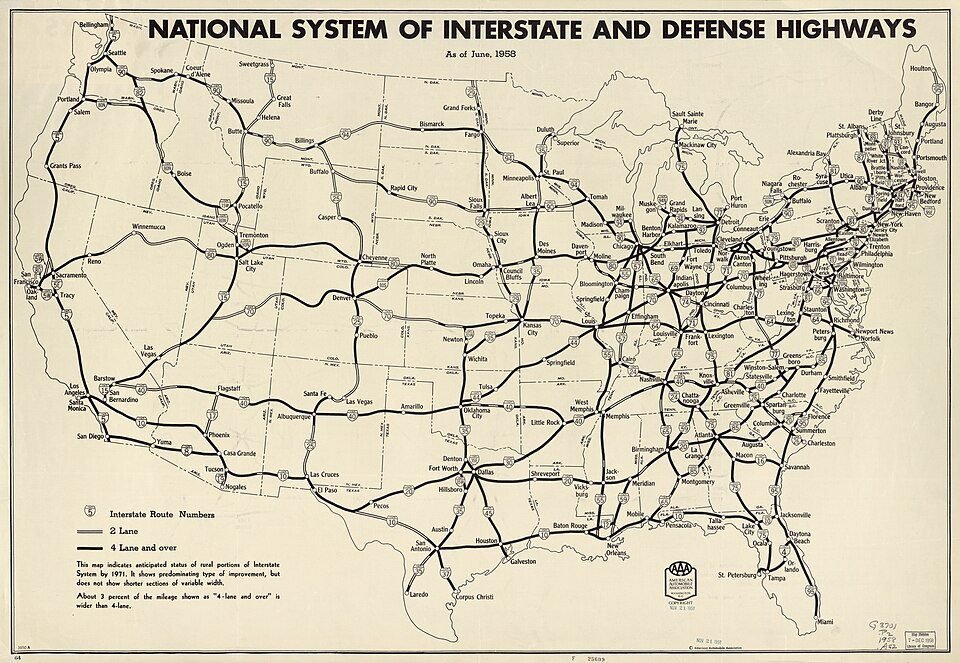
The Interstate Highway System
How Public finance helped build the Interstate Highway network.
The Interstate Highway System changed how Americans travel, ship goods, build suburbs, plan cities, and move military equipment. The Federal-Aid Highway Act of 1956 authorized a 41,000-mile Interstate system and created a finance model built around the Highway Trust Fund. Instead of treating the roads as just another annual expense, the federal government linked highway funding to highway-related taxes, especially fuel taxes, and used federal grants to help states build the system. [1]
“The good of our people, of our economy, and of our defense”
Dwight D. Eisenhower, on the Interstate program [4]
The federal share was the key incentive. Eligible Interstate costs generally had a 90 percent federal share, with states covering the remaining share. That meant the national government paid most eligible construction costs, while states planned and built projects under federal rules. A state that could receive nine federal dollars for every one state dollar had a strong reason to participate in a national plan. [1]
Fuel taxes made the system easier to explain. Drivers and freight carriers bought fuel, fuel taxes helped support the trust fund, and the fund supported highways. The match was not perfect in every detail, but the principle was clear: users of the road system contributed to the cost of building and maintaining it. [2]
The results were literally concrete and asphalt, but also measurable improvements. The Interstate connected cities, ports, military bases, factories, farms, distribution centers, and households. It reduced travel times, supported trucking, improved commerce, expanded tourism, changed commuting, and helped integrate national markets. It also served defense planning by improving the ability to move people and equipment across the country. [2]
The tradeoffs were significant. Highway construction displaced neighborhoods, especially in many urban areas. It enabled automobile independence and a greater travel autonomy than ever before and with that came suburban expansion. It affected local businesses, land use, pollution, and public transit. Maintenance became a major long-term cost. The system produced enormous mobility and commerce benefits, but it also reshaped communities and created obligations that continue today. [3]
The Interstate system shows the power and limits of dedicated revenue. Fuel taxes, trust funds, grants, and state construction created a national platform for travel, freight, defense, and economic change. As vehicles became more efficient and maintenance needs grew, the revenue model came under pressure, showing that even successful funding systems need adjustment over time. However, the power of public finance is clear – long term investments that have generational benefits are enabled by public finance.
Fiscal Facts
- The Federal-Aid Highway Act of 1956 authorized a 41,000-mile Interstate system. [1]
- Eligible Interstate costs generally had a 90 percent federal share. [2]
- Fuel taxes helped support the Highway Trust Fund. [3]
- The system served civilian travel, freight movement, and defense logistics.
References
[1] Federal Highway Administration, History of the Interstate Highway System: https://www.fhwa.dot.gov/interstate/history.cfm
[2] Federal Highway Administration, Federal-Aid Highway Act of 1956: https://www.fhwa.dot.gov/highwayhistory/road/s24.cfm
[3] U.S. Department of Transportation, Highway Trust Fund: https://www.fhwa.dot.gov/highwaytrustfund/
[4] Federal Highway Administration, The Quotable Ike – Interstate System: https://www.fhwa.dot.gov/infrastructure/quoteike.cfm

 Loss Transition Modeling Calculator 2">
  Security: Why Worker Ratios matter? 3">

 Budget Process" style="aspect-ratio: 1024 / 1024; height:auto;" title="Federal Budget Process 6">
  National Debt" style="aspect-ratio: 1024 / 1024; height:auto;" title="The National Debt: Explained 7">
  Freedom Day" srcset="https://taxproject.org/wp-content/uploads/2024/02/tax-freedom-2-1080x675.jpg 1080w, https://taxproject.org/wp-content/uploads/2024/02/tax-freedom-2-300x187.jpg 300w, https://taxproject.org/wp-content/uploads/2024/02/tax-freedom-2-400x250.jpg 400w" sizes="(max-width: 1080px) 100vw, 1080px" style="aspect-ratio: 2560 / 1594; height:auto;" title="When does your Clock Stop Ticking for
