Two people invest for the same long-term goal.
One invests in a mutual fund. The other invests in an exchange-traded fund (ETF). Their fund portfolios may own many of the same companies, provide similar market exposure, and generate similar returns before taxes.
Yet, their after-tax outcomes can still be materially different.
Many ETFs can move securities in and out of the fund through an “in-kind” exchange. In plain English, that means transferring the securities themselves instead of selling them for cash. Because no cash is often required, the ETF can often avoid generating a taxable capital-gain distribution for its remaining shareholders. By contrast, a traditional mutual fund may need to sell securities to raise cash. If those investments have appreciated, the sale can create capital gains that are distributed to the fund’s shareholders. These are real operational differences between the two investment structures. Mutual funds and ETFs are not identical products, but consumers often use them to accomplish the same investment objective. An S&P 500 mutual fund and an S&P 500 ETF, for example, may hold substantially the same companies and be purchased for the same reason: diversified, long-term exposure to the U.S. stock market.
The Securities and Exchange Commission (SEC) tells investors that ETFs typically generate fewer capital-gain distributions because of their in-kind structure and may therefore produce lower taxes than similar mutual funds.[1] That is where an operational difference becomes a consumer fairness issue. The issue is not whether ETFs deserve their current tax treatment, they do. The question is whether consumers should have to abandon an otherwise suitable mutual fund or understand the mechanics of fund taxation to preserve the benefits of tax deferral and long-term compounding.
The proposed Generating Retirement Ownership through Long-Term Holding Act, or GROWTH Act, would address part of this difference. It would generally allow an individual to defer recognition of a qualifying capital-gain distribution when the distribution is automatically reinvested in additional fund shares, similar to treatment already available for many ETFs and individual stock owners.[3][4]
The tax does not disappear. It is simply deferred until the investor sells or redeems shares.
The proposal is therefore best understood as a change in when the tax is paid, not whether the tax is paid.
The Difference Is Measurable
The SEC has long recognized that ETFs can be more tax-efficient than similar mutual funds, but what many investors don’t realize is how large that difference can become over time.
A 2025 academic study published in The Review of Financial Studies analyzed U.S. equity mutual funds and ETFs from over a 30 year period (1993 through 2023) using SEC fund data. The researchers compared the capital gains funds generated internally with the capital gains they distributed to shareholders as taxable capital gains.[2]
The results were striking.
| Fund type | Average realized capital gains | Average capital-gain distributions |
|---|---|---|
| ETF | 4.11% | 0.12% |
| Index mutual fund | 4.18% | 2.11% |
| Active mutual fund | 5.97% | 3.72% |
The index-fund comparison provides the clearest measure of the investment-wrapper effect because index mutual funds and ETFs often provide nearly identical market exposure.
Although index mutual funds realized almost exactly the same amount of capital gains internally as the ETF (4.18% vs. 4.11%) they distributed those gains differently.
ETFs distributed an average of just 0.12% of assets in capital gains, compared with 2.11% for index mutual funds. In other words, the average index mutual fund distributed more than 17 times as much in capital gains as the average ETF – even though they realized nearly the same amount of gains internally.
Active mutual funds distributed even more capital gains on average. That comparison is useful, but it should be interpreted carefully because actively managed funds often pursue different strategies, hold different securities, and trade more frequently than index ETFs. They should not be viewed simply as less tax-efficient versions of the same investment. For that reason, the comparison between index mutual funds and ETFs provides the clearest apples-to apples measure of how investment structure alone can influence tax outcomes. The researchers estimated the annual tax burden created by fund distributions. From 2012 through 2023, the estimated average annual burden was:
| Fund type | Estimated annual tax burden |
|---|---|
| ETF | 0.37% |
| Index mutual fund | 1.13% |
| Active mutual fund | 1.42% |
That estimated tax burden differed by:
- 0.76 percentage points between ETFs and index mutual funds
- 1.05 percentage points between ETFs and active mutual funds[2]
Because index mutual funds and ETFs offer similar market exposure, the 0.76 percentage-point difference provides the clearest illustration of the effect of investment structure alone.
These figures should not be interpreted as estimates of the GROWTH Act’s impact. The study measured historical tax burdens that included both dividends and capital-gain distributions. The GROWTH Act addresses only qualifying automatically reinvested capital-gain distributions. Note: The study demonstrates that a measurable outcome gap exists. It does not conclude that the GROWTH Act would eliminate the entire difference.
Why a Fraction of a Percentage Point Matters
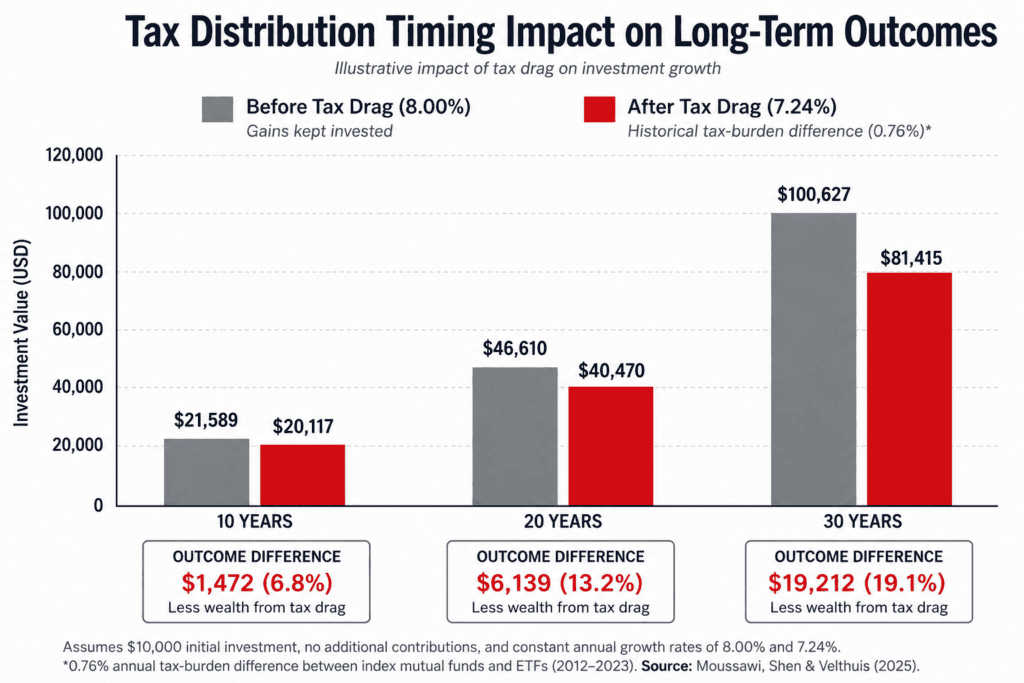
At first glance, a difference of less than one percentage point may not seem significant. Over decades, however, small annual differences can produce dramatically different outcomes. Consider a simple illustration based on the 0.76 percentage-point gap between ETFs and index mutual funds.
Assume two investors begin with the same $10,000 investment. Both investments earn the same 8% annual return. The only difference is that one investor experiences an annual 0.76 percentage-point tax drag, reducing net growth to 7.24%.The impact becomes much clearer over longer holding periods.
| Holding period | Growing at 8.00% | Growing at 7.24% (Tax Drag) | Difference |
|---|---|---|---|
| 10 years | $21,589 | $20,117 | $1,472 (6.8%) |
| 20 years | $46,610 | $40,470 | $6,139 (132%) |
| 30 years | $100,627 | $81,415 | $19,212 (19.1%) |
These figures are illustrative, not predictive. They are designed to show what can happen when a relatively small annual difference reduces the amount of capital available to compound over time. The cost of paying taxes earlier is not just the tax itself. It is the investment growth that tax dollars no longer have the opportunity to earn. Over time, those lost returns also stop generating returns of their own.
Model Your Own Growth
Model the Tax Drag yourself, set your time horizon, adjust your investments, add additional investments, set return rates, and the tax drag rate to see how the modeled outcomes change. Small annual differences don’t just reduce returns, they reduce the amount of money that remains invested to generate future returns.
Tax Distribution Timing Growth Model
Compare investment growth before and after a selected historical tax-drag reference over 10, 20, 30, or 40 years. Adjust the assumptions to see how small annual differences can compound over time.
Why the Outcomes Differ
ETF tax efficiency is well established, but ETFs are not exempt from capital gains taxes.
ETF investors can receive taxable distributions, and they generally owe capital-gains tax when they sell shares at a profit. The structural advantage is that many ETFs can often avoid generating taxable capital gains distributions while the investor remains invested.
Consider what happens when investors redeem shares from a traditional mutual fund. The fund may need to sell appreciated securities to raise cash for those redemptions. Selling appreciated securities can create taxable gains that are distributed to the shareholders who remain invested in the fund.
ETFs often have another option. Instead of selling securities, they can transfer a basket of securities to an authorized participant at a large institution through the ETF creation and redemption process.
Simple Mechanics:
Mutual Fund
Sell securities → receive cash → potentially realize taxable gains → distribute gains to current shareholders
ETF
Transfer securities themselves → a cash sale may not be required → fewer gains may need to be distributed
The academic research identifies this in-kind redemption mechanism as the primary source of ETF tax efficiency.[2]
Those structural differences help explain why investors in otherwise similar products can experience different tax outcomes. This also creates a fairness issue among mutual fund shareholders. A long-term investor who remains invested can incur a current tax liability because other shareholders chose to redeem their shares. The remaining investors did not request the redemption, choose which securities were sold, or decide to reduce the investment. Yet those investors may still bear part of the resulting tax burden.
The GROWTH Act would better align the timing of taxation with the long-term investor’s own decision to remain invested.
How a Mutual Fund Investor Can Owe Tax Without Selling
How Mutual funds manage capital-gain distributions can seem like a mysterious process to investors. Some situations can feel disconnected from an investor’s experience with other securities.
From a tax perspective, mutual funds are pass through entities that pass gains directly to investors. A mutual fund manages stocks and other investments. If the fund buys a stock for $20 and later sells it for $80, it realizes a $60 gain. Part of that gain can be distributed to shareholders as a taxable capital-gain distribution. Even when the distribution is automatically reinvested, the tax can still apply.[5]
If a fund makes a $1,000 distribution, its Net Asset Value (NAV) – essentially the daily share price – generally adjusts downward to reflect the distribution. Reinvesting the $1,000 buys additional shares at the adjusted price.
The investor remains fully invested, but the distribution can still be taxable. Any tax must be paid from the investor: wages, savings, or other investments, leaving the household with less capital available elsewhere.
Counterintuitive Results
an investor can lose money while owning the fund and still owe capital-gains tax.
Suppose an investor buys the fund late in the year. The market then falls, reducing the value of the investment. At the same time, the fund sells securities purchased years earlier at much lower prices and distributes the resulting gains to current shareholders.
The investor can lose money during the period they owned the fund, sell no shares, reinvest the distribution, and still owe capital-gains tax.
The investor is measuring what happened during the period they owned the fund. The tax code measures the gain realized by the fund when it sold appreciated securities. Both calculations can be correct at the same time.
Tax-basis rules help prevent the same economic value from simply being taxed twice when shares are eventually sold. But the timing problem remains. The investor’s economic experience and tax experience can still diverge. “I lost money. I sold nothing. I kept everything invested. Yet I still owe capital-gains tax?” This will not happen in every fund or every year. But the fact that it can happen at all illustrates how an investor’s tax experience can differ from their investment experience.
The SEC Has Recognized the Difference
The tax impact of mutual fund distributions has been recognized for decades.
In 2001, the SEC adopted rules requiring mutual funds to disclose standardized after-tax returns. At the time, the SEC recognized that taxes were among the largest costs associated with mutual fund investing and could materially affect investors’ after-tax returns. It also expressed concern that millions of taxable investors might not fully understand that impact.[6]
More than two decades later, the SEC continues to tell investors that ETFs may generate lower taxes than similar mutual funds because of their structure.[l]
The SEC has responded by requiring after-tax performance disclosure and providing investor education. Better disclosure helps investors understand the issue. It does not eliminate a tax-timing difference created by the Internal Revenue Code. A prospectus can explain the difference; it cannot change it. An SEC bulletin can explain in-kind redemptions. The average investor is still expected to understand how fund structure, capital-gain distributions, and tax timing affect long-term compounding. To most consumers, the products look remarkably similar: investment objective, holdings, performance, fees, and convenience. The structural tax difference is far less obvious.
This is not an argument that mutual funds are defective products or that every investor should switch to an ETF. Mutual funds may offer investment strategies, systematic investing features, advisory relationships, and services that consumers value.
Consumers should be free to choose a mutual fund if it best meets their goals, not because they have mastered the tax consequences of competing investment structures.
What the GROWTH Act Would Change
The GROWTH Act would generally allow investors to defer taxation on qualifying automatically reinvested capital-gain distributions until they sell their shares.
- It would not eliminate capital gains taxes.
- It would not change ETF mechanics.
- It would not prevent mutual funds from realizing gains.
Instead, it would change the timing.[3][4]
Under current law:
The fund realizes a gain → the gain is distributed → the investor reinvests it → the investor may owe tax now
Under the proposed GROWTH Act:
The fund realizes a gain → the qualifying distribution is automatically reinvested → recognition is generally deferred → the investor recognizes the deferred gain later as shares are sold or redeemed
The tax is deferred, not forgiven.
The proposal encourages long-term investing by allowing qualifying reinvested capital to remain invested until the investor chooses to sell. An investor who takes a distribution in cash would not receive the same treatment contemplated for a qualifying automatically reinvested distribution.
The Investment Company Institute (ICI), the trade association for the regulated fund industry and a supporter of the legislation, estimates that in one 10-year example a $10,000 investment could have produced up to $1,340 more after all taxes if the proposed deferral had been available. ICI also estimated that the investor would ultimately have paid approximately $140 more in capital-gains tax because the larger investment balance generated additional taxable gains.[7]
ICI is advocating for the legislation, so its estimate should be understood as industry-sponsored analysis rather than an independent government score.
The academic study does not evaluate the GROWTH Act directly. It does, however, demonstrate that investment structure has historically produced meaningful differences in taxable distributions and after-tax outcomes. [2]
The Roles of the SEC and Congress
Responsibility for this issue should not rest entirely with investors.
The SEC has a role in ensuring that material differences between investment products are presented clearly and meaningfully. It already requires after-tax performance disclosure and publishes guidance explaining that ETFs may provide tax advantages over similar mutual funds.[1][6]
The SEC should continue evaluating whether those differences are presented clearly enough for ordinary investors to understand when comparing investment products. Congress has a different responsibility.
The SEC can improve disclosure, but it cannot change the federal tax code. Congress must decide whether investors who automatically reinvest qualifying capital-gain distributions should continue to incur an immediate tax liability simply because they remain invested. A responsible evaluation should also consider the proposal’s fiscal impact. Deferring taxes means some revenue is collected later, and a dollar received in the future is not economically equivalent to a dollar received today. Congress should obtain an independent revenue estimate, examine the proposal’s safeguards, and evaluate its effect on long-term investors. The consumer impact should not be dismissed simply because it can be described in a prospectus.
Tax Parity, Investor Choice, and Better Outcomes
ICI estimates that approximately 40 million Americans in 23 million households hold about $7 trillion in long-term mutual fund assets outside retirement accounts.[7]
Not every investor will experience the same tax burden and not every mutual fund is tax inefficient. The scale of the affected market is nevertheless significant. Academic research shows that index mutual funds and ETFs realized nearly identical capital gains, yet distributed those gains, and the resulting tax burden, very differently.[2]
In other words, investment structure can influence how much capital remains invested and compounding over time, even when the underlying investments are similar, leading to significant differences in results for the investor.
Growth Opportunity
40 Million Americans
23 Million Households
$7 Trillion in Assets
The answer is not to change ETF mechanics or make them less efficient. Nor should consumers have to understand in-kind redemptions, authorized participants, pass-through taxation, and decades of tax implications simply to choose an appropriate investment.
The better principle is tax parity: consumers should be free to choose the investment that best meets their goals without an obscure tax-timing difference determining their long-term outcome. The SEC should make the differences clear. Congress should determine whether the tax code should allow the disparity to continue.
Congress should independently analyze and score the GROWTH Act so its costs, safeguards, and benefits can be evaluated through the formal legislative process. The proposal would not guarantee equal returns or eliminate capital-gains taxes. It would give long-term mutual fund investors a fairer opportunity to keep qualifying reinvested capital working until they choose to exit the investment and support the long term wealth building of millions of Americans.
The Tax Project Institute does not represent any fund company or industry association. Our analysis evaluates the consumer impact of the GROWTH Act with the goal of promoting consumer financial literacy, tax transparency, and long-term financial well-being.
References
[1] U.S. Securities and Exchange Commission. (2025, April 29). Characteristics of mutual funds and exchange-traded funds (ETFs): Investor bulletin. Investor.gov. https://www.investor.gov/introduction-investing/general-resources/news-alerts/alerts-bulletins/characteristics-mutual-funds-exchange-traded-funds
[2] Moussawi, R., Shen, K., & Velthuis, R. (2025). The role of taxes in the rise of ETFs. The Review of Financial Studies, 38(10), 2988–3039. https://doi.org/10.1093/rfs/hhaf044
[3] Generating Retirement Ownership through Long-Term Holding Act, H.R. 2089, 119th Cong. (2025). https://www.congress.gov/bill/119th-congress/house-bill/2089
[4] Generating Retirement Ownership through Long-Term Holding Act, S. 1839, 119th Cong. (2025). https://www.congress.gov/bill/119th-congress/senate-bill/1839
[5] Internal Revenue Service. (2026, March 26). Mutual funds (costs, distributions, etc.) 4. https://www.irs.gov/faqs/capital-gains-losses-and-sale-of-home/mutual-funds-costs-distributions-etc/mutual-funds-costs-distributions-etc-4
[6] U.S. Securities and Exchange Commission. (2001). Disclosure of mutual fund after-tax returns (Release Nos. 33-7941, 34-43857, IC-24832). https://www.sec.gov/rules-regulations/2001/09/disclosure-mutual-fund-after-tax-returns
[7] Investment Company Institute. (2026, February 10). Americans could see up to $1,340 more in mutual fund returns under the GROWTH Act. https://www.ici.org/news-release/americans-could-see-up-to-1340-more-in-mutual-fund-returns-under-the-growth-act