Rights, Responsibilities, and the Work of Self-Government
We usually think of the important offices in American government as president, senator, governor, mayor, or judge.
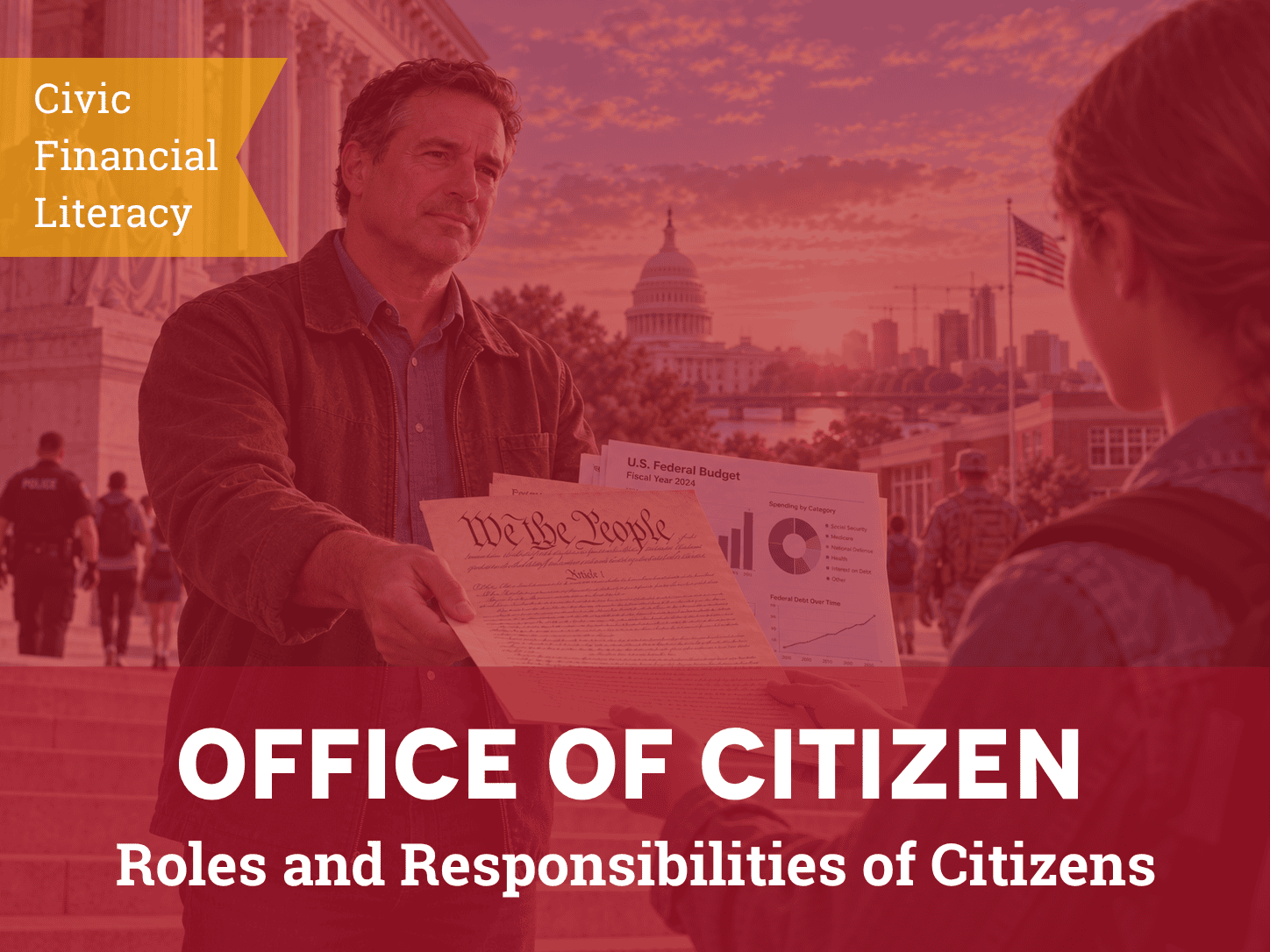
Yet every one of those offices ultimately derives its authority from somewhere else: the Citizen.
The Declaration of Independence expressed the principle simply: governments derive their legitimate powers from the “consent of the governed.”[1] The Constitution begins with “We the People,” placing citizens at the foundation of our constitutional republic.[2]
That gives ordinary citizens extraordinary power. It also gives them responsibility.
Citizenship is more than legal status, a passport, a collection of rights, or the opportunity to vote. It is a continuing role in a system of self-government. A Constitution can divide power, protect rights, establish checks and balances, and provide lawful ways to resolve disputes. It cannot make every choice for the people who operate that system.
Eventually, the republic depends on its citizens.
Four Things to Understand About Citizenship
1. Your role matters.
Citizens are not merely governed. Collectively, we choose leaders, influence public policy, provide the resources government uses, and help determine the direction of the country.
2. Rights come with responsibilities.
Our constitutional system protects individual liberty and limits government power. Preserving those freedoms also requires citizens who respect the rights of others and the lawful processes that protect them.
3. Citizenship requires informed choices, not just participation.
Voting matters, but so do understanding the issues, examining evidence, recognizing tradeoffs, participating effectively, tolerating disagreement, and expecting accountability from those entrusted with public authority.
4. Citizenship extends beyond yourself and beyond today.
Public choices affect more than our immediate interests. They affect families, communities, the country, and generations that will inherit the consequences of decisions made today.
Together, those ideas turn citizenship from a status into a responsibility.
What Must Citizens Do, and What Should They Do?
Not every responsibility of citizenship is the same.
Some are legal obligations. Citizens must obey the law, pay legally owed taxes, respond to lawful jury summons, and fulfill other duties established by law. Federal courts, for example, describe jury service as a civic duty.[3]
Voting is different. Americans have a protected right to vote, but voting is not legally compulsory in the United States.[4]
Beyond legal obligations are civic responsibilities that a healthy republic depends upon even though government generally cannot compel them. USCIS identifies responsibilities such as supporting the Constitution, staying informed, participating in democratic and community life, respecting the rights and opinions of others, paying taxes, serving on juries, and serving the country when required.[5]
Richard Haass, in The Bill of Obligations: The Ten Habits of Good Citizens, argues for additional habits including becoming informed, participating, remaining civil, being open to compromise, rejecting political violence, valuing democratic norms, promoting the common good, supporting civic education, and putting the country ahead of narrower interests.[6]
The distinction matters:
The law can compel compliance. It cannot compel good citizenship.
Government can collect taxes and summon jurors. It cannot force us to understand tradeoffs, respect disagreement, think about future generations, resist manipulation, or use political power wisely.
Those responsibilities have to come from citizens themselves.
A Citizen’s Responsibilities
A good citizen recognizes these responsibilities as essential to self-government and practices them consistently.
1. Understand
Learn enough about government, institutions, public finance, and major public issues to make informed choices. Expertise is not required. Making a diligent effort to understand is.
Thomas Jefferson captured the connection between knowledge and self-government:
“Wherever the people are well informed they can be trusted with their own government.”[7]
He later added more directly:
“If a nation expects to be ignorant & free… it expects what never was & never will be.”[8]
Citizens do not need to know everything. They do need enough knowledge to recognize tradeoffs, evaluate competing claims, and understand what is at stake in the choices before them.
2. Participate Effectively
Citizenship requires more than holding opinions. It requires knowing how to use the institutions of self-government.
Effective participation can include:
- voting and helping others participate,
- communicating with representatives,
- attending public meetings or hearings,
- providing public comment,
- joining civic or community organizations,
- petitioning government,
- organizing around an issue,
- using lawful court processes,
- running for office,
- or peacefully protesting when appropriate.
These are different tools for different circumstances. Effective citizenship means understanding where authority resides, how decisions are made, and which method of participation best fits the issue.
3. Protect Rights and Constitutional Processes
Respect the constitutional rights of others, including people with whom you disagree.
Self-government depends on lawful processes, peaceful political change, independent institutions, and the recognition that political opponents retain their rights regardless of who wins an election or which ideas are popular at the moment.
The protections we value for ourselves have meaning only if they also apply to others.
4. Demand Accountability
Citizens collectively are the source of political legitimacy. Public officials and institutions exercise authority entrusted to them through the constitutional system given to them by the People.
That creates a responsibility to pay attention to how that authority is used. Citizens should:
- ask questions,
- expect transparency,
- examine evidence,
- challenge abuses, improper uses of power
- insist that lawful processes be followed,
- and use elections, oversight, courts, public debate, and other constitutional mechanisms when change is needed.
Accountability is not citizens standing apart from government. It is part of the way citizens participate in self-government.
5. Think Beyond Yourself
It is reasonable to ask how government decisions affect you and your family. Taxes, laws, benefits, education, employment, public safety, and economic conditions all affect our lives.
Personal benefit, however, is only part of an informed choice. We must also consider our neighbors, community, and country.
“Ask not what your country can do for you, ask what you can do for your country.”
John F. Kennedy
Citizens should also consider how public decisions affect neighbors, other communities, fellow citizens, and the country as a whole. A policy can benefit one group while imposing costs on another. Responsible citizenship requires seeing more than one side of that equation.
6. Think Beyond Today
Citizens also have to widen their time horizon.
A decision may solve an immediate problem while creating obligations lasting decades. Borrowing may be justified during war, recession, crisis, or to finance investments whose benefits extend far into the future. It may also shift costs onto citizens who had no voice in today’s decision. Deferring problems or passing them onto future generations may only make them worse, and may be contrary to civic responsibility.
The Constitution’s Preamble makes this intergenerational dimension explicit by seeking to secure liberty not only to “ourselves” but also to “our Posterity.”[2]
George Washington later connected that principle directly to public finance, warning against unnecessarily placing on posterity burdens the current generation ought to bear. He also argued that where public opinion has great power, “it is essential that public opinion should be enlightened.”[9]
Responsible citizenship therefore asks two questions beyond immediate self-interest:
- Who else does this affect?
- Who eventually inherits the consequences?
7. Steward What You Inherit
Every generation inherits far more than government institutions.
We inherit:
- freedom and liberty,
- constitutional rights and the rule of law,
- popular sovereignty and the ability to govern ourselves,
- public safety and national security,
- economic opportunity and productive capacity,
- infrastructure and public assets,
- accumulated knowledge and civic institutions,
- national sovereignty and international standing,
- and debts, promises, risks, and obligations created before us.
Each generation of Americans inherit this, and for a time it becomes ours; we become the care takers until we pass it on to the next generation.
Citizenship asks us to preserve what works, improve what does not, make informed choices about what comes next, and eventually pass the country on.
“Freedom is a fragile thing and it’s never more than one generation away from extinction.”[10]
Ronald Reagan
Freedom is only one part of what each generation inherits, but the broader principle applies to much of the republic. The advantages of a successful society do not automatically perpetuate themselves.
They have to be understood, maintained, strengthened, taught, and passed on.
Citizens are Made, not Simply Born
Legal citizenship may come through birth or naturalization. Good Citizenship has to be learned and practiced.
Families, schools, communities, civic organizations, experience, and citizens themselves all contribute to that process. Simply growing up in a free country does not guarantee that someone will understand why its institutions matter, how government works, or how to participate effectively.
Lindsey Cormack makes this point in How to Raise a Citizen (And Why It’s Up to You to Do It), arguing that civic preparation cannot simply be left to formal schooling.[11]
The goal should not be to teach children which political conclusions to adopt. It should be to prepare them to reach their own conclusions responsibly: to understand their constitutional system, evaluate evidence, respect disagreement, participate effectively, and recognize that citizenship comes with obligations to other people and to the country they will inherit.
Each generation therefore is responsible for passing their knowledge on.
Prepare the next generation for Citizenship.
The Most Important Office
Presidents leave office. Members of Congress leave office. Judges retire. Administrations change.
Citizenship continues.
A constitutional republic can give citizens extraordinary rights, protections, opportunities, security, prosperity, and political power. It cannot determine what citizens will do with them.
Every generation eventually makes that choice for itself.
The measure of Citizenship therefore cannot be only what we receive from our country. It must also include how we use the power entrusted to us, whether we make choices with regard to more than our immediate interests, and what condition we leave the country in for those who follow.
Citizenship means understanding enough to choose well, participating effectively, protecting the constitutional system and the rights it secures, expecting accountability, respecting the rights and opinions of others, thinking beyond the present, and stewarding what we inherit for future generations.
Citizenship is power, responsibility, and stewardship.
The most important office in our constitutional republic may be the one entrusted to each of us:
Citizen
References
[1] National Archives and Records Administration. (1776). Declaration of Independence: A Transcription. https://www.archives.gov/founding-docs/declaration-transcript
[2] National Archives and Records Administration. (1787). The Constitution of the United States. https://www.archives.gov/founding-docs/constitution
[3] Administrative Office of the U.S. Courts. Jury Service. https://www.uscourts.gov/court-programs/jury-service
[4] U.S. General Services Administration. Is Voting Mandatory in the U.S.? USA.gov. https://www.usa.gov/is-voting-required
[5] U.S. Citizenship and Immigration Services. Citizenship Rights and Responsibilities. https://www.uscis.gov/sites/default/files/document/brochures/M-1051.pdf
[6] Haass, R. (2023). The Bill of Obligations: The Ten Habits of Good Citizens. Council on Foreign Relations. https://www.cfr.org/books/bill-obligations
[7] Jefferson, T. (1789). Letter to Richard Price. Thomas Jefferson’s Monticello. https://tjrs.monticello.org/letter/118
[8] Jefferson, T. (1816). Letter to Charles Yancey. Thomas Jefferson’s Monticello. https://tjrs.monticello.org/letter/327
[9] Washington, G. (1796). Farewell Address. Founders Online, National Archives. https://founders.archives.gov/documents/Washington/05-20-02-0440-0002
[10] Reagan, R. (1967). Inaugural Address, Public Ceremony. Ronald Reagan Presidential Library. https://www.reaganlibrary.gov/archives/speech/january-5-1967-inaugural-address-public-ceremony
[11] Cormack, L. (2024). How to Raise a Citizen (And Why It’s Up to You to Do It). Wiley.