A twist on debt management
Unfortunately, the United States cannot make its $40 trillion National Debt just disappear. It can, however, change how it borrows, when that debt comes due, and how much it costs to carry the debt. A strategy emerging at the Treasury Department, sometimes called the “Treasury Twist,” offers a window into why those decisions increasingly matter to the American Dream.
In August 2026, the total U.S. National Debt passed $40 trillion for the first time.[1]
That number is almost too large to comprehend (Four followed by 13 zeros). But there is another number that may be easier to understand and, in some ways, more important: the interest America must pay every year simply to carry that debt. In other words, how much our debt is costing us each year in interest.
The Congressional Budget Office (CBO) projects that net federal interest costs will reach about $1 trillion in 2026. By 2036, under current law, CBO projects those costs will more than double to $2.1 trillion a year.[2]
That means a growing share of federal revenue will go toward paying for past borrowing before the government spends a dollar on today’s priorities.
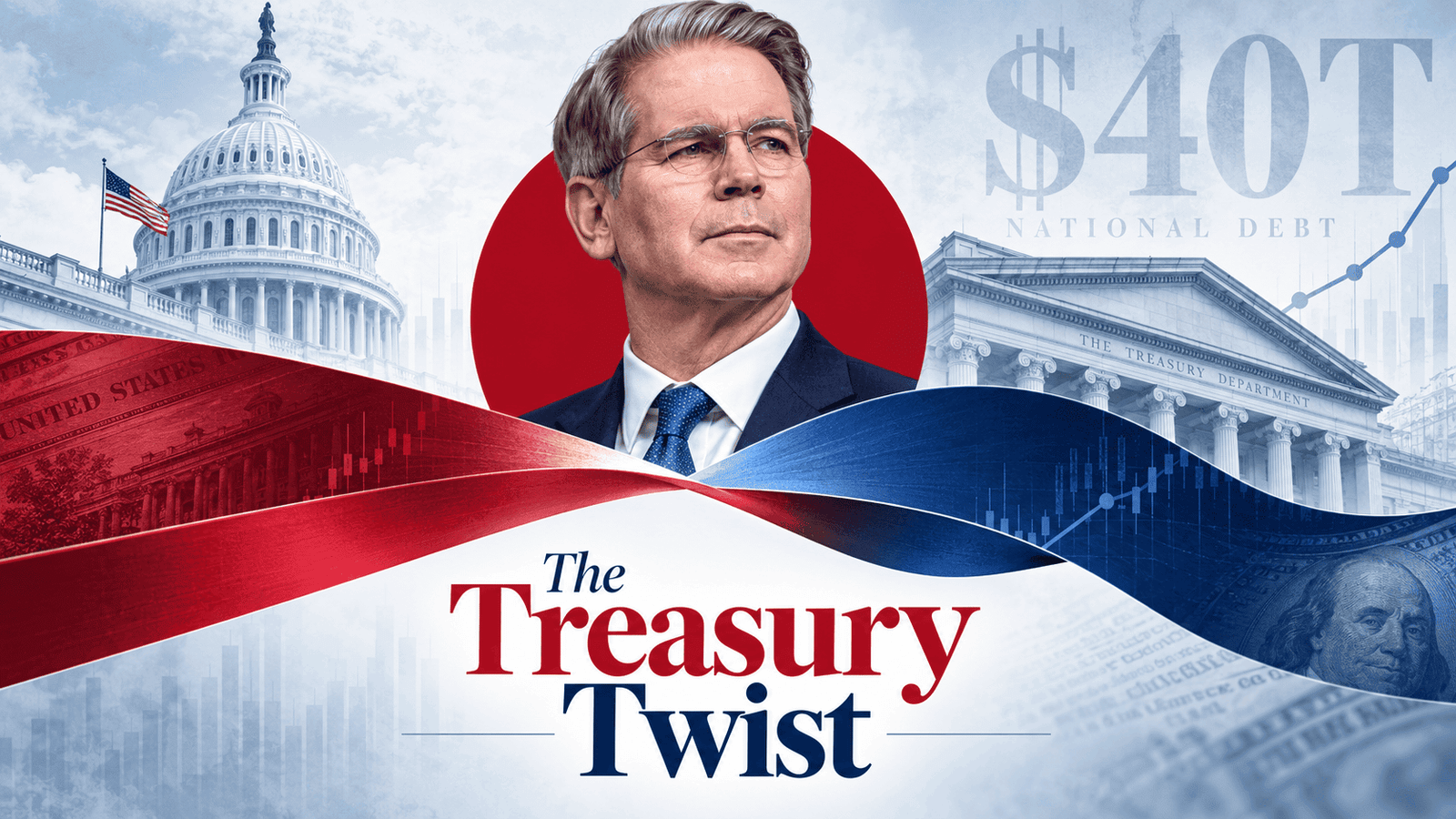
This is the backdrop for an unusual strategy taking shape at the U.S. Treasury under Secretary Scott Bessent. Financial markets have started calling it the “Treasury Twist” or “Bessent Twist.” The name sounds complicated. The basic idea is not.
How Does the Government Borrow Money?
First, it is important to understand that when the Federal government spends more than it collects in taxes and other revenue, it has to borrow the difference to make up for the Deficit. It does that primarily by selling Treasury securities.
The Treasury decides how much and for how long to borrow.
The Treasury can borrow money for just a few weeks or months by issuing Treasury bills. It can borrow for several years with Treasury notes. Or it can lock in financing for decades with longer-term Treasury bonds.
Treasuries choices for how long to borrow: 4 weeks → 3 months → 1 year → 2 years → 10 years → 30 years
Each option comes with different costs and risks. A homeowner might recognize the basic tradeoff. A long-term fixed-rate mortgage gives you certainty at generally a slightly higher rate. You know the rate you will pay for years.
A short-term loan may offer a lower rate today, but it eventually has to be refinanced. When that happens, the new rate could be lower, or it could be much higher.
The federal government is not a household, and federal finance works very differently from a family budget but the underlying borrowing decision is similar.
Do you lock in today’s cost for a long time, or borrow for a shorter period and take the risk that interest rates will rise and you may need to refinance at a higher rate?
That question becomes much more important when you owe $40 trillion in National Debt.
What Is the “Treasury Twist”?
The “Treasury Twist” is not the formal name of a government program. It is a market nickname for a shift in where Treasury is borrowing (selling) and where it is supporting (buying) the bond market.[3]
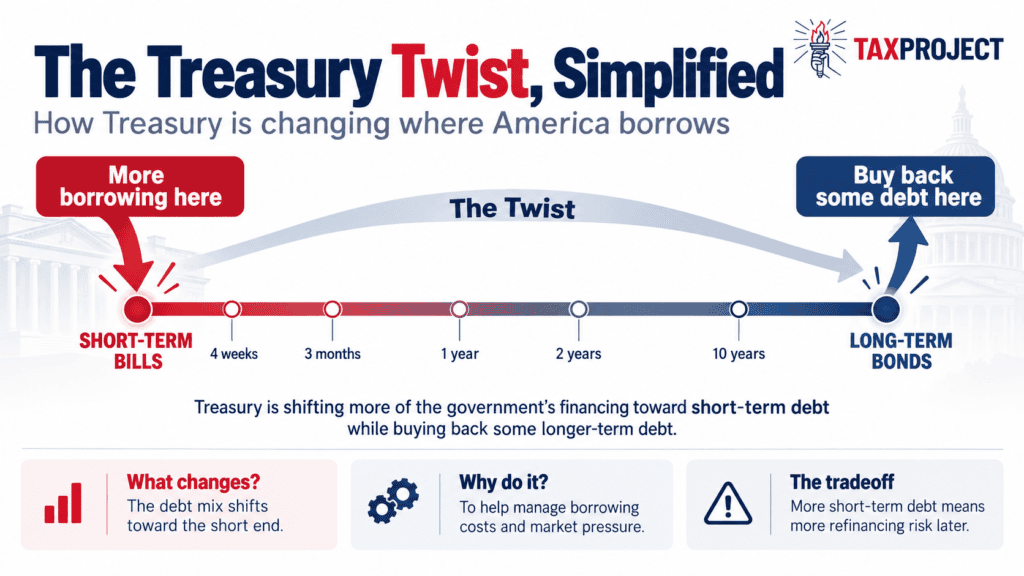
The treasury sells bonds to raise money on the market. Think of the Treasury market as a line: SHORT-TERM BILLS ←————————→ LONG-TERM BONDS
Treasury has some control over where along that line it raises money. On one end, it can rely more heavily on short-term Treasury bills to meet the government’s borrowing needs. Bessent has called Treasury bills the Treasury’s financing “shock absorber” because Treasury can adjust their issuance relatively quickly.[4] At the same time, Treasury has increased its purchases of some existing 10 to 30 year Treasury securities, officially to improve liquidity in the longer-term market.[5]
It is called a “twist” because Treasury is working both ends of the bond market in opposite directions: borrowing and issuing relatively more at the short end while buying back some longer-term debt.
That changes how much debt investors are being asked to absorb at each end. More borrowing at the short end puts more Treasury bills into the market, while buying back longer-term bonds removes some supply from the long end.
In simple terms, Treasury is shifting more of the government’s financing burden toward short-term debt while easing some of the supply pressure on longer-term debt.
So the basic “twist” looks like this: Borrow relatively more at the short end → buy back some debt at the long end.
Why does that matter?
Treasury does not set interest rates, but it does influence how much debt investors are being asked to absorb at different maturities. Issuing relatively less long-term debt than otherwise needed, while buying some long-term securities back, can reduce some of the supply pressure at the long end of the market. That combination has been compared with the Federal Reserve’s earlier Operation Twist, although today’s strategy works differently and is being carried out by Treasury rather than the Fed.[6]
Simply, the Treasury is changing the mix of America’s borrowing.
Why does Treasury want to Borrow More at the Short End?
The simple answer is cost.
Treasury’s longstanding debt-management goal is to finance the government at the lowest cost over time, while also managing risk.[4]
That last part, over time, matters.
Treasury cannot simply find whichever interest rate is cheapest today and borrow everything there. Doing so could overwhelm investor demand, raise rates, and leave the government dangerously dependent on one part of the market.
But the cost differences between short-term and long-term borrowing still matter enormously when the government must finance trillions of dollars.
Long-term interest rates include compensation investors demand for taking risks over many years. Investors have to consider the risks including future inflation, economic growth, federal borrowing, and the possibility that conditions may look very different, and potentially worse, 10, 20, or 30 years from now.
That additional compensation is often called the term premium.
You do not need to understand the economics behind it to understand the problem.
If investors become more worried about inflation, large federal deficits, risk of default, or the amount of government debt coming to market, they may demand higher interest rates to compensate for the additional risks they are taking on before agreeing to lend the government money for decades.
And with today’s enormous National debt, even relatively small increases in borrowing costs can eventually translate into very large Federal interest bills.
Treasury’s own advisers have noted that higher debt levels, larger deficits, and rising term premiums have contributed to higher and more volatile debt-service costs.[7]
That creates an obvious attraction to shorter-term financing when demand there is strong. Similar to how a consumer may take a variable rate mortgage because the short term rate is more attractive and saves them money. However, with that also comes the risk that rates may rise, potentially substantially, and longer term debt could become more expensive. So the Treasury instead of locking in expensive long-term rates is financing some of its needs with shorter-term bills at lower cost.
Borrowing Short Creates Another Risk
There is NO FREE LUNCH. Short-term debt comes due quickly.
A 30-year bond does not need to be refinanced for three decades. A three-month Treasury bill needs to be refinanced four times a year.
So borrowing more at the short end may reduce some current financing costs, but it also means Treasury must return to the market more frequently.
If short-term rates fall, refinancing could become cheaper. If they remain high or rise, the government could find itself continually refinancing enormous amounts of debt at higher rates.
This is called rollover risk or refinancing risk. CBO estimates that if Treasury rates were just 0.1 percentage point higher than its current forecast, federal interest costs would increase by about $323 billion over the next decade.[3] That is just 0.1%, so a just 1% increase in interest rates would have major impacts on the cost for servicing our debt.
In plain English:
Borrowing short can save money today, but it leaves more of tomorrow’s interest bill exposed to tomorrow’s potentially higher interest rates.
Treasury therefore has to balance two competing objectives: keeping borrowing costs down now while avoiding too much exposure to future rate hike changes.
With $40 trillion of debt, that balance has become increasingly consequential.
Where Do Stablecoins Fit In?
This is where the Treasury Twist strategy gets particularly interesting.
In July 2025, the GENIUS Act established a federal regulatory framework for payment Stablecoins.
Stablecoins are digital assets designed to maintain a stable value, usually one dollar. To maintain that value, regulated issuers must hold reserves backing the Stablecoins they create.
Under the GENIUS Act, qualifying reserves can include cash and very short-term Treasury securities with remaining maturities of 93 days or less.[8]
That means a rapidly growing Stablecoin industry could become a major new source of demand for short-term U.S. government debt. So even though countries maybe moving away from U.S. Treasuries as the Global Reserve currency, holding U.S. currency is still important especially for countries that have unstable and highly inflationary fiat currencies.
Bessent has explicitly made this connection. After the GENIUS Act became law, he said Stablecoin growth could lead to a “surge in demand for US Treasuries.”[9]
Several months later, Bessent told the Treasury Market Conference that Treasury was closely watching both Stablecoins and money-market funds because they are large buyers of Treasury bills. He said that as those markets grow, demand for bills should grow with them, and Treasury could adjust its longer-term issuance plans as investor demand changes.[4]
That process is already significant. In September 2026, Deputy Treasury Secretary Francis Brooke said Stablecoin providers held nearly $200 billion in Treasury bills and other securities close to maturity.[10]
Putting the pieces together:
More Stablecoins >>> Greater demand for short-term Treasuries >>> Deeper market for Treasury bills >>> More capacity for Treasury to finance government borrowing at the short end
That does not mean the GENIUS Act was simply created to finance the federal debt, nor does it guarantee lower borrowing costs. It does mean that Treasury itself has clearly identified Stablecoins as an emerging source of demand for the short end of the market and that gives Treasury significant financing flexibility.
How does this impact the American Dream?
More than it might appear at first glance.
Bessent himself has made the connection. Treasury securities sit near the foundation of the Global financial system. Their interest rates help establish the benchmark from which many other borrowing costs are determined.
In a 2025 speech, Bessent said Treasury yields affect everything from home mortgages and bank loans to corporate borrowing. He specifically connected lower Treasury borrowing costs to the ability of families to buy homes, to finance cars, and entrepreneurs to access credit and business loans.[4]
But there is an even larger connection.
Interest on the National Debt represents money the Federal government must spend today because it borrowed money yesterday.
CBO projects net interest spending of about $1 trillion this year, equivalent to roughly 3.3% of the entire U.S. economy.[2] That is more than the entire U.S. Military budget for perspective.
By 2036, CBO projects that figure will reach 4.6% of GDP and nearly equal to all federal discretionary spending combined.[2]
That does not mean every dollar spent on interest automatically eliminates a dollar of spending somewhere else. But it does mean the choices become harder, and could eventually lead to higher deficits, or squeezing out of other budget priorities. The government ultimately has only a limited number of ways to accommodate rising interest costs. It can collect more revenue (read more taxes), reduce other spending (cut programs and services), borrow more (add to the deficit), or rely on stronger economic growth (grow the economy) to provide additional resources. (See TPI article on US Ways Out of Debt)
The larger the National Debt, the higher the interest rate on the debt, the the larger the interest bill becomes. This in turn gives policy makers less fiscal flexibility to making decisions about infrastructure, defense, research, education, healthcare, retirement, taxes, emergencies, and other national priorities.
That is where government finance touches the American Dream. A country’s ability to invest in its future matters to the opportunities available to its citizens.
The More Troubling Problem Behind the Twist
The Treasury Twist may sound like a clever financial strategy. Although, its very existence may point toward a much larger problem.
CBO projects a federal budget deficit of about $1.9 trillion in 2026, growing to $3.1 trillion by 2036 under current law.[2]
US National Debt held by the public, which is different from the larger $40 trillion total-debt measure, is projected at about 101% of GDP in 2026 and 120% by 2036.[2]
Meanwhile, interest costs may continue rising.
That creates the possibility of an increasingly difficult financial cycle:
- Larger deficits require more borrowing.
- More debt creates more interest expense.
- Higher interest expense makes deficits larger.
- Larger deficits require still more borrowing.
This negative financial loop, sometimes called a Doom Loop, does not mean a debt crisis is inevitable. The United States still benefits from the world’s largest and deepest government securities market, a large economy, the global role of the dollar, and extraordinarily strong demand for Treasury securities. Although, those advantages do not make the underlying arithmetic disappear, and with each passing day of growing debt our challenges get harder. If investors increasingly demand additional term premium compensation for inflation, fiscal uncertainty, or the growing supply of long-term federal debt, managing America’s borrowing costs becomes harder. That helps explain why something as obscure as the Treasury Twist suddenly matters.
What the Treasury Twist Can and Cannot Do
The strategy could potentially help Treasury better match its borrowing with areas of strong investor demand and short term lower costs.
- It could improve liquidity in parts of the Treasury market.
- It could provide greater financing flexibility.
- And greater demand for short-term Treasury bills from money-market funds, banks, Stablecoin issuers, and other investors could provide Treasury with additional capacity at the short end of the market.
What it cannot do is eliminate the underlying fiscal problem.
- Treasury can change when debt matures.
- It can change where along the maturity curve it borrows.
- It can work to improve the market in which government debt trades.
- And it can try to minimize the cost of financing that debt.
But it cannot erase the debt itelf.
Nor can debt management permanently compensate for Federal spending and revenue remaining out of balance. In short, this is a bandaid to address a long term structural problem that may help the issue of increasing debt service costs, but it will not make the problem go away.
Treasury can change how America finances its debt. It cannot change the arithmetic that created the debt.
Why Citizens Should Understand This
Most Americans will never participate in a Treasury auction. They do not need to understand bond-trading terminology, calculate a term premium, or become experts on the yield curve.
But understanding the basic fundamental economics of debt and spending matters.
- Spending Deficits create Debt.
- Increasing Debt increases Interest costs.
- Interest costs consumes Government resources.
And as the debt grows, decisions about how the government finances it become increasingly important to the economy citizens live in.
That is Government Financial Literacy. Understanding how those choices eventually affect opportunity, affordability, public investment, taxes, and the resources available to future generations moves beyond Government finance into Civic Financial Literacy.
The Treasury Twist is an attempt to manage the enormous financing challenge the United States already faces. Whether it ultimately succeeds at reducing borrowing costs is something markets and time will determine. Perhaps the more important question is why such a strategy is being discussed at all. America has accumulated enough debt that managing the cost of carrying that debt has unto itself become a major economic challenge. The choices made today about how that burden is financed will help shape the opportunities available to Americans tomorrow and whether the American Dream thrives and lives on or dies.
References
[1] U.S. Department of the Treasury, Bureau of the Fiscal Service. (2026). Debt to the Penny. FiscalData.Treasury.gov. https://fiscaldata.treasury.gov/datasets/debt-to-the-penny/debt-to-the-penny
[2] Congressional Budget Office. (2026, February). The Budget and Economic Outlook: 2026 to 2036. https://www.cbo.gov/publication/62105
[3] Reuters. (2026, August 26). The Treasury twist. https://www.reuters.com/podcasts/treasury-twist-2026-08-26/
[4] U.S. Department of the Treasury. (2025, November 12). Remarks by Secretary of the Treasury Scott Bessent before the Treasury Market Conference. https://home.treasury.gov/news/press-releases/sb0314
[5] U.S. Department of the Treasury. (2026, August 19). Treasury Announces Increased Sizes of Nominal Long-End Liquidity Support Buybacks Beginning September 9. https://home.treasury.gov/news/press-releases/sb0607
[6] Reuters. (2026, August 20). The US pioneers Operation Twist and Shout. https://www.reuters.com/commentary/breakingviews/us-pioneers-operation-twist-shout-2026-08-20/
[7] U.S. Department of the Treasury, Treasury Borrowing Advisory Committee. (2025, November 4). Minutes of the Meeting of the Treasury Borrowing Advisory Committee. https://home.treasury.gov/news/press-releases/sb0307
[8] U.S. Department of the Treasury, Treasury Borrowing Advisory Committee. (2025). Report to the Secretary of the Treasury. https://home.treasury.gov/news/press-releases/sb0213
[9] U.S. Department of the Treasury. (2025, July 18). Statement from U.S. Secretary of the Treasury Scott Bessent on Enactment of the GENIUS Act. https://home.treasury.gov/news/press-releases/sb0197
[10] U.S. Department of the Treasury. (2026, September 22). Remarks by Deputy Secretary of the Treasury Francis Brooke before the Treasury Market Conference. https://home.treasury.gov/news/press-releases/sb0633