Fiscal Illusion Series Part 1: Explainer
The way governments collect taxes, finance spending, and present public benefits can shape how citizens perceive the cost of government. More than a century ago, economists identified this phenomenon as Fiscal illusion. Understanding it offers important insights into taxation, public finance, and the decisions citizens make about government.
Do you know how much Government Costs?
Where can you go to get THE NUMBER?
Is the True Cost of Government HARD to see?
Fiscal Illusion, two simple words that on their own are self explanatory, and no it has nothing to do with magic. Instead, it’s a documented cognitive bias well described in academic literature of economics and political science. This article explains the concept, first discussed in the 17th century, and later defined as what we know today as Fiscal Illusion. You will learn where it came from, the observations and behaviors that define it, a definition of what it means, and how it was informed and improved upon by a little known Nobel Prize winning economist.
1. The Art of Taxation
Governments have always faced a fundamental challenge: the need for revenue to operate, but the people paying the taxes are rarely enthusiastic about surrendering their money.
The challenge is hardly new.
Jean-Baptiste Colbert, the 17th-century finance minister to France’s King Louis XIV, is commonly associated with a memorable analogy comparing taxation to plucking a goose: the objective is to collect as many feathers as possible while producing the least amount of hissing.
Whether or not Colbert used those precise words, the observation captures an enduring reality of public finance: governments have incentives not only to collect revenue, but also to minimize the resistance associated with collecting it.
Tax systems are therefore not designed exclusively around economic efficiency, fairness, or the government’s financial requirements. Political feasibility, taxpayer behavior, and public acceptance also influence how taxes are structured and collected.
We explore this tension in our article, The Art of Taxation.
However, Colbert’s observation raises a more interesting question.
What if governments could reduce taxpayer resistance not by reducing the amount people actually pay, but by changing how those costs are perceived?
That question lies at the heart of a concept economists call Fiscal Illusion.
2. What Is Fiscal Illusion?
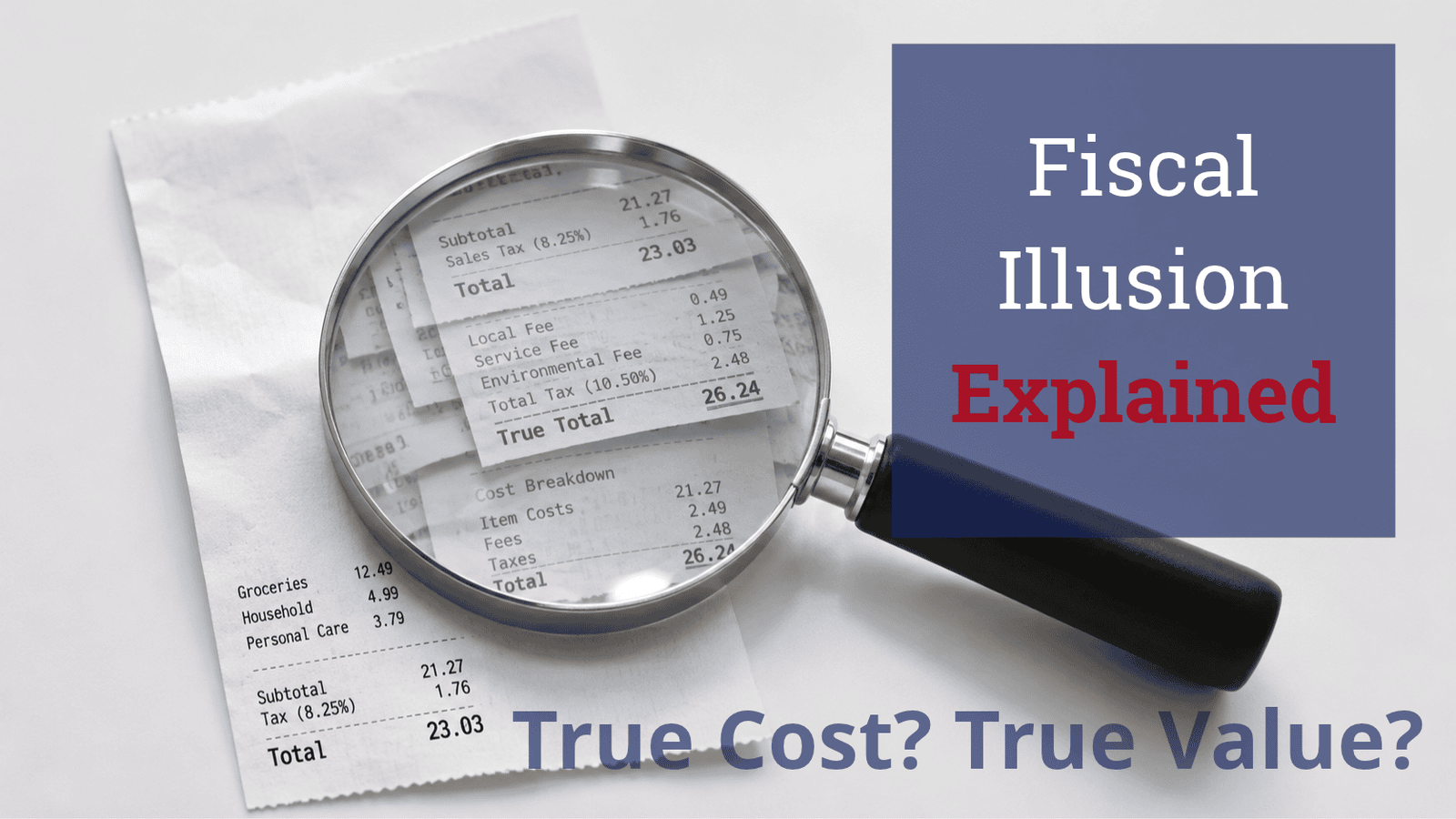
Fiscal illusion is a concept in public finance and economics describing how citizens can systematically misunderstand the True Costs and Benefits of Government because of the way taxes, spending, and government financing are structured or presented.
In simple terms, what citizens perceive government to cost may be different from what it actually costs them.
Consider two hypothetical taxes.
In the first case, a taxpayer receives an annual bill clearly identifying a $2,000 tax obligation.
In the second, the same $2,000 is collected gradually through small taxes embedded in purchases: utility bills, the gas pump, grocery store, bridge toll, streaming bill, airplane ticket, and other everyday transactions.
The financial burden may be identical, but the taxpayer’s awareness of it can be very different. I mean really, does anyone actually know how much in taxes they paid on these type of bills collectively? Even if you were meticulous about the ones you saw, and could break them out, are you aware of all the places where its not transparent, and just part of your expense?
The first case is visible and unmistakable. The second is dispersed across dozens or hundreds of transactions, many of which may not separately identify the tax.
Neither arrangement necessarily involves a false statement, or some intentional trick to deceive you. Yet the second case makes the cost of government much less noticeable, and it is a fact of life with our relationship to the government.
Fiscal illusion can also operate on the spending side.
Citizens may perceive a government program as providing benefits worth more than its actual value to them, especially when the benefits are visible but the associated costs are distant, dispersed, or difficult to identify. If a public train fare is $5, and the fully subsidized cost is over $30 per rider, the charged fare is a bargain for the rider, but still does not relieve the municipality of the burden.
A public project may be described in terms of the services it will provide without equal emphasis on its financing, long-term maintenance, or trade-offs with other public priorities.
In both cases, the problem is the same: citizens may make different decisions about taxation and spending than they would with a fuller understanding of the cost /benefit tradeoffs involved.
Fiscal illusion does not mean that all public spending is wasteful or that every tax is excessive. It describes a problem of perception and information, independent of whether a particular government program or cost is worthwhile.
And because governments collect revenue through so many different channels, citizens may never see a single, consolidated picture of their total tax contribution.
3. The Origins of Fiscal Illusion: Smith, Puviani, and Buchanan
Although the term fiscal illusion is more commonly known now, its intellectual foundations reach further back centuries.
Adam Smith: Citizens Should Understand Their Taxes
In 1776, Scottish economist Adam Smith published The Wealth of Nations, establishing four principles of taxation that became known as the Four Canons of Taxation:
- Equity: Citizens should contribute according to their ability to pay.
- Certainty: Tax obligations should be clearly defined, predictable, and understandable.
- Convenience: Taxes should be collected at times and in ways that are convenient for taxpayers.
- Economy: The cost of collecting taxes, including unnecessary burdens imposed on taxpayers, should be minimized.
These principles established an enduring standard for evaluating taxation, not simply by how much revenue it raises, but by how it treats the people paying it.
Smith’s principle of Certainty is especially relevant to Fiscal Illusion.
He argued that taxpayers should understand the amount they must pay, when payment is due, and how the tax will be collected. Smith was primarily addressing arbitrary or uncertain taxation, but his principle raises a broader question for modern public finance: is a tax system truly understandable if citizens cannot readily recognize its cumulative economic burden?
How Fiscal Illusion Challenges Smith’s Four Canons
Fiscal illusion reveals a potential conflict with modern fiscal practices and the principles Smith established more than two centuries ago.
- Equity — Can a tax system be judged fairly if its true burdens are difficult to identify?
- Taxes can impose economic costs on people other than those legally required to pay them. If taxpayers cannot see who ultimately bears the burden, evaluating whether a system distributes taxation fairly becomes more difficult.
- Certainty — Do citizens really understand what they pay?
- A tax can be legally established and technically disclosed while its cumulative burden remains obscure. Numerous taxes, complicated rules, and costs embedded in prices can make it difficult for citizens to understand their overall contribution. Fiscal illusion most directly challenges the broader transparency objective associated with this canon.
- Convenience — Can making taxes easier to pay also make them easier to overlook?
- This is perhaps the most interesting contradiction.
- Automatic withholding, for example, makes income-tax payments convenient and eliminates the need for many workers to make large periodic payments. The same convenience can reduce awareness of how much is being collected. A system designed for easier payment can simultaneously make the burden less noticeable, and in our busy world things that go unnoticed often go unreviewed.
- Economy — Does complexity impose costs beyond the taxes collected?
- Smith believed taxation should minimize unnecessary costs to the public beyond the revenue delivered to government.
- Complex tax arrangements can create compliance costs, administrative expenses, and economic distortions. If opacity is achieved through unnecessary complexity, those additional burdens can undermine the principle of Economy. Fiscal illusion does not automatically violate every canon. But when fiscal arrangements obscure burdens, complicate understanding, or exploit the convenience of collection to minimize awareness, they can conflict with the purposes these principles were meant to serve.
A tax system can be convenient for Government to collect and convenient for Citizens to pay, yet still leave Citizens poorly informed about what they contribute.
Interestingly, James Buchanan would later identify this precise tension between convenience and fiscal illusion.
Tax Project Institute explores Smith’s principles in greater detail in Four Canons of Taxation: Adam Smith’s Enduring Legacy.
Amilcare Puviani: The Theory of Financial Illusion
The economist most closely associated with the origins of Fiscal Illusion is Amilcare Puviani (1854–1907), an Italian scholar of public finance.
In 1897, Puviani published Teoria della illusione nelle entrate pubbliche, examining illusion in public revenues. He expanded this work in 1903 with Teoria della illusione finanziaria (Theory of Financial Illusion).
Puviani approached public finance from an unusual perspective. Rather than simply asking how governments should collect revenue, he examined how the organization of taxes and expenditures could influence public perceptions and minimize resistance.
His theory considered how governments could structure their finances to make taxes appear less burdensome and public benefits appear more valuable. Among the mechanisms he explored were taxes incorporated into the prices of ordinary purchases, numerous small taxes that obscure the cumulative burden, difficulty identifying who ultimately bears a tax, and spending arrangements that exaggerate perceived benefits. Puviani’s contribution was significant because he recognized that the fiscal system itself could influence citizens’ understanding of government.
The way a tax is collected is not necessarily neutral to how taxpayers experience it.
Crucially, Puviani’s analysis did not require every government decision to be part of a coordinated plan to deceive citizens. Political authorities could simply favor arrangements that encountered less resistance, gradually producing a system that systematically obscured costs.
The distinction matters historically, but the practical result for citizens can be much the same: the government collects revenue while taxpayers perceive less of the burden. The Cognitive tax is lowered, but the actual tax is still there, and that is the magic of Financial Illusion.
Puviani classified the ways in which a Government can affect the way taxes are perceived.
- Timing and Diffusion: Spreading out tax collections into smaller, less noticeable increments (like indirect sales or excise taxes embedded in everyday goods) rather than demanding a single, highly visible lump-sum payment as with income taxes.
- The Complexity of Rules: Designing tax codes with layers of obfuscations like exemptions, special provisions, and overlapping jurisdictions so that the true tax rate paid by any individual became nearly impossible to calculate.
- Shifting Burdens (Borrowing): Utilizing public debt to shift the immediate cost of government operations onto future taxpayers by taking on debt or future inflation by issuing money and devaluing the currency, decoupling the timing of state spending from the pain of taxation.
Puviani framed his observations as an Optimization Problem as to the Limits of Taxation. As an Economic Professor and observer, neither working for the Government or advocating for Citizens, his work can be viewed as optimizing how much a state could extract in revenue before facing a negative feedback boundary. Every government faces a boundary: the maximum revenue a society can tolerate before triggering popular negative sentiment, active rebellion, tax evasion, or economic collapse. Ironically, one could argue that America exists today because England found themselves on the wrong side of that boundary.
James Buchanan: Fiscal Illusion Meets Public Choice Theory
Puviani’s ideas received renewed attention in the 20th century, particularly through the work of American economist James M. Buchanan (1919–2013).
Buchanan, who received the 1986 Nobel Memorial Prize in Economic Sciences, was a leading figure in the development of Public Choice Theory.
Public Choice applies economic reasoning to political decision-making.
Rather than assuming that politicians, bureaucrats, and other public officials always act solely in pursuit of the public interest, it examines how they respond to incentives, constraints, and their own objectives. Political actors may seek reelection, support from constituents, greater institutional influence, or the successful implementation of policies they favor. Those goals can align with the public interest, but they need not always do so.
Buchanan recognized that Fiscal Illusion becomes especially important in democratic systems because citizens participate in determining government policy through elections and other political processes. If taxpayers misunderstand the costs of government, their preferences about taxes and spending may differ from the decisions they would make with more complete information.
In his 1967 book Public Finance in Democratic Process, Buchanan devoted an entire chapter to Fiscal Illusion, drawing directly on Puviani’s work and examining how fiscal institutions can influence individual political choices.
Buchanan also explicitly recognized the paradox within Adam Smith’s canon of Convenience: the very techniques that make paying taxes easier can also make taxpayers less conscious of the sacrifice involved.
He discussed income-tax withholding as a particularly relevant example, while recognizing that convenient collection serves legitimate purposes and should not simply be abandoned. This was an important extension of the original theory. The issue was no just about how a ruling government could minimize resistance. It was also how the structure of taxation and spending could influence the choices made by citizens in a democracy.
Voting the Public Purse: Who Benefits and Who Pays?
One of Buchanan’s most important contributions was explaining how the incentives of democratic voting differ from those of ordinary economic transactions. When individuals purchase something in the private marketplace, they generally weigh its benefits against the price they must personally pay. When government spends, it works differently. In a democracy, voters and politicians can support programs that benefit themselves or particular groups while distributing much of the cost across the broader taxpayer population.
In their landmark 1962 book, The Calculus of Consent, Buchanan and fellow economist Gordon Tullock examined the consequences of this difference.
Consider a government program that provides significant financial benefits to a particular industry, community, or group of voters.
The beneficiaries have a strong incentive to support the program. But if its cost is spread across millions of taxpayers, the amount paid by each individual may seem relatively insignificant. Beneficiaries may actively organize and lobby for the spending, while the larger population paying for it may barely notice or object.
Buchanan and Tullock explained:
“The minimum necessary condition is that the benefits from public activity be significantly more concentrated or localized than the costs.” [11]
They also explored how political groups can combine their support to approve spending that benefits different constituencies. Sometimes called logrolling, this is essentially an agreement: “I’ll support the project benefiting your district if you support the one benefiting mine.” Such cooperation can help governments reach agreements, but it can also produce spending decisions where the combined costs imposed on taxpayers receive less consideration than the benefits promised to participating groups. [11]
Buchanan and Tullock described the costs imposed on people through collective decisions they may not support as external costs. In everyday language, this is colloquially termed “Other People’s Money” or OPM in short. The phrase is a useful shorthand analogy, although it is not terminology we should attribute directly to Buchanan.
Their deeper insight was that the people approving government expenditures do not necessarily bear their full costs, while people who oppose those decisions may still be required to help pay for them.
Here is where the concept connects directly to Fiscal Illusion. Buchanan and Tullock recognized that indirect taxation can intensify the problem. When citizens cannot readily determine how much they personally contribute toward specific government programs, they may perceive those programs as costing less than they actually do. [11]
When Today’s Benefits Become Tomorrow’s Costs
Buchanan later expanded this analysis with economist Richard Wagner in their 1977 book, Democracy in Deficit: The Political Legacy of Lord Keynes.
They examined another political incentive: elected officials generally receive more immediate support for providing popular services and benefits than for imposing the taxes needed to finance them.
Government borrowing can temporarily separate these two decisions.
As Buchanan and Wagner wrote:
“Deficit financing creates signals for taxpayers that public services have become relatively cheaper.” [12]
Borrowing allows governments to provide benefits today without immediately collecting the full revenue needed to pay for them. However, those benefits have not, in fact, actually become cheaper. The financing obligation has simply been deferred. This introduces another important dimension of Fiscal Illusion: the people receiving benefits today are not necessarily the same people who will bear the financing costs in the future.
The implications are particularly relevant to America’s current fiscal condition. In fiscal year 2026, the federal government spent approximately $7.4 trillion, ran a budget deficit of approximately $2.0 trillion, and, as of November 12, 2026, had accumulated approximately $40.6 trillion in Gross National Debt. [13][14][15]
These figures do not establish that Fiscal Illusion caused the Nation’s debt. They do, however, illustrate the scale of spending and financing decisions that citizens must evaluate. While government borrowing can finance valuable investments that benefit future generations, borrowing for current expenditures can also leave future taxpayers responsible for financing choices from which they will receive fewer direct benefits.
Debt is not automatically a dollar-for-dollar transfer of wealth from one generation to another. It depend on what was financed, economic growth, who holds the debt, and how future governments meet their obligations. Nevertheless, the intergenerational question is an important consideration when answering the question.
Are today’s voters and political leaders making spending commitments whose costs will be borne, in part, by people who had no opportunity to participate in those decisions?
Tax Project Institute explores related concerns in Unfunded Liabilities: Are We Borrowing From Future Generations?, which examines future government commitments that are not fully funded, and Repressing the American Dream, which considers how policies used to manage large debts may affect savers, economic opportunity, and future generations. [16][17]
Buchanan’s larger point was not that voters are inherently selfish, or that government spending is necessarily undesirable. It was that political actors respond to incentives, just as individuals do in the marketplace. Without institutional constraints and a clear understanding of costs, collective decisions can produce outcomes that differ from what citizens might choose if the full financial consequences were visible.
The public treasury is collectively financed, but the incentives governing its use are not always aligned with the interests of everyone contributing to it.
Fiscal illusion can make that disconnect even harder to recognize.
For deeper background, readers can explore Buchanan’s original chapter, The Fiscal Illusion (1967), and his 1986 Nobel Prize lecture, The Constitution of Economic Policy.
4. How Fiscal Illusion Works in Practice
Fiscal illusion is not a single tax or technique. It describes a collection of mechanisms that can make the real costs and benefits of government harder to perceive.
Several are familiar features of modern public finance.
Taxes Hidden in Everyday Prices
Many taxes are incorporated into the prices consumers pay rather than separately identified. Fuel excise taxes, certain business taxes, and tariffs can affect the prices of products and services, sales and property taxes, utility taxes, tolls, transportation, parking, sin taxes, hospitality taxes, etc.
The actual economic burden depends on market conditions and how costs are distributed among businesses, workers, consumers, and investors. However, when a tax is embedded in a price, consumers may not recognize how much of that price reflects government policy. A consumer may recognize that gasoline has become more expensive without knowing how much of the price represents taxes. The cost is real, but its source is less visible.
Payroll Withholding and Employer-Paid Taxes
Most employees are familiar with the taxes deducted from their paychecks. Automatic withholding makes tax collection efficient and convenient. It also means taxpayers rarely experience writing a separate check for their full annual income-tax obligation. In addition, employers pay payroll taxes that generally do not appear as deductions on employees’ paychecks. Although the employer formally remits those amounts, economists generally recognize that much of the economic burden can fall on workers through wages that are lower than they otherwise would be.
This illustrates an important distinction in economics: the person or organization legally responsible for paying a tax is not necessarily the person who ultimately bears its cost.
Fragmented and Complex Taxation
A taxpayer might pay federal income taxes, state income taxes, local sales taxes, property taxes, payroll taxes, excise taxes, and numerous other levies. Each may be collected by a different level of government, under different rules, at different times. Individually, some payments may appear relatively small. Collectively, they can represent a significant financial burden. Yet few citizens receive a consolidated accounting showing all the taxes they economically bear across federal, state, and local governments.
This fragmentation makes the overall picture difficult to assemble. It also raises a remarkably simple question that many people may struggle to answer:
How much do I actually contribute in taxes each year?
Most people can identify their federal income-tax withholding or property-tax bill. Far fewer can readily assemble an estimate of their overall contribution across different types and levels of taxation.
Making the Invisible More Visible: Tax Project’s Tax Contribution Calculator
To help address this problem, Tax Project Institute developed a bespoke Tax Contribution Calculator designed to help individuals estimate and better understand their total tax contribution.
Rather than considering individual taxes in isolation, the calculator provides a practical way to explore the broader financial contribution of taxation that you make personally.
The purpose is educational: to help citizens develop a more consolidated understanding of their contribution to government.
Any such calculation necessarily depends on the information supplied and the assumptions used. Some indirect economic burdens, particularly taxes shifted through prices, wages, and investment returns, are difficult to attribute precisely to individual households. A tax contribution estimate should therefore be viewed as a tool for improving understanding, rather than a definitive measurement of every economic cost associated with government. Nevertheless, bringing dispersed tax obligations into a more understandable picture directly addresses one of the fundamental challenges identified by Puviani and Buchanan.
The more clearly citizens can see their tax contributions, the better equipped they are to evaluate the relationship between what government collects and what it provides.
Explore your estimated total tax contribution with the Tax Project Tax Contribution Calculator.
Deficit Financing: Enjoying Benefits Today, Paying Later
Borrowing introduces another form of Fiscal Illusion.
When governments finance expenditures through debt instead of current taxation, they can deliver programs and services without immediately raising enough revenue to pay for them. The benefits are experienced today, while part of the financing burden is shifted into the future. Government borrowing is not inherently bad, and can serve legitimate purposes, including financing long-lived infrastructure and responding to emergencies, and investments with high returns. But borrowing can make current spending appear less costly than it would if the full expenditure required immediate taxation. The obligations do not disappear. The finance expenses from Debt must be serviced, refinanced, or repaid, and future fiscal choices may involve increased taxes, spending cuts, reduction in services or service levels, and other economic trade-offs. Borrowing is also a method of financing expenditures, not an additional expenditure to count on top of the spending it finances. The political attraction is understandable: citizens may welcome the benefits of present spending while paying less attention to costs that will become apparent years later.
Making Benefits More Visible Than Costs
Fiscal illusion also applies to the expenditure side of government. Consider a new public facility. Citizens may see the ribbon-cutting ceremony, the new building, and the services it provides. What they may not see as clearly are the borrowing costs, ongoing operating expenses, maintenance requirements, and alternative uses of the same public resources. The project may be valuable and justified. The question is whether citizens understand both its benefits and its full economic cost. Puviani recognized that presenting government benefits favorably while making financing costs less visible could alter the public’s evaluation of government activity.
5. Why Fiscal Illusion Works: Psychology and Incentives
Fiscal illusion operates partly because human attention is limited. People have jobs, families, financial responsibilities, and countless demands on their time. Few can continuously investigate public budgets, tax incidence, financing arrangements, or the economic consequences of every government decision. Our minds also rely on shortcuts when processing information.
- Salience: We pay greater attention to costs that are obvious and immediate than costs embedded in other transactions.
- Framing: The way information is presented can influence how we evaluate it. A program described primarily by its benefits may generate a different reaction than one presented alongside its full costs.
- Present bias: People often place greater value on immediate benefits than on costs that will occur in the future.
- Mental accounting: We tend to evaluate separate expenses individually rather than always combining them into a complete financial picture.
- These effects are not merely theoretical.
In a 2009 study published in the American Economic Review, economists Raj Chetty, Adam Looney, and Kory Kroft examined how consumers responded when sales taxes were included in displayed store prices rather than added at checkout. In their grocery-store experiment, displaying tax-inclusive prices reduced demand for affected products by approximately 8 percent. The taxes had not changed. What changed was how clearly consumers could see them before making a purchasing decision. The research demonstrated that the visibility of taxation can influence economic behavior.
Readers can explore the original study, Salience and Taxation: Theory and Evidence.
More recently, a study by economist Kaetana Numa, published online in 2024 in the journal Public Choice, investigated what happens when people receive personalized information about their overall taxes and the costs of public services. In an experiment involving UK employees, providing personalized fiscal information increased support for lower taxation and spending and reduced support for higher levels.
The study provides further evidence that how well people understand their total fiscal position can influence their preferences. It also demonstrates why tools that help citizens consolidate and examine their tax contributions are relevant to Government Financial Literacy.
The research, Fiscal Illusion at the Individual Level, is available for readers interested in the empirical evidence.
When Less Visibility Becomes an Advantage
This is where psychology intersects with the incentives of government. If two methods of raising revenue produce similar economic burdens, but one generates substantially less public resistance, governments and political actors may have incentives to favor the less noticeable approach. That choice might be driven by administrative convenience, political feasibility, or a deliberate desire to reduce opposition.
Those motivations can overlap.
A fiscal system does not need to contain explicitly false information to systematically obscure its costs.
In some circumstances, reduced visibility may be an unintended consequence of otherwise reasonable policy choices. In others, minimizing taxpayer resistance may be an intended feature of the design. Puviani’s central insight was that the organization of public finance could be understood partly through these incentives. Buchanan’s contribution was to explain why such incentives remain relevant even when citizens elect the officials making fiscal decisions.
6. Why Fiscal Illusion Matters
Fiscal illusion matters because public decisions depend on how citizens evaluate government costs and benefits. Voters may reasonably support higher taxes for services they value. They may also prefer lower taxes and fewer government programs. Both are legitimate political preferences. The quality of those decisions depends partly on whether citizens understand the alternatives. If costs are underestimated, benefits are exaggerated, or future financing obligations are overlooked, public preferences may reflect incomplete or distorted information.
The implications extend beyond individual taxes.
Fiscal illusion can influence public support for spending programs, the political attractiveness of borrowing, perceptions of tax fairness, and the accountability and trust of government institutions. It also creates an important distinction between the legal visibility of taxation and its economic transparency. A tax can be legally enacted, publicly documented, and correctly administered while remaining difficult for citizens to recognize in their everyday economic lives. Similarly, governments may publish detailed budgets without making the long-term consequences of their financial decisions understandable to the average person.
This returns us to Adam Smith’s original Canons of Taxation principles.
A tax system might satisfy the legal requirements of Certainty while remaining difficult for ordinary citizens to understand. It may be convenient to pay yet obscure the actual burden. And without a clearer understanding of who ultimately bears its costs, judging Equity becomes more difficult.
The theory does not establish that every less-visible tax produces excessive spending, nor that greater visibility would always lead citizens to prefer smaller government. Empirical findings vary across institutions and circumstances. What it establishes is a framework for understanding why the design and presentation of public finance can influence the political choices citizens make. That is an important insight for anyone seeking to understand how modern governments operate.
7. Understanding Fiscal Illusion: The Importance of Informed Citizens
The most important role of Citizen is to understand their responsibilities in maintaining our republic and to understand our fiscal choices, your understanding of the benefits and trade offs, and to gain a working perspective of concepts like Fiscal Illusion to make more informed decisions.
Citizens do not need advanced economics degrees to recognize the fundamental questions involved:
- What does a government program actually cost, both today and over time?
- Who ultimately bears those costs, regardless of who formally pays the tax?
- How much do I contribute in taxes across different levels of government?
- How is government spending financed, and what future obligations does that financing create?
- What benefits does the program deliver, and how do those benefits compare with its costs and alternatives?
- Does the way the information is presented make some consequences more visible than others?
These questions are central to Government Financial Literacy (GFL) and the broader financial understanding required for informed civic participation.
Government Financial Literacy means understanding how governments raise, spend, borrow, and manage public resources and how those choices affect citizens and the economy. If you can answer YES to this question, you’re ready.
Would we make the same decision if the full costs and benefits were equally visible?
References
1. Smith, Adam (1776). An Inquiry into the Nature and Causes of the Wealth of Nations, Book V, Chapter II. The original discussion of the Four Canons of Taxation: Equity, Certainty, Convenience, and Economy.
2. Puviani, Amilcare (1903). Teoria della illusione finanziaria. The foundational work on fiscal illusion, examining how governments can influence public perceptions of taxation and expenditure.
3. Buchanan, James M. (1967). Public Finance in Democratic Process: Fiscal Institutions and Individual Choice, Chapter 10, “The Fiscal Illusion.” An important extension of Puviani’s work to democratic political decision-making.
4. Buchanan, James M. (1986). The Constitution of Economic Policy. Buchanan’s Nobel Prize lecture exploring the institutional and constitutional foundations of political and economic decision-making.
5. Chetty, Raj; Looney, Adam; and Kroft, Kory (2009). “Salience and Taxation: Theory and Evidence.” American Economic Review, 99(4), 1145–1177. Research demonstrating how tax visibility can influence consumer behavior.
6. Numa, Kaetana (2024). “Fiscal Illusion at the Individual Level.” Public Choice, published online July 2024, Volume 203 (2025), 105–137. Experimental research examining how personalized information about taxes and government spending influences fiscal preferences.
7. Tax Project Institute. The Art of Taxation The historical challenge of collecting revenue while minimizing taxpayer resistance.
8. Tax Project Institute. Four Canons of Taxation: Adam Smith’s Enduring Legacy The foundational principles of fair, certain, convenient, and economical taxation.
9. Tax Project Institute. Government Financial Literacy: What It Is and Why It Matters Why understanding government finances is an important part of informed citizenship.
10. Tax Project Institute. Tax Project Tax Contribution Calculator An interactive educational tool for exploring your estimated overall tax contribution.
11. Buchanan, J. M., & Tullock, G. (1962). The Calculus of Consent: Logical Foundations of Constitutional Democracy. University of Michigan Press. Chapter 11, “Simple Majority Voting and the Theory of Games.” https://www.econlib.org/library/Buchanan/buchCv3.html?chapter_num=11
12. Buchanan, J. M., & Wagner, R. E. (1977). Democracy in Deficit: The Political Legacy of Lord Keynes. Academic Press. Chapter 7, “Keynesian Economics in Democratic Politics.” https://www.econlib.org/library/Buchanan/buchCv8.html?chapter_num=8
13. U.S. Department of the Treasury, Bureau of the Fiscal Service. (2026). Debt to the Penny. Gross federal debt as of November 12, 2026. https://fiscaldata.treasury.gov/datasets/debt-to-the-penny/
14. U.S. Department of the Treasury, Bureau of the Fiscal Service. (2026). Federal Spending. Fiscal year 2026 total federal outlays. https://fiscaldata.treasury.gov/americas-finance-guide/federal-spending/
15. Congressional Budget Office. (2026, November 9). Monthly Budget Review: Summary for Fiscal Year 2026. https://www.cbo.gov/publication/61986
16. Tax Project Institute. (2025, May 13). Unfunded Liabilities: Are We Borrowing From Future Generations? https://taxproject.org/unfunded-liabilities/
17. Tax Project Institute. (2026, November 11). Repressing the American Dream. https://taxproject.org/repressing-the-american-dream/