The American Dream
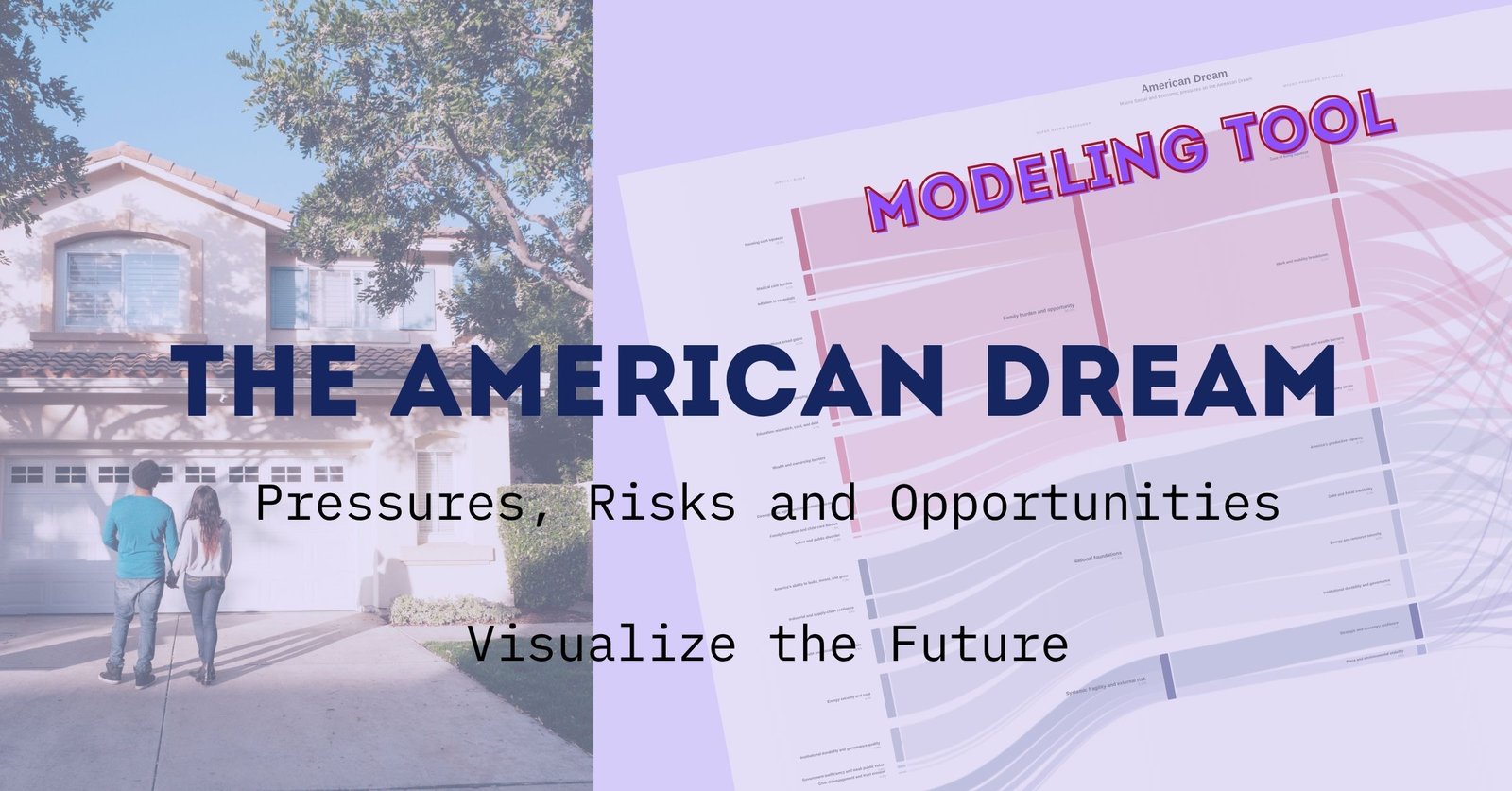
We’ve discussed the American Dream quite a bit at the Tax Project. One of our core missions, whether people believe it still exists or ever existed, is to maintain, preserve, and enhance the American Dream for future generations by creating Smarter Citizens for a Stronger Country. We think about this topic a lot and we have created various ways to view and articulate the pressures, and risks as well as the opportunities for improved outcomes. There is no set definition for it other than improving the Quality of Life, whatever that maybe, for All Americans. We’ve created a visualization of how we have thought about it and mapped it out, but it’s just an illustration to help us think about the components, and how to weigh and look at them. There is clearly no right or wrong way, but tools like this can help you organize your thinking about the subject. It was so powerful for us that we decided to invest some time and make a tool out of it. So here is our attempt to allow you to create your own Model with another free Citizen tool. Please – change it, add to it, adjust the size and weights – it is yours to keep. The tool allows you to export to high quality formats that you can print in poster size if you choose. We hope this will be of interest and value to you. Have fun, the Tax Project team.
The American Dream Pressure Map
Reference
Table of definitions and descriptions.
| Level | Label | Plain-English definition | Why it matters |
|---|---|---|---|
| Input Risk | Housing cost squeeze | Housing takes too much of a household’s income, whether through rent, mortgage, insurance, taxes, or related costs. | Housing is usually the largest family expense. When it rises too much, it crowds out saving, ownership, mobility, and family formation. |
| Input Risk | Pay not keeping up | Earnings do not rise fast enough to match the cost of living. | People may be working just as hard, or harder, without feeling like they are moving forward. |
| Input Risk | Medical cost burden | Health insurance, out-of-pocket costs, and medical risk create financial strain. | A health shock can quickly become a financial shock, especially for middle- and lower-income households. |
| Input Risk | Child care and family cost burden | The cost of raising children and supporting family life becomes harder to afford. | High family costs can delay marriage, reduce fertility, and weaken household stability. |
| Input Risk | Wealth and ownership barriers | Homes, savings, and investment assets become harder to buy or build. | The American Dream is not only about income. It is also about ownership, savings, and long-term security. |
| Input Risk | Education cost and mismatch | Education is expensive, and in some cases does not translate into better job opportunities or earnings. | School should help people move up. When the return is weak or the cost is too high, mobility suffers. |
| Input Risk | AI disruption without broad gains | AI changes work and production, but the gains may be concentrated while disruption is widely felt. | AI could raise productivity, but it could also weaken job ladders and concentrate wealth and bargaining power. |
| Input Risk | America’s ability to build, invent, and grow | The country becomes weaker at starting businesses, scaling innovation, adopting new technology, and raising productivity. | Long-run quality of life depends heavily on productivity, innovation, and dynamism. |
| Input Risk | Debt and fiscal-credibility strain | Rising debt, deficits, and interest costs reduce flexibility and confidence in the nation’s finances. | Over time this can crowd out productive investment, raise future burdens, and weaken resilience. |
| Input Risk | Energy security and cost | Energy becomes too expensive, unreliable, or constrained. | Energy affects nearly everything: household budgets, industry, transport, digital infrastructure, and national competitiveness. |
| Input Risk | Demographic aging and dependency burden | The population gets older and there are relatively fewer workers supporting more retirees and dependents. | This can slow growth, strain public finances, and weaken generational progress. |
| Input Risk | Institutional durability and governance quality | Public institutions become less effective, less trusted, or less able to solve problems. | If institutions weaken, even solvable problems can linger and compound. |
| Input Risk | Industrial and supply-chain resilience | The country becomes more dependent on fragile or foreign production networks. | Weak resilience makes the economy more vulnerable to shocks, shortages, and strategic pressure. |
| Input Risk | Great-power rivalry and geopolitical fragmentation | Strategic rivalry, bloc formation, or global instability create economic and political stress. | This can raise security costs, disrupt trade, and weaken global stability. |
| Input Risk | Dollar and monetary-system durability | The long-run strength and trust in the U.S. dollar and related financial system weaken. | This is more of a long-horizon systemic risk, but it matters because it affects flexibility, borrowing, and confidence. |
| Input Risk | Climate, insurance, and place risk | Environmental stress raises insurance costs, damages property, and makes some places harder to live in or insure. | This can directly reduce affordability, stability, and regional opportunity. |
| Input Risk | Government inefficiency and weak public value | Government services and spending deliver less value than citizens expect for the taxes paid. | It reduces trust, wastes resources, and weakens the public side of quality of life. |
| Input Risk | Inflation in essentials | The cost of food, energy, rent, health care, and other basics rises faster than households can absorb. | Essentials matter most because families cannot easily avoid them. |
| Input Risk | Crime and disorder | Safety and public order weaken in ways that affect daily life and community confidence. | Severe in some places, but generally more localized than the top structural pressures. |
| Input Risk | Civic disengagement and trust erosion | People participate less in civic life and have less confidence that the system is fair or responsive. | This weakens the country’s ability to self-correct. |
| Input Risk | Major war or security shock | A major military or geopolitical shock disrupts the economy and public life. | Low-frequency, but potentially very high impact. Included as a systemic fragility risk. |
| Super Macro | Family Burden and Opportunity | Pressures that directly affect the day-to-day ability of households to afford life and move up. | This is where families feel the American Dream most immediately. |
| Super Macro | National Foundations | Conditions that shape the country’s long-run capacity to grow, innovate, govern, and remain resilient. | These are the deeper foundations that support future living standards and opportunity. |
| Super Macro | Systemic Fragility and External Risk | Risks that may be less visible day to day but can produce large disruptions if the system weakens or shifts suddenly. | These are the “slowly, then suddenly” pressures that can change the whole environment. |
| Macro Channel | Cost of living squeeze | Basic necessities take up too much of the household budget. | When the basics are too expensive, families have less room to save, invest, or improve their lives. |
| Macro Channel | Work and mobility breakdown | Work becomes less reliable as a path to getting ahead. | The American Dream depends on effort and talent translating into upward progress. |
| Macro Channel | Ownership and wealth barriers | Building wealth, owning a home, and creating financial security become harder. | Ownership is one of the clearest markers of long-term progress and independence. |
| Macro Channel | Family and community strain | Family life, social stability, and local support structures weaken. | Strong families and communities are part of both quality of life and long-run resilience. |
| Macro Channel | Growth and dynamism slowdown | The economy becomes less innovative, less productive, and less capable of generating broad gains. | Long-run improvements in living standards depend on growth that reaches ordinary people. |
| Macro Channel | Fiscal and institutional stress | Public finances and institutions face strain, reducing flexibility, trust, and performance. | Even good policy becomes harder when the system is financially or institutionally weak. |
| Macro Channel | Energy and infrastructure pressure | Energy, physical systems, and enabling infrastructure become more costly or less reliable. | These are basic inputs into household life, business activity, and national competitiveness. |
| Macro Channel | Strategic and systemic risk exposure | The economy and society become more vulnerable to global instability, shocks, or structural breaks. | These risks may build quietly, then have outsized consequences when conditions shift. |
| Outcome | Harder to afford life | Families have less room in the budget after paying for basics. | This is the most immediate and intuitive sign that quality of life is under pressure. |
| Outcome | Harder to get ahead | Work and effort no longer translate into progress as reliably as they once did. | This is one of the clearest ways the American Dream breaks down. |
| Outcome | Harder to own a home and build wealth | Ownership, savings, and long-term security feel out of reach. | Wealth-building supports freedom, stability, and intergenerational progress. |
| Outcome | Harder to start and support a family | Marriage, children, caregiving, and stable family life become more difficult to sustain. | Family life is central to both quality of life and long-run social health. |
| Outcome | Lower quality of life | Day-to-day life becomes more stressful, less healthy, or less satisfying. | Quality of life includes more than money. It includes time, health, safety, and peace of mind. |
| Outcome | More financial and economic insecurity | Households become more vulnerable to job loss, illness, inflation, or other shocks. | Security matters because instability can erase years of progress very quickly. |
| Outcome | Fewer paths to move up | There are fewer accessible ladders into a better job, better life, or stronger future. | A society with fewer ladders is a society with less mobility. |
| Outcome | Kids less likely to do better than parents | Intergenerational progress slows or reverses. | This is one of the clearest tests of whether the American Dream is alive. |
| Outcome | A weaker future economy | The nation’s long-run growth, resilience, and opportunity base weaken. | This shapes what future generations can expect in jobs, incomes, and innovation. |
| Outcome | Less trust and shared confidence | People feel less confidence in institutions, fairness, and the country’s direction. | Trust helps societies cooperate, adapt, and solve problems. |
| Outcome | The Dream feels less attainable | People increasingly feel that the system does not reward effort fairly or reliably. | Even if some metrics hold up, belief matters. If people stop believing they can move up, the Dream is weakened. |