When Discretionary Becomes the Small Slice
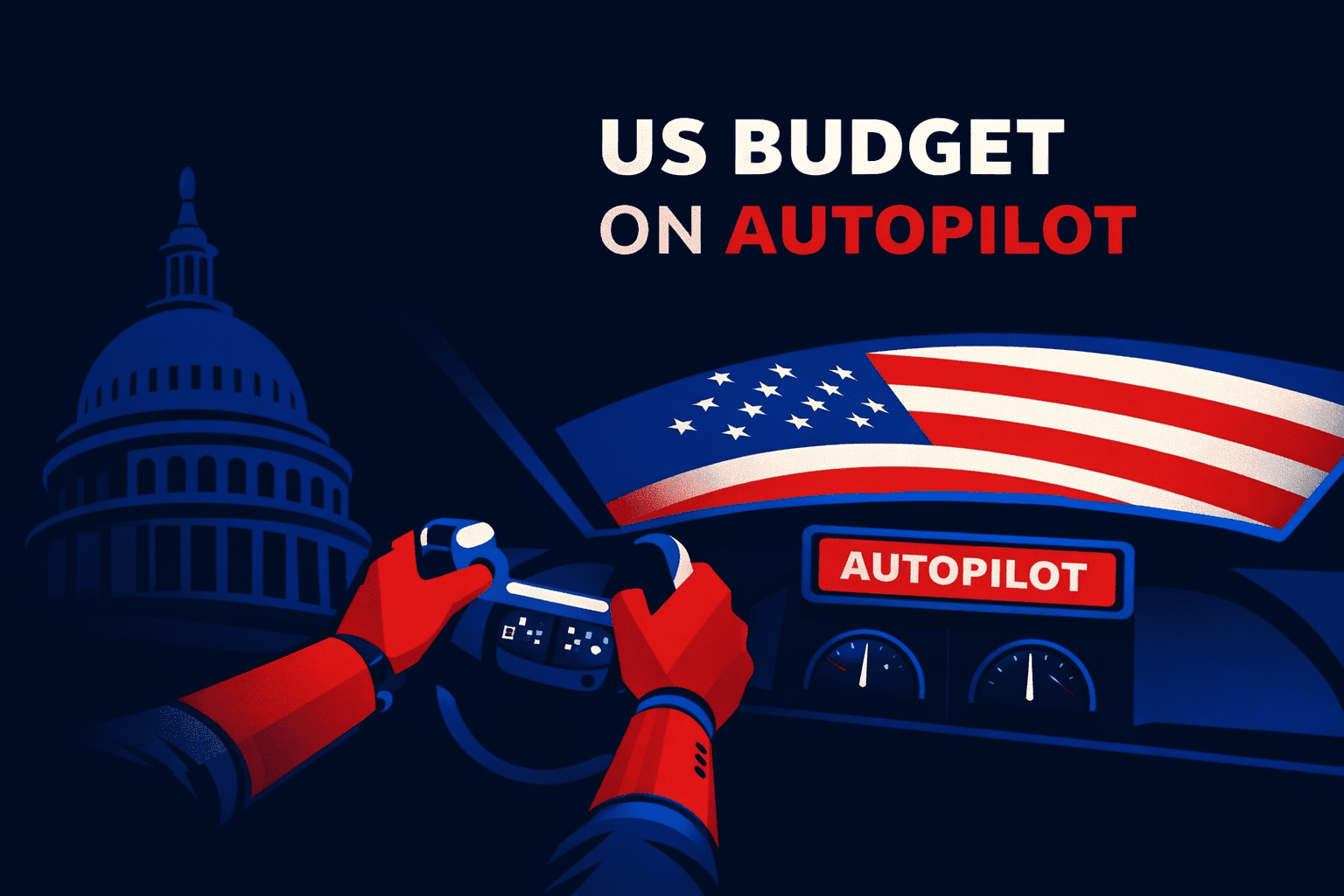
The US Federal budget appears as something Congress actively “sets” each year. In reality, a growing share runs on autopilot – governed by laws passed in prior years and by interest costs tied to past borrowing. That shift matters because it reduces flexibility. When the adjustable slice gets smaller, even well-intentioned efforts to “balance the budget,” “cut waste,” or “fund new priorities” run into a hard constraint: there is less room to move without changing the underlying laws. [1][2]
Office of Management and Budget (OMB) historical data shows a long, clear trend: discretionary spending used to represent most Federal outlays (spending) as recently as the 1960s, and today it represents roughly a quarter. [2] Figure 1 illustrates the same core idea: over time, the “annual choice” (a.k.a. Discretionary) portion shrinks while Mandatory spending and Net Interest take up more and more of the total.
For plain-language definitions of discretionary, mandatory, and entitlements, see Tax Project Institute’s explainer. [1]
Figure 1. Discretionary vs Mandatory & Net Interest (share of total federal outlays).

As the Discretionary component of the budget continues to shrink as a percentage of the budget Congress is left with less flexibility, and fewer tools to combat Fiscal challenges. While this was done intentionally in many cases to ensure that funding for critical programs like Social Security, and Medicare are funded, it has the effect of hamstringing the legislative branch in a number of ways.
1) Smaller Steering Wheel
Discretionary spending is the part of the budget Congress decides through the annual appropriations process. It funds many of the visible functions people associate with government: agencies, staffing, operations, contracts, grants, and a wide range of public services. [3]
As discretionary becomes a smaller share of total outlays, the annual appropriations process controls less of the overall budget. Congress is still making choices, but with fewer degrees of freedom – all but roughly one quarter of the budget is on auto pilot before they even start. The practical result is simple: fewer options exist inside the discretionary part of the budget that can be changed quickly without changing the law.
This is the first flexibility problem. Many public debates treat the entire budget as negotiable every year. It is not. A rising share is effectively pre-committed by statute and by the interest payments on our National Debt. [2][3] Because of this there is less room to swing, move budget to areas that may require it without taking on additional debt, and larger budget deficits.
2) “Automatic” but not “Unchangeable”
Mandatory spending runs based on permanent law: eligibility rules, benefit formulas, payment rates, and automatic adjustments. It does not require an annual appropriations vote to continue. [3] These are essentially the auto pilot components of the Federal Budget.
However, Mandatory spending can be changed. The challenge is that it usually requires changing the underlying statute, which often involves complex policy design, distributional tradeoffs, and longer legislative timelines often met with gridlock in our current political environment. That makes it harder to adjust Mandatory programs as a “quick fix” when budget pressure arises.
This creates a mismatch between politics and mechanics: discretionary levels can be adjusted in annual funding bills, while major changes to large mandatory programs, that take up the majority of the budget, typically require separate authorizing legislation and sustained political agreement. [3] This has the practical effect of making most of the budget off limits each year unless there is consensus on changing components of the mandatory budget, which both parties are often hesitant to do.
3) Entitlements Growth
A major reason the autopilot share grows is that many Mandatory programs are built to scale and expand cost automatically. Spending can rise because:
- More people become eligible (demographics)
- Per-person costs rise (especially in health care)
- Benefit formulas and thresholds adjust over time (indexing, inflation)
- Refundable credits and income-tested benefits expand and contract with economic conditions [4]
This is not inherently “good” or “bad.” It is what happens when programs are designed to deliver stable benefits based on rules. But it does mean the budget baseline rises even if Congress takes no new action in a given year.
When that baseline grows faster than revenues, pressure concentrates on the smaller discretionary slice. The consequences show up in visible ways: funding fights, recurring rhetoric about “cuts,” and a sense that budgeting is constant crisis management. The underlying driver is often structural: the baseline is doing what the laws tell it to do. [2][4] The challenge is that the Entitlements component of the budget, in particular Health Care, has grown dramatically over the last few decades and is taking an increasingly larger piece of the budget.
4) Net Interest competes with everything else
Net interest is the cost of financing the US National Debt, in other words the interest paid on the National Debt in the form of Treasury securities (net of certain interest income). [3] It is not a program most people interact with directly, but it draws from the same pool of Federal Budget resources.
When debt levels are high and interest rates rise, interest costs can increase even if no benefit is expanded and no agency is funded more. That creates a second flexibility squeeze: interest is effectively a prior obligation. It gets paid first, and it reduces the dollars available for everything else. The US paid over $1 trillion in Interest on our National Debt, more than the entire US Military budget. [5]
This is one reason budget debates can feel increasingly zero-sum. When more of the budget is committed to mandatory programs and interest, the share left for annual choices becomes smaller, and tradeoffs become more challenging. [2][3]
5) Limited Efficiency Drives
Efforts to improve government efficiency, reduce overhead, and cut waste matter. But they run into arithmetic challenge, even if they eliminated the entire Discretionary budget, roughly three quarters of spending would still occur. While this isn’t practical, or likely, it provides perspective on the limitations of any cost cutting efforts, including the most recent DOGE efforts.
When discretionary spending is only roughly a quarter of federal outlays, it limits how large savings can be if reforms stay mostly inside discretionary programs. Even aggressive discretionary cuts face tradeoffs because discretionary spending includes many visible services and operational functions people rely on. [2][3] The discretionary budget includes many things that would probably surprise many citizens that they are discretionary including Education, the Military, Homeland Security, housing assistance, and medical programs like the CDC, and NIH to name just a few.
Meanwhile, the biggest structural drivers of the budget’s composition shift sit mostly in Mandatory programs and Net interest – areas that do not respond to short-term “efficiency” campaigns in the same way. [2][3]
That is why many high-profile cost-cutting efforts generate headlines but produce smaller results than promised: the biggest budget pressures are often located in the portions that require statutory change or longer-term fiscal adjustments.
What this means for citizens watching budget debates
The practical takeaway is straightforward: the annual budget fight is real, but it is increasingly a fight over a smaller share of total federal spending that limits Congressional flexibility. Big claims about “fixing the budget” without addressing larger Mandatory programs and Net Interest costs should be treated with skepticism – not because reform is impossible, but because the control levers are different. [2][3]
A budget with less discretionary share has less flexibility. That makes it harder to:
- Respond quickly to new priorities without borrowing and increasing deficits adding to the National Debt
- Reduce deficits through easy cuts
- Avoid political brinkmanship in appropriations
- Hold decision-makers accountable for the full budget (because only part is voted on annually) [2][3]
The budget autopilot challenge is fundamentally a governance challenge: when most spending is determined outside the annual appropriations cycle, meaningful change requires changing the rules – not just negotiating the yearly slice. [3] The growth of Entitlements and Mandatory spending and Interest are putting more an more pressure on the Fiscal Budget each year, leading to annual structural deficits in budget over $1 trillion a year. In FY 2025 the US Federal Budget was $7 trillion on revenue of $5.2 trillion with a $1.8 trillion deficit added to the $38 trillion National Debt. [6] The long term trend is clear, growing Mandatory spending will continue to consume more and more of the budget and lead to increasingly structural deficits which will compound the challenge as interest payments and entitlements continue to grow. Meaningful change will likely require adjustments to Mandatory programs and reduction in annual deficits through spending cuts and/or tax increases. See our article on Ways out of Debt HERE.
References
[1] Tax Project Institute. (2025, September 24). Mandatory vs discretionary vs entitlements: A simple explainer. https://taxproject.org/mandatory-vs-discretionary-vs-entitlements-a-simple-explainer/
[2] Office of Management and Budget. (n.d.). Historical tables. The White House. https://www.whitehouse.gov/omb/information-resources/budget/historical-tables/
[3] Congressional Budget Office. (2021, December 2). Common budgetary terms explained. https://www.cbo.gov/publication/57660
[4] U.S. Department of the Treasury, Fiscal Data. (n.d.). Federal spending (America’s Finance Guide). https://fiscaldata.treasury.gov/americas-finance-guide/federal-spending/
[5] Fortune. (2025, December 17). The $38 trillion national debt is to blame for over $1 trillion in annual interest payments. https://fortune.com/2025/12/17/38-trillion-national-debt-interest-payments-over-1-trillion-per-year-crfb-outlook-forecast/
[6] OMB. (2026). OMB Budget. https://www.whitehouse.gov/omb/information-resources/budget/