Why USASpending, Treasury, OMB, CBO can be factual and still not match
If you have ever tried to look up how much the Federal Government “spent” and found one number on USAspending, another in a Treasury report, and another in a document from the Office of Management and Budget (OMB) or the Congressional Budget Office (CBO), you are not imagining things. The numbers rarely if ever match exactly. That is confusing for a simple reason: people may assume all Federal spending numbers are trying to answer the same question. They are not.
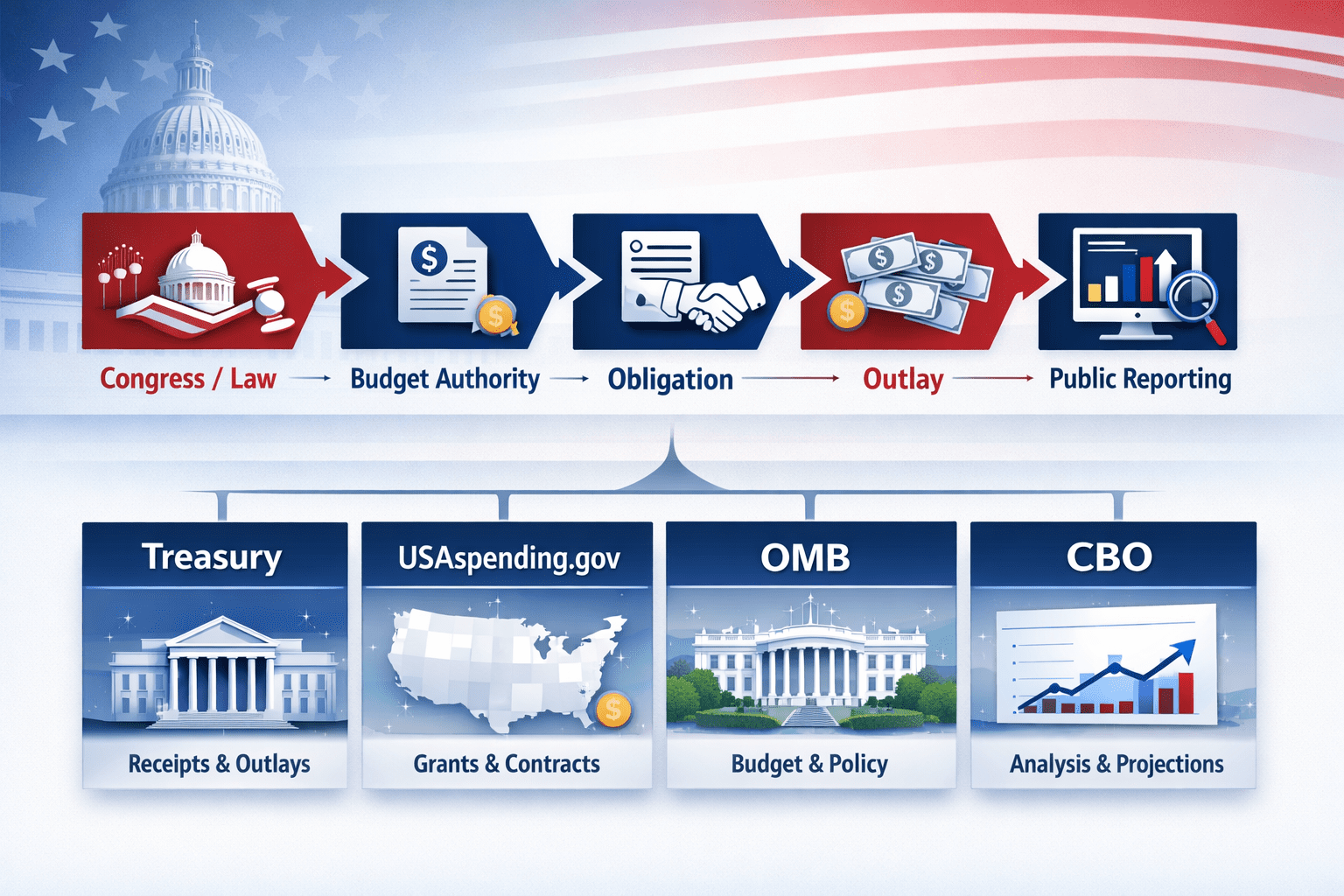
Each maybe accounting for different reporting of money. Some sources are showing money the government was legally allowed to use. Some are showing money the government committed to spend. Some are showing money that actually left the government’s accounts. Some are showing projections, or estimates rather than final recorded totals. And some are designed for public transparency at the contract and grant level, while others are designed to serve as the government’s official accounting summary. For example Treasury’s Combined Statement is the official publication of Federal receipts and outlays, while USASpending is the government’s public spending transparency site built from multiple reporting systems and data feeds.[1][2]
That is why a person can find several different federal “spending” numbers that are all real, all official, and still not directly comparable. The problem is usually not that one source is lying. The problem is that each source is built for a different purpose. However, for example, calling something USASpending and then having to explain it is NOT the actual spending of the Federal government, but the obligations and some outlays, can understandably come across as misleading, and maybe even outright false to some.
This article explains the basic terms, the main organizations, where the data come from, why the numbers differ, and where readers should go depending on what they are actually trying to find. For readers who want the larger context of how the federal budget is proposed, enacted, apportioned, and executed, see Tax Project’s Budget Process Explainer.[9]
Key Terms
Before comparing websites and agencies, it helps to define the basic terms.
- Budget authority is the legal permission to commit (spend) Federal funds (money). Congress provides this authority through appropriations or other laws.[3]
- Obligations are legal commitments to spend, not the actual spend. If an agency signs a contract, awards a grant, commits to salaries, or incurs another binding commitment, that creates an obligation.[3][4]
- Outlays are money actually paid out, or Spent. These are the checks, cash disbursements, electronic transfers, or other payments used to satisfy those obligations.[3]
These terms are related, but they are not the same thing. The Congressional Budget Office explains obligations as legally binding commitments and outlays as the disbursement of funds to settle those commitments.[3] USASpending explains the same distinction in simpler public-facing language: an obligation is a promise to spend, while an outlay is the actual spending.[4]
That difference sounds technical, but it matters a great deal. Much of the public confusion around federal spending comes from people comparing one source that tracks obligations with another source that tracks outlays, or from comparing a projection with an actual payment total.
Simple Example
Suppose you take out a $50,000 bank loan to remodel your kitchen.
Budget Authority (Permission): The bank approves you for up to $50,000. That is similar to budget authority. You are allowed to use that amount, but the money has not all been spent yet.
Obligation (Commitment): You then sign a contract with a builder for $42,000. That is similar to an obligation. You have made a legal commitment, but the builder has not been fully paid yet.
Outlay (Spend): The builder asks for $10,000 upfront, $15,000 halfway through the project, and the remaining $17,000 at completion. Those payments are similar to outlays. Cash leaves your account over time as the work is performed.
In this example, your authority to spend is $50,000, your legal commitment is $42,000, and your actual spending happens in installments. If someone looked only at your signed contract, they might say you “spent” $42,000 but that was only the obligaton. If they looked only at your first payment, they might say you spent $10,000. Both would be describing something real, but they would be describing different stages and accounting of the process.
Federal spending works much the same way. Congress provides legal authority. Agencies obligate money through contracts, grants, salaries, or benefits. Then outlays occur when money is actually disbursed.[3][5]
Budget Process
This article does not provide a full budget-process guide, but a little background helps.
At a high level, Congress enacts funding and legal authority. The Office of Management and Budget (OMB) apportions most executive branch budgetary resources and oversees budget execution. Agencies then obligate funds and later record or make outlays as payments occur. The Treasury department collects and publishes governmentwide financial information, and agency data also flow into public transparency tools such as USAspending.[5][6]
This larger chain matters because each major Federal source sits at a different point, and intentionally tracks a different set of data. Some are focused on legal authority and execution controls. Some are focused on cash reporting. Some are focused on analysis for Congress. Some are focused on public-facing transparency.
Readers who want the broader walk-through of this process can see the Tax Project’s article on the Federal Budget process here: The Federal Budget Process Explained.
Federal Government Organizations
A large part of the confusion comes from people seeing acronyms without understanding the role of each Governmental organization.
The U.S. Department of the Treasury (Treasury) is the Federal government’s main authorative source for spending and cash outlays. Treasury publishes the Monthly Treasury Statement, which summarizes monthly receipts, outlays, deficit or surplus, and financing on a modified cash basis, and it publishes the Combined Statement, which Treasury describes as the official publication of receipts and outlays of the U.S. government.[1]
The Office of Management and Budget (OMB) is part of the Executive Office of the President. OMB helps prepare the President’s Budget, oversees budget execution across the executive branch, apportions budgetary resources, and defines many of the concepts and classifications used in Federal budgeting. OMB also publishes historical budget tables and guidance such as Circular A-11 that is often referenced as Spending by various sources.[5][6][7]
The Congressional Budget Office (CBO) is Congress’s nonpartisan budget analysis office. It does not serve as the government’s master accounting ledger. Instead, it provides Congress with cost estimates for legislation, budget and economic outlooks, baseline projections, and plain-language explanations of budget concepts. These numbers may be used in media when discussing spending and budgets. [3][8]
USASpending.gov is the federal government’s public spending transparency site. It is designed to let users explore contracts, grants, loans, recipients, agencies, vendor awards, locations, and federal accounts. It is useful for tracing where money was obligated and, in many cases, where outlays were reported, but it is not the same thing as Treasury’s official annual governmentwide receipts-and-outlays statement.[2][4] In other words, in contrast to the sites naming, it is mostly Obligations, and some Outlays, but not truly “Spending” on an accounting outlay basis.
Each of these sources is official. Each is useful. But each is built to answer a different type of question.
Public Confusion
Because there are so many accounting contexts for spending, the public often hears a phrase like “the government spent $X” without context as to what that number refers to. It could be:
- money Congress made available (Budget Authority),
- money an agency legally committed (Obligation),
- money actually paid (Outlay),
- an estimated future amount (Estimate),
- or a rounded analytical figure in a budget document.
Since many citizens may not understand the differences, that missing context is where the confusion starts.
If one person quotes Treasury, another quotes USAspending, another quotes OMB, and another quotes CBO, they may all be citing real Federal numbers. But they may be pulling numbers from different reporting systems, different points in time, and different definitions of spending. That can make the disagreement sound larger than it really is or distort the numbers. Unfortunately, it maybe our own public officials who use these numbers to distort topics to their advantage by making a misleading claim sound more precise than it is.
Where to find information
The practical question most readers care about is not which acronym is most important. It is where they should go for the answer they want.
Where to Find Information
| If you want to know… | Best place to start | Why |
|---|---|---|
| How much the federal government actually paid out overall (Spending) | Treasury Monthly Treasury Statement or Treasury Combined Statement | Treasury is the government’s official receipts-and-outlays anchor. Use the Monthly Treasury Statement for current monthly and year-to-date totals, and the Combined Statement for the annual official publication. |
| How much an agency obligated, which Contracts or Grants it issued, who received the money, or where it went (Obligations, some Outlays) | USAspending.gov or Tax Project’s Feature rich alternative Government Explorer | USAspending is built for award, account, recipient, and agency exploration. |
| See the President’s budget, and how the OMB classifies accounts and budget concepts | OMB budget materials and OMB Circular A-11 | OMB manages executive-branch budget concepts, classifications, apportionment, and budget presentation. |
| What Congress’s independent scorekeeper says about deficits, future baselines, or the cost of legislation, and their estimates | Congressional Budget Office | CBO provides nonpartisan congressional analysis, estimates, projections, and plain-language explanations. |
| A simpler explanation of how the federal budget process works from start to finish | Tax Project: The Federal Budget Process Explained | Good for readers who need the full process, not just the reporting differences. |
That table is the simplest answer to most reader questions. People often use the wrong source not because the source is bad, but because they are asking it to do something it was not built to do.
Why the Numbers Differ
To help unravel the confusion, there are four main reasons federal spending numbers differ across sources.
1. They are measuring different things
Treasury is mainly focused on receipts, outlays, and deficit totals. USASpending shows obligations and award-level detail. OMB presents budget concepts, classifications, and executive-branch historical tables. The Congressional Budget Office often provides rounded analytical figures, baselines, estimates, and projections.[1][3][5][8]
If you compare one source built around obligations to another built around outlays, there will be differences.
2. They sit at different stages of the spending pipeline
Obligations usually occur before outlays. A department can obligate funds for a contract or grant in one fiscal year and outlay the money over several years. That is common in procurement, construction, and many grant programs. Other programs, such as entitlement payments, may outlay more steadily and quickly.[3][5]
3. They use different reporting systems and scopes
USASpending is not fed from a single, perfectly unified source. It draws from multiple reporting systems and combines account-level and award-level data. Its documentation also notes that not all government entities report under the same requirements, including the legislative and judicial branches.[2]
Treasury’s role is different. It is producing the government’s official governmentwide receipts-and-outlays publications, not an award explorer.[1]
4. Reporting quality and timing vary
USAspending notes that more recent years generally have better-quality data, that agency financial-system data begin later than some award data, and that award-level outlay reporting before fiscal year 2022 may be incomplete. It also notes a delay in some Department of Defense and Army Corps of Engineers contract data.[2][4] Our own experience has shown us that values on their website can change years after the fact (which is why we stopped caching some of the data).
That means a reader looking for a neat, single, perfectly comparable “Federal spending number” across every system may end up disappointed. The systems overlap, but they do not function the same way.
FY 2025 as a real example
Fiscal year 2025 is a good example because official year-end figures are available.
Treasury’s Combined Statement for FY 2025 reported approximately $5.235 trillion in receipts, $7.010 trillion in outlays, and a $1.775 trillion deficit.[1]
Office of Management and Budget’s FY 2027 Analytical Perspectives materials, reported FY 2025 unified receipts of approximately $5.236 trillion, unified outlays of approximately $7.011 trillion, and a unified deficit of $1.775 trillion.[5][7]
Congressional Budget Office’s FY 2025 is described in more rounded analytical terms, referring to roughly $5.2 trillion in revenues, $7.0 trillion in outlays, and a deficit of about $1.8 trillion.[8]
Those numbers are close, but not identical. That small difference is exactly the kind of thing readers notice and wonder about. OMB itself explains that although its figures are generally consistent with Treasury’s, differences can arise because of later reporting corrections, classification changes, and conceptual differences between OMB and Treasury reporting.[7] CBO’s presentation is less suited to one-for-one matching because its role is analytical, not to serve as the government’s final accounting statement.[8]
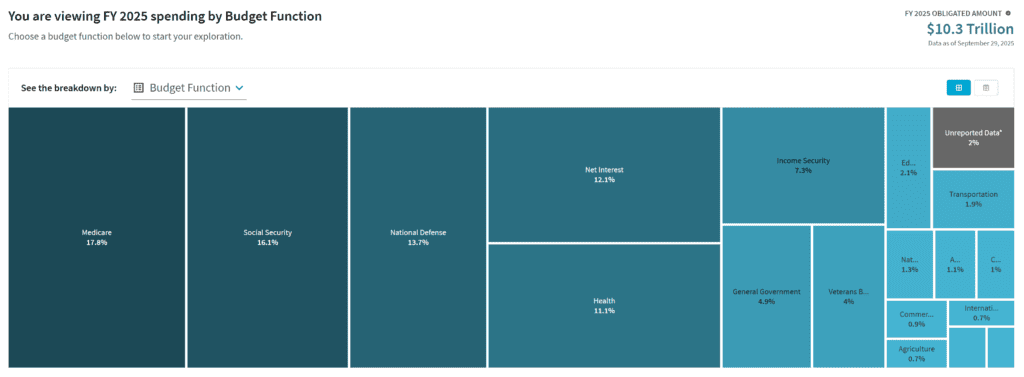
USASpending is different again showing $10.3 trillion in obligations, trillions of dollars different than outlays. It is extremely useful for exploring obligations, awards, recipients, agencies, and accounts, but it is not best thought of as the government’s single final annual top-line cash scoreboard for “spending.” It is a transparency platform, not the same type of publication as Treasury’s Combined Statement.[2][4]
USASpending: What it is good for, and what it is not
What it’s good for:
USASpending is often the best place to start when the reader wants to know:
- which agency made an award,
- which company or recipient got the money,
- what federal account funded it,
- where the work was performed,
- or how much was obligated on a contract or grant.
That is a major strength, mostly our governments obligations. It give a great sense of how much our country is committed to now and into the future, and where (who) that money is obligated to.
What it’s not for:
However, if the question is: “What is the official total amount the federal government spent for the year?”, the US Treasury is the better starting point.[1][2] Oddly, and as we have expressed confusingly, USASpending is NOT the best source to look for what is “spent” by the Federal Government, that accounting is best shown by the outlays in the MTS report from the Treasury.
This distinction matters because public debates often blur the difference between a transparency portal and an official governmentwide accounting publication. They are related, but they are not interchangeable and as we show above, the differences can be in the trillions of dollars, not just a rounding error. Citizens armed with these “facts” maybe wielding information incorrectly when used in different contexts.
For readers who want a more feature-rich way to explore USAspending-based federal spending data, Tax Project’s Government Explorer is intended to provide a more navigable and feature rich front end while still drawing on USASpending data.
Why this matters
Informed citizens are the basis of our Republic, and the foundation of our Democracy. Our founding fathers understood that the protection of our country would rest on the knowledge and participation of it’s citizens, not just relying upon our elected officials. Public debate over Federal spending dictates many important parts of how our government is run, and what is prioritized and funded impacting the lives of all Americans. Politicians may use these terms interchangeably in contexts that often present their case in a favorable light. While some may call this dishonest, others may call it a lie, the common point is that if you don’t understand these terms you maybe manipulated by category or term confusion. While we believe that not all politicians are dishonest, it is up to citizens to understand the context, and be able to ascertain the accurate and factual information in the correct context on their own. When people quote different numbers from different systems without explaining what those numbers actually measure, understanding the terms, context, and sources will help you make more informed choices.
When one person cites obligations, another cites outlays, another cites a budget estimate, another cites a rounded CBO analytical total, and another cites Treasury’s official receipts-and-outlays statement. All may be using real figures. But real figures can still mislead when they answer different questions than what the reader thinks they do.
The better approach is to ask a more precise question first:
- Am I trying to measure legal authority? (Budget Authority – Permission)
- legal commitment? (Obligation – Commitment)
- actual payment? (Outlays – Spend)
- a budget estimate? (Estimate – Projection)
- or a recipient-level spending record? (Award, Grantee)
Once that question is clear, the source usually becomes much easier to choose. Treasury is the best starting point for official overall outlay totals. USASpending is best for award and account exploration of obligations. OMB is best for executive-branch budget concepts and the President’s budget. The Congressional Budget Office is best for Congress’s independent estimates, projections, and cost analyses.
So is it simple, not unfortunately it is not. This does not remove all complexity, but hopefully it makes Federal spending data easier to understand. We encourage you to continue on your journey of Government Financial Literacy. Smarter Citizens, Stronger Country

References
[1] U.S. Department of the Treasury, Bureau of the Fiscal Service. Combined Statement of Receipts, Outlays, and Balances of the United States Government, Fiscal Year 2025. https://fiscal.treasury.gov/reports-statements/combined-statement/
[2] USAspending.gov. Data Sources and About the Data. https://www.usaspending.gov/data/data-sources-download.pdf, https://www.usaspending.gov/data/about-the-data-download.pdf
[3] Congressional Budget Office. Common Budgetary Terms Explained. https://www.cbo.gov/publication/57660
[4] USAspending.gov. Obligations vs. Outlays. https://www.usaspending.gov/
[5] Office of Management and Budget. Analytical Perspectives, Budget of the U.S. Government, Fiscal Year 2027, especially Budget Concepts. https://www.whitehouse.gov/wp-content/uploads/2026/04/ap_6_concepts_fy2027.pdf
[6] Office of Management and Budget. Circular A-11. https://www.whitehouse.gov/omb/information-for-agencies/circulars/
[7] Office of Management and Budget. Public Budget Database User’s Guide. https://www.whitehouse.gov/wp-content/uploads/2026/04/db_guide_fy2027.pdf
[8] Congressional Budget Office. Monthly Budget Review: Summary for Fiscal Year 2025 and related FY 2025 summaries. https://www.cbo.gov/
[9] Tax Project. The Federal Budget Process Explained. https://taxproject.org/budget-process/