Explainer: Our National Budget, how it works
Our National Budget is a long complicated process that takes place over months each year, and given it’s importance you can understand why so much effort goes into it’s creation. For anyone that has worked on or created a large budget they know that there are many components, but beyond the detail and the complexity every Executive knows that a budget represents more than just numbers and spending, it represents the plan and priorities for what each administration is hoping to achieve for the coming year. Each year, the President comes with their Administration’s priorities, and the budget is the first place to set that agenda. The budget sets the allocation for each area of Government, and what they are authorized to spend with the money. The budget process starts with the President transmitting a single, unified budget to Congress. This represents a non binding proposal, not law; it is the administration’s agenda and the common starting point for every fiscal decision that follows. The unified-budget requirement dates to the Budget and Accounting Act of 1921, which centralized executive-branch submissions and brought order to what had been a fragmented process. The proposal sets priorities, frames discussions, and is the basis for trade-offs, and provides draft legislation that Congress may adopt, alter, or ignore.
The budget’s importance is practical as well as political. It aligns planned activities and the resources to carry them out; it’s the blueprint Congress uses to set overall Spending and Revenue levels, and it is the legal authority agencies need to operate (Sets their Budget and Spending authorization) once laws are enacted.
“A budget is not just a collection of numbers, but an expression of our values and aspirations.”
Barack Obama
Funding Categories
The Federal Budget Spending falls into three distinct streams that behave differently across the year:
- Mandatory (entitlements). Just like the title implies, these are Statutory Laws (Mandatory) that dictate spending on various programs. Benefits and payments determined by standing law such as Entitlement programs like Social Security, Medicare, and Medicaid. Mandatory Spending continues unless Congress amends the underlying Statutes (Laws). Roughly two thirds of the Federal Budget is Mandatory.
- Discretionary. The non Mandated portion of the budget is the Discretionary budget representing about one third of the Federal budget. The discretionary budget is the portion of the annual budget that gets negotiated each year. This represent a smaller part of the budget, but surprisingly to some, items like National Defense fall into the smaller discretionary budget.
- Net interest. This represents the Interest charges on our National Debt. While not Mandatory, it must be paid each year unless the U.S. chooses to default on their debt. So for all intents and purposes, this is Mandatory spending.
Role of Government Entities
“A government that cannot budget is a government that cannot govern.”
Paul Ryan
Executive Branch
- President & Office of Management and Budget (OMB). The President’s office sets the agenda; The OMB plays a major role in the preparation, and organization of the President’s budget. Each agency submits their budget proposals for the year, and the OMB organizes their submissions into a single proposal for submission to Congress. After laws pass, OMB apportions funds and oversees the budget to agencies on a schedule that prevents Agencies from overcommitting or spending beyond their authorized appropriation in violation of Anti Deficiency Act. OMB’s operating manual for both planning and in-year execution is published in Circular A-11. The A-11 provides an in depth overview and description of the budget process and all the various components, including reconciliation, and the role and function of different processes. If you are interested in an in depth understanding of the Budget Process, read this document – detailed but informative. (OMB Circular A-11)
- Department of the Treasury. The Treasury manages the government’s cash (via the Treasury General Account) and issues debt to finance enacted laws. The debt limit is a separate statute that caps total outstanding federal debt; when it binds, Treasury may use statutory extraordinary measures until Congress raises or suspends the limit. In general, the Treasury has no role in the policy of the budget, their role is to ensure that funding is available for the appropriated budget.
Legislative Branch
- Joint Committee on Taxation (JCT). The JCT is comprised of the Tax Writing arms of the House (Ways & Means Committee), and Senate (Senate Finance Committee). The JCT is Congress’s official revenue estimator for tax provisions; by statute, JCT’s tax numbers are the ones Congress uses, and the Congressional Budget Office incorporates them into their bill scoring. The JCT is responsible for providing both conventional (“static”) and macroeconomic (“dynamic”) analysis of tax legislation.
- Static analysis estimates the direct impact of a tax change on revenue, assuming no significant changes in economic behavior.
- Dynamic analysis estimates how a tax change might affect the broader economy (e.g., investment, employment, and GDP) and then how those changes would, in turn, affect federal revenue.
- Congressional Budget Office (CBO). The CBO provides congress with nonpartisan estimates of the proposed budgets. CBO publishes the baseline (what the current spend and revenue are with current laws) and prepares cost estimates for proposed legislation (what the estimated effects are over 10 years on spend and revenue with proposed legislation). They take the JCT estimations and build them into their estimation model.
- Budget Committees (House/Senate). Once the President submits the administrations budget Proposal the Congressional budget committees take this as input, which that can use or completely ignore, to draft the annual budget resolution – essentially a top level blueprint for congress that sets the overall spending and revenue totals and may include reconciliation instructions. It is a concurrent resolution to both the Senate and House and does not go to the President for approval. This includes the (302(a)) Allocation spending amount sent to the Appropriation committees.
- Appropriations Committees. The Congressional Appropriation Committees receive the top-line discretionary total allocation from (302(a)) and divide it among 12 subcommittees (302(b)) sub allocations. The Appropriation Committees write the annual funding bills that allow agencies to obligate (Spend) money. The 12 Appropriation subcommittees align with Cabinet Level departments:
- Agriculture, Rural Development, Food and Drug Administration, and Related Agencies
- Commerce, Justice, Science, and Related Agencies
- Defense
- Energy and Water Development, and Related Agencies
- Financial Services and General Government
- Homeland Security
- Interior, Environment, and Related Agencies
- Labor, Health and Human Services, Education, and Related Agencies
- Legislative Branch
- Military Construction, Veterans Affairs, and Related Agencies
- State, Foreign Operations, and Related Programs
- Transportation, Housing and Urban Development, and Related Agencies
- Authorizing & Tax-writing Committees. Committees like Ways & Means (House) and Finance (Senate) handle permanent law for mandatory programs and revenues; changes here alter the law that drives entitlement spending and tax collections.
Annual Budget Calendar (Gantt View)
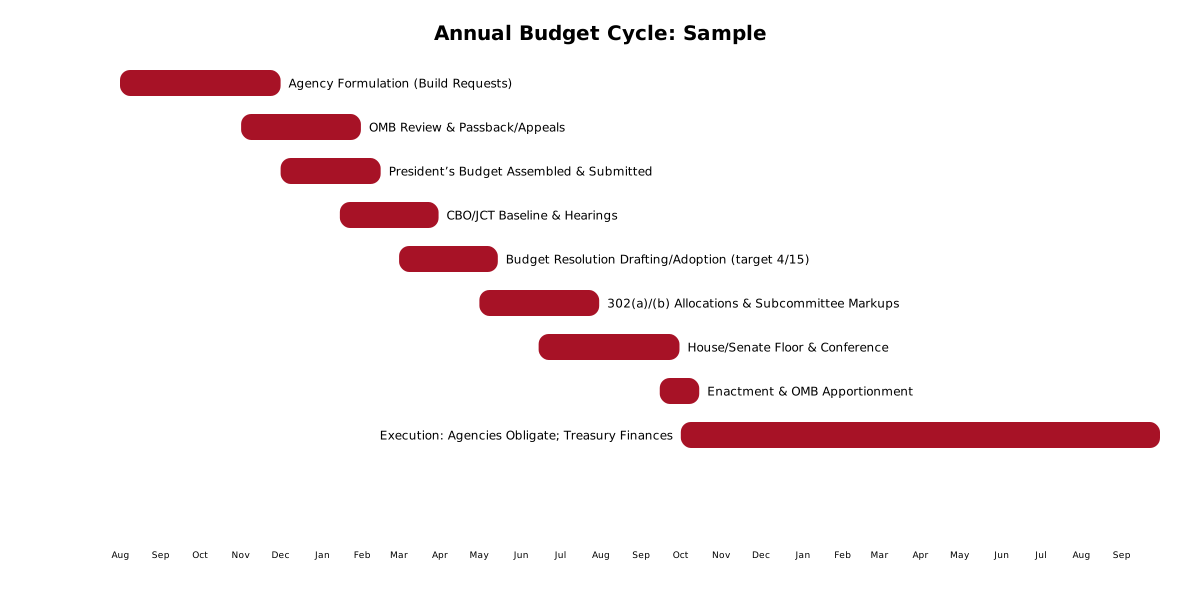
The Federal Government’s Fiscal year runs from October 1 to September 30 the following year. In order to keep the country running without interruptions Congress tries to enact full-year budget appropriations before the October 1st start of the fiscal year; if not, it uses Continuing Resolutions (temporary appropriations laws) to keep agencies open and funded while negotiations continue.
The process of creating a National Budget take a lot of time from a great number of people because of it’s importance to our country. As such, significant effort throughout the year is put into it’s creation and execution. Here is a sample of an annual Budget Calendar
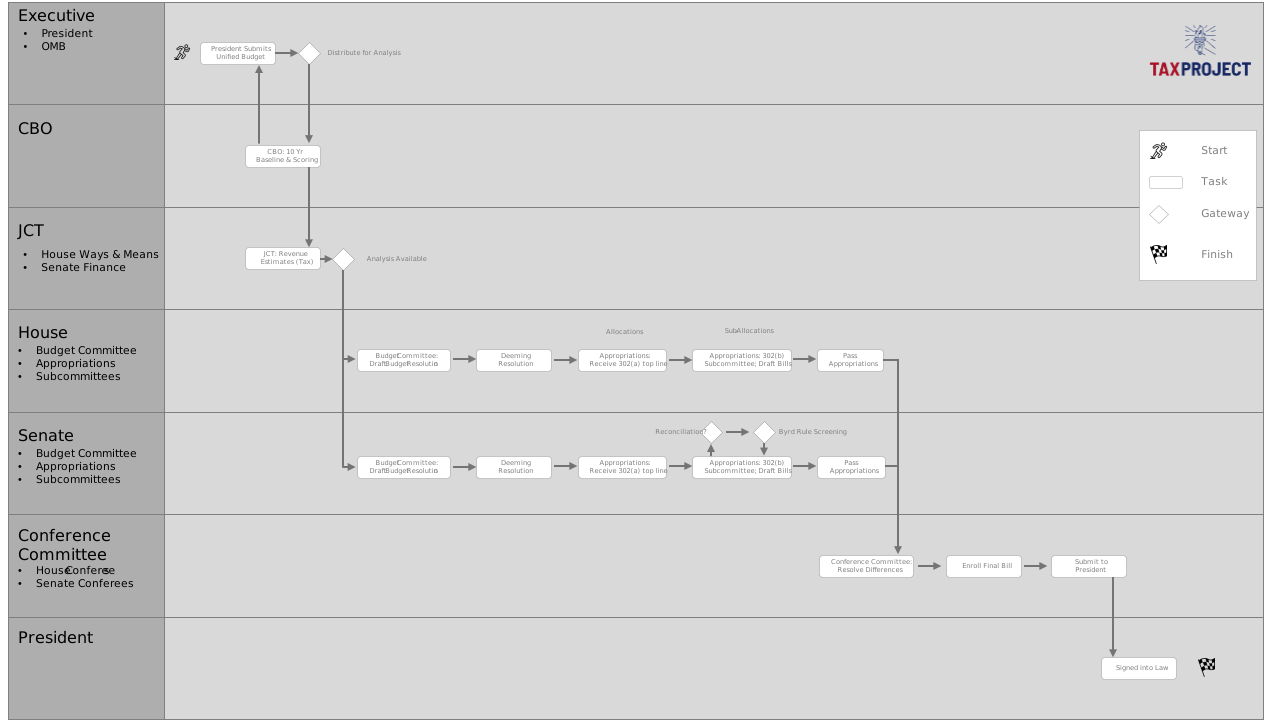
National Budget Process
1) President’s Budget Proposal
Administrations, and Parties maybe Planning weeks, months, or even years before any official budget, but the official Budget cycle begins when the President sends a unified budget to Congress (traditionally early February). This blueprint sets out proposed revenues, spending, and policy changes. It is agenda-setting, not binding, and Congress can and does at times ignore the proposal.
2) Baseline & “Scoring”
Before Congress writes its own plan, it needs a yardstick, a baseline of the current environment. CBO’s baseline projects revenues and outlays (spending) under current law for 10 years; CBO then estimates (called “scoring” in Congressional parlance) bills by measuring how they would change from the baseline. For tax provisions, JCT provides the official revenue estimate that CBO incorporates into their estimates. For major bills, committees may request separate macroeconomic (dynamic) analysis. After enactment, the Statutory PAYGO Act requires OMB to maintain rolling 5 and 10 year scorecards tallying the net deficit effects of new direct-spending and revenue laws; if balances are positive and Congress doesn’t clear them, the sequestration process is triggered forcing across the board mandatory spending cuts.
3) Congressional Blueprint (Budget Resolution)
The Congressional Budget Resolution is the financial blueprint Congress uses to guide its annual budget process. Created by the House and Senate Budget Committees, it sets the overall totals for federal spending and revenue for the upcoming fiscal year. This resolution is not a law and doesn’t go to the President, but it serves as a crucial internal document that gives the House and Senate Appropriations Committees a single, top-line spending number known as the 302(a) allocation.
If the House and Senate fail to agree on a unified Budget Resolution, a common scenario, a procedural workaround called a deeming resolution is used. This allows each chamber to unilaterally establish its own spending levels and begin the appropriations process. This workaround can lead to the two chambers passing spending bills with different funding levels, which must be resolved through negotiations in conference committees at the end of the process.
4) Discretionary Funding (Sub Allocations)
After the Budget Committees set the top-line spending number, the Appropriations Committee takes over to handle Discretionary funding. This is the portion of the federal budget that Congress must approve each year, unlike mandatory spending which is set by existing laws.
The Appropriations Committee receives a single, overall spending cap from the Budget Resolution, known as the 302(a) allocation. The Committee then holds hearings and negotiations to divide this total into 12 separate 302(b) suballocations, one for each of its 12 subcommittees. Each subcommittee is responsible for a specific area of government, such as Defense or Commerce, and must draft its annual spending bill within its assigned 302(b) allocation limit. These spending bills provide federal agencies with the legal authority to obligate, or spend, funds. Throughout this process, “points of order” (parliamentary rule objections) are used as a procedural tool to enforce the spending limits, and any differences between the House and Senate versions of the bills are reconciled in a Conference Committee.
5) Reconciliation Process
The reconciliation process is a legislative tool that allows Congress to fast-track major policy changes related to the budget, a process often used to pass bills with only a simple majority in the Senate. It begins when a budget resolution includes specific reconciliation instructions that direct committees to draft legislation to meet spending or revenue targets. These pieces of legislation are then combined into a single reconciliation bill. This process bypasses the Senate’s usual 60-vote threshold to end a filibuster, making it a powerful tool for the majority party to enact its agenda, even with limited bipartisan support.
To prevent its misuse for non-budgetary matters, the Senate is governed by the Byrd Rule. This rule bars “extraneous” provisions (those with little or no direct budgetary effect) from being included in a reconciliation bill. The Senate Parliamentarian, a nonpartisan expert on Senate rules, advises on whether a provision violates this rule. Because of the Byrd Rule, legislative sponsors must carefully craft their provisions to ensure they have a primary and enduring budgetary impact. This unique process has been used to pass significant and often controversial laws, such as major tax cuts and healthcare reform.
6) Enactment & Execution
Once the President signs appropriations and any authorizing changes into law, OMB apportions funds (often by quarter or project), agencies obligate and spend within those legal limits, and Treasury manages cash and borrowing to meet obligations. The Impoundment Control Act of 1974 sharply limits attempts to withhold funds: proposed rescissions (cancellations) and deferrals must follow statute and timelines.
7) Handling impasses
If full-year bills aren’t finished, Congress enacts a Continuing Resolution – a temporary appropriations law that typically funds agencies at prior-year levels for a set period. If neither regular appropriations nor a CR is in place when authority expires, agencies follow shutdown procedures under OMB A-11 while “excepted” activities (e.g., protection of life and property) continue. Debt-limit standoffs are a separate risk: the debt limit doesn’t decide what to spend, but it constrains Treasury’s ability to finance already-enacted obligations; when it binds, Treasury uses extraordinary measures until Congress acts.
Summary
The National Budget process is a long and drawn out process, that while tedious and some would say flawed, is a critical process for the functioning of our Government and for the country at large. It sets the administrations priorities and agenda, and gives authorization for Federal agencies to spend, setting limits on how much, and where the funds should be utilized.
“The budget process is a long, arduous process. It’s a sausage-making process, and it’s not always pretty.”
Senator Susan Collins
Sources
- CRS, Library of Congress: Introduction to the Federal Budget Process; The Budget Reconciliation Process: The Senate’s “Byrd Rule”; Impoundment Control Act background. (Congress.gov)
- OMB: Circular A-11 (apportionment §120; CRs §123; shutdowns §124); Statutory PAYGO scorecards and annual reports. (The White House, whitehouse.gov)
- CBO: How CBO Prepares Cost Estimates; How CBO Develops the Budget Baseline. (Congressional Budget Office)
- JCT: Revenue Estimating overview; methodology notes. (Joint Committee on Taxation)
- Treasury: Debt-limit overview; official descriptions of extraordinary measures. (U.S. Department of the Treasury)
- Legal Information Institute (LII): Impoundment and the constitutional backdrop. (Legal Information Institute)
- Congress.gov: 1974 Congressional Budget and Impoundment Control Act (Public Law 93-344). (Congress.gov)