A new Government program called Invest America aimed at creating investment accounts for youth called Invest America accounts, commonly referred to as a “Trump Accounts” was created as part of the One Big Beautiful Bill, Section 530a, is available for signup next year and it is something every parent should know about and consider. It is designed to give children a long-term savings and investing vehicle and even FREE starter money (see details below). This article is an explainer to help you understand what the program is, what it’s good for, eligibility requirements, and how to signup for the program.
High Level Summary
At a high level the Invest America Program is a Government sponsored Investment program for Youth.
Who it’s for: all children under 18 (activated by a parent/guardian). [2]
Investments: Contributions must be invested in index funds that track the stock market (i.e., broad investments, not stock-picking). [4][5]
Access to Funds: Generally accessible at age 18 for qualified expenses. [4][5]
Investing wisely is always a good idea, but investing wisely early in life is an even better idea because of the power of compounding. The Invest America account is a great way to help your child by teaching them the power of investing, while giving them a powerful tool to assist with their Financial well being. This program could be the gateway to help families of all background to home ownership, college educations, and more vibrant economic futures. Here are some great features of the program:
Savings – The program is similar to a IRA for youth or a 529 savings plan, you can invest and earnings compound over time and they have access to it when they turn 18 years old on qualified expenses (e.g. College, Work Credentials, starting a business, First Time Home purchase). [1][2] Unlike a 529 they can use it on qualified expenses other than education.
Guard Rails – The program by law only allows investments in broad US Index Funds, like the S&P 500, with low fees (No more than 0.10%). These investments beat most other investment classes over the long term. These index funds are diversified, professionally managed, overseen by the Treasury and help novice investors by investing in the broad market and helping them share in the gains in America.
Contributors & Contributions – The program allows up to $5000 a year per child in contributions that can come from almost anyone including Parents, Guardians, Friends & Family, and that limit maybe increased by Qualified Charitable Organization and Government Entity contributions that allow contributions above the $5000 annual limit.
Tax Deferred – The investment earnings are held tax free until withdrawal. At 18 the money maybe withdrawn for qualified expenses and those withdrawals become taxable. After 18 the account acts like a normal IRA with (not IRA ROTH) with the same rules and limits.
Free Starter Money – Your child maybe eligible for FREE Starter money, up to $1000, see details below. A head start from birth means more time to compound and grow investments.
Charitable Contributions – There is a growing list of philanthropist that are donating significant amounts to this program, and the ability of additional non profits to contribute to accounts for various constituents, especially for those most in need. See details below.
Employer Benefits – Dozens of companies are jumping on the bandwagon and specifically supporting the Invest America program and providing Employer Benefits for child Invest America accounts. Creating a whole new category of Employee Benefit beyond Child Care subsidies. A large and growing list of major companies are supporting this initiative.
What is it good for?
Helping your child understand Finances can be one of the most powerful and important things a parent can do for their child. Setting them up, and helping them understand Finances and ensuring their Financial Wellbeing can set them up for a lifetime of success. The program can help with:
Financial Literacy – Teaches your child about investing, and exposes them to understand concepts like savings, compounding, and the stock market.
Wealth Building – It invests in equity index funds exposing them to one of the best investment and wealth building classes of investments over the long term, helping them gain access to one of the best assets used by the Wealthy to accumulate wealth.
Major Life Purchases – The program can be used to help youth invest in their first house, pay for college, work credential programs, or starting their own business. All major life events that can improve a persons outlook on the future.
Retirement Security – By investing early, and using the account as a retirement account. After 18 you can continue to invest with the same rules as an IRA over a very long horizon and really take advantage of the power of compounding to create a large financial asset for your child when they retire.
How to Signup?
Full signup details are not available yet but sign-ups are expected to open July 4, 2026, and the government has said official enrollment instructions and approved providers will be published when enrollment opens. [2][3] These signups will be separate from your Tax Returns, and you must sign up to be eligible. We will update this article when the announcement is made, and details are available with a link and instructions.
Eligibility for the $1,000 FREE Federal Starter Money
One of the great components of this program is a head start for Newborns. The program will seed $1000 into the account for those eligible, giving an incredible head start in investing, and potentially turning into 65 years or more of investing and compounding before retirement something that is often only common in the very wealthy or fiscally disciplined. Here’s the details for the Federal Starter deposit:
Must be born after December 31, 2024, and before January 1, 2029 (i.e. Calendar years 2025-2028), if an account is established for them. [1]
Must be an American citizen
Must have a valid Birth Certificate
“If you could give your child $1 Million for retirement, would you?”
This is not a joke! No, the Government is NOT going to give you $1 Million dollars, but with a little effort they can give you a decent chance to make $1 Million, and all you need is time, patience, and a small investment and compounding will do the heavy lifting. The program is built to be a platform to encourage continued saving (parents, family, and potentially employers/partners), not just a one-time seed. [1][2] Even modest contributions early can push the retirement age value toward (or beyond) seven figures. Here is the scenario, you have a Newborn, you enroll them in the Invest America program and they receive their $1000 Federal Starter money and keep it for 65 years invested in an S&P 500 Index Fund.
What you could get for FREE*
If the account receives the Starter Seed $1,000 at birth and stays invested until age 65 with NO other investments you can get:
We’ve run a few other scenarios, one with a modest $12 a month contribution, another with a $500 a year contribution, and a max contribution scenario. One requires skipping a few coffees a month, the other is probably a heavier lift for most people but still doable, and the last is probably out of reach for many, but here for illustration purposes.
Scenario 2 (Low)
Scenario 3 (Modest)
Scenario 4 (Max)
Initial Investment
$1,000
$1,000
$1000
Rate of Return
9.7%
9.7%
9.7%
Ongoing Contribution
$12/month ($144/year)
$500/year
$5000/year Max
Time Period
65 Years
65 Years
65 Years
Contribution at End
$9,360
$32,500
$325,000
Value at End of Period
$1,050,191.65
$2,726,814.75
$23,572,646.64
Run your own Scenarios with the Tax Project Investment Calculator
Note*, these estimates are hypothetical and based on historical averages and assume you were eligible for the $1000 Starter seed deposit. Your actual returns may vary based on the market and these estimates do not calculate inflation or include the taxable gains costs which maybe substantial. Use the calculator to provide estimates and speak with a Financial Advisor for your specific needs to review the numbers.
Charitable and Employer Contributions
The Invest America program has specific carveouts for non family contributions including Non Profit organizations and Government Entities that are making significant pledges and contributions specifically to the program. Just this month Michael and Susan Dell announced a $6.25 Billion contribution to expand eligibility beyond newborns. The funding is for $250 for up to 25 million children, aimed at kids who do not qualify for the federal $1,000 newborn seed. [4][5][9] Non Profit 501(c)3 organizations like InvestAmerica.org are being setup specifically to promote and support Invest America and provide resource and a place where Philanthropists, and Parents can learn more and lend support.
These companies and more are contributing, including some providing employee benefits for child Invest America accounts.
Invest America supporters
Summary
At the Tax Project we do not promote specific policies, but it’s hard not to like something with so many positive benefits. While nothing is perfect, and as with all programs there will likely be some hiccups, challenges, and critics – it is nice to see a program that targets helping the youth of America in a broad way that helps everyone but also provides a boat that will lift many disadvantaged children and potentially dramatically change their future trajectory for the better and help them share in American prosperity. Honestly, with all the gloom and doom around the National Debt, Social Securities challenges, Student Debt, Home affordability, Cost of Living challenges that the youth today face, having a public program with deep cooperation from the private sector allowing our youth access to the Capital markets, and giving them support and more importantly hope that their future may be better. Every parent, every child, and every business leader should know about this program. Check in periodically, we will be following and providing more on this program and looking for ways to contribute our support.
References
[1] The White House. (2025, August 29). Trump Accounts Give the Next Generation a Jump Start on Saving. (The White House) [2] Invest America. (n.d.). Invest America – program overview (sign-ups expected July 4, 2026; eligible children under 18). (Invest America) [3] Invest America. (n.d.). FAQ – Treasury/IRS instructions and approved providers at enrollment. (Invest America) [4] Reuters. (2025, December 2). Michael and Susan Dell pledge $6.25 billion… (Reuters) [5] Associated Press. (2025, December 2). Michael and Susan Dell donate $6.25 billion… (AP News) [6] Shiller, R. (n.d.). Online Data – U.S. Stock Markets 1871-Present. Yale University. (econ.yale.edu) [7] Siegel, J. J. (1992). The Equity Premium: Stock and Bond Returns since 1802. (efinance.org.cn) [8] Damodaran, A. (n.d.). Historical Returns on Stocks, Bonds and Bills (S&P 500), 1928-2024. NYU Stern. (Stern School of Business) [9] The White House. (2025, December 2). Landmark Dell Gift Supercharges Trump Accounts for America’s Kids. (The White House)
Taxation lies at the heart of all governments. It funds the services, institutions, and protections that define modern states. However, the question of how to tax fairly, efficiently, and effectively has been debated for centuries, even millennia. Few thinkers have had as profound an influence on this topic as Adam Smith, the 18th-century Scottish economist and moral philosopher whose seminal work, The Wealth of Nations (1776), introduced what are now known as the Four Canons of Taxation[1].
These principles — Equity, Certainty, Convenience, and Economy — continue to shape how modern tax systems are evaluated. In the United States, Smith’s ideas strongly influenced early American leaders including our Founders and remain embedded in the design of the federal tax code.
This article explores Smith’s life and intellectual context, the origin and meaning of the Four Canons, their influence on American political thought, and how the U.S. tax system measures up against these enduring principles.
Adam Smith: Architect of Classical Economics
Adam Smith (1723–1790) was a philosopher and economist born in Kirkcaldy, Scotland. Educated at the University of Glasgow and later Oxford, Smith became a professor of logic and moral philosophy and part of the period known as the Scottish Enlightenment. His early work, The Theory of Moral Sentiments (1759), examined ethics, human behavior, and the moral foundations of society.
But it was his 1776 masterpiece, An Inquiry into the Nature and Causes of the Wealth of Nations, that revolutionized economics[1]. In it, Smith laid the foundations for classical economics, championed free markets, and discussed the role of government. It was in this work that he formulated what are now referred to as the Four Canons of Taxation.
Smith was not an anarchist or anti-tax advocate. He believed that governments had vital roles to play — including defense, justice, education, and infrastructure[1]. To perform these functions, governments required funding. Thus, taxation was necessary, but it had to meet certain standards of fairness, predictability, and efficiency.
The Four Canons of Taxation
1. Equity: Tax According to Ability to Pay
“The subjects of every state ought to contribute towards the support of the government, as nearly as possible, in proportion to their respective abilities; that is, in proportion to the revenue which they respectively enjoy under the protection of the state.”[1]
Adam Smith
Smith’s principle of Equity suggests a proportional tax system. Those who earn more should pay more, not just in absolute terms but potentially in relative terms. This was a precursor to the concept of progressive taxation. Taxation should reflect a taxpayer’s ability to pay without creating undue hardship.
In America, these principles were deeply embedded in our Founders:
“The rich must contribute to the public expense, not only in proportion to their revenue, but something more than in that proportion.”[2]
Thomas Jefferson
“A just proportion of the public burdens should be borne by each individual citizen, according to his ability to contribute.”[3]
Alexander Hamilton
Today, the U.S. tax code uses a progressive income tax, aligning in principle with Smith’s idea of Equity, though debate continues over what constitutes a fair share, and Smith’s specific use of the word Proportion as relative to income versus the progressive system (beyond relative) that we have today.
2. Certainty: Clear and Predictable Obligations
“The tax which each individual is bound to pay ought to be certain, and not arbitrary. The time of payment, the manner of payment, the quantity to be paid, ought all to be clear and plain.”[1]
Adam Smith
Taxes should be transparent and not left to the whims of officials. A predictable and transparent tax system enables individuals and businesses to plan effectively and fosters trust in government.
This view was of “great importance” to our founders, that certainty, fairness, transparency and the ability of citizens to understand their taxes were embedded in our system.
“It is of the greatest importance that the business of revenue should be conducted with the utmost fairness, and that every citizen should understand the nature and extent of the tax to which he is subject.”[4]
Alexander Hamilton
U.S. tax laws today are formally certain, with statutory rates, schedules, and regulations. Every citizen understand their duties, when their taxes are due, and to a large extent how they are formulated. However, the sheer size and complexity of the tax code has been criticized for undermining this canon. The tax system is full of deductions, credits, special carve outs, and ambiguous language, often requiring professional assistance to interpret.
3. Convenience: Taxes Should Be Easy to Pay
“Every tax ought to be levied at the time, or in the manner, in which it is most likely to be convenient for the contributor to pay it.”[1]
Adam Smith
Tax collection should consider the circumstances of taxpayers. For example, collecting income tax via payroll withholding ensures that payment coincides with earnings. Again, our Founders believed in this concept, including Alexander Hamilton, our first Treasury Secretary.
“The mode of collecting taxes ought to be convenient to the people… suited to their habits and circumstances.”[5]
Alexander Hamilton
The U.S. tax system has improved on this front, with withholding the EZ form, e-filing, and installment plans, though filing remains burdensome and costly for many. Unlike many countries, the US Governments lack of a sponsored and free option for all citizens to file, or a pre calculated option for citizens to approve since the vast majority of all information is already known by the IRS has been a topic of debate and impacts this principle.
4. Economy: Minimize Cost of Collection
“Every tax ought to be so contrived as both to take out and to keep out of the pockets of the people as little as possible, over and above what it brings into the public treasury of the state.”[1]
Adam Smith
Smith was concerned not only with the tax burden itself, but with the administrative cost, economic drag, and opportunity for corruption in tax collection. Efficient systems maximize public revenue while minimizing compliance and enforcement costs.
America’s founders were also worried about this as well.
“The expenses of collection should be as little as possible… It is essential that the system of revenue avoid waste, corruption, and unnecessary cost.”[6]
Alexander Hamilton
Today, the IRS’s cost of collection is relatively low compared to many other nations (about 35 cents per $100 collected)[7], but the indirect compliance burden on taxpayers is high — estimated at over $300 billion annually in time and preparation costs[8].
Comparison Table: U.S. Tax System vs. Smith’s Canons
Canon
Smith’s Standard
U.S. Implementation
Assessment
Equity
Taxpayers contribute proportionally according to their ability to pay
Progressive income tax system
America’s Progressive income tax meets the spirit to a large part, if not the direct implementation (Proportional), but other forms of regressive taxes dilute equity
Certainty
Tax obligations must be clear and predictable
Codified tax code, published schedules
The US has one of the more structured Legal Tax Codes in existence, but in practical terms the size and complexity undermines this principle.
Convenience
Payment should align with taxpayer circumstances
Withholding system, online filing, payment plans
The US system attempts to make it easy with e-Filing and EZ returns, but for complex filers it remains burdensome.
Economy
Minimize administrative and compliance cost
IRS efficient at collection; high compliance cost for taxpayers
The US has a fairly Efficient and automated collection system, although some will argue given the size and extent of the IRS [9], but high cost to taxpayers in time and prep
Table 1
Conclusion
Adam Smith’s Four Canons of Taxation remain a gold standard for evaluating any Government fiscal system. They represent not only economic logic but moral reasoning: that government should raise money fairly, predictably, conveniently, and efficiently. Almost 250 years ago, coinciding exactly with the US Semiquincentennial, Adam Smith’s Canons still stand as sound governance for all countries.
Incorporated implicitly into America’s founding philosophy, these canons influenced early debates on taxation and continue to frame modern discussions on tax reform. The U.S. system embodies many of these principles in structure, but often falls short in execution due to complexity, political compromise, and uneven application.
Smith’s legacy is not just a blueprint, but a framework that allows governments and citizens to ask questions: Is our tax system just? Is it efficient? And is it worthy of the public trust?
In that sense, the Four Canons of Taxation are not just economic principles — they are a moral test for government itself.
Social Security has long been considered the “third rail” of American politics—untouchable and too risky to reform. After all, millions of Americans have worked a lifetime counting on certain commitments. Changing it after decades of hard work is a difficult political maneuver and not typically well tolerated. But as the program’s financial sustainability erodes, and younger generations increasingly question whether they’ll ever see a return on their payroll taxes (60% between 18-49 don’t believe [23]), calls for partial or full privatization are resurfacing. While once dismissed as politically radioactive, the idea of allowing individuals to invest part of their payroll taxes into private accounts is gaining traction—not only among free-market economists but also younger Americans facing record debt, housing costs, and generational inequity.
This article examines the Social Security program’s origin and challenges, the structure and results of its pay-as-you-go model, the growing unfunded liabilities, and the comparative outcomes of private investment alternatives. We explore real-world comparisons with other OECD Countries systems, provide Treasury Secretary Scott Bessent’s position, and quantify the impact of Social Security on the federal budget and intergenerational equity. The article looks at the Pros and Cons of each position, and provides a comparison.
Social Security Origins: A New Deal Legacy
Social Security was established in 1935 under President Franklin D. Roosevelt during the Great Depression. It was designed as a social insurance program to provide financial support to retirees, widows, and the disabled. The system relies on current workers’ payroll taxes to pay benefits to current retirees, forming a “pay-as-you-go” structure (PAYGO, PAYG) rather than a traditional investment-based pension. The PAYGO system relies on the Government to pay these as budget expenses from tax revenue versus a Private Retirement Account that accumulates value over time and pays for itself.
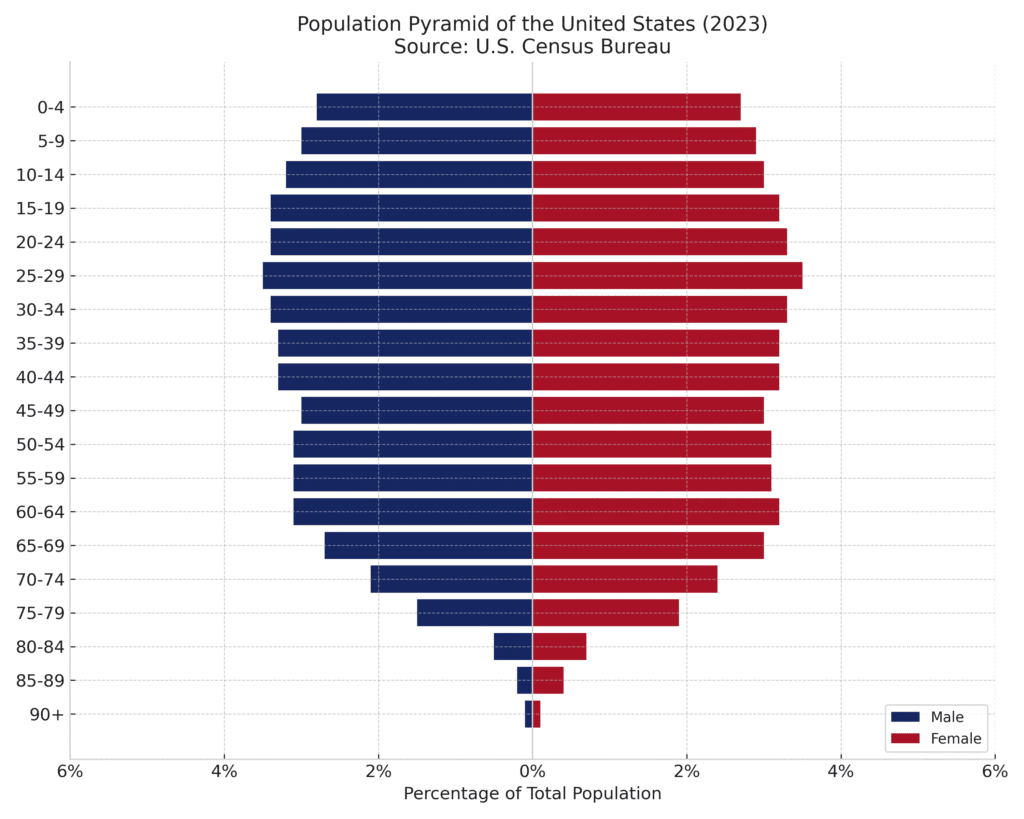
However, the economics of the original program are starting to have some structural challenges that are not easily overcome. Originally, Social Security had 42 workers supporting each retiree. Today, that ratio is closer to 2.7 and falling, a demographic shift that has made the system increasingly unstable [1], especially as the Population pyramid shifts (See Figure 1).
The Math Problem: Pay-As-You-Go and Unfunded Liabilities
Unlike private retirement accounts that accumulate assets over time, Social Security operates as a transfer program. The payroll taxes paid today are not saved or invested for the contributor’s future—they are immediately redistributed to current beneficiaries, this is the Pay-as-you-Go system (often referred to as PAYGO or PAYG).
The key problem with this structure is demographic: as birth rates decline and life expectancy increases, fewer workers are supporting more retirees. This has produced a growing imbalance. According to the Social Security Trustees’ 2024 report, the program faces an unfunded liability of $22.6 trillion over the next 75 years [2].
Unless major changes occur—either through tax increases, benefit reductions, or structural reform—Social Security is projected to exhaust its trust fund by 2033. At that point, benefits would be automatically reduced by an estimated 23% across the board [3]. This would obviously have major, and negative consequences on many Americans that depend on these payments, and likely be seen as a betrayal on commitments made to them for a lifetime of work.
Demographics not on Social Securities Side
As Lifespans increase the U.S. population is getting older and retired citizens continue to increase as a percentage of the population intensifying Social Security’s funding crisis. As of 2024, individuals under 18 comprise about 21.5%, ages 18–44 about 36%, ages 45–64 about 24.6%, and those 65+ around 18% of the total population. [12]
That shrinking working-age cohort (15–64) relative to retirees creates a high dependency ratio. With fewer contributors supporting more beneficiaries, the strain on the system continues to rise. Since Social Security is a Pay as you Go system and not based on investments that have appreciated over time, if you have an imbalance of working age Payers versus older retired beneficiaries the system begins to fall apart economically without restructuring. This is a Worldwide phenomenon as life expectancies continue to increase and countries that have adopted a Pay as you Go system are exposed to demographic shifts that create challenging economics. In general, for these systems to work you must have a wider middle supporting a tapering, and smaller group in retirement.
Figure 1 Source: US Census
Investment Alternative?
So, economically, how does a Privatized system work versus our current Social Security System? To understand the opportunity cost of the current system, consider by comparison a median-income worker contributing the same amount to a private investment account instead of Social Security. The Social Security tax rate is currently 12.4%, split evenly between employee and employer. For a median income of $60,000 (in 2024), that’s $7,440 annually.
Assumptions:
Starting at age 22, retiring at 67
$60,000 annual wage, growing at 1.5% real wage growth
Contributions: 12.4% of wages invested in an S&P 500 index fund
Historical S&P 500 average real return: 7% [4]
Metric
Social Security
Private Investment
Total Contributions (nominal)
$500,000+
$500,000+
Monthly Retirement Income (estimated)
$1,800–$2,000
$6,000–$8,000
Total Lifetime Benefit
~$500,000–$600,000
~$1.5M–$2.5M+
Table 1 Source: Tax Project Estimate Example
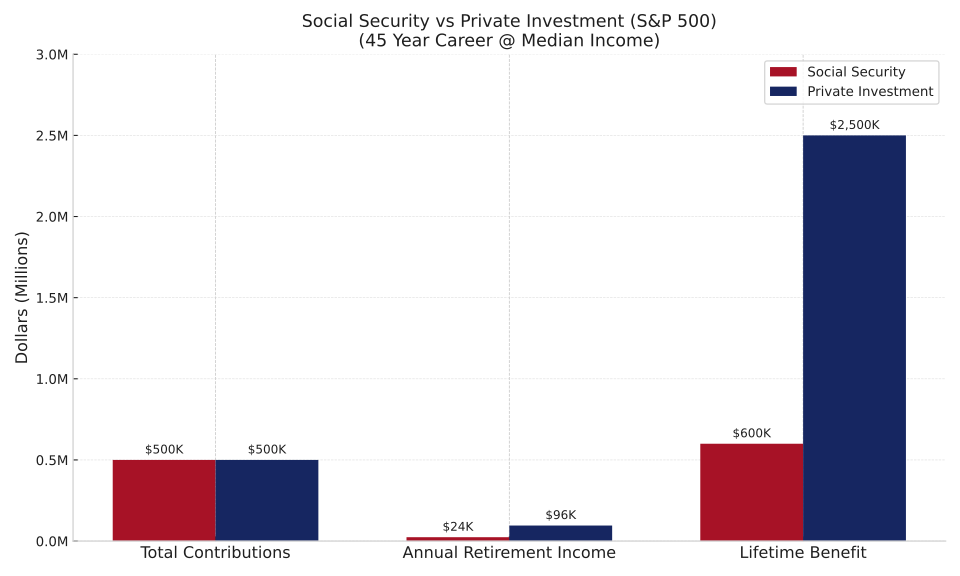
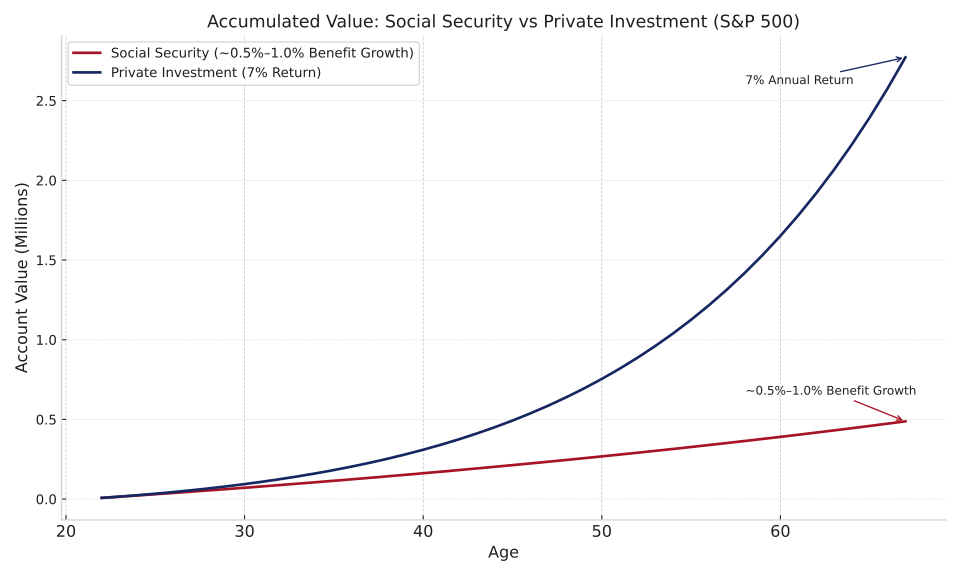
It should be noted, that this is a simple example is using mid range income citizens, and does not model the upper and lower incomes which can have significantly different outcomes. It should also be noted that the Private account is exposed to much higher market risks, than a Government backed account, and there are no guarantees of Market performance, or loss of principle. However, as a base example it is clear that the Private solution substantially outperforms the Social Security program, providing up to 4 times the income (See Figure 2, 3). This obviously could be life changing for many individuals, from barely managing to get by to living a more comfortable life in their retirement.
Comparing Private Investment vs Social Security
Figure 2 Source: Tax Project Example EstimateFigure 3 Source: Tax Project Example Estimate
The compound returns of a private investment account (indexed to the S&P 500) dramatically outpaces the flat benefit structure of Social Security. Even adjusted for inflation and risk, the delta is significant.
This was only an example, your exact numbers will differ based on your income and contributions. If you wish to calculate on your own you may try these resources:
This delta in outcomes, as shown in Figures 2 and 3, exists for a reason. Social Security was not designed as an investment vehicle – it’s a redistributive social insurance scheme. High-income earners subsidize lower-income earners. Healthy workers subsidize disabled ones. Individuals with longer life expectancies (often wealthier, healthier demographics) benefit more than those who die earlier.
This redistribution is intentional. Roughly 20% of Social Security benefits go to survivors and disabled individuals. The rest is retirement support—but even this is progressive: a low-wage worker receives a higher replacement rate (often 90% of their income) than a higher-wage worker (25–40%) [5]. Social Security is not a retirement plan per se, but a tax to create a Social Safety net to distribute money to those in greater need.
Global Comparison of Retirement Benefit Plans
America is not alone in providing Retirement Benefit plans, here is a comparison of the Top 25 OECD countries by GDP Retirement Benefit programs.
Country
Model (Gov’t System)
Mandated Supplemental
Funding Method
Solvency Issues
Return Rate
United States
Public
None (voluntary 401(k) excluded)
PAYG
High
Low
Japan
Public
National Pension + GPIF reserve
PAYG + Asset-Backed
Medium
Medium
Germany
Public
Statutory + Emerging Asset Fund
PAYG + Partial Reserves
Medium
Low
United Kingdom
Public
Auto-Enrolled Private Pensions
PAYG + Mandatory DC
Low
Medium
France
Public
Mandatory Supplementary
PAYG
Medium
Low
Canada
Public
CPP (Asset-Backed, Mandatory)
Asset-Backed
Low
Medium
Italy
Public
None (Voluntary Private Optional)
PAYG
High
Low
South Korea
Public
Basic Pension
PAYG
High
Low
Spain
Public
None (Voluntary Only)
PAYG
High
Low
Australia
Hybrid
Superannuation (Mandatory DC)
Asset-Backed
Low
High
Netherlands
Hybrid
Mandatory Occupational DC
Asset-Backed
Low
High
Mexico
Public
Mandatory AFORE (DC)
Asset-Backed
Medium
Medium
Switzerland
Hybrid
Mandatory Pillar 2 DC
Asset-Backed
Low
Medium
Sweden
Hybrid
Mandatory Premium Pension DC
PAYG + Asset-Backed
Low
High
Poland
Public
Employer PPK (Mandatory Opt-Out)
PAYG + Partial DC
Medium
Low
Belgium
Public
None (Voluntary Private Optional)
PAYG
Medium
Low
Austria
Public
None (Voluntary Private Optional)
PAYG
Medium
Low
Norway
Public
Oil Fund Reserves (Public Use)
PAYG + Sovereign Fund
Low
High
Ireland
Public
None (Auto-enrollment pending)
PAYG
Medium
Low
Denmark
Hybrid
ATP + Occupational Mandatory DC
Asset-Backed
Low
High
Finland
Hybrid
Mandatory Public + Reserve
PAYG + Asset-Backed
Low
Medium
Portugal
Public
None
PAYG
High
Low
Czech Republic
Public
None (Voluntary Private)
PAYG
Medium
Low
Greece
Public
None
PAYG
High
Low
Hungary
Public
None
PAYG
High
Low
Table 2 Source: IMF, Worldbank, SSA, OECD, Mercer CFA Institute
Note that all the Top OECD countries, unlike countries like Chile which are fully privatized, have some sort of either a Public or Hybrid (Public/Private) Retirement Benefit plan. The countries with LOW solvency risk all have some type of Asset Backed solution where investments are made that grow over time, except for Norway which essentially has the same with their National Sovereign Wealth Fund, the largest in the World, contributing instead of individuals. It should also be noted, some what paradoxically, that ALL of the countries that pay High rates of return to their Beneficiaries (highlighted in green on Table 2) ALSO all have LOW Solvency issues, the best of both worlds. Lower financial risks, higher returns using some type of Asset Backed system. In contrast, note the many countries with Public plans with PAYG models that have high HIGH solvency risks, and LOW payouts. The worst of all worlds, and unfortunately that is where America stands today.
Budgetary Impact: Growing Expense, No Asset
From a Federal budget perspective, Social Security is the single largest budget item with $1.4 trillion in outlays in FY 2024, accounting for roughly 20% of total federal spending [8].
Critically, Social Security is not a government asset. It does not generate returns or grow the nation’s wealth—it is a liability that increases over time, as benefit obligations rise with demographics. Unlike a sovereign wealth fund or private asset backed investments, Social Security has no capital base, it is not invested and does not grow in value. It is an ever-growing expense that is a liability for our Government, not a revenue-generating investment.
This funding gap, creates a solvency issue for the fund, and projections already anticipate reduced payouts by 2033 [3]. This will require either new sources of revenue (taxes), reduced payouts, or higher eligibility requirements (higher retirement ages). For many people these are unacceptable outcomes.
Privatization: Arguments Against
Social Security has become a critical component of American lives, and the thought of change is scary. It is meant as a Social Safety Net and anything that minimizes that security, and increases risk is viewed rightly with concern. Critics of privatizing Social Security raise concerns of risk, fairness, and protecting the most vulnerable.
1. Loss of the Redistributive Function
Social Security is not just a retirement program—it’s a progressive, redistributive system that transfers income across generations and income levels.
From higher earners to lower earners (due to progressive benefit formulas)
From healthy individuals to those with disabilities or survivors
Across gender and racial wealth gaps
Privatization, by design, makes benefits directly proportional to contributions and investment returns, which eliminates these transfers. This could weaken the social contract, especially for groups who rely most heavily on the system—such as lower-income workers, women, minorities, and the disabled.
2. Erosion of the Universal Safety Net
The current system provides guaranteed income, indexed to inflation, for life. This protects against:
Longevity risk (outliving one’s assets)
Market risk (mismanagement of assets or retiring into a downturn)
Cognitive decline (mismanaging funds in old age)
Disability (declining or limited physical abilities shorten working career)
Wealth Gap (offset lower income participants with relatively higher benefits than higher income groups)
Security (Income for the life of the beneficiary guaranteed)
Spousal (Income for dependent widowed spouses)
Depending on the implementation, Private accounts would shift this burden to individuals, many of whom may lack financial literacy or stability to manage these risks. Even with lifecycle funds and default allocations, the system would no longer guarantee baseline income, exposing millions to potential poverty in old age.
3. Market Volatility and Distributional Inequality
While long-run market returns are historically strong, retirement outcomes under private accounts would vary significantly based on:
Career timing (Market returns vary considerably based on time period e.g., retiring in 2009 vs. 2021)
Investment choices and fees (Loss of principle, poor investment decisions can greatly effect outcomes)
Economic cycles and policy shocks (Macro economic cycles and events like Covid or Wars can greatly impact returns)
Markets are inherently riskier, and Privatization would transfer this risk from the government to the participant. This also introduces intra-generational disparities – two workers with identical careers and investments could end up with vastly different outcomes. Such disparities undermine the risk-pooling foundation of Social Security.
4. Administrative Complexity and Cost
Privatized systems, especially those with choice, may entail higher a variety of extra costs that would be born by the participant.
While centralized custodial platforms managed by the Government can mitigate this, this can all add costs. Currently, the U.S. lacks the institutional infrastructure to support this function.
Privatization: Arguments For
Proponents of private investment accounts argue that the objections to privatization, while valid, are either addressable through design or outweighed by the substantial gains in individual and National financial outcomes. That privatization can increase the material wealth of the country, and put the Nation on a better fiscal course, and that it matches our countries philosophical principles of liberty and ownership.
1. Higher Long-Term Returns and Quality of Life
S&P 500 index funds have returned 6–7% real annually historically, far outpacing the 0–2% implicit return Social Security provides many younger or higher-income workers.
This delta compounds over decades. A median-income worker could retire with 3x or better lifetime income under private investment—even after inflation dramatically improving the quality of life for some populations.
These higher balances could allow for:
Earlier retirement (retirement is about wealth, not age)
Higher consumption in retirement (being able to afford more of the things that add to a quality life)
Improved generational quality of life (being able to pass wealth between generations instead of take it)
2. Intergenerational Wealth Transfer and Ownership
Social Security benefits terminate at death. There is no residual asset to pass on.
Private accounts create inheritable wealth—allowing families, particularly in lower-wealth communities, to build intergenerational assets and break the cycle of dependency.
3. Promotes Individual Liberty and Economic Agency
Privatization returns control to individuals, allowing them to decide how their retirement assets are invested.
This aligns with broader American values of personal choice, property rights, and economic freedom.
4. Transforms a Fiscal Liability into a National Asset
Social Security is currently a growing budgetary liability, with unfunded liabilities exceeding $22 trillion [21].
Private accounts would instead become national household assets, increasing capital formation, savings rates, and investment capacity -similar to the effect of Australia’s superannuation system, which now manages over $2.5 trillion in assets [22].
5. Mitigated Market Risk with Sound Design
Critics overstate market risk in multi-decade investment horizons. Over any 40-year period in U.S. history, a diversified equity portfolio has never yielded a negative real return and has significantly outperformed Social Security funding.
Risks can be reduced or neutralized via:
Lifecycle/default funds
Mandatory annuitization
Capital buffers
Minimum return guarantees (e.g., 2% real floor)
Subsidization of at-risk groups via general revenues or redistribution of Capital Gains from Privatization
6. Fixes System Insolvency Without Raising Taxes
Privatization bypasses the demographic death spiral of the current pay-as-you-go model.
Instead of higher payroll taxes or benefit cuts, reformers propose transitioning to funded accounts over time, optionally grandfathering current retirees.
Reform shifts the structure from intergenerational transfer to self-funded savings, improving long-term solvency and fairness.
7. Localized Equity Support Through Public Custody Models
Inspired by Sweden’s PPM system, custodial platforms can be public, ensuring fee transparency, fraud protection, and mandated passive allocations.
In the U.S., excess capital gains or fund growth could be redirected toward targeted supports (e.g., low-income workers, disabled populations, disaster relief) without sacrificing long-term solvency.
Comparing Private Investments versus Social Security
Item
Social Security
Private Account
Risk
Guaranteed by Full Faith of US Government and the unlimited ability to Tax.
Exposed to Market, can gain and lose principle, much more volatile.
Guarantees
Fully Guaranteed, but dependent on Government Formula which can change.
No guarantees, based on Market returns. Can lose principle.
Performance
Not invested, based on Social Security formula to contribute. Very Low effective equivalent return.
Equity Market based returns outpace other investments. Much higher historical returns for long term investments.
Equity
You own nothing, at death you can not transfer assets.
Assets are owned by individual, can be transferred to beneficiaries.
Asset or Liability
Liability – Social Security is an expense that each year must be paid from current Taxes to Beneficiaries.
Asset – The Government would have no liability, and the value would become an Asset to the Beneficiary.
Unfunded Liability
As a Liability, shortfalls in revenues versus future payouts become unfunded liabilities
No Liabilities
Generational Wealth
Not an asset, so wealth can not be passed on.
Assets can be passed on, increasing Generational Wealth.
Social Safety Net
Provides Lower Income, and Disabled Citizens a Social Safety Net to provide some income, and potentially higher than their contributions.
Does not natively provide Social Safety Net. May help some at risk with higher incomes, but does not address Low Income or Disability. Programs could be setup to address.
Administration and Regulation
Centrally administered by Government, highly Regulated by Congress
To be determined, but likely a combination of Government regulation and administration in conjunction with Private Enterprises to administer program and set guidelines on acceptable plans to reduce risks.
Fraud & Abuse
Overall low, but significant amounts. From 2015-2022 improper payments of $72 billion. [13]
To be determined, but investment fraud, and abuse happen in our current financial system and this will be no different.
Retirement Age
As a Pay As You Go system, Social Security requires more workers to pay for beneficiaries, putting pressure to keep Retirement ages high especially as the retirees makeup larger portions of population.
Likely a Privatized system would have requirements. However, retirement is NOT about age, it is a about wealth. If you have achieved your asset growth, you could retire early, potentially much earlier than Social Security mandated dates.
Fixed Income
Social Security Provides a Fixed Income guarantee for the lifetime of the beneficiary. This means it can’t go down, but also that it doesn’t go up (there are periodic Cost of Living adjustments, but for the most part it is static).
Private accounts do not have Fixed Income guarantees. If you live longer, or have lost principle you are at higher risk. However, you can also have your principle and assets continue to grow, and have much higher assets and income to draw from.
Did the Trump Administration let the Cat out of the Bag?
While not a formal policy announcement from the Trump Administration, in remarks this past week, current US Treasury Secretary Scott Bessent discussed the idea of private retirement accounts as a solution to long-term fiscal imbalances.
“We’ve allowed Social Security to drift too far from its roots. The average American would be far better off with a real investment account – especially if they own it, can pass it on, and see it grow.” [10]
Treasury Secretary Bessent, a former Chief Investment Officer of Soros Fund Management, noted:
“Social Security could be partially privatized by giving younger workers the option to invest a portion of their payroll tax into low-cost index funds. Over 40 years, the compounding returns would generate far more wealth than the current system, which is essentially insolvent.” [6]
Bessent views private accounts not only as more financially sustainable but also as a path toward wealth-building for younger and disadvantaged Americans who are currently locked into our current Social Security System that is a low-yield, Pay-as-you-go system.
“In a way, it is a back door for privatizing Social Security,” “If, all of a sudden, these accounts grow and you have in the hundreds of thousands of dollars for your retirement, that’s a game changer, too.” [11]
While this topic has been passed around in policy discussions for a long time, privatization has always brought out fears, and opposition.
Conclusion: The Cat May Already Be Out of the Bag
Social Security reform is no longer an ideological debate—it is an actuarial necessity to keep the system solvent. The system’s financial path is unsustainable, and young Americans increasingly question whether they are paying into a program that will exist when they retire.
The Tax Project does not weigh into the debate, just presents facts and data, and hopes that Smarter more informed Citizens help make their choices. To some, the choice maybe obvious, for others the fear and risks of changes outweigh any gains. All have valid concerns and points. What is clear, is that the US Social Security program has structural challenges that won’t be resolved without some types of reform, and that delaying or ignoring the problem has not helped the challenge. There are working models out there, and we believe that Americans when presented with facts and data will always make the best choices. We will always bet on America’s Future.
The topic of Capital Gains can be contentious, with many calling for various schemes to tax the wealthy including unrealized capital gains. However, a long discussed debate in economic, legal, and political circles is whether or not Capital Gains amounts to DOUBLE taxation. The argument that it amounts to double taxation is that the income when it is earned is taxed, and then taxed again when the proceeds from that income appreciate through investment and are sold. Essentially taxing the same income twice – once when it was earned through labor, and again from the appreciation from the asset purchased with the labor. Others defend it as a legitimate method of taxing new income derived from capital, which should be treated similarly to income from labor.
In this debate there is no right or wrong way, just different approaches for collecting Government tax revenue. This article analyzes the question of if Capital Gains is Double taxation, examines the structure, arguments, and implications of capital gains taxation. It unpacks both sides of the double taxation debate, analyzing the effects of inflation and asset illiquidity, explores international comparisons, and capital gains’ composition in Federal revenue.
II. What Are Capital Gains?
Capital gains are the profits earned from the sale of an asset—such as stocks, bonds, real estate, or a business—when the sale price exceeds the original purchase price. Those gains are then categorized by the amount of time they are held before sale to determine their tax treatment as follows:
Short-term (held <1 year): these are taxed at ordinary income rates (10%–37%).
Long-term (held ≥1 year): these are taxed at preferential rates (0%, 15%, or 20%) depending on the taxpayer’s income level.
Additionally, a 3.8% net investment income tax (NIIT) may apply for high earners, pushing the top effective rate to 23.8% federally [1]. Unlike labor income, capital gains are taxed only when realized (i.e., the asset is sold).
III. The Case That Capital Gains Taxation Is Double Taxation
A. Taxed Once on Earned Income
The money used to invest typically originates from wages, salary, or business income—already subject to income tax. For example, a worker earns $100,000, pays $25,000 in taxes, and invests a portion of the remaining amount. If that investment later grows, the appreciation is taxed again.
Critics argue this represents sequential taxation on the same income stream: first on the principal earned from income, then on its growth when an asset is sold, all of which is derived from the same initial income.
B. Taxed Again on Gains and Inflation
Capital gains taxes apply to nominal gains, not real (inflation-adjusted) gains. Meaning, unlike with labor where you get paid in regular near term increments, like weekly or bi weekly, gains can happen over much longer periods in years and sometimes decades where you do not have the same access to the capital as you would with normal income and it is exposed to inflationary effects over that time period. So, if someone gave you $10 in 1950, and $10 in 2025, which would be worth more? Inflation adjusted the $10 bill in 1950 would be worth over $130 dollars adjusted for inflation today. So, critics argue that not only are you taxed on the original income again, you are also taxed on the inflation.
Example: A property purchased in 1990 for $200,000 and sold in 2025 for $600,000 shows a $400,000 gain. However, if cumulative inflation was 140% over that period, the real gain is much lower ($400,000 gross gain – inflation $280,000 = $120,000 post inflation gain). However, tax is still levied on the full $400,000.
This results in effective tax rates on real gains far above the statutory capital gains rate. Meaning that adjusted for inflation, the tax rate is much higher than the 15 or 20% normally associated with long term Capital gains. In the example we looked at the capital gains of $400,000 at 20% capital gains rate would result in a tax liability of $80,000. If you applied it to the post inflation gain of $120,000 and used the tax liability of $80,000 that would be an effective tax rate of over 66%, well above the 20% Capital Gains rate.
C. Accessibility and Deferral
While labor income is paid regularly and can be spent immediately, capital gains are often effectively “locked in” for certain holding periods allowing investments to appreciate. While labor is of course exposed to the same effects, the duration is much shorter and the long term effects are not as noticeable.
Investors must keep their assets invested for appreciation.
Investors must sell assets to realize gains.
Selling may trigger tax and reduce the reinvestment base.
Long holding periods increase exposure to inflation and market risk, further eroding value.
IV. The Case That Capital Gains Taxation Is Not Double Taxation
A. All Income is Taxed
Supporters argue that the Capital Gains tax is not levied on the same income twice. Rather, the tax is applied to a new income stream – the appreciation of the asset in value. Classically, most income comes from Land, Labor, or Capital and Capital gains, like wages or interest, is a form of income that should be taxed.
From this perspective, only unrealized gains (conceptual gains in asset value, but not sold so the value is not realized or accessible) would be untaxed income. Once realized, they should face taxation like any other source of income.
B. Preferential Rates Offset Burden
To account for potential double taxation concerns, the U.S. tax code provides preferential tax rates for long-term gains. While ordinary income may face a top marginal tax rate (currently up to 37%), long-term capital gains face a top rate of 20% (plus 3.8% NIIT for high earners).
This rate differential is meant to:
Compensate for inflation and risk.
Encourage long-term investment.
Offset any perceived over-taxation due to prior taxation of investment income principal.
C. Deferred Taxation
Investors have the benefit of controlling the timing of their tax liability by when they choose to sell their assets. Unlike wages, which are taxed immediately and subject to other taxes, like Social Security and Disability insurance, capital gains taxation is deferred until the investor chooses to realize the gain. This allows:
Compounding growth without taxation drag.
Strategic tax planning.
Lower present value of future tax liability.
Some call this deferral a built-in subsidy that benefits investors and offsets claims of double taxation.
D. Addressing Income Inequality
While this item does not refute that Capital Gains is Double taxation, it speak to the concept of Fairness and balance. Capital gains are heavily concentrated among the wealthy. In 2021, the Top 1% of taxpayers earned 74% of all long-term capital gains in the U.S. [2]. If gains were exempt from taxation, a significant share of income would go untaxed. While a very small percentage, some Ultra High Net worth individuals may have enough Capital that their Asset appreciation may produce more than their lifestyle income requirements. For this group of individuals they can derive a majority, if not all, of their income through Capital appreciation vs labor. By taxing Capital gains you can offset this.
V. The Structural Problems in Capital Gains Taxation
Even if not technically double taxation, the structure of capital gains taxation introduces distortions and inefficiencies. The value of money, due to inflation, lowers over time. This makes the incentive to save and invest lower, if the economic rewards are not there for the risks of the lowering value of assets due to inflation.
A. Inflation Distortion
As noted, Capital gains are taxed on nominal (non inflation adjusted), not real (inflation adjusted), appreciation in asset value.
Sample: Effect of 3% Annual Inflation over 30 Years (~140%)
Nominal Gain (non adjusted)
Real Gain (inflation adjusted)
Tax Liability @ 20%
Effective Tax on Real Gain
$200,000
~$80,000
$40,000
50%
$300,000
~$125,000
$60,000
48%
Inflation increases the risk of investing by lowering the return in real value of a long-term holder’s gain. In essence lowering the purchasing power of their initial investment leading to disproportionately higher taxation on the real gains.
B. Lock-In Effect
Since tax is triggered by realization of the sale of appreciated assets, investors often delay selling assets to avoid tax, even if reallocation would be economically optimal. This “lock-in effect”:
Reduces liquidity.
Discourages portfolio rebalancing.
Distorts capital markets.
C. Wealth Leverage Arbitrage
Wealthy individuals increasingly use asset-backed loans to access liquidity without triggering taxable events. High net worth individuals can essentially deploy a Buy, Borrow, Die strategy to:
Borrowing against appreciated stocks or property.
Using proceeds for consumption/living expenses or investment.
Die without selling their assets and never realizing a taxable event.
This strategy—unavailable to many lower-wealth individuals—creates tax arbitrage. See our article on Buy Borrow Die for more details on this strategy and how it works.
VI. International Comparisons and Policy Alternatives
Several developed nations take different approaches to capital gains taxation, from none to the majority of it being taxed at ordinary income rates. It is important to note, that the the tax compositions of every country are different, and that a lower or higher capital gains rate does not necessarily equate to a higher overall effective tax rate.
Country
Treatment of Capital Gains
Belgium
Exempt for individuals (unless professional trader)
Switzerland
Often exempt for individuals; taxed if “professional”
UK
Taxed at 10% or 20% for individuals, some inflation relief
Canada
50% of capital gains included in taxable income
Germany
Taxed, but long-held property gains may be exempt
Several proposals in the U.S. to update the Capital Gains Tax have included:
Indexing capital gains for inflation: adjusting basis to reflect real purchasing power.
What it means: That the inflation adjusted amount would be removed and only the non inflation gain amount would be taxed, lowering the overall tax liability. This could encourage more people to invest.
Step-up basis reform: eliminating the reset of asset value at death.
What it means: When a person dies the benefactor receives the assets at the current valuation price. So for example if an asset has appreciated from $100,000 to $200,000 there would be an unrealized gain of $100,000. However, if the benefactor receives the asset and the current valuation is $200,000, they would have no taxable appreciation ($200,000 stepped up basis – $200,000 current valuation). This tax treatment significantly benefits the benefactor, and the tax efficiency of the estate.
What it means: Providing special exemptions so that smaller and lower income populations can invest, participate and benefit from the power of market based appreciation. Presumably with the intent to increase the wealth potential of market appreciation to larger portions of the population.
VII. Comparison
Item
Capital Gain
Income
Tax Treatment
Taxed on original Income, and Capital appreciation
Only taxed on Income.
Market Risk
Assets exposed to volatility and loss of principle based on investment
No Market Risks
Inflation Risk
Assets exposed to inflation over the period held.
No (limited) Inflation Risks
Deferral Benefit
Can choose when to realize gain.
Income taxed immediately
Preferred Tax Rates
Long Term Capital Gains taxed at 15% or 20%
Taxed at ordinary income rates up to 37%
Estate Benefit
Estate can pass to benefactor with stepped up basis.
No Estate Benefit
Payroll Taxes
Payroll taxes on original income, no additional Taxes (except NIIT) on Capital Gains
Additional Social Security, and Disability Insurance taxes taken out of Income
Access to Capital
Depends on asset, but generally no access to Capital during appreciation period. (Not assuming asset based loans)
Immediate access to Capital from Income
Accessibility
Vast majority of Capital Gains are buy high worth individuals
Not a significant portion of lower income earners
VIII. Capital Gains and Federal Revenue
Despite being taxed at lower rates and only upon realization, capital gains constituted a relatively small percentage of Federal Revenue, but a significant amount overall of Federal revenue:
In FY 2022, capital gains taxes generated approximately $250 billion in Federal revenue—around 8% of total federal individual income tax receipts [3].
The amount of revenue collected from Capital Gains is volatile. During economic booms, capital gains revenue can surge (e.g., $325B in FY2021); during recessions or economic turmoil it can plummet substantially (e.g., $89B in FY2009) [4]. Federal Tax revenues benefit substantially from Market appreciation.
IX. Conclusion: Double Taxation?
Whether capital gains taxation constitutes double taxation depends on how one defines the income base:
If the focus is on origin of funds (already-taxed income used to invest), then taxing gains may appear sequential (double).
If the focus is on new income stream created, then it is simply a form of taxing new income, no different than any other income.
The real issue may not be whether it’s “double taxed” but how fairly, efficiently, and equitably it is taxed—especially given the inflation effects, lock-in effects, and the concentration of gains among the wealthiest households. These are all decisions of Government, and Tax Payers (voters) how they wish to compose Government Revenue.
Capital gains taxation is not unique in its complexity or controversy. It is a structural component of US Federal Tax Revenue, and at times politically sensitive portion of U.S. tax code.
X. Capital Gains Tax Rates Over Time (U.S. Federal)
Historical Top Capital Gains Rates as shown in Figure 1. Short term Capital Gains have essentially followed Ordinary Income tax rates which have come down since the 1940’s, and Long Term Capital gains have been in the range of 15 to 28% since the 1980’s.
Carried Interest: The Investment Industry Loophole That Won’t Die
Carried interest or “carry” is one of the most enduring controversies in the U.S. tax code. It allows private equity, hedge fund, venture capital, and real estate fund managers to pay a significantly lower tax rate on a substantial portion of their income than typical wage earners, despite the fact that this income functions essentially as performance-based compensation. While reform proposals have circulated for decades, none have succeeded. Why does this provision persist? And how much additional revenue could it generate?
What Is Carried Interest?
Carried interest is the share of profits that investment fund managers receive from their funds’ returns, typically amounting to 20% of the fund’s net profits above a specified threshold. It is designed as a performance incentive and is paid in addition to a fixed management fee, usually around 2% of assets under management (AUM) [1]. Crucially, carried interest is not compensation for capital invested, but rather for services rendered —choosing investments, managing risk, and executing deals. Despite this, the income is often taxed at long-term capital gains rates.
The Historical Basis: Sweat Equity
The roots of carried interest lie in early 20th-century oil and gas partnerships. General partners received a share of the profits “carried interest” for contributing expertise and labor rather than capital. This treatment later spread to real estate and private equity, where it was viewed as a form of “sweat equity” [2]. The U.S. tax code under Subchapter K (1954) reinforced this idea: partners in a partnership are taxed according to the character of the income earned by the partnership. So, if the fund earns long-term capital gains, the General Partner’s (GPs) carried interest is also taxed as capital gains [3].
While it makes sense for a passive investor to receive capital gains treatment, applying the same to GPs who contributed no capital but are actively compensated for performance is where the controversy begins.
Investment Funds: Business Model and Revenue Structure
Funds like hedge funds, private equity, and venture capital operate as pooled investment vehicles. Their compensation structure is typically known as “2 and 20”:
2% management fee on Assets Under Management (AUM, paid annually)
20% performance fee on profits earned beyond a hurdle rate [4]
The management fee provides stable income, while carried interest represents the bulk of the long-term upside. Here’s a breakdown of estimated annual carried interest income by sector in the U.S. (2024):
Sector
U.S. AUM
Estimated Carry
Hedge Funds
~$5.5T
~$30B [5]
Private Equity
~$4.5T
~$47B [6]
Venture Capital
~$1.0T
~$12B [6]
Real Estate Funds
~$1.2T
~$6B [7]
Infrastructure/Credit
~$0.8T
~$3B [7]
Total (U.S. carry)
~$98B/year
Table 1 Source: LCH Investments, McKinsey, AICPA
This $98 billion represents income largely taxed at capital gains rates, despite functioning as labor-based compensation.
Figure 1 Source: (See Table 1)
Capital Gains vs. Ordinary Income vs. Carried Interest
From an economic perspective, carried interest behaves like ordinary labor income: it’s earned by providing a service (investment management), not by risking capital. Yet, under current law, it receives the same tax treatment as capital gains.
Income Type
Definition
Risk Exposure
Top Federal Tax Rate
Ordinary Income
Wages, salaries, bonuses
None (guaranteed)
37%
Capital Gains
Return on investment of one’s own capital
High
20% (+3.8% NIIT)
Carried Interest
Share of gains from managing others’ capital
Low to none
20% (+3.8% NIIT)
Table 2
In practice, carried interest is taxed at a flat 20% (plus 3.8% NIIT for high earners – the Net Investment Income Tax, see NIIT definition), the same as long-term capital gains, so long as the underlying investment is held >3 years (a provision added by the 2017 Tax Cuts and Jobs Act) [8]. Unlike genuine capital gains, which are typically generated from capital that was originally earned as income and thus already taxed once, carried interest often represents compensation for services and receives favorable capital gains treatment without prior income taxation. This has led critics to argue that capital gains may be doubly taxed, while carry is taxed just once—and at the preferential rate.
Capital Gains Tax Bracket vs. Carry
Here is a breakdown of capital gains tax brackets for 2024:
Filing Status
0% Rate (Up to)
15% Rate
20% Rate (Over)
Single
$47,025
$47,026 – $518,900
$518,900
Married Filing Jointly
$94,050
$94,051 – $583,750
$583,750
Head of Household
$63,000
$63,001 – $551,350
$551,350
Table 3 Source: IRS
Since fund managers receiving carry usually earn far above these thresholds, virtually all carried interest is taxed at the top capital gains rate of 20%, plus the 3.8% NIIT surtax.
Legal Challenges and Political Inertia
Although tax authorities have long been aware of the mismatch, the IRS has not reclassified carry as ordinary income, likely because of how entrenched it is in partnership tax law (Subchapter K). Carried interest has also withstood numerous legislative challenges:
2007-2008: Bipartisan proposals led by Rep. Sander Levin (H.R. 2834, 110th Cong.) and Sen. Chuck Grassley aimed to reclassify carried interest as ordinary income, but did not advance into law. Levin’s proposal passed the House as part of H.R. 3996 in November 2007 and again in 2008 as part of H.R. 6275, but both efforts stalled in the Senate [12]
Obama-era budgets called for reform repeatedly [9]
Trump’s TCJA (2017) only tightened the holding period requirement to 3 years
Biden and Sen. Ron Wyden have proposed closing the loophole, but efforts remain stalled due to intense lobbying by financial firms [10]
How Much Revenue Is At Stake?
Including all asset classes, the U.S. investment management sector extracts an estimated $98 billion/year in carried interest. With a 17% tax delta between capital gains and ordinary income rates (37% – 20%), the maximum additional federal revenue from reclassifying carry would be around $16.7 billion/year [11]. Actual revenues are likely to be less than estimate.
Scenario
Tax Rate
Tax Paid (on $98B)
Current (capital gains)
20% + 3.8% NIIT
~$23.3B
If taxed as ordinary income
37%
~$36.3B
Delta
~17%
~$13–17B/year
Table 4 Source: Tax Project Estimates on Table 1 Data
Given the $6.4 trillion federal budget in FY2024, this amounts to ~0.25% of total outlays. While $16 billion is a lot of money, given the energy and controversy behind it, it does little to improve the Federal Revenue. In terms of budget impact – we rate this more of a political talking point than a transformative reform.
Conclusion
The carried interest loophole remains due to a combination of legal precedence, institutional inertia, and powerful lobbying. While economically it has been widely criticized by both Republicans and Democrats, its closure would raise relatively modest revenue. It may also be seen as a question of fairness in that it is given preferential rate treatment versus ordinary income earners and is only available to a small highly compensated group. Nonetheless, for many reform advocates, it remains a glaring example of tax code inequity: a compensation scheme masquerading as investment income, allowing some of the wealthiest Americans to pay lower tax rates than ordinary income earners.
Citations
[1] Preqin Alternative Assets Report (2023) [2] Fleischer, Victor. “Two and Twenty: Taxing Partnership Profits in Private Equity Funds.” NYU Law Review, 2008. [3] Internal Revenue Code, Subchapter K, §702(b); Rev. Proc. 93-27 [4] Hedge Fund Research (HFR) Industry Report, 2024 [5] LCH Investments Hedge Fund Report, Jan 2024 [6] McKinsey Global Private Markets Review, 2024; Bain Global PE Report, 2024 [7] AICPA Private Capital Markets Update, 2024 [8] Tax Cuts and Jobs Act, Pub. L. 115–97, Sec. 1061 [9] Congressional Budget Office: Budget Options Report (2016) [10] U.S. Senate Finance Committee, “Ending the Carried Interest Loophole Act,” 2022 [11] Tax Project estimate using $98B x (37% – 20%) [12] The Venture Alley: “Carried Interest Tax Legislation Won’t Go Away,” Jan 2012, https://www.theventurealley.com/2012/01/carried-interest-tax-legislation-wont-go-away/
Tax Project Institute is a fiscally sponsored project of MarinLink, a California non-profit corporation exempt from federal tax under section 501(c)(3) of the Internal Revenue Service #20-0879422.