As you grow older, you become more self assured, knowledgeable and more independent – able to make many decisions on your own. At some point in your teenage years, you may come to believe in your infallibility, and how correct you are in all things. As you get older, life has a way of teaching you new lessons, and if we were smart and true to ourselves there were probably lessons that our parents tried to teach us many years before and we were too smart at the time to listen. When you become a parent, you come to realize many more of those lessons after the fact. One big lesson for parents is that you can’t make decisions for your children all of the time, for one they won’t always listen, and two – they need to learn on their own. You try to protect them from the things that will really hurt them or having lasting effects, but sometimes a little blood and skinned knees can be way more instructive than any parental chat.
“When I was a boy of fourteen, my father was so ignorant I could hardly stand to have the old man around. But when I got to be twenty-one, I was astonished at how much the old man had learned in seven years.”
Mark Twain
Wisdom of the Mom: What we can learn from mothers
One lesson we learned, and we didn’t even realize we were being taught, was the “You Slice, You Choose” game. The “game” was simple, usually there was something desirable like a Pie and your mother would designate one person to slice, and another person got to choose which slice to take. Simple, but devious – at first glance without a lot of thought a young lad may think if I get to slice, I can slice a bigger piece of the pie. A wiser, more experienced child will realize that any deviation by the slicer from the center was a gain for them as they would invariably choose the larger slice. Overtime, as everyone knew the game the slices became more and more even, and the “game” self enforced fairness without any policing or intervention from parental units. After a while, you could swear that each slice was done by a computer aided laser in the planning and precision of the pie slice so perfectly even down the middle. Many years later, you marvel at the wisdom of mothers and wonder what other ancient mysteries and riddles could these geniuses have solved if their life mission wasn’t wasted helping you slice pie.
Mom and the Budget
Every year now it seems like the Federal Budget is now in play as a game piece to be negotiated by both parties trying to gain advantage over each other. Even though everyone knows the dates and when the deadline is, it always seems to go right up to the end, and in this case over the deadline. Such is the case in the partisan environment we live in today. However, I’m struck that it’s really nothing more than a high stakes game of “You Slice, You Choose.” That may over simplify it by quite a bit, but the fundamentals are the same.
Pie Analogy
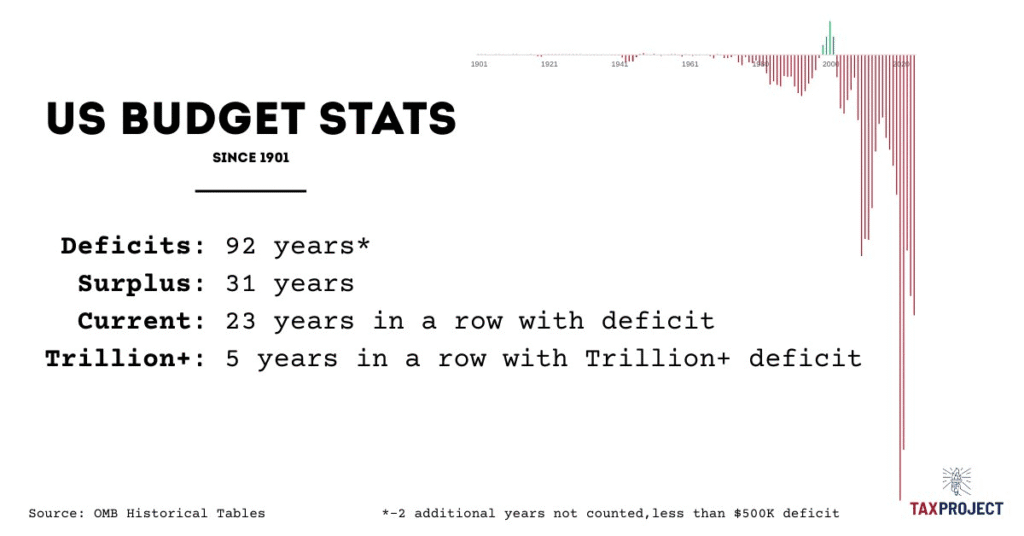
Our Federal Revenue is the ingredients for the pie. Our Federal budget is the size of the pie. Some years the pie will be larger than what you can eat, known as a budget surplus, and you can put some in the fridge for later. Other years you can borrow extra ingredients to have a bigger pie now at the expense of smaller pies in later years, known as a budget deficit. Much like pies in our household, there was never enough. Since 1901 we’ve had 92 years of budget deficits.
Figure 1
Our debt keeps growing, as well as the interest on the debt. Each year eating more and more pie.
Pie Dynamics
Before you even slice the pie, you realize several pie dynamics are at play. The amount of ingredients each year, the more ingredients the bigger the pie – so as Revenue grows, so does the size of the pie. The size of pie we make is dependent on the quantity of ingredients we have, and if we choose to leave some pie for later (surplus), or we decide to borrow ingredients from the future (deficits) with the potential consequence of having to reduce the size of future pies.
Pie Slicing
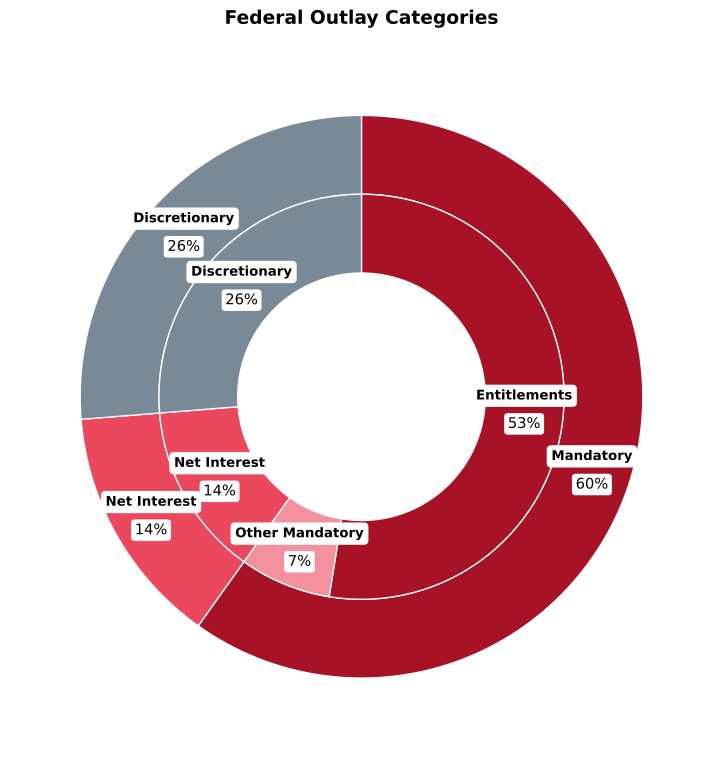
After you understand the pie dynamics, you can begin the process of slicing. However, before you slice you want to have any idea of how you want to divvy up the pie, and knowing with the Federal Budget almost 3/4’s (74%) of the pie is already gone before you slice it allocated to Mandatory and Net Interest components. The Net interest is all the extra pie we had in previous years. The more we add to the deficit, the larger it get. As it keeps growing, the smaller and smaller the pie available is in the future. Unless new laws are passed, the debate is in the quarter of the pie designated as Discretionary. However, even many of those don’t feel discretionary like National Defense – you could cut it back, but you probably aren’t going to eliminate it.
Figure 2
Pie – Choosing your Slice
So the only thing left is tough choices. Slicing can be a painful process, because when it comes time to choose – you realize that something you may have wanted more of shrunk, and something you wanted less of grew and you are stuck with that choice. Unlike in the family edition of the “You Slice, You Choose” game, both parties participate in the slicing and choosing. There is no self reinforcing fairness mechanism other than the active participation of engaged and informed citizens. This is the game Congress must play each year.
Pie in the Sky
Increasingly, people bring up MMT (Modern Monetary Theory). Using our pie analogy, according to MMT as long as inflation is in check, your pie can be as big as you want it to be. We wish these Economists were available to instruct our parents. Alas, in our household there was no magic infinitely growing pie, just tough choices. Until such time as an infinite pie becomes available, we’ll have to face touch choices as a country.
You Slice, You Choose
Summary
The Federal Budget is much more complicated, and the outcomes and consequences much more serious than a game of “You Slice, You Choose” but the lessons from Mom are none the less instructive. We all have to choose between tough choices, we all have to make reasonable assumptions and trade offs, and create mechanisms for fairness and balance that reinforce themselves automatically and fairly. In the game of life understanding Government Financial Literacy gives us the tools to understand the rules of the game, how to participate, and understand the dynamics, and trade offs that must be made in order for all of us to thrive. We learn many lessons in life, some of them stick with you. Thanks mom, I miss you every day.
Trump’s Proposed External Revenue Service: A Return to 1913
Former President Donald Trump has recently floated the idea of replacing the Internal Revenue Service (IRS) with an “External Revenue Service” that would eliminate income taxes and instead rely on tariffs and fees imposed on foreign governments. In essence, replace Income Taxes with fees on Foreign trade shifting the burden of taxes on foreign entities instead of inwardly on US citizens. While this proposal is still in its early stages, lacks concrete details, and may never come to fruition it has sparked discussions about potential benefits and drawbacks of such a dramatic shift in U.S. tax policy.
Historical Context
While many will hear about this proposal and think this is a major, if not radical change it’s important to note that Income taxes are a relatively recent development in U.S. history. The Federal Income tax as we know it today was only established in 1913 with the ratification of the 16th Amendment. Prior to this, the U.S. government primarily relied on tariffs and excise taxes for revenue.
Potential Benefits
Proponents of this proposed system argue that it could offer several advantages:
Simplification: Eliminating income taxes could greatly simplify the tax code, potentially reducing compliance costs for individuals and businesses.
Increased competitiveness: By shifting the tax burden to foreign entities, U.S. businesses might become more competitive in the global market.
Strategic leverage: Tariffs and fees on foreign governments could be used as tools in international negotiations and to address trade imbalances.
Encouraging domestic production: Higher costs on imported goods could incentivize domestic manufacturing and reduce reliance on foreign supply chains.
Domestic Job growth: Tariffs can create barriers protecting domestic industries and promoting job growth and potential repatriation of foreign jobs, companies, and manufacturing.
Strategic positioning: As the US has entered a new cold war with China as a near peer competitor, strategic tariffs could serve as an effective check limiting their Economic growth and ability to build military and economic power against the US.
Trade-offs and Challenges
However, this proposed system also presents significant challenges and potential drawbacks:
Revenue stability: Relying primarily on tariffs and foreign fees could make government revenue more volatile and dependent on international trade dynamics.
Consumer costs: Tariffs are ultimately paid by consumers through higher prices on imported goods. This could lead to increased living costs for many Americans.
International relations: Imposing significant tariffs and fees on foreign governments could strain diplomatic relationships and potentially lead to retaliatory measures.
Economic distortions: Tariffs can create market inefficiencies and lead to suboptimal resource allocation. It could potentially cause massive shifts in supply chains and have major ripples in economies throughout the world with a wide range of impacts, and potentially negative consequences for all participants.
Constitutionality: The legality of completely eliminating income taxes and replacing them with an external revenue system would likely face legal challenges.
Potentially Regressive: US Federal Income taxes are highly Progressive with 89% of taxes being paid by the Top 25% of tax payers. Shifting to tariffs for revenue maybe inflationary to goods. While it is likely the higher income individuals consume more, it may be that staples required by all consumers may disproportionately impact those most in need.
Feasibility: While this may sound good on paper, the IRS collects roughly $5 trillion in income tax revenue annually – it may not be economically feasible or possible to collect this from external entities
Tariffs as a Form of Taxation
It’s crucial to understand that tariffs are indeed a form of taxation. While they are imposed on foreign goods and not seen as a direct cost to the consumer, the cost is typically passed on to domestic consumers through higher costs. This means that under the proposed system, Americans would still be paying taxes, albeit indirectly through higher prices on imported goods.
Strategic Considerations
Despite the economic drawbacks, some argue that tariffs can serve strategic purposes beyond revenue generation. In particular, tariffs on goods from near-peer competitors like China could be used as leverage in geopolitical negotiations or to protect sensitive industries as well as check a rising global power who we are currently in a cold conflict with and may potentially be in a hot conflict in the future. However, this approach carries risks of escalating trade tensions and potential economic retaliation.
Conclusion
Trump’s proposed External Revenue Service represents a old, but radical departure from the current U.S. tax system. While it offers potential benefits in terms of simplification and strategic leverage, it also presents significant challenges and economic risks. As with any major policy shift, careful consideration of both short-term and long-term consequences is essential.
It’s important to emphasize that this proposal is still in its early stages and lacks specific details. The feasibility, implementation, and potential impacts of such a system would require extensive study and debate. Furthermore, any major overhaul of the U.S. tax system would likely face significant political and legal hurdles.
As discussions around this proposal continue, it will be crucial to consider not only the economic implications but also the broader impacts on international relations, domestic policy, and the overall well-being of American citizens. Ultimately, any changes to the tax system should aim to balance revenue needs, economic growth, fairness, and strategic interests in an increasingly complex global landscape.
Imagine running your household. You earn money (income), spend on essentials (expenses), and sometimes need to borrow for bigger purchases (debt) that exceed your income or savings. The national debt is similar, but on a much larger scale, affecting the entire country. While it is not the same as the US has some other unique features that allow it to potentially borrow more, it acts in the same way.
What is it?
The National Debt is simply the total amount of money the US government owes. It accumulates whenever the government spends more than it collects in taxes and other revenue. It is like using a credit card – convenient in the short term, but the bill comes due eventually and like a credit card the Government must pay interest on the debt in the form of Interest payments, often referred to as Debt service.
Who manages it?
Several key players manage the National Debt:
The Treasury Department1: They issue debt instruments like Treasury bills, notes, and bonds, borrowing money from investors to raise money “credit” for the Government.
The Federal Reserve: They play a role in managing interest rates, which affect the cost of borrowing for the government. They set a key borrowing rate known as the Fed Funds rate at which other banks’ rates are set against. As interest rates rise, so does the expense of service the debt, much like credit card companies raising the interest rates for your credit.
Congress: They authorize the government to spend and borrow money, responsible for managing the debt. Congress holds the purse strings on spending by authorizing spending bills and setting the Debt limit with authorized Debt ceilings.
Who does what?
Several independent agencies track the National Debt:
Government Accountability Office (GAO): They audit the government’s financial statements and report on the debt.
Congressional Budget Office (CBO): They provide economic forecasts and analyze the impact of debt on the budget.
Bureau of the Fiscal Service: They manage the day-to-day operations of the national debt.
Executive (President of the United States): The President sets the Fiscal Policy, Priorities, and Plan for the budget.
Office of Management and Budget (OMB): They help prepare the President’s budget, manage the Execution once Congress has approved the budget, and manage the oversight and performance management of the budget.
How does it grow or shrink?
Debt grows when the government spends more than it takes in. This can happen through various scenarios:
Fiscal Policy: When the President’s Fiscal Policy spends (intentionally or unintentionally) more than the taxes and revenue collected.
Tax cuts: When taxes are lowered and not offset by the Economic growth from the tax cuts.
Increased spending: More money on programs like entitlements including Social Security and Medicare or discretionary items like national defense, infrastructure programs add to the debt.
Economic downturns: When the economy shrinks, tax revenue falls, and the government chooses to borrow to stimulate it instead of reducing spending.
Exogenous events: Events like the 2008 Financial Crisis, Wars, or the COVID Pandemic can lead to debt spending to address.
The debt shrinks when the government collects more revenue than it spends or through strategic debt payments. Many of these are possible but often not used as they can be politically risky.
Government Spending Cuts: The Government can reduce spending by cutting or reducing programs.
Increased Taxes: The Government can increase taxes, although the long-term effects are mixed potentially reducing long-term growth which also impacts taxes collected.
Economic Growth: While not shrinking the debt, as the Economy grows more taxes are collected. If expenses remain the same, growth will reduce the ratio of expenses to revenue, effectively shrinking the budget.
Where does it fit in with spending and policy?
Fiscal policy is set by the President and refers to how the government manages its spending and taxes. It is a balancing act: providing essential services while keeping the debt under control. Like household credit it must be balanced with the benefits of immediate spending versus the challenges of paying items back later knowing that for every dollar you put on credit you will be reducing your available money to spend because a portion of your income will now go to credit card fees.
“If you choose not to decide, you still have made a choice”
Freewill performed by Rush
Historical context
The National Debt started during the Revolutionary War to finance the fight for US Independence. Since then, it has fluctuated based on several factors like wars, economic recessions, and government priorities.
How is it authorized?
Congress authorizes the government to borrow money by passing legislation, setting limits on the amount of debt allowed, known as the Debt Ceiling. From time to time this limit must be authorized to expand the Debt Ceiling to enable more debt to pay government bills.
The Future?
The National Debt is a complex issue with no easy solutions. Balancing competing priorities, managing interest payments, and ensuring long-term economic stability are key challenges. While there is no magic bullet, responsible fiscal policy, public understanding, and informed debate are crucial for navigating the complexities of the National Debt. The debt burden and interest on the National Debt are very real and left unmanaged can lead to negative consequences to the Economy and our Country.
The US Economy, measured by its Gross Domestic Product (GDP), represents the total value of all goods and services produced within a year. However, looming over this economic output is the ever-growing shadow of National Debt, raising concerns about sustainability and future generations. This article delves into the comparison between these two figures, explores how recent events impacted them, and examines the challenges posed by a large National Debt exceeding the size of the US Economy.
The National Debt of the United States has been steadily climbing, driven by several factors including fiscal policy, increased spending, and economic downturns. The COVID pandemic significantly accelerated this trend, adding over $7 trillion to the debt, while the roots run deeper. The Great Recession of 2008 also played a major role, pushing the debt-to-GDP ratio above 60% for the first time since World War II. As of Valentines Day 2024, the US National Debt stands at a staggering $34.3 trillion, that’s 34 x 10(12), exceeding 125% of the country’s GDP1.
Inflationary Dance with Debt
This high debt burden intersects with another economic concern: inflation. Increased spending and money supply expansion are often cited as contributing factors to inflation. In 2023, the US experienced inflation rates not seen in decades, exceeding 9% at one point2. While complex and multifaceted, the correlation between debt, money supply, and inflation cannot be ignored3. As Warren Buffett famously said, “Only when the tide goes out do you discover who’s been swimming naked.” Growth in money supply does not automatically mean inflation, but if it outpaces productivity, inflation often follows.
“Only when the tide goes out do you discover who’s been swimming naked.” 4
Warren Buffet
Sustainability Concerns and Interest Bite
Beyond inflation, a ballooning debt raises concerns about its long-term impact. Servicing the debt consumes an increasingly larger portion of the federal budget, diverting resources from crucial areas. The interest on our debt in 2023 reached $659 billion dollars4, to put that in perspective there are less than 40 countries in the World whose entire economy is greater than the interest alone we are paying on our debt5. As interest rates rise, often seen during periods when the Federal Reserve is combatting inflation, interest payments balloon exacerbating the challenge of pay down the debt. Additionally, a high debt can weaken investor confidence, potentially leading to higher borrowing costs and hampering economic growth6.7
“I have yet to see a time when it made sense to bet against America. And I doubt very much that any reader of this letter will have a different experience in the future.”
Warren Buffett
Balancing Act and Looking Ahead
Managing the national debt requires a delicate balancing act. Reducing spending can be politically unpopular, and raising taxes carries economic risks. Meanwhile, relying solely on economic growth for debt reduction is an uncertain strategy. Finding a sustainable path forward necessitates responsible fiscal policy (spending within our means) and bipartisan cooperation, both of which remain elusive in the current political climate.
However, as Warren Buffett has bullishly stated: “I have yet to see a time when it made sense to bet against America. And I doubt very much that any reader of this letter will have a different experience in the future.”
While expressing confidence in the long-term potential of the US economy, acknowledging the need for responsible debt management remains crucial.
Tax Project Institute is a fiscally sponsored project of MarinLink, a California non-profit corporation exempt from federal tax under section 501(c)(3) of the Internal Revenue Service #20-0879422.