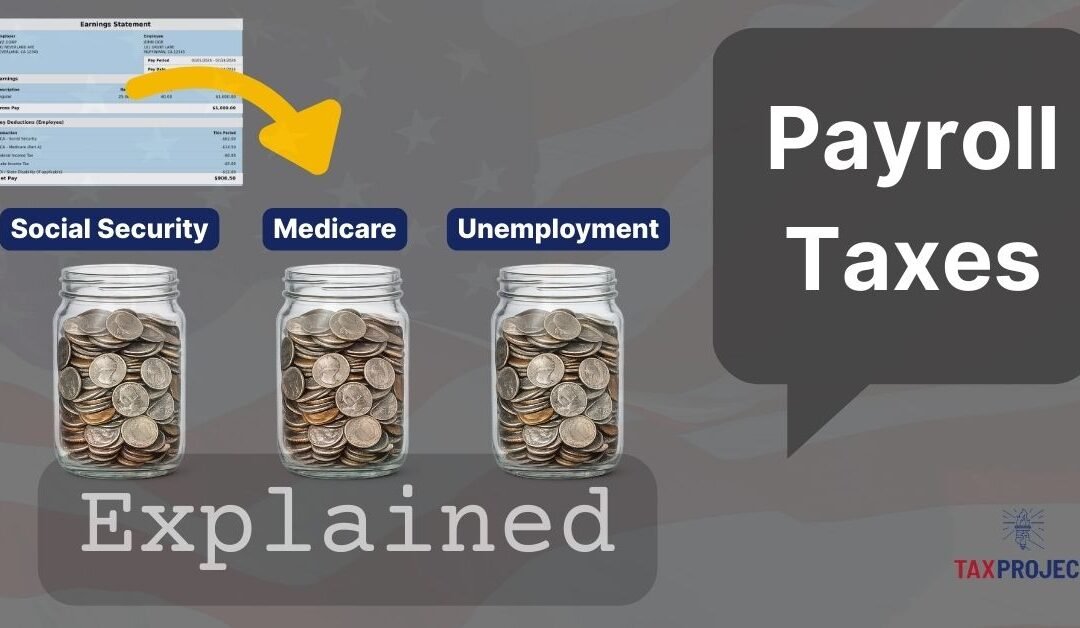
Payroll taxes are taxes tied directly to wages and salaries. They are collected automatically through payroll withholding and employer payments, and they are the primary way the U.S. finances Social Security and part of Medicare, along with federal and state unemployment systems. In practice, payroll taxes are among the most “unavoidable” taxes for working households because they apply to paychecks from the first dollar of covered wages, regardless of whether you ultimately owe federal income tax.
This explainer covers (1) the purpose of payroll taxes, (2) payroll taxes vs other paystub withholdings, (3) the Federal, State, and Local components and how they’re calculated, (4) the employer share and why it matters, (5) a short history of how payroll taxes started, (6) where payroll taxes fit in the revenue picture, (7) and why payroll taxes are often regressive.
Payroll Tax History
The Modern U.S. Payroll Taxes grew out of the Great Depression era. They were part of the Franklin D. Roosevelt’s New Deal program introducing sweeping new social programs as part of America’s social safety net. The Social Security program was designed to support income in Old Age (Retirement), and a separate Federal Unemployment insurance framework. The Social Security Act was signed into law on August 14, 1935, and has continued to be updated ever since. In 1939 Survivor benefits were added, Disability benefits were part of the Social Security Amendments of 1956 after a disability freeze was created in 1954. Payroll taxes began to be collected in 1937, and monthly benefits began in 1940. [7]
Why Payroll Taxes were designed this way: policymakers wanted a long term structural financing mechanism tied to work, with contributions from both Workers and Employers. That approach created a dedicated funding stream and helped define the program as earned social insurance.
Unemployment insurance also developed as a Federal-State system financed largely through Employer payroll taxes, with Federal FUTA operating as a Federal layer and States running their own benefit systems and tax structures. [5] [6]
Purpose of Payroll Taxes
Payroll taxes exist to fund specific “social insurance” programs tied to work. The idea is that when you earn wages, you and your employer contribute to programs that provide benefits during retirement (and for survivors and disability) and provide income support during periods of unemployment. That design matters because it explains why payroll taxes are structured as a percentage of wages, why they show up separately from income taxes, and why some parts have cap limits or thresholds.
Social Security, for example, is financed primarily through payroll contributions. It was designed as contributory insurance tied to earnings and work history, rather than being funded solely through general income taxes. That “contributions for benefits” framing is baked into how the taxes are calculated and how the programs are discussed in policy debates. [1]
Payroll Taxes vs “Everything Withheld”
A paystub can look like a pile of taxes and deductions, but it helps to separate them into three categories:
Payroll taxes (the focus of this article): wage-based taxes that fund Social Security, Medicare, and unemployment programs. [2]
Income tax withholding: Federal income tax (and sometimes State/Local income tax) withheld from paychecks as a prepayment of your income tax liability. These are not “payroll” taxes even though they’re withheld by payroll.
Deductions: health insurance premiums, retirement contributions, HSA/FSA contributions, and other benefit deductions. These aren’t taxes, though they can affect “taxable wages” for certain taxes depending on the type of benefit.
The Internal Revenue Service (IRS) often uses the broader term employment taxes to describe the full set of tax responsibilities connected to wages (withholding, depositing, and reporting). IRS Publication 15 is a primary reference employers use for these rules. [3]
“Covered wages” means wages that are subject to a specific payroll tax (for example, wages subject to FICA, FUTA, or state unemployment tax rules).
Payroll Tax Components
When you look at your pay stub you will likely see a whole bunch of acronyms and line items. These come from both the Federal Government and State/Local Governments. They use a lot of acronyms and some of them are shorthand for more than one component. Here are the components you will see in some form or another on your stubs.
Federal Payroll Taxes (core components)
FICA (Federal Insurance Contributions Act):
The Federal Payroll Taxes for Social Security and Medicare that are withheld from wages (and matched by employers). Items 1–3 below are FICA taxes: Social Security and Medicare, including the Additional Medicare Tax that applies to higher earnings. [3]
1) Social Security Tax – Old-Age, Survivors, and Disability Insurance (OASDI)
Rate: 6.2% withheld from employees and 6.2% paid by employers. [1]
Wage base (cap): Social Security tax applies only up to a maximum amount of wages each year. For earnings in 2026, the Social Security wage base is $184,500. [1]
What you see: When your year-to-date wages cross the wage base, Social Security withholding stops for the rest of that calendar year. [2]
Simple formula (employee side): Social Security tax = 6.2% × wages up to wage base [1]
2) Medicare Tax (Part A / Hospital Insurance)
Rate: 1.45% withheld from employees and 1.45% paid by employers. [2]
No wage cap: Medicare tax applies to all covered wages, unlike Social Security. [2]
Rate: An additional 0.9% on Medicare wages above certain thresholds which vary by filing status (see Table 1). [4]
Employer withholding rule: Employers must begin withholding the additional 0.9% once an employee’s wages paid by that employer exceed $200,000 in a calendar year, regardless of filing status. [4]
Simple formula (conceptual): Additional Medicare Tax = 0.9% × wages above the applicable threshold [4]
Filing Status
Threshold
Single
$200K
Married filing jointly
$250K
Married filing separately
$125K
Table 1
4) Federal Unemployment Tax (FUTA)
Who pays: Employer-paid (not withheld from employees). [5]
Basic structure: The standard FUTA tax rate is 6.0% on the first $7,000 of wages per employee per year. [5]
Credits: Employers typically receive credits for state unemployment taxes paid, often reducing the effective FUTA rate substantially (with exceptions in “credit reduction” situations). [5]
State Payroll Taxes (core components)
5) State Disability Insurance (SDI)
Who pays: Varies by state; commonly employee-paid via paycheck withholding (and in some states employer-paid or split). [6]
Basic structure: A state-run insurance program funded through payroll contributions in some states that provides partial wage replacement when a worker can’t work due to a non-work-related illness or injury (and, in some states, certain pregnancy-related conditions). [6]
What you see: Often appears as “SDI” (or similar) on a paystub in states that run a disability insurance program. [6]
Simple formula (conceptual): SDI contribution = SDI rate × taxable wages (subject to state rules and any wage base). [6]
6) Paid Family Leave (PFL)
Who pays: Varies by state; commonly employee-paid via paycheck withholding (and in some states employer-paid or split). [6]
Basic structure: A state-run program funded through payroll contributions in some states that provides partial wage replacement when a worker takes qualifying family or caregiving leave (for example, bonding with a new child or caring for a seriously ill family member). [6]
What you see: Often appears as “PFL” (or a related label) on a paystub in states that offer paid family leave funded through payroll contributions. [6]
Simple formula (conceptual): PFL contribution = PFL rate × taxable wages (subject to state rules and any wage base). [6]
7) State Unemployment Insurance / Unemployment Insurance (SUI/UI)
All states run unemployment insurance systems, but state payroll taxes vary widely. The biggest state Payroll tax category is State Unemployment Insurance (SUI/UI). In most cases:
Who pays: It is primarily employer-paid
Rate: The rate varies by employer
Wage base (cap): The taxable wage base varies by state, and Employers may also face additional state payroll contributions depending on state programs. [6]
Local Payroll Taxes
8) Local Payroll Taxes
Local Payroll taxes aren’t universal, however, they do exist and some cities and counties impose payroll-based taxes (often framed as employer payroll expense taxes). Local payroll taxes exist in a few jurisdictions and are highly location specific.
How the Math Works
For most W-2 workers (not self-employed), Payroll Taxes are calculated based on covered wages, and the amounts are split into:
EMPLOYEE Withholding: Social Security, Medicare, and possibly Additional Medicare Tax
EMPLOYER Paid Payroll Taxes: Employer match for Social Security and Medicare, plus FUTA and State/Local Employer Payroll taxes. [2] [3]
If you remember one thing: your paystub shows the employee side, but employers typically pay meaningful payroll taxes on your behalf on top of your gross wage that you never see on your pay stub. [3]
Payroll Tax Calculator
Try our Payroll Tax Calculator to estimate your Payroll Taxes*
Employer Paid Payroll Taxes
Payroll taxes are often discussed like they’re only the amounts withheld from your paycheck. That’s incomplete. Whether you know it or not, Employers are required to pay significant portions of Payroll taxes on your behalf.
Employers typically pay:
Employer Social Security: 6.2% up to the wage base. [1]
Employer Medicare: 1.45% on all covered wages. [2]
Federal Unemployment Tax Act (FUTA): employer-only federal unemployment tax, subject to credits. [5]
State Unemployment Insurance/Unemployment Insurance (SUI/UI): and other state/local payroll programs: usually employer-paid and highly variable. [6]
Why this matters for workers: the employer share affects the total cost of employing someone. Over time, employers tend to think in “all-in” labor cost terms (wages + payroll taxes + benefits). You don’t need an economics lecture to see the implication: if the employer’s cost of employing a worker rises, that can influence wage offers, hiring decisions, depress future wage growth, or how compensation is allocated between cash wages and benefits.
*NOTE – Self-employed generally pay self-employment tax (Self-Employment Contributions Act – SECA) that roughly covers both employee + employer halves of Social Security and Medicare.
Where do Payroll Taxes fit?
Payroll taxes are a major source of Revenue in the Federal budget. A Congressional Research Service overview reports that in FY2023, payroll taxes generated $1.6 trillion, or 36% of total Federal revenue, making Payroll taxes the second-largest revenue source after individual income taxes. [8]
Because payroll taxes are such a large source of federal revenue, they’re central to how Social Security and Medicare are financed. Even small changes to payroll tax rates or the wage base can meaningfully change how much money those programs bring in over time.
Payroll Taxes are often Regressive
A tax is commonly called regressive when lower-income households pay a higher share of their income in that tax than higher-income households. It doesn’t mean they pay more or a higher rate, but as a percentage of their income it represents a higher share. Payroll taxes often fit that description, mainly because of how Social Security is structured and how different households earn income.
Two key drivers:
The Social Security wage cap. Social Security tax applies only up to an annual wage base. Above the wage base cap limit, the 6.2% employee tax stops (and the employer match stops too), which lowers the effective Social Security tax rate as wages rise beyond the cap. [1]
Payroll taxes focus on wages. Payroll taxes generally apply to wage and salary income, not to most investment income (such as capital gains), which tends to be a larger share of income for higher-income households. [9]
There’s an important nuance: Medicare taxes are less regressive than Social Security taxes because Medicare has no wage cap and includes an additional surtax above certain thresholds. [2] [4] That doesn’t eliminate regressivity overall, but it changes the shape: the “cap effect” is primarily a Social Security issue.
Payroll Taxes FAQ
Why did my Social Security withholding stop late in the year? Because Social Security tax applies only up to the annual wage base. In 2026, the wage base is $184,500. [1]
Why does Medicare keep being withheld even after Social Security stops? Because Medicare has no wage cap; it applies to all covered wages. [2]
Why did my employer start withholding an extra 0.9% Medicare tax? Because employers must withhold Additional Medicare Tax once wages paid by that employer exceed $200,000 in the calendar year. [4]
If I have two jobs, can I pay too much Social Security tax? Yes. Each employer withholds up to the wage base as if it’s your only job. Over-withheld Social Security across multiple employers is handled as a credit/refund on Form 1040. [2]
Are bonuses subject to payroll taxes? In general, most cash compensation treated as wages is subject to Social Security and Medicare under IRS wage rules, with specifics governed by employer payroll guidance. [3]
Do independent contractors pay payroll taxes? Contractors generally don’t have payroll withholding like W-2 employees, but they may owe self-employment taxes and make estimated tax payments depending on their situation. [3]
Summary
Payroll taxes were introduced during the Great Depression part of the New Deal and fund core social insurance and unemployment programs and make up a major component of the American Social Safety net. Both you and your employer pay into these programs. Your employer treats these payments as part of your total compensation and benefits. They include what you see withheld from your paycheck and a significant employer paid amount that usually isn’t visible. Payroll taxes are the second largest source of Federal revenue after Income taxes.
U.S. Department of Labor, Employment and Training Administration. n.d. “Unemployment Insurance Tax Topic.” Office of Unemployment Insurance. Retrieved February 14, 2026 (https://oui.doleta.gov/unemploy/uitaxtopic.asp).
Congressional Research Service. 2024. Overview of the Federal Tax System in 2024. R48313. Washington, DC: Congressional Research Service. Retrieved February 14, 2026 (https://www.congress.gov/crs-product/R48313).
*Estimate Only – for illustration purposes only, should not be used as an official use. Contact your Accountant or Tax professional for guidance. The Tax Project Institute is not a Government entity, and not associated with the IRS, Social Security Administration, or Medicare.
The U.S. tax system is designed to be progressive, meaning that higher-income individuals generally pay a larger percentage of their income in taxes. As you make more income, you are taxed at progressively higher tax rates. However, public understanding of how this system works, particularly concerning marginal tax rates, is often limited. This explainer aims to clarify the concept of the marginal tax rate and address common misconceptions.
What is the Marginal Tax Rate?
It is a common misconception that your entire income is taxed at a single rate. People often think of the marginal tax rate as “the tax rate,” as if it were one flat tax rate applied to your entire income. However, that is not how it works. To really understand how your income tax is calculated, you need to understand marginal tax rates and the concept of graduated tax rates. The marginal tax rate is the rate applied to a specific portion of your income that falls within a particular tax bracket. Think of it this way: as your income increases, it may cross into higher tax brackets. The marginal tax rate is the rate at which any additional income within that specific bracket is taxed.
Graduated Tax Brackets: How the System Works
The U.S. federal income tax system employs a graduated tax bracket system. This means that instead of a single tax rate, income is divided into multiple ranges, or “brackets,” and each bracket is taxed at a different rate, each being a progressively higher rate ensuring that high income earners make larger contributions to Federal Revenue.
Here is how the US graduated Income Tax system works:
Brackets: Income levels are broken into a range known as a bracket with a start and ending point for each range of income. For example, $0 – $10,000, and $10,001 – $20,000 would each be their own Bracket.
Multiple Income Brackets: The tax table is composed of multiple tax brackets with ranges starting at zero escalating through different graduated tiers and ending in infinity.
Increasing Rates: Each bracket is assigned a specific tax rate, and these rates generally increase as the income level rises.
Income Within the Bracket: Only the portion of income that falls within a particular tax bracket range is taxed at that bracket’s rate.
US Tax Bracket
The US Tax Bracket is a table with a set of Tax Ranges for a given filing status with a progressive rate for each corresponding income level as follows in Table 1.
Tax Rate
For Single Filers
For Married Individuals Filing Joint Returns
For Heads of Households
10%
$0 to $11,925
$0 to $23,850
$0 to $17,000
12%
$11,925 to $48,475
$23,850 to $96,950
$17,000 to $64,850
22%
$48,475 to $103,350
$96,950 to $206,700
$64,850 to $103,350
24%
$103,350 to $197,300
$206,700 to $394,600
$103,350 to $197,300
32%
$197,300 to $250,525
$394,600 to $501,050
$197,300 to $250,500
35%
$250,525 to $626,350
$501,050 to $751,600
$250,500 to $626,350
37%
$626,350 or more
$751,600 or more
$626,350 or more
Table 1 Source: IRS
How to use Tax Brackets
Using an example of a married couple with combined gross income of $120,000. After eligible deductions and exemptions their adjusted gross income (AGI) is $100,000. Using the Tax Bracket in Table A above, they would use the center column for Married Individuals Filing jointly and apply tax rates as follows in Table 2 below.
Tax Rate
For Married Individuals Filing Joint Returns
Taxable Amount for Each Bracket
10%
$0 to $23,850
The first portion of their $100,000 AGI would be taxed at 10% from $0 up to $23,850.
Calculation: $23,850 * 10% = $2,385 in Taxes for this bracket
12%
$23,850 to $96,950
The second portion of their $100,000 AGI would be taxed at 12% from $23,850 to $96,950. Only the amount in this range is taxed, so $96,950 – $23,850 = $73,100 taxable in this range.
Calculation: $73,100 * 12% = $8,772 in Taxes for this bracket
22%
$96,950 to $206,700
The third portion of their $100,000 AGI would be taxed at 22% from $96,950 to $206,700. Since their total AGI was only $100,000 the amount of their income in this tax range is $100,000 – $96,950 = $3,050.
Calculation: $3,050 * 22% = $671 in Taxes for this bracket
Total Tax Liability
The Total Tax liability is the sum of the tax amount for each bracket.
Calculation: $2,385 + $8,772 + $671 = $11,828
Table 2
What Does the Marginal Tax Rate Apply To?
Marginal tax rates are applied to a taxpayer’s taxable income. Taxable Income is not the same as Gross Income. Your entire income is referred to as your Gross Income. This is your total income before deductions. After you have subtracted all applicable deductions and exemptions from your Gross Income this is referred to as your Adjusted Gross Income (AGI). Your AGI income is what is taxed at the tax bracket rates. So, you are taxed on only a portion of your income, and each portion of that income is taxed at a different rate according to each bracket’s tax rate.
Marginal Tax Rate vs. Effective Tax Rate
Another important concept to understand is to distinguish between the marginal tax rate (MTR) and the effective tax rate (ETR):
Marginal Tax Rate (MTR): The tax rate applied to a portion of income within a specific tax bracket.
Effective Tax Rate (ETR): The total tax liability divided by total income.
In our example illustrated in Table 2 the Married Couple earning $120,000 whose top income falls in the 22% Marginal Tax Rate (MTR), they are often referred to as being in the 22% tax bracket. This is often where the misconception comes, if your Adjusted Gross Income on $120,000 of income is $100,000 than if you are in the “22% tax bracket”, they should pay $26,400 ($120,000 * 22%). However, because of the graduated tax bracket system, the ETR is always lower than the highest MTR a taxpayer faces. Here is why: The ETR represents the average tax rate on all of a taxpayer’s income AFTER eligible deductions and exemptions against their total tax liability. Since different portions of their income are taxed at different rates (as determined by the tax brackets), the overall tax burden, expressed as a percentage of total income, will be less than the rate applied to the very highest portion of their income, most often referred to as their tax bracket. So, in our example in Table 2, the married couple with $120,000 in gross income has a tax liability of $11,828. Therefore, their Effective Tax Rate (ETR) is only 9.86% ($11,828/$120,000) instead of the “22% tax bracket” of their highest Marginal Tax Rate. This is because the Gross Income is reduced by eligible deductions and exemptions to produce an Adjusted Gross Income BEFORE it is exposed to the tax bracket, and that the graduated tax bracket only exposes a portion of the AGI to each graduating tax bracket rate.
Misconceptions About Marginal Tax Rates
A prevalent misunderstanding is that a taxpayer’s entire income is taxed at their highest marginal tax rate. This leads to the incorrect belief that tax increases on higher income brackets affect all of a taxpayer’s earnings.
Many people mistakenly believe that their entire income is taxed at the rate of their highest tax bracket. They do not realize that the graduated tax system means that only the portion of their income that falls within each bracket is taxed at that bracket’s rate. This misunderstanding leads to an overestimation of their tax liability. The effective tax rate is always lower than the marginal tax rate because it averages the different rates applied to different portions of income.
To reiterate, in a graduated system, taxes are calculated incrementally. Only the income within a specific range is taxed at the rate assigned to that range, and only after Gross Income has been reduced by eligible deductions and exemptions. Higher marginal tax rates do not apply to all income, only to the portion exceeding lower-bracket thresholds.
Tax Brackets Over Time
Since the ratification of the 16th Amendment in 1913 that allowed progressive taxation and the introduction of a Federal Income Tax, the US Tax Bracket has had a number of changes.
Changes
The Top Marginal Income Tax Rate has varied from a low of 7% to a high of 94%.
The number of Tax Brackets has varied from a low of 2 (1988-90) up to 56 (1918).
Income thresholds are adjusted periodically for inflation to prevent “bracket creep” [1].
Filing status significantly impacts income thresholds.
In Diagram 1 we show the Top Marginal Tax Rate by year. This applies to the highest income earners only, and only to the portion that falls within the income levels of the top marginal tax bracket.
Diagram 1 Source: IRS
Taxpayers in the Highest Marginal Tax Bracket
The Top Marginal Tax Rate is often referenced when discussing Taxes and this can be misleading. As we have discussed we know that the top MTR is only applied to the AGI which can vary substantially from different from Gross Income, and the ETR is often substantially less. Historically, the number of taxpayers in the highest marginal tax rate bracket has been relatively small compared to the total taxpayer population.
Tax data and analysis indicate these general trends:
A small percentage of taxpayers fall into the highest tax brackets [2].
The majority of federal income tax revenue is concentrated among the highest-income earners [3].
The number of individuals and households affected by the top tax rate varies due to economic conditions and legislative changes.
Very high top marginal tax rates occurred during periods of high government expenses, including wars, as seen during World War II. While the top marginal tax rate reached 94%, it applied to a very limited number of high-income individuals [4].
Conclusion
The marginal tax rate is a fundamental element of the U.S. progressive income tax system. However, its application is often misunderstood. The graduated tax bracket system ensures that a taxpayer’s effective tax rate is lower than their highest marginal tax rate. So, when someone discusses their “Tax Bracket” and expresses it as a single value, this is higher than their Effective Tax Rate due to deductions, exemptions, and the graduated tax bracket. Understanding these concepts is crucial for accurate discussions about tax policy, your contributions, and its impact on individuals and the economy.
Tariffs Are Taxes: Their Impact, History, and Economic Consequences
Tariffs, fundamentally, are taxes imposed by a government on imported goods and services, albeit indirect taxes. They serve multiple purposes: protecting domestic industries from foreign competition, generating revenue for the government, and sometimes acting as leverage in trade negotiations. While tariffs can shield local businesses from overseas competitors, they can result in higher prices for consumers with broader economic effects including inflation.
How Tariffs Affect Consumers and Businesses
When tariffs are applied to imported goods, those costs get added to the cost of goods and generally prices increase to maintain profit margins. All taxes are passed off to either the investor (in the form of lower returns), the employee (in the form of lower wages), the consumer (in the form of higher costs), or the owner (in the form of lower profits). As a result, domestic businesses that rely on imported materials or products face higher production costs. These increased costs are frequently passed on to consumers through higher retail prices. For example, a 25% tariff on imported steel leads to increased costs for automobile manufacturers, appliance producers, and construction firms, all of which depend on steel as a raw material. Consumers then pay more for cars, home appliances, and housing due to these higher input costs.
The effects can also ripple through industries that rely on foreign supply chains. If tariffs are placed on Chinese-made semiconductors, American electronics manufacturers may struggle to maintain competitive pricing, leading to reduced consumer demand, potential job losses, and slower economic growth. Tariffs not only affect direct buyers of imported goods but also the broader economy by influencing business investment decisions and supply chain structures.
Current U.S. Tariff Environment
As of early 2025, the United States has imposed significant tariffs on imports from major trading partners. On February 1, 2025, President Trump announced executive orders imposing a 25% tariff on imports from Canada and Mexico and a 10% tariff on imports from China, effective February 4, 2025. These measures were introduced under the rationale of addressing national security concerns, including unlawful migration and fentanyl flows.
These tariffs are expected to increase federal tax revenue by $142 billion in 2025, translating to an additional tax burden of $1,072 per U.S. household. While this may boost government revenues in the short term, economists predict that these tariffs will raise inflation by 0.7% to 1.2% and reduce GDP growth by 0.6 percentage points. Inflationary pressures stemming from tariffs can further erode consumer purchasing power, creating a cycle of higher costs and reduced economic activity.
Tariffs and Inflation: How Prices Rise
Tariffs contribute to inflation by increasing the cost of imported goods, which then pushes domestic producers to raise their prices. This phenomenon, known as “cost-push inflation,” occurs when businesses pass increased costs onto consumers. If a tariff makes imported aluminum more expensive, U.S.-based beverage companies using aluminum cans must pay more, which results in higher prices for drinks like soda and beer.
Additionally, when consumers face higher prices for goods affected by tariffs, they may demand higher wages to maintain their standard of living. This can lead to a wage-price spiral, where rising wages increase production costs, further driving up prices in a self-reinforcing cycle. Historically, such inflationary cycles have been difficult to break and can require significant monetary policy interventions, such as interest rate hikes by the Federal Reserve.
The History of U.S. Tariffs and Taxation
Historically, tariffs were the primary source of Federal revenue in the United States. Between 1798 and 1913, they accounted for anywhere from 50% to 90% of Federal income. For example, in 1865, excise taxes made up about 63% of Federal revenue, while tariffs contributed 25.4%. So in the not too distant past, and for more than half our countries existence, there were no income taxes and most taxes came from tariffs and excise taxes. (See our article on External Revenue Service)
However, with the introduction of the Federal income tax in 1913, reliance on tariffs as a major revenue source declined. Over the past 70 years, tariffs have rarely contributed more than 2% of total federal revenue. In fiscal year 2024, U.S. Customs and Border Protection collected $77 billion in tariffs, which amounted to only 1.57% of total federal revenue.
Comparing Tariffs to Other Forms of Taxation
Unlike income taxes, which are based on earnings, or sales taxes, which apply broadly to consumer purchases, tariffs target specific goods and services entering the country. This selective nature makes tariffs an indirect tax, meaning consumers may not immediately recognize their effects, even though they ultimately bear the cost through higher prices.
For example, a household that buys imported electronics, furniture, or clothing may notice price increases but may not immediately attribute them to tariffs. In contrast, a direct income tax increase is immediately visible in a worker’s paycheck. Because tariffs often function as a hidden tax, their economic impact can be underestimated by the general public.
Recent Tariff Developments and Economic Outlook
With the resurgence of tariffs under the Trump administration, concerns about their long-term economic impact are growing. Analysts predict that the latest tariff measures could strain U.S.-Canada-Mexico trade relations, with potential retaliatory tariffs from affected countries. If Canada and Mexico impose countermeasures, U.S. exporters—especially in agriculture and manufacturing—could face declining international sales.
Additionally, tariffs on China may disrupt global supply chains, increasing costs for U.S. companies that depend on Chinese manufacturing. Businesses may respond by shifting production to other countries, but such transitions take time and can lead to temporary shortages and price volatility.
Conclusion
While tariffs have historically played an essential role in U.S. economic policy, their modern implications highlight the complexity of global trade. While they can protect domestic industries and generate government revenue, they often lead to higher consumer prices, inflation, and strained trade relations. The recent tariffs imposed in 2025 illustrate the careful balancing act policymakers must navigate to safeguard national interests without disrupting economic stability.
Understanding tariffs in the broader context of taxation history and economic policy helps provide a clearer picture of their long-term effects. As tariffs continue to be used as a tool for trade and economic policy, their impact on consumers, businesses, and inflation will remain a critical issue for policymakers and the public alike.
Trump’s Proposed External Revenue Service: A Return to 1913
Former President Donald Trump has recently floated the idea of replacing the Internal Revenue Service (IRS) with an “External Revenue Service” that would eliminate income taxes and instead rely on tariffs and fees imposed on foreign governments. In essence, replace Income Taxes with fees on Foreign trade shifting the burden of taxes on foreign entities instead of inwardly on US citizens. While this proposal is still in its early stages, lacks concrete details, and may never come to fruition it has sparked discussions about potential benefits and drawbacks of such a dramatic shift in U.S. tax policy.
Historical Context
While many will hear about this proposal and think this is a major, if not radical change it’s important to note that Income taxes are a relatively recent development in U.S. history. The Federal Income tax as we know it today was only established in 1913 with the ratification of the 16th Amendment. Prior to this, the U.S. government primarily relied on tariffs and excise taxes for revenue.
Potential Benefits
Proponents of this proposed system argue that it could offer several advantages:
Simplification: Eliminating income taxes could greatly simplify the tax code, potentially reducing compliance costs for individuals and businesses.
Increased competitiveness: By shifting the tax burden to foreign entities, U.S. businesses might become more competitive in the global market.
Strategic leverage: Tariffs and fees on foreign governments could be used as tools in international negotiations and to address trade imbalances.
Encouraging domestic production: Higher costs on imported goods could incentivize domestic manufacturing and reduce reliance on foreign supply chains.
Domestic Job growth: Tariffs can create barriers protecting domestic industries and promoting job growth and potential repatriation of foreign jobs, companies, and manufacturing.
Strategic positioning: As the US has entered a new cold war with China as a near peer competitor, strategic tariffs could serve as an effective check limiting their Economic growth and ability to build military and economic power against the US.
Trade-offs and Challenges
However, this proposed system also presents significant challenges and potential drawbacks:
Revenue stability: Relying primarily on tariffs and foreign fees could make government revenue more volatile and dependent on international trade dynamics.
Consumer costs: Tariffs are ultimately paid by consumers through higher prices on imported goods. This could lead to increased living costs for many Americans.
International relations: Imposing significant tariffs and fees on foreign governments could strain diplomatic relationships and potentially lead to retaliatory measures.
Economic distortions: Tariffs can create market inefficiencies and lead to suboptimal resource allocation. It could potentially cause massive shifts in supply chains and have major ripples in economies throughout the world with a wide range of impacts, and potentially negative consequences for all participants.
Constitutionality: The legality of completely eliminating income taxes and replacing them with an external revenue system would likely face legal challenges.
Potentially Regressive: US Federal Income taxes are highly Progressive with 89% of taxes being paid by the Top 25% of tax payers. Shifting to tariffs for revenue maybe inflationary to goods. While it is likely the higher income individuals consume more, it may be that staples required by all consumers may disproportionately impact those most in need.
Feasibility: While this may sound good on paper, the IRS collects roughly $5 trillion in income tax revenue annually – it may not be economically feasible or possible to collect this from external entities
Tariffs as a Form of Taxation
It’s crucial to understand that tariffs are indeed a form of taxation. While they are imposed on foreign goods and not seen as a direct cost to the consumer, the cost is typically passed on to domestic consumers through higher costs. This means that under the proposed system, Americans would still be paying taxes, albeit indirectly through higher prices on imported goods.
Strategic Considerations
Despite the economic drawbacks, some argue that tariffs can serve strategic purposes beyond revenue generation. In particular, tariffs on goods from near-peer competitors like China could be used as leverage in geopolitical negotiations or to protect sensitive industries as well as check a rising global power who we are currently in a cold conflict with and may potentially be in a hot conflict in the future. However, this approach carries risks of escalating trade tensions and potential economic retaliation.
Conclusion
Trump’s proposed External Revenue Service represents a old, but radical departure from the current U.S. tax system. While it offers potential benefits in terms of simplification and strategic leverage, it also presents significant challenges and economic risks. As with any major policy shift, careful consideration of both short-term and long-term consequences is essential.
It’s important to emphasize that this proposal is still in its early stages and lacks specific details. The feasibility, implementation, and potential impacts of such a system would require extensive study and debate. Furthermore, any major overhaul of the U.S. tax system would likely face significant political and legal hurdles.
As discussions around this proposal continue, it will be crucial to consider not only the economic implications but also the broader impacts on international relations, domestic policy, and the overall well-being of American citizens. Ultimately, any changes to the tax system should aim to balance revenue needs, economic growth, fairness, and strategic interests in an increasingly complex global landscape.
Tax Project Institute is a fiscally sponsored project of MarinLink, a California non-profit corporation exempt from federal tax under section 501(c)(3) of the Internal Revenue Service #20-0879422.