Understanding the Role of Bond Vigilantes and Government Fiscal Management
Bond markets play a pivotal role in any economy, serving as the mechanism by which governments raise money to fund their operations and programs. However, these markets are not just passive—they react to the fiscal and monetary policies of a government. If those policies are perceived to be risky and irresponsible, bond investors can invest elsewhere lowering demand for bonds and driving up interest rates and making it more expensive for governments to borrow money. This phenomenon is referred to as the actions of bond vigilantes. But before we delve into the role of bond vigilantes, it’s essential to understand the broader economic framework within which they operate—particularly the concepts of monetary policy, government debt, and how these influence the broader bond market.
Monetary Policy: What It Is and Why It Exists
Monetary policy refers to the actions taken by a country’s central bank (in the U.S., the Federal Reserve) to manage the supply of money, control inflation, stabilize the currency, and achieve sustainable economic growth. The main goal of monetary policy is to regulate inflation while also promoting economic stability. By adjusting the money supply and interest rates, the central bank can influence economic activity, employment levels, and consumer spending.
The Tools of Monetary Policy
The Federal Reserve has a few core tools that it uses to implement Monetary Policy:
- Open Market Operations (OMOs): This is the most commonly used tool. OMOs involve the buying and selling of government securities, such as Treasury bonds, in the open market. By buying bonds, the Fed increases the money supply, effectively lowering interest rates. Conversely, by selling bonds, it reduces the money supply and raises interest rates. This helps control inflation and smooth out economic cycles.
- Discount Rate: This is the interest rate at which the central bank lends to commercial banks. If the Fed lowers the discount rate, borrowing becomes cheaper for banks, and they, in turn, can lower interest rates for consumers and businesses. This helps to stimulate economic activity. When credit is looser this is often referred to as an Accommodating policy. If the Fed raises the discount rate, it makes borrowing more expensive, which can slow down an overheating economy. When credit is tighter this is often referred to as a Restrictive policy.
- Reserve Requirements: This is the portion of depositors’ balances that commercial banks must hold as reserves and not lend out. By adjusting reserve requirements, the Fed can influence the amount of money that banks can lend to consumers and businesses. A lower reserve requirement increases the amount of money in circulation, while a higher reserve requirement decreases the amount of money available for lending.
The main goal of these tools is to ensure that the economy doesn’t experience too much Inflation (which can erode purchasing power) or Deflation (which can lead to reduced economic activity and a slowdown in growth).
Why Does Monetary Policy Exist?
Monetary policy exists to stabilize the economy and control inflation. Without a central authority to regulate money supply and interest rates, economies can fall into cycles of boom and bust—hyperinflation, recessions, and depressions. By setting the right monetary policy, the Fed helps to smooth these fluctuations, keeping the economy on a stable growth path and avoiding extreme imbalances.
- Inflation Control: High inflation can reduce the value of currency and savings. It distorts pricing and makes long-term planning more difficult for businesses and consumers. The Fed uses monetary policy to control inflation within a target range (often around 2%).
- Economic Stability: By adjusting interest rates and influencing credit availability, monetary policy helps to prevent excessive inflation or deflation. It also moderates the effects of recessions by stimulating demand when needed.
In the US the Federal Reserve is the Central Bank for the country, and is said to have a dual mandate that aligns with these goals. 1) Price Stability – the current Fed has set a target of 2% inflation to manage the Inflation Control. 2) Maximum Employment – to insure economic activity leads to Economic stability and job growth.
The Government and Debt: Why Borrowing is Necessary
A government typically borrows money by issuing bonds, which are essentially debt securities. These bonds are bought by investors (including domestic and foreign institutions, banks, and individuals) who receive regular interest payments (the coupon) in exchange for lending money to the government. Governments borrow for several reasons:
- Funding Deficits: Governments often run deficits—when their expenditures exceed revenues (mainly from taxes). Borrowing allows them to cover the difference.
- Public Investment: Borrowing allows governments to fund long-term investments in infrastructure, education, and healthcare without immediately raising taxes.
- Crisis Management: In times of crisis (such as wars, natural disasters, or economic downturns), governments often need to borrow heavily to provide relief and stabilize the economy.
How Government Debt and Fiscal Policy Relate to Bonds
The government uses bonds as a way to raise the necessary capital (money) to finance its operations. Treasury bonds are seen as a safe investment, particularly for large institutions and foreign governments, because they are backed by the full faith and credit of the U.S. government. However, how much debt the government takes on and the policies it implements around borrowing can have a profound impact on the bond market.
When the government issues debt in the form of Treasury bonds, it promises to pay the principal back at a later date, along with interest at the agreed-upon rate. The interest rate (or yield) on these bonds is determined by market conditions, inflation expectations, and the government’s perceived ability to meet its financial obligations.
As long as investors trust that the government will honor its debt obligations, Treasuries remain attractive, even in times of economic uncertainty. However, if market participants lose confidence in the government’s ability to manage debt responsibly, and perceive higher risks, they may sell their holdings in Treasury bonds, driving interest rates (yields) higher and making it more expensive for the government to borrow. This is where bond vigilantes come into play.
Bond Vigilantes: The Market’s Check on Government Fiscal Policy
The term bond vigilantes often carries a certain connotation of malevolence, as if these market participants are actively trying to harm the government by making its borrowing more expensive. However, this perception is a misunderstanding of the true nature of bond vigilantes. In reality, bond vigilantes are not malevolent actors but rational participants in the marketplace who are simply reacting to perceived additional risks in a bond offering. These market players are primarily concerned with the quality of the asset—in this case, government debt—and the risks associated with it.
vigilante
vig·i·lan·te ˌvi-jə-ˈlan-tē , (Noun)
A member of a volunteer committee organized to suppress and punish crime summarily (as when the processes of law are viewed as inadequate)
broadly : a self-appointed doer of justice
The bond vigilantes’ role is a market-driven check on fiscal policy. They do not act out of malice, but rather as a response to the increased risk they perceive in holding government bonds as an investment. When the government takes actions that might increase inflation, debt, or the likelihood of default thereby increasing risk, bond vigilantes react by demanding higher returns (higher yields) to compensate for that added risk. If they do not feel they are being adequately compensated for those risks, they will look elsewhere to deploy their capital, such as in alternative investments like stocks, foreign bonds, or commodities.
Rational Market Mechanism of Bond Vigilantes
At their core, bond vigilantes are rational actors in a market where the value of assets (in this case, U.S. Treasuries) is determined by supply and demand. When the risks associated with these assets increase, the price of bonds decreases, and in turn, yields increase. This is a natural market response to the perceived decline in the quality of an asset.
The underlying logic is straightforward:
- If investors believe that a government’s fiscal policies could lead to higher inflation, growing debt, or the risk of default, they will demand higher yields to compensate for that perceived risk.
- If the government does not adjust its policies in response to this feedback, bond prices will fall further, yields will rise, and the cost of government borrowing will increase, reflecting the higher risk.
In essence, bond vigilantes are not acting with a specific agenda to punish the government, but are simply making a rational decision based on the changing risk profile of the asset they are holding. They are demanding higher returns because they believe the risk of holding government debt has risen, whether due to concerns about fiscal mismanagement, inflation, or geopolitical instability.
Bond Vigilantes and the Price of Treasury Bonds
A simple way to understand how bond vigilantes work is to look at the relationship between bond prices and yields. When a government’s fiscal policies are perceived as risky, investors may begin selling off existing bonds. As the supply of bonds increases in the market, their prices fall, and because bond prices and yields are inversely related, the yields rise. If an investor is facing increased risk, they will demand higher yields to compensate for that risk.
Consider this scenario: if the U.S. government were to increase its debt or adopt inflationary policies that the market views as unsustainable, bond vigilantes would begin selling off Treasuries, driving prices down and pushing yields higher. This would increase the cost of borrowing for the U.S. government, making it more expensive to finance operations. This serves as a natural check on fiscal policy, encouraging governments to adopt more sustainable spending and borrowing practices to avoid the consequences of escalating borrowing costs.
Who are the Bond Vigilantes?
Bond vigilantes are just Bond market participants who react to changes in government fiscal and monetary policies, not some special group policing Government. These large investors demand higher returns (higher yields) to compensate for perceived risks in holding government debt, especially when policies lead to rising debt, inflation, or fiscal instability.
Key Players and Their Rough Participation Levels
- Institutional Investors (40%): This includes mutual funds, pension funds, and insurance companies. They are significant holders of government bonds and act as bond vigilantes when fiscal policies raise concerns about inflation or debt sustainability.
- Hedge Funds (30%): These funds are more speculative and nimble, using leverage to bet on macroeconomic shifts. Hedge funds play a large role in short-term bond market movements and often lead the charge in demanding higher yields when fiscal mismanagement is perceived.
- Foreign Governments and Sovereign Wealth Funds (20%): Countries like China, Japan hold large amounts of U.S. debt. If they feel U.S. debt is becoming too risky, they can quickly influence bond yields by selling Treasuries.
- Individual Investors (10%): Although less influential, retail investors who own savings bonds or retirement accounts can react to inflation or concerns about government debt by shifting away from U.S. Treasuries.
Bond Vigilantes Summary
Bond vigilantes are not and organized group of malevolent actors seeking to damage the government, but rational players responding to perceived risks in an investment. Their actions are simply part of a larger market dynamic where risk is constantly assessed, and investors make decisions based on the expected return on their investments. When investors sense that the risk of holding government bonds is higher, they will demand higher compensation, in the form of higher yields, or else they will move their capital elsewhere. This is a healthy mechanism that ensures governments stay accountable to the markets, forcing them to manage debt and fiscal policy more prudently.
In summary, bond vigilantes play a crucial role in keeping governments in check. They are rational actors responding to increased risk by adjusting the yield on government bonds. Their actions force governments to reconsider their fiscal policies or face higher borrowing costs, which could in turn lead to a reassessment of the sustainability of their debt and spending practices.
The Role of Bond Vigilantes in History: The 1970s and 1980s
The 1970s and 1980s are often cited as the classic example of bond vigilantes in action. During this period, the U.S. experienced high levels of inflation (peaking at 13.5% in 1980) and growing government debt, which caused bond investors to demand higher yields.
1. The 1970s: Rising Debt and Inflation
- The 1970s were marked by stagflation—a combination of high inflation and stagnant economic growth. The U.S. was dealing with the aftermath of the Vietnam War, rising oil prices, and growing government spending on entitlement programs.
- The Federal Reserve, under Arthur Burns, was criticized for keeping interest rates too low for too long, allowing inflation to spiral. Bond vigilantes responded by selling Treasuries, pushing yields higher.
- Bond yields soared, and the U.S. government found itself in a difficult position: borrowing costs were rising, and the value of the dollar was being eroded by inflation.
2. The 1980s: Volcker’s Response
- In response to the bond vigilantes’ actions and the growing economic instability, Paul Volcker, Chairman of the Federal Reserve, implemented a tight monetary policy, raising interest rates to historic levels (peaking at 20% in 1981) to combat inflation.
- This move successfully curbed inflation, but it came with significant economic pain: the U.S. entered a recession, and unemployment soared. However, the aggressive action by Volcker was necessary to restore credibility in the bond market and get inflation under control.
- The 1980s marked the beginning of a new era where bond vigilantes played a critical role in holding governments accountable for fiscal and monetary policy.
The Parallels to Today
The current economic environment bears similarities to the 1970s and 1980s, with rising debt levels, inflation concerns, and fiscal challenges. Bond vigilantes may re-emerge if investors perceive that the U.S. government is not effectively managing its fiscal policies. Several factors contribute to this emerging concern:
- Rising Debt: The U.S. national debt now exceeds $36 trillion, and the government’s annual debt servicing costs are rising. Last year alone the interest payments on the National Debt were over $1 Trillion, surpassing the Military budget. This is drawing comparisons to the 1980s, when rising debt levels led to higher borrowing costs and market instability.
- Inflation: After years of low inflation, recent inflationary pressures have re-emerged, driven by factors such as supply chain disruptions, rising energy prices, and large government spending. The Fed has recently calmed this is down by raising interest rates, but if inflation continues to rise, bond vigilantes may demand higher yields as compensation for inflation risk.
In recent months, U.S. Treasury bonds have experienced notable volatility, challenging their long-standing reputation as the world’s safest investment. This shift has been driven by a combination of factors, including escalating national debt, inflationary pressures, and political uncertainties.
The yield on the 10-year Treasury note has risen significantly, reflecting increased investor concerns. For instance, in April 2025, the yield surged to 4.5%, its highest level in over a decade. This uptick was attributed to factors such as rising inflation expectations and a growing national debt [2].
Ongoing Fiscal policy, including maintaining Tax Cuts and Jobs Act (TCJA) tax cuts, increased government spending, and fiscal deficits further strain bond market tension. The CBO projects National Debt to continue to expand, raising questions about the sustainability of U.S. fiscal policy [3,5].
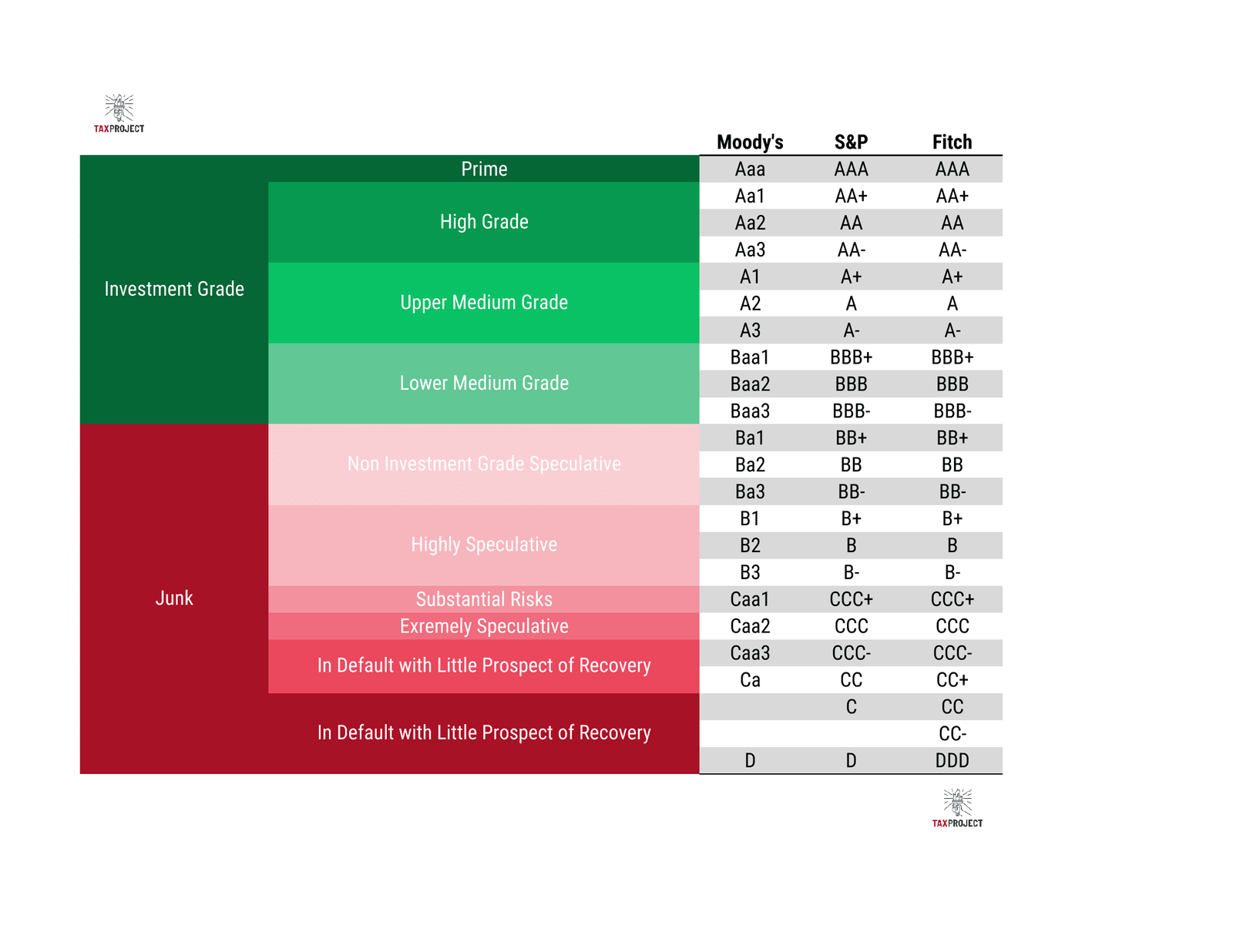
Investor sentiment has been further impacted by credit rating agencies downgrading the U.S. credit rating. In May 2025, Moody’s downgraded the U.S. credit rating to Aa1 from Aaa, citing concerns over increasing government debt [4].
The Consequences of Rising Yields: A Fragile Economic Environment
The US is in a somewhat fragile situation with the highest National Debt since World War II. This could limit the Federal Reserves options if U.S. bond yields were to rise dramatically, especially in response to concerns over fiscal policy, the consequences would be severe:
- Higher Borrowing Costs: The government would face increased debt servicing costs, consuming a significant portion of the federal budget.
- Inflation: Higher yields could signal more inflation, eroding the value of the dollar and reducing purchasing power.
- Dollar Devaluation: If the market loses confidence in U.S. fiscal management, the value of the U.S. dollar could fall, and the U.S. could lose its status as the world’s reserve currency.
- Global Financial Turmoil: A loss of confidence in U.S. Treasuries could lead to a flight to other assets like gold or the Chinese yuan, destabilizing the global financial system.
Dire Impact of 15% Interest Rates
If the U.S. were to face 15% interest rates, similar to the 70’s era Volcker policies, the annual interest payments on the national debt would surge to around $5.4 trillion—exceeding the entire $4.9 Trillion in Federal revenue of the U.S. for 2024 [1]. This would create an untenable fiscal situation:
- All federal revenues would be consumed by interest payments, severely limiting the ability of the government to fund other essential services, such as social programs, defense, and education.
- The U.S. would likely face a massive budgetary crisis, tax increases and cuts to critical programs would become unavoidable.
- Rising borrowing costs could push the U.S. into default or require debt restructuring, both of which would have catastrophic effects on global financial markets.
Conclusion
Bond vigilantes serve as an important market discipline mechanism that can force governments to reconsider fiscal and monetary policies. When investors perceive that a government is mishandling its debt or failing to control inflation, they respond by selling bonds, driving yields higher. This forces the government to either adjust its policies or face higher borrowing costs. The lessons from the 1970s and 1980s show us that fiscal mismanagement and rising debt can lead to economic pain, especially if bond vigilantes push back.
In today’s world, with rising debt levels and inflation concerns, the potential for bond vigilantes to re-emerge is high. If the U.S. government fails to manage its fiscal policies effectively, it could face the consequences of higher interest rates, a devalued dollar, and a loss of confidence in U.S. Treasuries—leading to economic instability both domestically and globally. The fragility of the current environment makes it important for the government to manage this fragile state with sustainable fiscal policies and prudent monetary policies before bond vigilantes act for them and force their hand into dire consequences for the US.
Citations
- US Treasury: https://fiscaldata.treasury.gov/americas-finance-guide/government-revenue/#:~:text=Last%20Updated%3A%20September%2030%2C%202024,to%20%244.92%20T%20in%202024.
- Reuters. Tariff Chaos Leaves Its Mark on U.S. Debt Costs. Reuters, 2025. https://www.reuters.com/breakingviews/tariff-chaos-leaves-its-mark-us-debt-costs-2025-04-14
- Financial Times. U.S. Fiscal Policy Faces Growing Scrutiny Amid Rising Debt Levels. Financial Times, 2025. https://www.ft.com/content/f825cae6-89ba-466f-9538-b6488d23673f
- Reuters. Moody’s Downgrades U.S. Credit Rating to Aa1 Amid Growing Debt Concerns. Reuters, 2025. https://www.reuters.com/markets/us/moodys-downgrades-us-aa1-rating-2025-05-16
- CBO: https://www.cbo.gov/publication/61270#:~:text=Projections%20for%202055,Revenues%3A%2019.3%25%20of%20GDP