AI and robotics could raise economic output while reducing the need for human labor. If that happens at scale, the US runs into a basic mismatch: much of today’s tax system is tied directly or indirectly to wages. Payroll withholding, wage income, and wage-driven consumer spending form a large part of the revenue “engine.” In a high-automation economy, that engine weakens unless the tax base shifts toward what still scales with output.
The AI transition as envisioned by some will cause massive upheaval to social, and economic systems across the world. Plenty of work must be done to plan for this potential future in developing frameworks to support such a transition. This article covers two things only: (1) the order-of-magnitude scale of UBI and UHI-style programs will require, and (2) the mechanisms government could use to capture enough AI-era productivity to fund them. It does not cover job churn, social stress, or geopolitical spillovers. The aim is to make the dollars concrete and map the major funding options. The intent of this article is not to predict the future, but provide guidance and a framework for what may be required and the scale of various options, and the magnitude of the challenges ahead.
“AI could wipe out half of all entry-level white-collar jobs – and spike unemployment to 10-20% in the next one to five years.”
Dario Amodei, CEO Anthropic
What “UBI” and “UHI” mean in this article
To keep the math understandable, costs are modeled per household (so family members are not counted multiple times).
UBI is treated as a “basic” cash floor, anchored to the real median household income. UHI is treated as a “high” cash floor, anchored to the 90th percentile household income (top 10% threshold). Those are not endorsements of any specific program design. They are benchmarks that help show how quickly the funding problem scales when the target shifts from “basic” to “high.”
Inputs used:
US households: 132,737,146 (2024 ACS). [1]
UBI level: $80,610 (2023 real median household income). [2]
UHI level: $234,900 (2023 household income at the 90th percentile). [3]
FY2024 federal receipts: $4.918 Trillion (for perspective). [4]
Nominal GDP reference: about $29.8 Trillion (Q4 2024 annual rate). [5]
“AI will affect almost 40 percent of jobs around the world, replacing some and complementing others.”
“In advanced economies, about 60 percent of jobs may be impacted by AI.”
IMF [6]
Cost Overview: How big the dollars get, fast
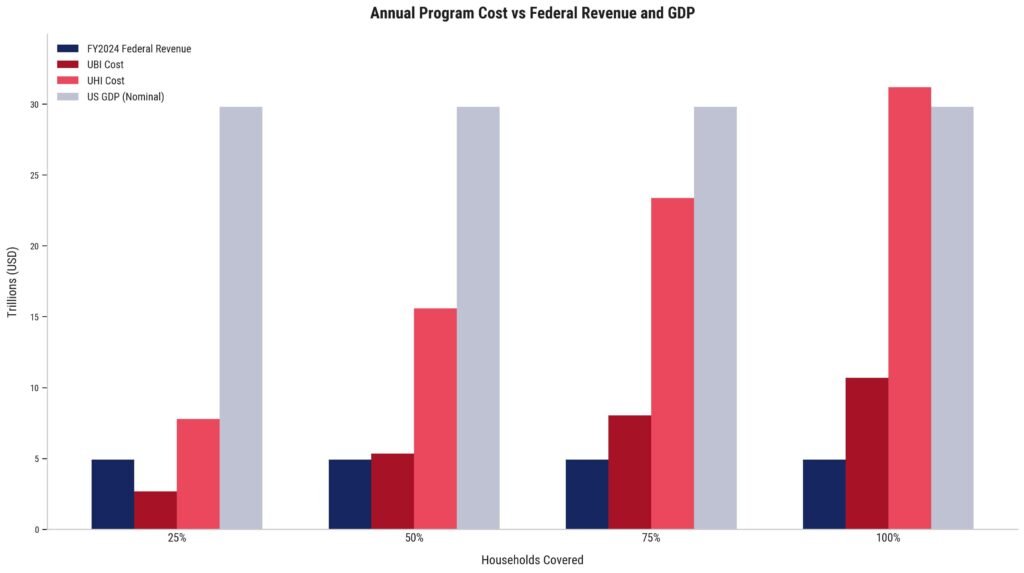
The chart below (Figure 1) shows annual cost if UBI or UHI is paid to 25%, 50%, 75%, or 100% of US households. Coverage is included to show scale and sensitivity. It is not a policy recommendation.
Figure 1 UBI and UHI Scenarios
The chart in figure 1 is used to illustrate a point: a broad UBI quickly becomes comparable in cost to the entire federal government; a “high” UHI level program becomes many times larger. Whatever a future program looks like, the US would be operating at a scale where the funding base and capture method must be designed to support an order of magnitude larger change, and put in place mechanisms to capture the AI transition gains.
What AI Productivity gains would be needed?
The term “Productivity gains” can sound abstract. In simple terms we can discuss the cost required in comparison to the share of the economy it represents.
Using the Gross Domestic Product (GDP) used to represent the Total Economic output of our country as a reference point of roughly $29.8T [5]:
UBI (100% coverage) at $10.7T is roughly 36% of today’s GDP.
UHI (100% coverage) at $31.2T is roughly 105% of today’s GDP.
So if Government wishes to implement UBI/UHI style programs the Economy must grow substantially, and the Government must create a mechanism to reliably capture these productivity gains in order to support the transfers required for these programs.
In other words, in a post AI transition economy – the AI productivity gains and value generated from AI would need to be of an enormous scale, and the collection mechanism would need to capture the value reliably in order for these programs to work.
A practical way to think about it is the “capture rate” for AI Productivity is what share of national output that ends up as public revenue. In FY2024, Federal revenue was $4.918T, which is roughly 16%-17% of GDP depending on the GDP measure used. [4][5] That gives a rough idea of what “normal” looks like today.
“It’ll be 10 times bigger than the Industrial Revolution – and maybe 10 times faster.”
Demis Hassabis, Google DeepMind
Now apply that to our UBI/UHI scenarios:
If public revenue stayed around 17% of GDP, funding a $10.7T UBI would require an economy on the order of $60T+ per year (because 17% of $60T is about $10.2T). That is roughly 2x today’s GDP.
Funding a $31.2T UHI at the same revenue share would imply an economy on the order of $180T+ per year, which is roughly 6x today’s GDP.
Those are not forecasts. They are scale checks. They show that sustaining large transfers requires either:
Much higher Tax Rates
A much larger economy (Meaning AI is going to have to create ALOT of value and productivity gains)
Lower or Narrower benefits than the “all-on” benchmarks used here.
This is why funding design matters as much as growth assumptions. The question becomes: what can the US reliably tax when labor income is no longer the central revenue base and jobs and income are increasingly lost to automation.
Funding: what can are the captures mechanisms in an AI-heavy economy?
Here we look at possible mechanisms that could be put into place in a framework that would capture the AI Productivity and fund the UBI/UHI style programs. In a post AI transition steady state, the most stable funding tends to come from bases that are broad, measurable, and hard to evade. “AI-specific” taxes can contribute, but most are better as supplements than as the backbone.
AI Productivity Capture Mechanisms
Option
What it is (plain definition)
Strengths
Weak points
Best role
A) Labor-Equivalent replacement charge
A fee based on estimated “workers replaced” by automation, meant to mimic the labor tax wedge.
Simple story: replace jobs, contribute.
Hard to define; easy to game; can reduce productivity.
Narrow/targeted use, not backbone.
B) Metered AI usage tax (tokens/compute)
An excise on AI activity (tokens, inference calls, compute-hours).
Measurable upstream; scales with usage.
Proxy for value; encourages offshoring/self-hosting; can slow adoption.
Supplement, best upstream.
C) Broad consumption tax (VAT-style + rebates)
A broad tax on spending, paired with rebates/credits to protect households.
Scales even if wages shrink; hard to avoid.
Politically difficult; regressive if not rebated.
Strong backbone candidate.
D) Capital income taxes
Higher effective taxation of dividends, capital gains, and high-end capital income.
Targets where returns may concentrate.
Volatile and gameable; cycles with markets.
Secondary pillar.
E) Corporate tax redesign
Minimum taxes and base redesign to reduce profit shifting; tax where sales occur.
Targets AI-era margins; reduces base erosion.
Complex; global tax competition.
Core pillar, but not sufficient alone.
F) Rents/royalties on bottlenecks
Tax scarce “rents” (land/location value, energy access, spectrum, possibly compute if scarce).
Efficient and stable; hard to hide.
Some bases may be too small alone; compute scarcity uncertain.
Strong pillar.
G) Citizen dividend fund
Public fund owns a slice of productive assets and pays dividends.
Durable legitimacy; broadens ownership of productivity gains.
Governance risk; takes time to build scale.
Long-run complement to taxes.
H) Debt/deficits (bridge)
Borrow to start programs before the new base is built.
Fast to deploy.
Not stable long-run; interest/credibility limits.
Bridge only.
Which Option?
The Tax Project does not comment on policy recommendations. However, a stable post-transition funding system is unlikely to rest on a single “magic tax.” It is more likely to resemble a stack. Broad consumption-based funding (Option C) is structurally strong because it scales with the economy regardless of labor share. Rent-like taxes (Option F) are also structurally strong because they target bases that cannot be moved offshore easily (land and spectrum are the clearest examples). Corporate redesign and capital income taxes (Options E and D) matter because AI-era gains may concentrate in profits and asset returns, but these are also the most contested and gameable bases, which is why they tend to work best as pillars alongside broader bases.
The AI specific ideas—charging by “labor equivalents (LE) replaced” (Option A) or metering compute/tokens (Option B) – may read well politically, but they struggle as a primary funding backbone. LE charges tend to collapse under definition and when corporations game the system, and usage taxes are proxies that can be arbitraged. This is not to say that corporations are doing anything wrong, they will naturally optimize for their circumstance. These mechanisms may still contribute at the margin, especially if applied upstream where metering is clean, but the heavy lifting usually falls to broad, durable bases and, over time, to ownership structures that turn productivity into dividends (Option G). Whatever is chosen, this will be a tricky path. There are always second order effects, and any tax can potentially harm productivity and the competitiveness of those being taxed, particularly in a global economy.
The Road Ahead: Plan now
If AI and robotics displace labor at scale, as many have predicted, the US cannot assume that today’s labor heavy tax base will keep funding the government it currently has, let alone new multi-trillion-dollar benefit programs in the form of UBI or UHI. The scale shown above implies a hard reality: sustaining UBI or UHI at meaningful coverage requires some combination of (1) a much larger economy, (2) a higher and more durable share of GDP collected as public revenue, and (3) redesigned tax bases that still work when wages are no longer the main revenue collection mechanism.
That redesign cannot be improvised in a crisis. It requires advance planning: defining viable tax bases, building administrative systems that can operate at scale, and establishing rules stable enough to survive political cycles. Even if the transition is slower than expected, the time to build a credible framework is now – these systems and the required legislature will take a good deal of time.
Tax auditing is a mechanism used by the Internal Revenue Service (IRS) to ensure compliance with the Tax Code, including tax evasion, underreporting of income, inflating deductions, and other fraudulent practices. Tax auditing plays an important role in maintaining the integrity and effectiveness of the United States’ revenue collection and ensures the equal application of Tax Code to generate revenues used to support essential government services.
This article examines tax auditing in the U.S., providing a data-driven analysis of audit processes, how businesses and individuals are audited, and the implications for tax compliance, non-compliance, and government revenue.
Internal Revenue Service and Tax Auditing
The Internal Revenue Service (IRS), established in 1862 to pay for the Civil War by collecting income taxes, administers the Federal Statutory Tax Law, the main body of which is the Internal Revenue Code (IRC), referred to as Tax Code or Tax Law, and ensures that taxpayers meet their tax obligations (1). The IRS’s mission is to “provide America’s taxpayers top quality service by helping them understand and meet their tax responsibilities and to enforce the law with integrity and fairness to all” (2).
IRS tax auditing provides a necessary function of the United States’ tax administration system, ensuring the equal compliance of America’s tax collection. The process involves examining and verifying tax returns and financial records to ensure compliance with federal tax laws.
IRS Audit Types
Tax auditing is a tool the IRS uses to verify the accuracy of tax returns and to enforce tax law. The IRS generally has two types of audits: Correspondence and Field audits.
Correspondence Audits: Correspondence Audits make up most audits, are generally automated, and most involve mail-based verification of specific issues with the Taxpayer to verify and/or correct. In FY 2022, 85% of IRS audits were correspondence audits (626,000 audits of Individuals) (3). They are common for low-income taxpayers and Earned Income Tax Credit (EITC) claimants.
Field Audits: Field Audits occur when IRS agents meet taxpayers in person for a financial review. Field audits are generally more intensive and often target higher-income individuals, businesses, and complex financial situations. Since they involve in-person examinations by IRS agents, they are resource-intensive but often lead to substantial revenue adjustments. On average, Field Audits recommended additional taxes of over $85,000 per audit while Correspondence Audits averaged $6,000 recommended additional taxes per audit (4).
IRS Audit Statistics
Typically, the IRS releases detailed statistics on tax audits and compliance activities annually in the IRS Data Book, which provides insights into the agency’s operations, including the number of audits performed in a given fiscal year (5). For instance, in Fiscal Year (FY) 2023, the IRS closed 582,944 tax return audits, resulting in $31.9 billion in recommended additional tax (6). In FY 2023, individuals made up about 76% of all IRS audits, while corporations accounted for around 24% (7). In fiscal year 2024, IRS collected about $5.1 trillion in taxes and paid out more than $553 billion in tax refunds, credits, and other payments (8).
Figure 1: Ratio of IRS Audits for Businesses and Individuals (Source: IRS)
Figure 2: Comparison of IRS Returns, Audits, and Criminal Investigations. (Source: IRS)
Taxpayers and Audits
From a taxpayer’s standpoint, audits can be time-consuming, emotional, and costly. However, most Americans believe paying taxes is a civic duty (9). Tax audits can influence taxpayers reporting honestly as they play an essential role in maintaining tax compliance and ensuring accurate revenue collection.
Many taxpayers hire professional assistance, adding to their expenses. Critics argue that audits impact honest taxpayers who must navigate complex tax laws despite making a good-faith effort to comply (10, 43).
Furthermore, the IRS already possesses vast amounts of financial data from employers, financial institutions, and third-party reports. For an estimated 40% of taxpayers, the IRS can assess tax compliance and auto-file without taxpayer submissions or audits (11). This has led to calls for automated submissions with pre-filled tax returns and automated verification systems.
Legal Tax Avoidance: Involves minimizing tax liabilities available in the tax code. This is every taxpayer’s legal right, and they may fully optimize to the extent allowable by law.
Tax Evasion: This is a criminal offense and is a specific form of Tax Fraud that focuses on illegal tax avoidance. This may include aggressive tax avoidance schemes that may leverage underreporting income, inflating deductions, or using loopholes or tax havens outside the bounds of legal avoidance.
Tax Fraud: This is a criminal offense and covers a wide range of fraudulent activities including underreporting, concealing income, or otherwise avoiding paying taxes. The main feature of tax fraud is the taxpayer’s intent to knowingly not pay taxes they know are lawfully due.
Factors Impacting Tax Audits
The IRS uses algorithms and data analytics to identify tax returns with a higher likelihood of inaccuracies or fraud (12). Taxpayers across all income levels are subject to audits, but the audit rate varies significantly based on income and other factors. For instance, the overall audit rate in 2019 was approximately 0.29%, though certain groups faced higher-than-average scrutiny (13).
Factors: Taxpayer Income
Low-Income Taxpayers: Taxpayers earning below $25,000 annually, particularly those claiming the Earned Income Tax Credit (EITC), faced an above-average audit rate of 0.78% in 2019 (14). EITC is a refundable tax credit designed to support low-to-moderate-income households. However, the IRS estimates that roughly 50% of EITC claims contain errors, contributing to the higher audit rate for this group (15). While the intention of these audits is to ensure proper payment, critics argue that the IRS’s reliance on EITC audits disproportionately affects certain demographics, especially those in low-income brackets (16).
Middle-Income Taxpayers: Individuals earning between $25,000 and $200,000 faced a relatively low audit rate, often below 0.2% (17).
High-Income Taxpayers: While historically subject to higher audit rates, high-income taxpayers saw a notable decline in audits over the past decade. For example, in 2011, approximately 7.2% of taxpayers with income above $1 million were audited. By 2018, that rate dropped to 1.6% (18). In 2021, Accounting Today reported a 72% decrease in IRS audits of millionaires over an eight-year period (19).
Factors: Unreported Income
Unreported Income: A major trigger for IRS automated systems are discrepancies between income reported and information received by the IRS (e.g., W-2s, 1099s, etc.) (20).
Factors: Excessive Deductions
Excessive Deductions: The IRS compares deductions that are significantly higher than the average taxpayers in your income bracket and raises red flags, especially deductions related to business expenses, charitable contributions, and home offices (21).
Factors: Business Losses and Deductions
Business Losses and Deductions: The IRS looks for potential underreporting of income or misclassification of hobbies as businesses that trigger scrutiny. Recurring or substantial business losses, especially for small businesses, may cause the IRS to question whether a business is a legitimate profit-seeking venture (22).
Factors: Errors and Inconsistencies
Errors and Inconsistencies: Calculation errors, typos, or missing data can trigger automated systems to flag these errors that can lead to further review (23).
Factors: Foreign Accounts / Transactions
Foreign Accounts / Transactions: The IRS places increased scrutiny on these transactions due to concerns about tax evasion. Failure to properly report foreign bank accounts or assets can contribute to higher enforcement (24)
Factors: Cash Heavy Business
Cash Heavy Business: Businesses that conduct large portions of their business in cash may draw additional scrutiny as cash transactions are hard to track and subject to underreporting (25).
Figure 4: IRS Audits of Millionaires (2012–2020)(Source: TRAC)
Audit Disparities and Bias
The IRS has been pushed for greater transparency as many of the algorithms and AI that are part of their audit selection process are not provided to the public (26). While these systems are designed to be objective, they can inherit biases based on their design or the data they’re trained on. Several factors including income, race, socioeconomic status, complexity of tax law, and proxy discrimination can occur. For example, certain zip codes or occupations may be disproportionately associated with higher audit rates (27).
Congressional Research has highlighted racial disparities in IRS audit selection (28). A 2023 study by economists at Stanford University found that Black taxpayers are audited at higher rates than other racial groups, even though the IRS does not collect or use data on taxpayer race (29). The disparity appears linked to the reliance on EITC audits, but that does not fully explain why Black taxpayers are disproportionately audited. However, it is important to note that IRS audit algorithms primarily focus on error rates and questionable claims rather than taxpayer race, which the IRS does not collect or use, and the Stanford report did not have race data but instead had to estimate race (30). While the IRS acknowledges these concerns, it has committed to addressing systemic biases in its audit selection processes (31). Modernizing data systems and refining selection algorithms are part of ongoing efforts to ensure audit fairness.
Tax Audits, Compliance and Policy
IRS Tax and Audit data inform policymakers by highlighting areas of the tax code that could improve income generation, social distribution policies, and gaps in tax code that taxpayers use through legal and non-legal means. By analyzing audit data, lawmakers can propose reforms to improve tax code efficiency and effectiveness (32).
Tax audits play a key role in maintaining compliance. By identifying errors, fraud, and underreporting, audits deter tax evasion and promote voluntary compliance. The IRS estimates that every dollar spent on tax enforcement results in several dollars of additional revenue (33).
In addition to direct revenue collection, audits also generate indirect compliance benefits. Knowing that audits are a possibility encourages taxpayers to report their income accurately and claim only legitimate deductions (34).
Overall, the gap between taxes paid and taxes legally owed is known as the “Tax Gap.” The IRS estimated in 2022 that the gross tax gap was $696 billion (35).
The Cost of Tax Compliance
The cost of tax compliance in the U.S. is a significant economic factor, affecting both individuals and businesses. These costs can be broadly categorized into direct expenses, such as paying for tax services or purchasing tax software, and indirect expenses, which include the value of time spent gathering documents and preparing returns.
The Tax Foundation estimates that American Taxpayers spend approximately $133 billion annually on out-of-pocket tax compliance expenses. Combined with the opportunity cost of time spent, the total compliance burden reaches an estimated $546 billion, nearly 2% of the entire US Economy as measured by Gross Domestic Product (GDP) (36).
Americans spend over 6.5 billion hours annually complying with tax regulations. That is the equivalent of over 3 million full-time employees for a year. This time spent represents a significant loss of productivity. The IRS and the Office of Information and Regulatory Affairs (OIRA) provide estimates of the time required to complete tax forms, and these estimates contribute to the overall calculation of compliance costs (37).
Audit Return on Investment (ROI)
Given the stress they induce and effort that is involved, are audits worthwhile? For fiscal year 2023, the IRS had a budget of approximately $14.1 billion, which includes funding for taxpayer services, enforcement (including audits), operations support, and IT modernization (38). In contrast, the IRS’s auditing and enforcement efforts generated about $39.6 billion in additional tax revenue during the same period (39). The IRS intensified efforts to collect back taxes from high-income individuals in 2024, recovering over $1.3 billion from wealthy taxpayers (40). Simply looking at the direct additional revenue alone, and not the additional revenue collected from the deterrent effect of IRS enforcement in general, comparing the approximate $40 billion in revenue against less than $15 billion in total expenses, of which audits are a fraction, the IRS has a net positive return of over $25 billion, so overall a high ROI and worthwhile endeavor. However, looking at the total cost of compliance borne by the taxpayers of the estimated $546 billion or ~2% of GDP, the net positive returns of the IRS $25 billion don’t appear to be as strong an investment (41).
Figure 5: Audit ROI (Source: FRED, Treasury, Tax Foundation, IRS)
Conclusion
Since the US Federal government moved away from tariffs as the primary source of revenue to income, payroll, and corporate taxes, compliance mechanisms became necessary (42). Tax audits, therefore, are a necessary tool of the U.S. tax system, ensuring accurate revenue collection and promoting taxpayer compliance. While audits can be burdensome, they play a crucial role in deterring fraud, promoting fairness, and supporting the nation’s services and fiscal health.
While necessary, with an estimated burden of tax compliance at ~2% of GDP (36), ongoing efforts to improve audit processes that reduce biases, lower the cost and burden on taxpayers are necessary to build trust and efficiently use taxpayer money. Ensuring transparent policies and continued advancements in data analysis, automation, and simplification, the IRS can strike a balance between enforcement, taxpayer rights, and taxpayer burden, ultimately contributing to a more effective tax system benefiting the whole country.
Tax Project Institute is a fiscally sponsored project of MarinLink, a California non-profit corporation exempt from federal tax under section 501(c)(3) of the Internal Revenue Service #20-0879422.