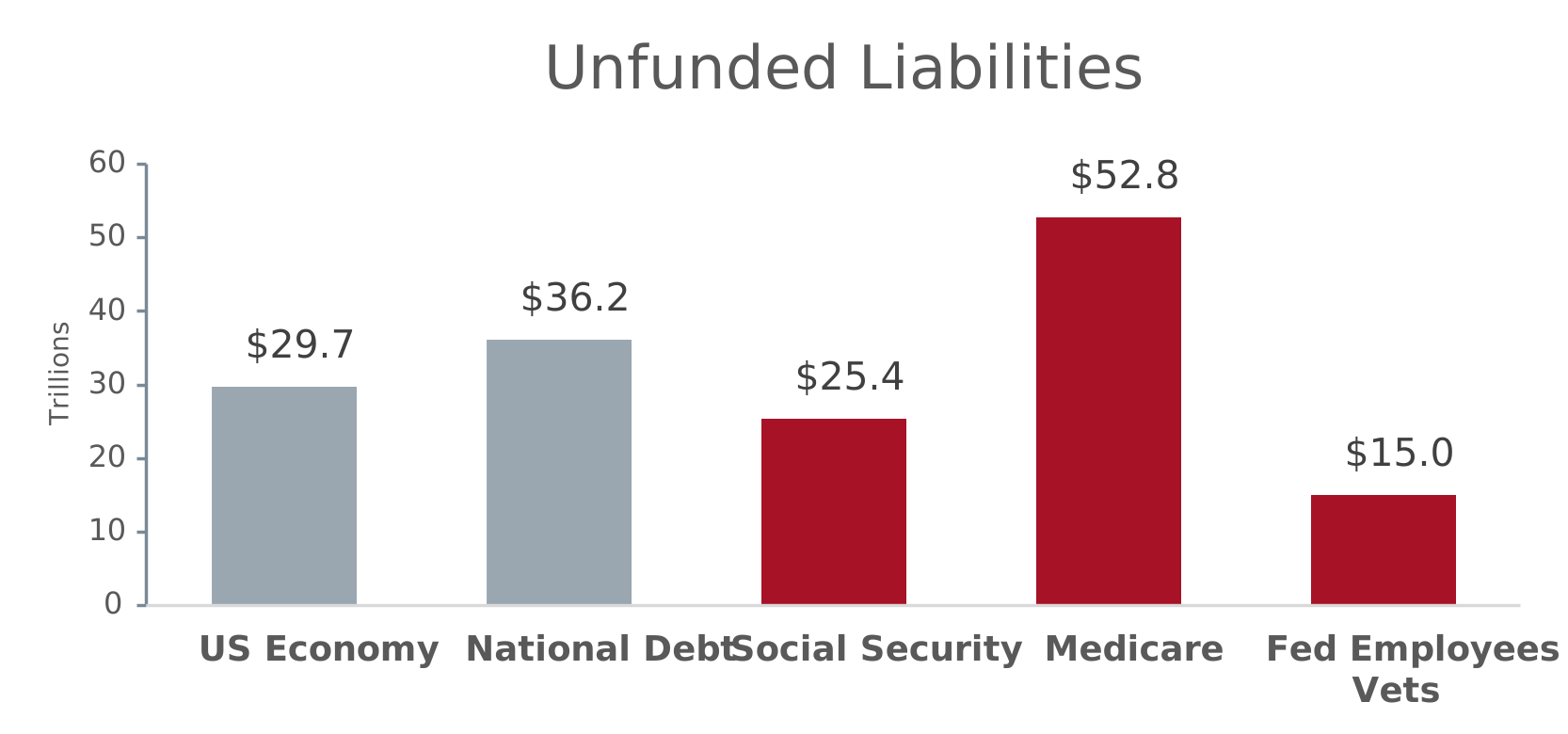
The future of the United States economy, and perhaps the equity between generations, presents an immense challenge and choice with how to manage fiscal responsibility for unfunded liabilities. The National Debt is a frequently discussed topic and people have a general awareness that it should be managed intuitively. By its very nature it is a common topic in the financial zeitgeist, much like the choppy white water on the ocean’s surface. Unfunded Liabilities though are like a hidden current beneath a calm surface, these commitments represent promises made today that lack a clear, fully funded pathway to fulfillment and are a less frequently discussed topic that may not gather attention. A segment that appeared on “60 Minutes” with Federal Reserve Chairman Jerome Powell discussed the economy and if the National Debt is a danger to the economy. Powell denoted that in the long run “the US is on an unsustainable fiscal path” and that we are “borrowing from future generations.” To be fair this question was related to the National Debt and does not even address Unfunded Liabilities which only compounds the challenge. This begs to question whether the current generation is making a “Faustian Bargain,” are we trading long-term societal health and prosperity for short-term comfort by deferring policy decisions.
To answer this question, we must first understand what unfunded liabilities are, their colossal scale, how they fit into the overall fiscal health of our country, and their implications for the future.
What are Unfunded Liabilities?
In simple terms, an unfunded liability is a future financial obligation for which there is no sufficient pre-existing asset or dedicated revenue stream. Unlike the national debt, which represents accumulated past borrowing, unfunded liabilities are projections of future shortfalls in programs the government is legally or morally committed to. These often involve long-term entitlement programs where the present value of future promised benefits far exceeds the present value of projected future revenues.
Main components of the U.S. Unfunded Liabilities:
• Social Security: The Old-Age and Survivors Insurance and Disability Insurance (OASDI) programs, which provide retirement, disability, and survivor benefits. • Medicare: The federal health insurance program for people 65 or older, certain younger people with disabilities, and people with End-Stage Renal Disease (ESRD). This includes Hospital Insurance (Part A), Supplementary Medical Insurance (Part B), and Prescription Drug Coverage (Part D). • Federal Employee and Military Retirement Benefits: Pensions and other post-retirement benefits for civilian federal employees and military personnel. • Veterans’ Benefits: Compensation, pensions, healthcare, and other support for veterans and their families. These are not merely accounting entries; they represent promises made to millions of Americans—promises that, under current law and demographic projections, cannot be met without significant adjustments.
The Colossal Bill: Quantifying the Unfunded Commitments
The scale of these unfunded liabilities is staggering, dwarfing the already formidable national debt. The most comprehensive and authoritative source for these figures is the Financial Report of the United States Government, prepared annually by the U.S. Department of the Treasury in coordination with the Office of Management and Budget (OMB), and audited by the Government Accountability Office (GAO) [1]. It is crucial to note that these figures are typically presented as “present values” over a 75-year projection period, meaning future shortfalls are discounted to their equivalent value in today’s dollars.
As of the 2024 Financial Report of the United States Government (released February 2025) [1]:
• Total Social Insurance Net Expenditures (primarily Social Security and Medicare): This combined shortfall represents the largest portion of the nation’s unfunded liabilities. For Fiscal Year 2024, this amounted to approximately $78.3 trillion over a 75-year projection period [1]. This figure alone is more than twice the total annual Gross Domestic Product (GDP) of the entire U.S. economy.
Let’s break down the two giants within this category:
• Social Security (OASDI): The 2024 Social Security Trustees’ Report indicates an unfunded obligation of approximately $25.4 trillion over the 75-year projection period [2, 3]. Without legislative action, the Old-Age and Survivors Insurance (OASI) Trust Fund is projected to be able to pay 100 percent of scheduled benefits until 2033. After that, it will only be able to pay about 79 percent of scheduled benefits from continuing income [3].
• Medicare (Parts A, B, & D): Medicare’s unfunded liability is even larger. The 2024 Medicare Trustees’ Report projects an unfunded obligation of approximately $52.8 trillion over the 75-year period [1, 3]. The Hospital Insurance (HI) Trust Fund (Medicare Part A) is projected to be able to pay 100 percent of scheduled benefits until 2036, after which it will be able to pay about 89 percent [3]. Medicare’s financial challenges are exacerbated by rising healthcare costs and an aging population. Beyond these primary social insurance programs, other significant unfunded commitments contribute to the overall fiscal picture:
• Federal Employee and Veteran Benefits Payable: These represent accrued liabilities for pension and other post-retirement benefits for civilian federal employees and military personnel, as well as veterans’ compensation and burial benefits. The 2024 Financial Report of the United States Government reports $15.0 trillion for “Total Federal Employee and Veteran Benefits Payable” on the government’s balance sheet [4]. It is important to distinguish that this is a balance sheet liability, reflecting accrued benefits to date, rather than a 75-year actuarial projection of all future shortfalls like Social Security and Medicare. However, it still represents a significant long-term commitment that needs to be funded.
• Other Unfunded Plans and Liabilities: While less dramatic in scale compared to Social Security and Medicare, other programs carry unfunded aspects. Examples include certain aspects of Medicaid (a jointly funded federal-state program where federal mandates can create unfunded burdens on states), and some federal loan programs or insurance commitments where future payouts could exceed reserves. The concept of “unfunded mandates” on states, for instance, like those related to environmental regulations or disability access, effectively shifts federal obligations to local governments, creating their own set of fiscal challenges [5]. Due to the diverse nature of these obligations and the varied methods of accounting for them (ranging from spending projections to contingent liabilities or balance sheet entries), there isn’t a single, universally accepted, aggregated dollar amount for “Other Unfunded Plans and Liabilities” that directly compares to the 75-year present value projections for Social Security and Medicare. While they contribute to the nation’s broader fiscal challenges, the most authoritative reports primarily focus their explicit “unfunded liability” calculations (in terms of present value of future shortfalls over 75 years) on the major entitlement programs of Social Security and Medicare. When considering the total picture of long-term fiscal imbalance, beyond just Social Security and Medicare, some broader analyses, such as those from the Penn Wharton Budget Model, project an “infinite horizon fiscal imbalance” (covering all current and future generations) that could reach $162.7 trillion as of 2024 [6]. This figure underscores the true magnitude of the nation’s fiscal challenge.
Diagram 1 Source: US Treasury
Unfunded Liabilities in the Context of the National Debt
It’s crucial to understand the relationship between unfunded liabilities and the national debt. The national debt is the total accumulated outstanding borrowing by the U.S. Federal Government over the nation’s history. As of May 8, 2025, the U.S. national debt stands at approximately $36.21 trillion [7]. While the national debt is the sum of past deficits, unfunded liabilities represent promises for future spending that are not yet financed or due. However, they are deeply intertwined. As entitlement programs like Social Security and Medicare mature, their unfunded portions translate into increasing demands on the federal budget. When current revenues are insufficient to cover these mandated benefits, the government must either increase revenue by raising taxes, or borrow to make up the difference, thereby adding to the national debt. The national debt is the manifestation of yesterday’s unfunded promises and ongoing spending decisions. Unfunded liabilities are the future promises that, unless addressed, will become tomorrow’s addition to the national debt. This perpetual cycle creates a growing burden.
The Impact on Future Generations: A Faustian Bargain?
The profound question at the heart of this fiscal dilemma is whether current generations are making a “Faustian Bargain” with future generations.
Faustian Bargain: The term “Faustian Bargain” originates from the classic German legend of Faust, a scholar who, disillusioned with the limits of human knowledge, makes a pact with the demon Mephistopheles (i.e., Deal with the Devil). In exchange for limitless knowledge, worldly pleasures, and power for a set period, Faust agrees to surrender his soul to the devil. The essence of a Faustian bargain is a trade-off: an immediate, often enticing benefit or power, at the cost of something valuable, often an intangible, moral, or spiritual value eventually. The bargainer often recognizes the malevolent nature of the deal and its ultimately tragic or self-defeating outcome [8].
Answering the Question?
Are current generations, by failing to address the growing unfunded liabilities, effectively making a Faustian bargain? The “immediate benefit” is the continued receipt of promised Social Security, Medicare, Pensions, and other benefits to current generations without politically painful reforms and in essence transferring that burden to future generations. So unlike Faust who received the benefit and had to deal with the consequence, the current generation will receive the benefit without the consequence. Meaning the current generation can pass the consequences on by doing nothing.
Americans should expect promises made to be kept, and short falls in funding are a recurring no fault event. However, if the goal is to promote long term health and prosperity than something should be done. Politicians aren’t motivated to push to address this political third rail that would involve either raising taxes, cutting spending, reducing benefits, raising eligibility ages or likely a combination of these. So much like the song Freewill by the band Rush, “If you choose not to decide, you still have made a choice.” By doing nothing, the current generation is passing this burden on.
What happens if we don’t address?
This may be more of a moral dilemma than fiscal question as the fiscal health and economic opportunity of future generations is at stake with the most severe impact on future generations. If unchecked, the escalating unfunded liabilities will lead to:
• Higher Taxes: Future generations will likely face higher taxes to cover these mounting obligations. This could stifle economic growth, reduce disposable income, and limit their ability to save and invest. • Reduced Government Services: As a greater portion of the budget is consumed by mandatory entitlement spending (making up large portions of the unfunded liabilities) and interest on the debt, less funding will be available for other crucial public services like education, infrastructure, research and development, and national defense—investments that are vital for future prosperity and competitiveness. • Slower Economic Growth: High levels of public debt and unsustainable entitlement programs can crowd out private investment, and lead to slower overall economic growth. This means future generations will inherit a less dynamic economy with fewer opportunities. • Intergenerational Inequity: The burden is disproportionately shifted to younger and future generations, who will pay into systems that may offer them fewer benefits than the US is currently providing. This raises fundamental questions about fairness and the social contract between generations. • Reduced Fiscal Flexibility: The government’s ability to respond to unforeseen crises (economic downturns, pandemics, wars) will be severely constrained if a large portion of its budget is already locked into mandatory spending and debt service. How can this be addressed? In short, not very easily. The pathway to addressing would likely require a combination of policy choices that include: • Reforming Entitlement Programs: This could involve adjusting eligibility ages, modifying benefit formulas, introducing means-testing, or reducing benefits for programs like Social Security and Medicare. • Controlling Healthcare Costs: Addressing the underlying drivers of healthcare inflation is critical for the long-term solvency of Medicare. Finding efficiencies will mitigate the risk. • Increased Revenue: This might involve tax increases and must be balanced carefully to consider the impact on economic growth. • Economic Growth: A stronger economy generates more tax revenue and helps to manage debt more effectively. Economic growth will ease fiscal challenges across the board.
What is the Cost?
The 2024 Financial Report of the U.S. Government highlights a “75-Year Fiscal Gap” of 4.3% of GDP [1]. This means there is a short fall in revenue to fund programs that will require some combination of reduced spending, reduction in services, higher taxes, and hopefully some higher revenue due to growth. To truly grasp the magnitude of this challenge, let’s contextualize and estimate per citizen in Table 1. Using a rough estimation if we apply that 4.3% gap to a 40 hour working week you get about 1.72 hours a week of extra contributions needed to pay for the gap.
Program
Cost
Cost per Citizen
Social Security (OASDI)
$25.4 Trillion
$76 Thousand
“Medicare (Parts A, B, & D)”
$52.8 Trillion
$157 Thousand
Federal Employee & Veteran Benefits
$15 Trillion
$44 Thousand
Other Unfunded Liabilities
?
?
Total
$93.2 Trillion
$277 Thousand
Table 1
Conclusion
It is right to be skeptical of 75 year government estimates, and a lot can happen and change in that period. However, the challenges are very real and will ultimately manifest themselves in unpleasant ways unless acted upon. Like the seemingly harmless slow drip of water that over time can be tremendously powerful carving canyons and moving mountains. The moral dilemma of addressing the issue head on or pushing it to another generation will present difficult choices for citizens and leaders. The solutions will likely require making tough trade offs and sacrifices. The Faustian Bargain of immediate gratification and deferring tough choices shifts the primary cost, long-term well-being and opportunities on to future generations. Ignoring this challenge today has ethical and economic ramifications that will resonate for decades.
The challenge is immense, but not insurmountable. The question is whether today’s leaders and citizens possess the foresight, will, and courage to confront these head-on, or if we continue to make a Faustian bargain, leaving future generations to pay the price. The choices we make today will define the economic destiny and intergenerational equity of tomorrow.
References
[1] Treasury: 2024 Financial Report of the United States Government. https://fiscal.treasury.gov/files/reports-statements/financial-report/2024/full-financial-report.pdf [2] Social Security Administration (SSA): 2024 Annual Report of the Board of Trustees of the Federal Old-Age and Survivors Insurance and Federal Disability Insurance Trust Funds. https://www.ssa.gov/oact/tr/2024 [3] U.S. Department of the Treasury: Fact Sheet: 2024 Social Security and Medicare Trustees Reports. https://home.treasury.gov/system/files/136/TR-2024-Fact-Sheet.pdf [4] Treasury: Note 13. Federal Employee and Veteran Benefits Payable from the 2024 Financial Report of the United States Government notes section. https://fiscal.treasury.gov/files/reports-statements/financial-report/2024/notes-to-the-financial-statements13.pdf [5] Wikipedia: Unfunded Mandate https://en.wikipedia.org/wiki/Unfunded_mandate [6] Penn Wharton Budget Model: Complete Measures of U.S. National Debt. https://budgetmodel.wharton.upenn.edu/issues/2025/1/27/complete-measures-of-us-national-debt [7] Treasury: Understanding the National Debt. https://fiscaldata.treasury.gov/americas-finance-guide/national-debt/ [8] Britannica: Faustian bargain. https://www.britannica.com/topic/Faustian-bargain [9] United States Census Bureau: U.S. and World Population Clock. https://www.census.gov/popclock/
In the complex landscape of federal spending, transparency and accountability are paramount. Recent revelations regarding trillions of dollars in untraceable funds have ignited a renewed call for rigorous oversight. Enter the Locating Every Disbursement in Government Expenditure Records (LEDGER) Act, a bill sponsored by Senator Rick Scott (R-FL) and Roger Marshall (R-KS), aiming to overhaul the U.S. Department of the Treasury’s payment tracking system. This legislation promises to shed light on the often opaque world of government disbursements and bring increased visibility to taxpayer dollars.
A Push for Fiscal Responsibility
The LEDGER Act was introduced as a measure to increase transparency in federal spending. The bill aims to provide greater clarity on how taxpayer dollars are spent, and to reduce the possibility of waste, fraud, and abuse. This legislation is part of an ongoing effort to push for greater fiscal responsibility within the Federal Government. The pending legislation, while still not law, if passed could significantly strengthen transparency, and accountability.
The Impetus: DOGE Report $4.7 Trillion Dollar Revelation
The genesis of the LEDGER Act can be traced to a Government Accountability Office (GAO) report, often referred to as the “DOGE” report (Department of the Treasury’s Government-wide Funds). This report denoted $4.7 trillion in federal payments lacking proper traceability codes, raising serious concerns about the government’s ability to track and account for its spending.
The GAO’s findings delved into the Treasury’s processes for recording and categorizing federal payments. They found that a significant portion of disbursements were not being assigned the necessary codes to identify the purpose, source, and recipient of the funds. The Treasury uses Treasury Account Symbols (TAS) to tie payments to budget-level items, however, many TAS fields, that are optional, were left blank. This created a massive blind spot, making it impossible to trace the money trail in a detailed, transaction-by-transaction manner. The GAO found this by analyzing the raw data coming from the treasury, and finding gaps in the transactions with TAS data recorded, that would allow for proper tracking.
This revelation highlighted a significant gap in the Treasury’s financial management. Without proper traceability codes, it becomes exceedingly difficult to follow the money trail, increasing the risk of waste, fraud, and abuse. The DOGE revelation served as a reminder of the need for enhanced transparency and accountability in Federal spending.
What the LEDGER Act Does: A Transaction-Level Revolution
The LEDGER Act seeks to address the shortcomings identified in the DOGE report by mandating the implementation of a comprehensive traceability code system for all federal payments. While there are no specific implementation details at this time, if passed the bill is passed, based it’s stated intent and the GAO report’s findings, it is likely the bill will require the Treasury to track each individual payment transaction with specific metadata. This metadata would likely include:
Purpose of Payment: A clear description of what the funds were used for.
Funding Source: Identification of the specific agency, program, or appropriation that funded the payment.
Vendor or Recipient: Details about the entity or individual receiving the payment.
Contract or Grant Numbers: Relevant identifiers for contracts or grants associated with the payment.
Date and Time of Transaction: Precise timestamps for each payment.
This level of granularity would create an audit trail, allowing for detailed analysis of federal spending patterns. The LEDGER Act is likely to enhance the Treasury Account Symbol (TAS) system, by making the optional fields required, and adding greater detail to the TAS system. The administration has since mandated the use of this field. See our Article on Modernizing Government Financial Systems and use of Hyperledger technology.
Implementation: A Transformation of Treasury Operations
If passed, the LEDGER Act would require a significant transformation of the Treasury’s payment processing systems. The Treasury would be tasked with:
Developing and Implementing Traceability Codes: Creating a standardized system of codes that can be applied to all federal payments.
Integrating with Existing Systems: Modifying existing payment systems to accommodate the new traceability code requirements.
Establishing Data Standards: Defining clear and consistent data standards for the traceability codes to ensure accuracy and uniformity.
Creating a Centralized Database: Developing a centralized database to store and manage the transaction-level data.
Developing Reporting Tools: Creating tools that allow agencies, auditors, and oversight bodies to generate reports and analyze spending patterns.
Providing Training: Training federal employees on the new traceability code system and data entry procedures.
Oversight and Auditing: Creating a system that allows for regular audits and oversight of the new systems.
This would likely involve investment in technology, software development, and training. The Treasury would need to work closely with other Federal agencies to ensure seamless integration and data sharing.
A New Era of Visibility and Accountability
The LEDGER Act promises to usher in a new era of visibility and accountability in federal spending. By providing transaction-level data, it would enable:
Enhanced Auditing: Accountants and auditors would have access to detailed transaction records, making it easier to identify errors, irregularities, and potential fraud.
Improved Management: Agency managers would have real-time insights into spending patterns, allowing them to make more informed decisions.
Increased Government Oversight: Oversight bodies and lawmakers would have the tools to scrutinize federal spending and hold agencies accountable.
Greater Public Transparency: The public would have access to more detailed information about how their tax dollars are being spent.
Government Accounting:
Our Federal Government has a maze of accounting systems, and tools to track Federal Spending. The Federal government discloses portions of this data on various websites based on the type of spending. They are generally broken down in these categories:
Awards: These represent funds given to non-federal entities, such as contractors, grantees, and loan recipients. Significant budget items included in awards are; federal contracts to private companies for military equipment, or infrastructure, and grants to state and local governments for programs.
Accounts: These represent all federal spending, including internal agency operations, such as employee salaries, and operating expenses. Significant budget items included in accounts are; military personnel pay, Social Security payments, and Medicare payments.
Public Disclosure and how the LEDGER Act changes differ from Other Systems
The LEDGER Act’s focus on transaction-level detail sets it apart from existing Federal spending data systems:
Federal Procurement Data System (FPDS): This system focuses specifically on Federal procurement awards, which are contracts for goods and services. While FPDS provides detailed information on these contracts, it does not track other forms of federal spending, such as grants or loans, and it does not provide transaction-level details. (FPDS.gov)
USASpending.gov: This website aggregates data from FPDS and other sources to provide a broader view of federal spending. However, it only includes a subset of total federal spending. It excludes classified information, personally identifiable information (PII), and some proprietary data. Furthermore, according to the GAO USAspending.gov has billions in transactions each year that are listed as unreported by agencies, where no data or visibility is made to the public, highlighting a lack of transparency. While it does show some account level spending, it is designed to show award spending and does not contain transaction level detail. (USAspending.gov)
U.S. Treasury Fiscal Data: This data provides a comprehensive overview of the entire federal budget, including revenue, spending, and debt. However, it does not offer the granular, transaction-level detail that the LEDGER Act would provide. It shows high level financial information. (FiscalData.Treasury.gov)
The LEDGER Act would complement these systems by providing a deeper layer of accountability. It would allow for a more comprehensive understanding of how federal funds are being used, from the initial award to the final payment.
Is this a Big Deal?
At the Tax Project Institute our goal is to educate the public on what citizens contribute to our country and the transparency of how our government spends their contributions. While it may seem somewhat shocking that there is so little oversight that $4.7 Trillion dollars is untraceable, it really should not come as much of a surprise given that the TAS codes had been made optional. Additionally, the Government has a number of checks in place, like the GAO and our Improper Payments (including Fraud) Tracking Systems (Figure 1), that perform audits and account for weaknesses in controls and processes, and call out places for Government improvement. What is most concerning is the lack of accountability and controls to address these findings that these processes find. For example Government agencies are required by law to report spending to USASpending.gov but yet in a GAO audit only 103 of 152 agencies reported (68%) (Figure 2).
As of this date, the USASpending.gov site shows trillions in “Unreported” data from 2017 (as far back as it goes) to date.
Year
Unreported Amount (Billions)
2017
$97.9
2018
$43.8
2019
$31.8
2020
$70
2021
$131.8
2022
$137.1
2023
$147.4
2024
$164.5
2025
$37.9
We should note, that there has been significant progress in these numbers recently, indicating a new emphasis and progress in this area. You can use the USASpending.gov site or the enhanced version available from the Tax Project Institute (Requires Free Registration)
So bottom line, is it a Big Deal? – no, while shocking the revelations really aren’t anything new, but the chance of getting the ONLY source of Federal Government Wide spending at the transaction level, with enforcement of record keeping to trace all payments to budget line items is a very big deal indeed and could go down ultimately as a landmark in Government Transparency.
Conclusion: A Step Towards Ongoing Fiscal Transparency
The LEDGER Act represents a significant step towards greater fiscal responsibility and transparency in federal spending. By mandating transaction-level tracking, it would provide unprecedented visibility into how taxpayer dollars are being used. While implementation may require significant effort and investment, the potential benefits in terms of accountability and oversight are substantial.
The bill’s success, if passed, will depend on the Treasury’s ability to develop and implement a robust process to ensure ongoing enforcement of traceability code system. However, if successful, the Locating Every Disbursement in Government Expenditure Records (LEDGER) Act would be a crucial piece of ongoing government transparency, ensuring that taxpayer dollars are used wisely and efficiently.
As the Trump administration continues to make headlines with its approach to governance, one of the most contentious issues has been the Department of Government Efficiency (DOGE), led by tech billionaire Elon Musk. At the Tax Project Institute, we remain committed to our core mission of promoting government spending transparency, ensuring that American citizens have access to the data they need to make informed decisions about how their tax dollars are spent.
The recent flurry of developments surrounding DOGE has raised questions about its scope and transparency. While government watchdog groups have expressed concerns about the agency’s operations and potential conflicts of interest, we at the Tax Project Institute do not condone any actions that may violate laws or harm individuals and organizations. However, we are interested in seeing more data become available to the public.
DOGE Mission
DOGE was established by President Trump through an executive order, with the stated goal of modernizing federal technology and software to maximize governmental efficiency and productivity. Despite this narrow focus, critics argue that the agency’s broader mission to cut government waste and slash federal regulations could have far-reaching implications. While we may not agree with DOGE’s approach, we welcome the potential for increased transparency and data availability that could arise from its activities.
At the Tax Project Institute, we believe that transparency is essential for a functioning democracy. It allows citizens to hold their government accountable and make informed decisions about public policies. Unfortunately, instead of receiving comprehensive and systematic information about government expenditures, we often rely on sensational news stories to glean insights into how American tax dollars are being spent. The lack of transparency forces us to piece together fragments of information from various sources, including the pieces emerging from DOGE.
Transparency for All
We hope that as DOGE continues its work, more data will be made officially available to the public. This would align with our mission to empower American citizens by providing them with the information they need to make informed choices. Whether one supports or opposes specific government spending initiatives, it is their right to know how their tax dollars are being used. This principle is fundamental to democratic governance and ensures that citizens can hold their elected officials accountable for fiscal stewardship.
The creation of DOGE, with its stated goal of making cuts to the federal budget and workforce, has sparked intense debate. While some may view this initiative as a necessary step towards fiscal responsibility, others see it as a threat to essential public services and jobs. Regardless of one’s stance on these policies, it is crucial that citizens have access to accurate and detailed information about government spending.
Transparency in government spending is not merely a matter of principle; it has tangible benefits for democracy. When citizens are well-informed about how their tax dollars are allocated, they can engage more effectively in public discourse and participate in decision-making processes. This engagement fosters a more accountable government, as policymakers are more likely to align their actions with public priorities when citizens are actively monitoring their activities.
Moreover, transparency can help reduce corruption and mismanagement of funds. By making budget information easily accessible, governments can deter corrupt practices and ensure that resources are allocated efficiently. This is particularly important in the context of tax expenditures, where a lack of transparency can obscure the impact of tax policies on economic outcomes.
Tools like USAspending.gov and other fiscal data platforms have made significant strides in providing insights into federal spending. However, there is still room for improvement. At the Tax Project Institute, we advocate for policies that ensure American citizens have access to comprehensive and reliable data on government expenditures. By promoting transparency, we can build a more accountable and responsive government that truly serves the interests of all Americans.
Summary
In conclusion, while the Trump administration’s approach to reform may be contentious, our focus at the Tax Project Institute remains on the core principle that citizens have a right to know how their government operates and allocates resources. We hope that initiatives like DOGE will lead to more official data releases, reducing reliance on sensational news leaks and fostering a more informed and participatory citizenry. By advocating for greater transparency, we aim to empower Americans to engage more actively in their democracy, fostering a more accountable and responsive government.
The question seems simple enough: how much does the government spend each year? Yet, the answer is surprisingly elusive. Unlike your household budget, the vast and complex nature of government spending makes it incredibly difficult to pin down a single, definitive number. This lack of transparency can be frustrating for taxpayers and undermines trust in government institutions.
There have been efforts to improve this transparency. The Freedom of Information Act (FOIA) allows citizens to request government documents, including spending data. The Data Act of 2014 standardized federal spending data formats, making it easier to compare and analyze. Websites like USASpending.gov offer a wealth of information on federal outlays and obligations.
However, even with these advancements, challenges remain.
A Maze of Numbers:
Conflicting Reports: Imagine asking three friends how much they spent last month and getting three different answers. The Government Accountability Office (GAO), Office of Management and Budget (OMB), Treasury, Federal Procurement system, and USASpending.gov might all report different spending figures. This can be attributed to variations in methodology, timing, and the data source used.
Budgeting vs. Spending: The government operates on a budget cycle, outlining planned spending for the year. However, actual spending (outlays) can differ from budgeted amounts due to factors like delays, adjustments, and economic fluctuations.
Appropriations vs. Outlays: Appropriations are the legal authorization to spend money, while outlays are the actual payments made. While appropriations represent future spending, outlays reflect past spending.
USASpending.gov: A step forward, but not the finish line
This government website is a valuable resource, providing detailed breakdowns of federal spending by agency, budget function, program, and even specific contracts. However, a crucial distinction exists: USASpending.gov primarily displays obligations, which are commitments to spend money, rather than actual outlays (spend).
While obligations provide insight into planned spending, they don’t tell the whole story. It can take months or even years for obligated funds to be fully spent, if at all. This mismatch between what USASpending.gov shows and the numbers reported by other agencies can be confusing.
The Trust Factor:
This lack of clear and consistent data on government spending erodes public trust. For example, for Fiscal Year 2023 the OMB shows $6.1Trillion in spending, and USASpending.gov shows $9.3Trillion. A more than 50% budget spending delta, trusting a 3+ Trillion difference makes it hard to comprehend how you could rely on these figures as accurate. In fact, when the Government Accounting Office(1) (GAO) audited the data on USASpending.gov they found that only 10 of 37 reporting groups had “high” quality data. What’s worse is how they defined high quality – meaning error rates up to 20%. Needless to say if a CEO or CFO signed off on their corporate records being off by 20% there is a good chance they could wind up in jail. Additionally, USASpending.gov has billions in “unreported” spending each year even though Federal agencies are legally mandated to supply the data. At TPI, we find that having Contractual Obligations instead of actual spend on USASpending.gov is somewhat misleading in the first place. Don’t get us wrong, it’s a step forward that the data is available, but name the site USAContracts.gov or something other than spend. Taxpayers deserve to know where their hard-earned money goes, and the current complexity makes it difficult to hold elected officials accountable.
The Tax Project Institute: Championing Transparency
The Tax Policy Project Institute (TPI) is a non-partisan organization working to bridge this gap. They believe in the power of accessible, user-friendly data. TPI aims to transform the way government spending information is presented, making it easier for the public to understand and use.
Demystifying the Data:
TPI’s approach involves:
Standardization: Working to ensure all government agencies use consistent data formats and definitions.
Data visualization: Creating user-friendly charts and graphs to make complex information more digestible for the average citizen.
Interactive tools: Developing online tools that allow users to easily explore and analyze government spending data.
Public education: Raising awareness about the importance of transparent government spending and empowering citizens to engage with the data.
By simplifying access to reliable information, TPI empowers taxpayers to become active participants in the democratic process. Understanding where their money goes fosters trust in government institutions and encourages informed dialogue about our nation’s fiscal priorities.
The Road to Transparency
While significant progress has been made, the quest for clear and consistent information on government spending continues. While we give our Government significant credit for the strides it has made in openness, transparency, and access to data, it is clear there is still a long way to go. By utilizing innovative data management practices and user-centric design, organizations like TPI are paving the way for a more transparent future. With readily available, trustworthy data, citizens can hold government accountable and work together to ensure responsible use of public funds. Then, hopefully, we can answer a simple question: how much does the government spend?
Tax Project Institute is a fiscally sponsored project of MarinLink, a California non-profit corporation exempt from federal tax under section 501(c)(3) of the Internal Revenue Service #20-0879422.