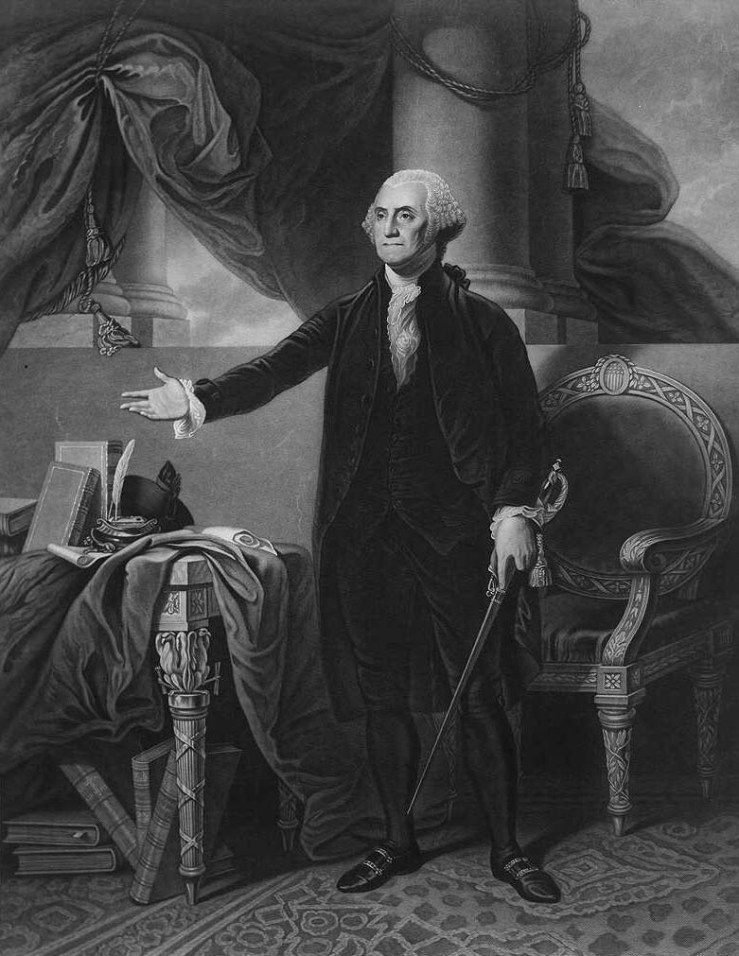
Most presidential farewell addresses look backward. They recount accomplishments, defend decisions, and try to shape how history will remember a presidency. George Washington’s Farewell Address was different. It was less a retrospective than guidance to a young Nation. Published in September 1796 as a public letter rather than delivered as a live speech like today, it offered guidance on how to preserve the American republic after its founding generation stepped away.[1][2]
The address, with editing help from James Madison and Alexander Hamilton, displays remarkable foresight and still carries unusual weight today into the thinking of our founders. The U.S. Senate, to this day, continues the tradition of reading Washington’s Farewell Address each year, a practice that began during the Civil War in 1862 and later became an annual observance. The endurance of that ritual says something important: Americans have long viewed the address not as a ceremonial relic, but as a durable statement of civic instruction.[3][4]
The address speaks to several areas that were warnings to our young Nation, a recipe of sorts for the preservation of our union, knowing that each area created perils to the future of the American experiment. Among its most striking warnings was on the uses and perils of Debt.
Not Anti-Debt but Anti-Habitual Debt
Washington did not argue that all public borrowing is bad. In fact, he said the opposite at the outset. Public credit, he wrote, should be cherished as “a very important source of strength and security.”[5] That is a practical, not ideological, statement. A nation with sound credit has built trust and can respond to crisis, finance urgent needs, and command greater confidence at home and abroad.
However, Washington framed limits around that principle. Public credit should be used “as sparingly as possible.” Expenses should be avoided where possible through peace. Necessary spending to prepare for danger can be justified if it prevents larger future costs. What he opposed was the casual accumulation of debt and the temptation to push the burden onto future generations.[5]
His warning remains one of the clearest fiscal statements from the founding era: debt may at times be necessary, but necessity is not the same thing as normalization.
Generational Responsibility
The moral center of Washington’s debt passage is not really about accounting. It is about responsibility across generations. He urged the country to avoid “the accumulation of debt” and not to throw upon posterity “the burden which we ourselves ought to bear.”[5]
That line matters because it frames debt as more than a balance sheet item. It raises a civic question. What obligations is one generation entitled to hand to the next? Washington’s answer was not that future generations should never bear any burden. Wars and emergencies could make borrowing unavoidable. His point was that citizens and leaders should not do so lightly, and certainly not for convenience, or political ease.[5]
That is a more serious standard than much of modern fiscal debate. Too often, debt is discussed as polar absolutes that are either harmless or inherently catastrophic. Washington took a narrower and more disciplined view. Debt was neither good nor bad in itself. It was a tool. Its legitimacy depended on purpose, restraint, and repayment.
Debt then Taxes
Washington also stated a harder truth that remains politically unwelcome: debt does not remove costs. It delays and redistributes them. In the Farewell Address, he wrote that “towards the payment of debts there must be revenue; that to have revenue there must be taxes.” So in that way he calls out the obvious, with debt spending, it must be paid for an that invariably means taxes. He added that taxes are always, to some extent, “inconvenient and unpleasant,” and that citizens should judge revenue measures with candor because these choices are inherently difficult.[5]
“towards the payment of debts there must be revenue; that to have revenue there must be taxes.”
George Washington, Farewell Address
That passage is unusually blunt. Washington was telling the public that self-government requires honesty. Borrowing may spare current voters from immediate sacrifice, but it does not repeal the underlying math. Public debt must be serviced through some combination of taxation, reduced future flexibility, inflationary pressure, or tradeoffs elsewhere in the budget. His point was not just aimed at officeholders. He said public opinion itself must cooperate.[5]
That is one reason the address remains so relevant. Washington understood that fiscal irresponsibility in a republic is rarely the work of leaders alone. It often reflects a public culture that wants the benefits of government without the costs.
Why this mattered in 1796
Washington’s warning came from recent experience, not abstract theory. The United States emerged from the Revolutionary War with serious debts and fragile finances. Building national credit was one of the major tasks of the early federal government. A weak republic with poor credit would be less secure, less stable, and less capable of handling future emergencies. That helps explain why Washington treated public credit as an asset worth preserving.[2][5]
At the same time, the 1790s had already shown how contentious taxation could become. The new federal government had to raise revenue, and those efforts were politically explosive. Washington had seen firsthand that taxes were unpopular, that national obligations were real, and that public finance could become a direct test of whether citizens were willing to sustain the institutions they claimed to support.[5]
So his debt warning was built on a dual lesson from the founding era: a republic needs credit, but it also needs fiscal discipline.
Why it matters more now
That warning lands differently when federal debt has grown to levels the founding generation could scarcely have imagined. According to Treasury’s Debt to the Penny data, total federal debt outstanding stood over $39.0 trillion as of April 2, 2026.[6] (See the Tax Project’s Debt Clock app)
That number alone does not settle every policy argument. Modern states can carry large debts for long periods. But scale matters. At some point, debt begins to reduce fiscal room, raise financing burdens, and constrain future choices. It becomes harder to respond to recession, war, or emergency when so much capacity is already spoken for. Washington’s concern was not simply that debt exists. It was that a free people might grow accustomed to living on borrowed capacity and presenting the bill later.[5][6] Washington’s warning makes more sense in some ways in modern context as the interest payments on the current US National Debt now exceed $1 trillion dollars annually, taking around one fifth of all Federal Revenue.[7]
That is why his words feel more current, not less. The address speaks directly to a recurring temptation in democratic politics: promise now, pay later.
What can be learned from it
Washington’s debt passage offers several practical civic lessons.
- First, public credit is valuable and should not be deployed casually. A nation that cannot borrow credibly when needed is weaker.[5]
- Second, not all borrowing is equal. Borrowing for emergency defense or genuine necessity is different from making debt a routine substitute for discipline.[5]
- Third, peace is a fiscal virtue. Washington linked debt restraint to avoiding unnecessary wars and unnecessary expenses. Constant conflict is not only costly in blood and treasure; it is corrosive to public finances.[5]
- Fourth, intergenerational fairness matters. His sharpest moral language was directed at shifting today’s burden onto tomorrow’s citizens.[5]
- Fifth, debt does not eliminate the need for taxes or tradeoffs. It only changes when and how the burden is felt. More Debt leads to taxation. [5]
These are not partisan lessons. They are structural ones. They apply regardless of party, era, or ideology – this is simple economics.
A Farewell Address for our Nation’s Future
Washington’s Farewell Address endures because it was never merely about departure. It was about preservation. Its debt warning was not a call for austerity at all costs, nor an argument that government should never borrow. It was a call for prudence, honesty, and responsibility in a self-governing republic.
That is why the text is still read in the Senate today, on the 250th anniversary of America. It reminds each generation that constitutional government depends not only on institutions, but on habits – restraint in peace, seriousness in crisis, and a willingness of the public to bear costs rather than simply defer them.[3][4][5]
Washington’s most enduring debt lesson is also his simplest: credit is useful, but it should be used carefully; borrowing may be necessary, but it should not become normal; and a nation should be slow to ask its descendants to pay for what it was unwilling to pay for itself.[5]
References
[1] Library of Congress. “Religion and the Federal Government, Part 1.” States that the address was published on September 19, 1796, in David Claypoole’s American Daily Advertiser and reprinted widely. (Library of Congress)
[2] Library of Congress. An Inquiry into the Formation of Washington’s Farewell Address. Notes that the address was dated September 17, 1796, and published on September 19 in Claypoole’s Daily Advertiser. (Library of Congress)
[3] U.S. Senate. “About Traditions & Symbols | Washington’s Farewell Address.” Explains that the Senate reading tradition began on February 22, 1862, during the Civil War. (U.S. Senate)
[4] U.S. Senate. “Washington’s Farewell Address.” States that the Senate later made the observance annual and describes the modern reading practice. (U.S. Senate)
[5] Yale Law School, Avalon Project. “Washington’s Farewell Address 1796.” Contains the full text, including the passages on public credit, debt, taxes, religion, and education. (Avalon Project)
[6] U.S. Treasury, TreasuryDirect. “Debt to the Penny.” Shows total federal debt outstanding of $39,000,264,506,637.00 as of April 2, 2026. (treasurydirect.gov)
[7] Fortune. “The $38 trillion national debt is to blame for over $1 trillion in annual interest payments from here on out, CRFB says” (Fortune)