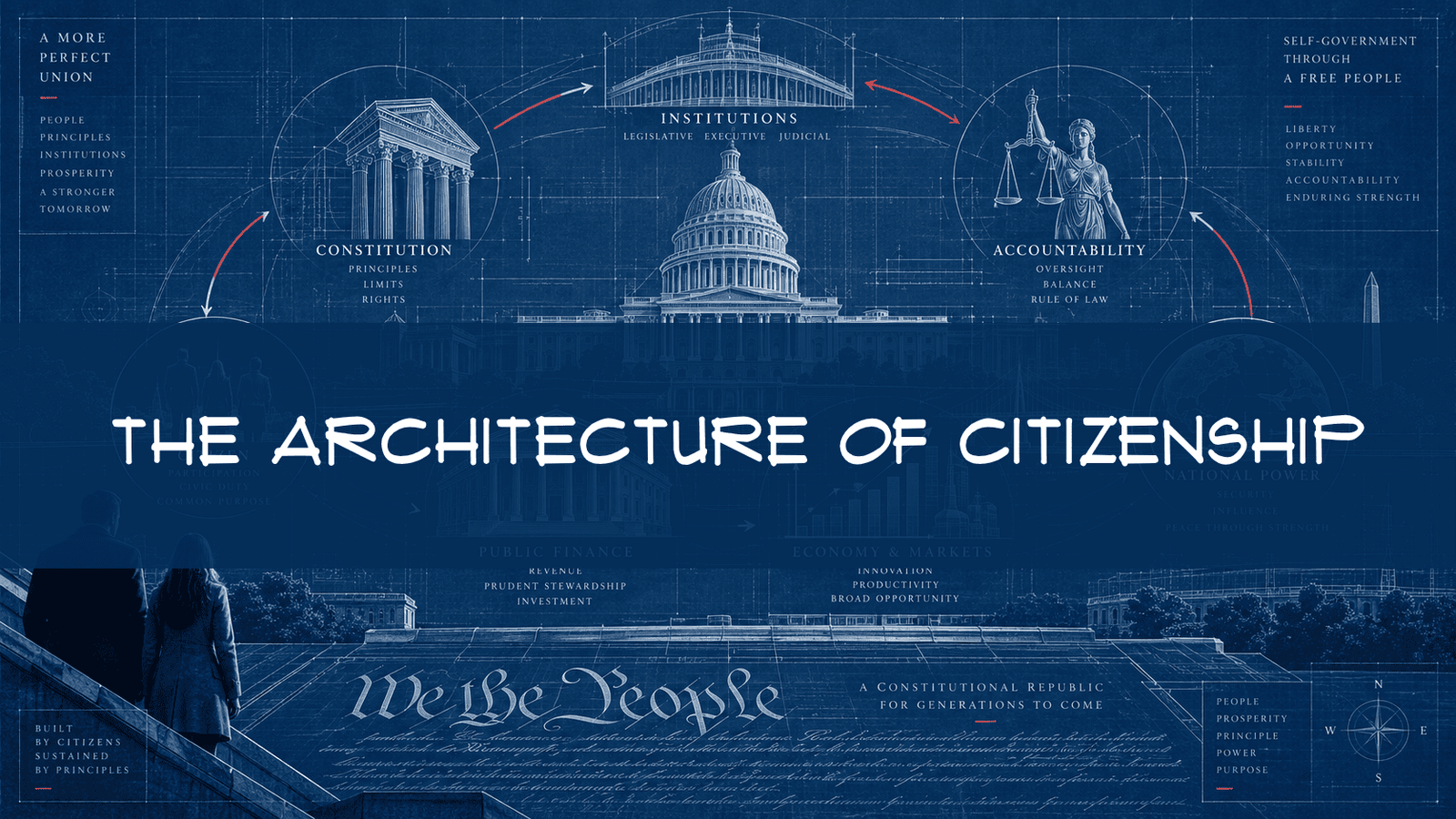
How Our Constitutional Republic, Public Finance, and American Power Connect, and Why Understanding Them Is Part of Being a Citizen
Citizenship is easy to think of as a legal status, a passport, the right to vote, or a list of rights and responsibilities.
However, in the American system, citizenship means something more.
American Citizens sit at the center of a constitutional republic built on the idea that legitimate political authority ultimately comes from the people. We choose who governs. Through that government, they make collective decisions, on our behalf, about what our country should do. We provide the resources that make those choices possible. We live with the benefits and consequences. Ultimately, we decide whether to continue, change, or reverse course.
That makes understanding government more than a civics exercise.
To understand our role as citizens, we need to see how the larger system fits together: why the Constitution divides and limits power, how the unwritten social contract that we live by shapes what we expect from government, how taxes and borrowing turn political choices into financial commitments and action, how markets and economic strength affect what government can actually do, and how those resources contribute to American power at home and abroad and the unique position America holds in the world.
We do not need to become constitutional scholars, economists, or budget experts.
All of that said, self-government requires citizens to make informed choices. And an informed choice is much more than asking, “What can government do for me right now?”
Government decisions can benefit us today while imposing costs tomorrow. They can help one group or community while creating consequences for another. They can solve an immediate problem while creating obligations lasting decades. The choices we make collectively can affect our families, our communities, the strength of the country, and people not yet born.
Citizens therefore need enough understanding to ask not only:
What does this do for me?
but also:
And then what happens? For whom? At what cost? And for how long? Who bears the burden?
This article is a overview of that larger system and of the American citizen’s place at its center.
This is the Architecture of Citizenship.
The Citizen Comes First
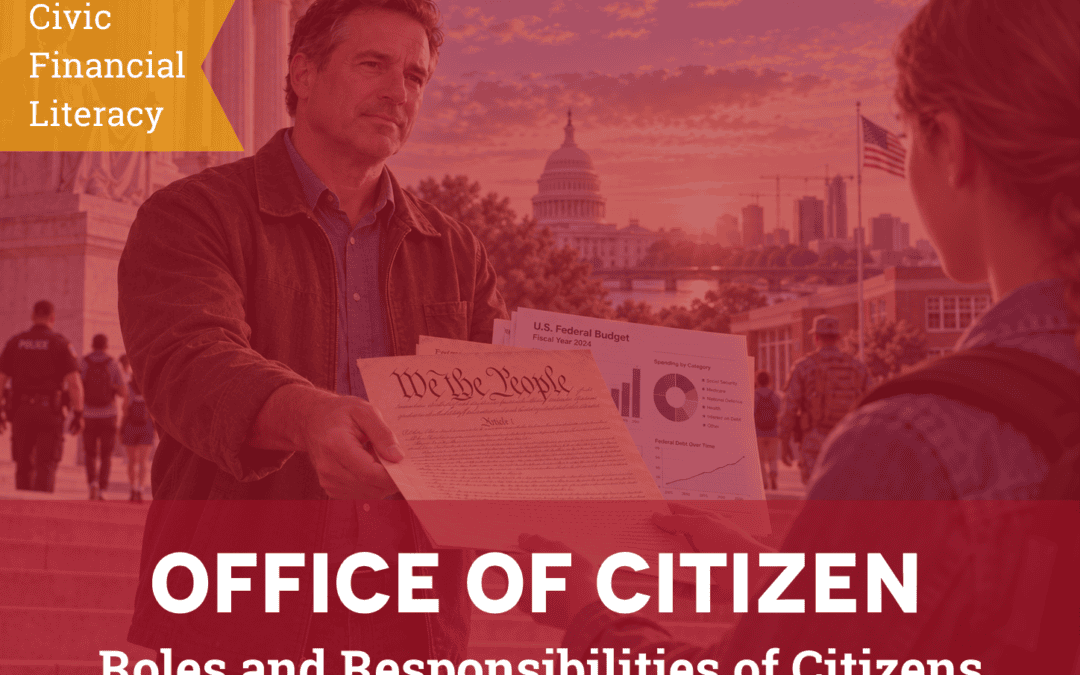
The opening words of the Constitution are not “We the government” or “We the states.” They are “We the People.”[1]
We the People of the United States, in Order to form a more perfect Union, establish Justice, insure domestic Tranquility, provide for the common defence, promote the general Welfare, and secure the Blessings of Liberty to ourselves and our Posterity, do ordain and establish this Constitution for the United States of America.
Preamble, U.S. Constitution
The Declaration of Independence had expressed the underlying principle eleven years earlier: governments derive “their just powers from the consent of the governed.”[2]
The Constitution then created a governmental structure based on that principle of popular sovereignty. Its Preamble also looked beyond those present at the founding, declaring an intention to secure the blessings of liberty to “ourselves and our Posterity.”[1]
That makes a Citizen fundamentally different from a subject of the state.
A subject of a state is governed by authority. A customer receives services from an institution. A citizen in a self-governing republic possesses a share of the political authority from which government derives its legitimacy.
Most citizens exercise that authority indirectly. We elect representatives, serve on juries, petition government, challenge government through the courts, participate in civic life, debate public choices, and ultimately help determine who will exercise governmental power.
But giving political authority to the people creates another problem.
How should that power be exercised without allowing government, political leaders, or even temporary majorities to exercise unlimited authority?
That question takes us to the Constitution, not because this is primarily an article about the Constitution, but because the Constitution is the framework through which Citizen authority is organized, exercised, and restrained.
A Republic by Design
The United States is a Constitutional Republic with representative democratic institutions.
Citizens participate in democratic elections and choose representatives, but governmental authority is constrained by a Constitution, distributed among institutions, and subject to protections that cannot ordinarily be swept aside by a temporary political majority. Article IV of the Constitution expressly guarantees every state a “Republican Form of Government.”[3]
The distinction was intentional.
In Federalist No. 10, James Madison contrasted representative republican government with what he called “pure democracy.” One of his concerns was faction, including the possibility that a majority could use political power against the rights or interests of others.[4]
The founders’ response to concentrated power was not a single safeguard.
It was a system of overlapping restraints.
Power was divided between the federal government and the states. Federal power was divided among the Legislative, Executive, and Judicial branches. Legislative authority itself was divided between the House and Senate. Presidents received a veto. Congress could override it. The Senate received particular roles in appointments and treaties. Congress could impeach officials. An independent judiciary added another check.
The larger point is not memorizing the mechanics of each institution.
It is understanding the problem the architecture was designed to solve:
How do you give citizens the ultimate authority to govern themselves, create a government strong enough to function, and still prevent that power from becoming unlimited?
Federalist No. 51 captured the problem particularly well:
“You must first enable the government to control the governed; and in the next place oblige it to control itself.”[5]
The founders did not build a system that depended entirely upon every person entrusted with power acting wisely or benevolently. They divided authority, created competing institutions, and established checks so that power itself could help restrain power.
Alexander Hamilton described the larger American experiment in Federalist No. 1 as a test of whether people could establish good government through “reflection and choice,” rather than leaving their political arrangements to accident and force.[6]
That idea is remarkably close to what we mean by architecture.
The American constitutional system was not simply inherited or allowed to emerge. People deliberately debated how power should be granted, divided, constrained, and ultimately held accountable.
The architecture was designed both to exercise power and limit power.
That is not an incidental feature of American government. It is one of its central achievements.
Protecting Self-Government and Liberty
This creates an enduring tension in the American system.
Citizens must possess the ability to govern themselves.
At the same time, individual rights cannot simply disappear whenever a political majority finds them inconvenient.
Elections allow citizens to change those who govern. Representation makes self-government possible across a large nation. Federalism distributes authority geographically. Separation of powers divides it functionally. Constitutional rights establish boundaries that ordinary political majorities cannot simply erase.
Majorities matter enormously in republican government.
So do constitutional restraints on majorities and on government itself.
The objective is neither a government too weak to perform its responsibilities nor a government possessing unlimited authority.
It is self-government under law.
A Remarkable Design, Not a Claim of Perfection
The Constitution was an extraordinary achievement of political design.
That does not mean the framers believed either themselves or their work to be infallible.
Benjamin Franklin made essentially that point on the final day of the Constitutional Convention. At age 81, he acknowledged that there were provisions he did not approve of and that experience had taught him to doubt his own certainty.
He nevertheless concluded:
“I agree to this Constitution with all its faults, if they are such.”[7]
Benjamin Franklin
That is a useful perspective.
The founding system had real flaws and contradictions, some of which later generations confronted through constitutional amendments, legislation, court decisions, political struggle, and changing understandings of citizenship.
We do not need to catalogue that history here to recognize the larger architectural achievement.
The system was designed to be durable without being completely frozen. It established fundamental rules that could not be changed casually, while providing a constitutional process through which later generations could amend them.
The Constitution’s aspiration was itself forward-looking: not a perfect union, but a “more perfect Union.”[1]
Every generation therefore inherits both an established constitutional framework and responsibility for what it does within it.
The Social Contract: What Do We Choose to Do?
The Constitution does much more than organize government.
It grants governmental powers, limits those powers, protects rights, establishes institutions, and states broad national purposes, including justice, domestic tranquility, common defense, general welfare, and liberty.[1]
Those constitutional boundaries matter. Government cannot simply do whatever a temporary majority wishes.
But within that lawful framework remains an enormous range of choices.
- When should government exercise the powers it possesses?
- For what purposes?
- To what extent?
- Who should bear the costs?
- Which responsibilities should be individual?
- Which should we undertake collectively?
Those are not simply questions about whether government has legal authority.
They are questions about what citizens expect government to do with the authority the constitution provides.
That is where the idea of the Social Contract becomes useful.
Americans continually negotiate that relationship, even when we do not call it a social contract.
How much security should government provide?
What infrastructure should we build together?
What responsibilities should society assume for retirement, health care, poverty, education, national defense, or disasters?
Which risks should individuals bear themselves?
Which should we share?
What freedoms should remain protected from government even when a majority favors intervention?
Reasonable citizens can understand these questions and still reach very different conclusions.
Tax Project Institute explores the concept more deeply in The Unwritten Pact: Exploring the Social Contract in Modern Times, including the relationship among liberty, collective responsibility, taxation, government, and citizen participation.[8]
But whatever choices citizens make within that constitutional framework, eventually they encounter another reality.
Someone has to provide the resources.
Public Finance Turns Political Choices Into Reality
A government can promise many things. It cannot provide them without resources.
National defense requires people, equipment, technology, facilities, and capital. Retirement programs require payments. Roads require construction. Courts require judges and staff. Health programs require funding. Interest on previously borrowed money has to be paid.
Eventually, nearly every political choice enters the financial architecture of government:
Tax. Spend. Borrow. Manage money.
This is where the aspirations of the Social Contract encounter economic reality.
That connection was central to the creation of the modern American government.
Under the Articles of Confederation, the national government lacked many of the fiscal capabilities necessary to operate effectively. The Constitution gave Congress national powers to tax and borrow, while Treasury administration, customs collection, public credit, debt management, and early financial institutions helped turn those legal powers into functioning governmental capacity.
TPI’s America250 New Nation Era examines this transformation from weak confederation finance toward a national fiscal system capable of collecting revenue, managing obligations, establishing credit, and operating a national government.[9]
This is an important part of citizenship that traditional civics education can miss.
Voting helps determine who has authority to make choices.
Public finance helps determine whether those choices can be carried out, who provides the resources, and what obligations those choices create.
Todays Benefits aren’t the Whole Story
This is also where informed citizenship requires a broader perspective.
There is nothing improper about asking how government affects you or your family. Government decisions can change our taxes, income, retirement, employment, health care, education, neighborhoods, and economic opportunities.
Those effects matter. A lot.
But personal benefit is relevant information.
It is not sufficient information on its own.
A policy may provide an immediate benefit while creating an obligation lasting decades. A tax reduction may leave citizens with more resources today while affecting future revenues and economic conditions. A new program may address a genuine public need while committing future taxpayers to continuing expenditures.
Conversely, spending today on infrastructure, education, defense, research, or other investments may impose a present cost while creating benefits that persist long after today’s taxpayers are gone.
The important question is not simply whether government spends more or less.
It is whether citizens understand the tradeoffs well enough to make informed choices.
That means considering:
- Near-term and long-term effects.
- Benefits and costs.
- Individual interests and shared interests.
- Our own community and the country as a whole.
- Today’s citizens and tomorrow’s citizens.
- How the burdens and benefits are distributed.
The Preamble’s reference to “ourselves and our Posterity” reflects an idea that runs throughout self-government: citizens make choices not only for the present but also for the society others will inherit.[1]
Posterity

pɑˈsterəti

formal : people in the future
1 : the offspring of one progenitor to the furthest generation
2 : all future generations

Posterity will remember her as a woman of courage and integrity.

A record of the events was preserved for posterity.

The truth about what happened will be known/lost to posterity.
Washington later made the financial implication unusually explicit, warning against “throwing upon posterity the burthen which we ourselves ought to bear.”[10]
“throwing upon posterity the burthen which we ourselves ought to bear.”[10]
George Washington
Washington’s guidance was clear. It does not say that every generation must avoid borrowing, spending, or making long-term commitments. Washington himself recognized circumstances in which borrowing could be appropriate. It says that citizens should understand when today’s choices create tomorrow’s obligations and consider those obligations as part of the decision.
Government Operates Inside an Economy
Government’s possess extraordinary power.
That power does not operate outside economic reality.
Taxes affect households and businesses. Spending moves resources. Regulation changes incentives. Borrowing requires lenders. Interest rates affect financing costs. Inflation changes purchasing power. Trade policy affects producers and consumers. Investors decide where to deploy capital. Workers make decisions about where to live, work, and invest their skills.
Government acts.
People and Markets respond.
Those responses can reinforce a policy, weaken it, produce unintended consequences, create new problems or opportunities.
That observation is not an argument for or against a particular policy.
It is an argument for asking what comes next.
And then what?
- Who ultimately pays?
- Who benefits?
- What behavior changes?
- What does the policy cost later?
- What opportunities are created or displaced?
- What happens if the assumptions supporting it prove wrong?
- And what happens if it succeeds?
Those are economic and financial questions.
But in a system where citizens ultimately determine the direction of government, they are also questions of Citizenship.
Financial Capacity Becomes National Power
The architecture extends beyond domestic government.
A country’s ability to protect its interests and exercise influence in the world rests partly on the strength of the society and economy beneath it.
Economic productivity matters.
So do technological capacity, energy, industrial production, taxation, capital markets, public credit, the ability to borrow, institutional credibility, and confidence in a country’s currency.
For the United States, deep capital markets, the Treasury securities market, and the international role of the dollar contribute to the government’s ability to raise resources, respond to crises, finance military commitments, and operate at global scale.
Public Finance is therefore not separate from national power.
George Washington understood the connection remarkably early.
In his 1796 Farewell Address, Washington called public credit an important source of national strength and security. He recognized that borrowing could sometimes be necessary, including preparation against danger, while also urging the country to avoid unnecessary accumulation of debt.[10]
More than two centuries later, the financial system is vastly larger and more complicated.
The underlying principle remains straightforward:
A nation’s financial capacity helps determine what the nation is capable of doing.
That applies in ordinary times. In challenging times, it can matter even more during war, financial crisis, geopolitical competition, or other periods when national resources are under stress.
Washington’s Address: Guidance for a fledgling Nation
Washington’s Farewell Address was unlike any other, it is useful for another reason. It demonstrates the limits of constitutional architecture.
Washington warned Americans about sectional division, political faction, foreign interference, public credit, debt, and other dangers he believed could affect the stability of the republic.
But Washington was not speaking only to presidents, lawmakers, or government officials.
He addressed “Friends & Fellow-Citizens.”[10]
And his message placed considerable responsibility on them.
His connection between knowledge and republican government could hardly be clearer:
“It is essential that public opinion should be enlightened.”[10]
George Washington
Washington understood that in a political system where public opinion ultimately has enormous influence, the quality of public judgment matters.
When discussing public credit, taxes, and debt, he likewise argued that elected representatives could not carry the responsibility alone. Public opinion had to cooperate.[10]
TPI examined this fiscal portion of Washington’s address more fully in Washington’s Farewell Address and the Use of Debt.[11]
His warning points toward a limitation no constitutional convention could completely solve.
Institutions can divide power.
Constitutions can constrain government.
Laws can protect rights.
But no architecture can permanently substitute for the judgment of the Citizens operating it.
And if Citizens are expected to exercise judgment, they need to be able to see and understand what government is doing.
Transparency Makes the Architecture Visible
Citizens cannot meaningfully supervise a government they cannot see.
They need information about what government collects, what it spends, what it owes, what it promises, who benefits, what risks it assumes, and what outcomes result.
That is the purpose of transparency.
But transparency alone is not enough.
Government could place thousands of pages of budgets, financial statements, economic projections, regulations, and program reports online and technically make them available to everyone.
If citizens cannot make sense of the information, transparency has achieved only part of its purpose.
Information becomes accountability only when people can understand what it means.
That is where Government Financial Literacy enters the architecture.
Government Financial Literacy and Citizenship
Government Financial Literacy, or GFL, is the knowledge and understanding of how governments generate, allocate, spend, borrow, and manage public resources, and how those decisions affect citizens, communities, households, and the economy.[12]
It does not require every citizen to become a budget analyst, economist, or accountant.
It means understanding enough to ask better questions.
- What does this cost?
- Who pays for it?
- Who receives the benefit?
- Is the commitment temporary or permanent?
- Are we paying for it today or borrowing against tomorrow?
- What assumptions does it depend upon?
- What alternatives are we giving up?
- Who bears the risk if those assumptions fail?
- What happens five, ten, or twenty years from now?
- And what will those choices leave to the citizens who follow us?
Different citizens can understand the same facts and reach different conclusions.
That is not a failure of civic education.
A constitutional republic does not require universal agreement.
It requires the capacity for informed disagreement.
Government Financial Literacy is therefore about more than understanding taxes and government budgets.
It helps citizens connect political promises with resources, immediate benefits with long-term obligations, public choices with economic consequences, and government finances with national capacity.
It is part of the knowledge required to exercise citizenship in a modern constitutional republic.
The Architecture of Citizenship
We began with a more complete way of thinking about citizenship. Citizenship as an Architecture, a structure by which our government depends, and a duty that every citizen must perform.
- Not merely as a legal status.
- Not merely as a voting responsibility.
- Not merely as possessing rights.
- And not merely as asking what government can provide to us.
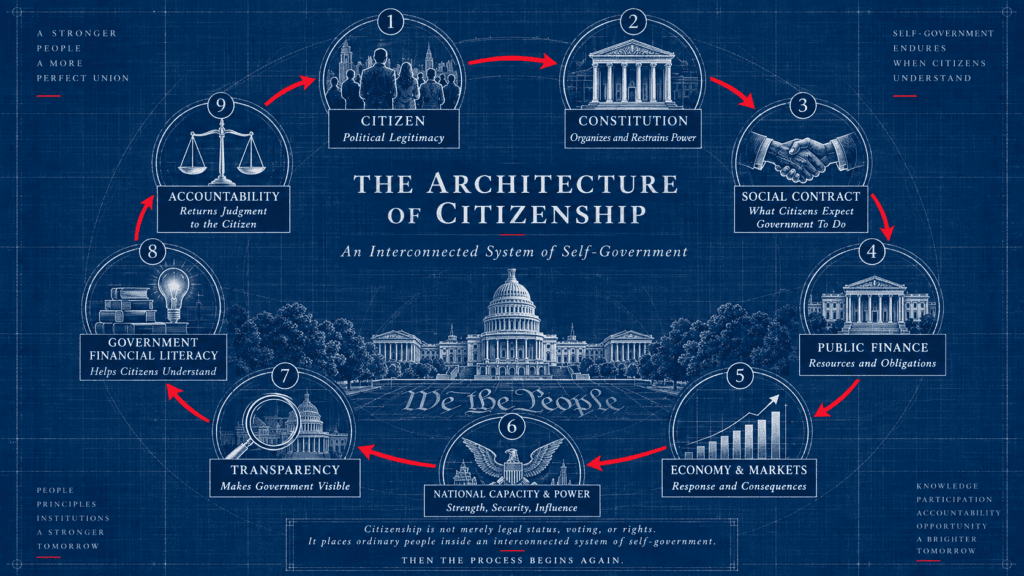
Citizenship places ordinary people inside an interconnected system of self-government.
- The citizen is the source of political legitimacy.
- The Constitution organizes, distributes, and restrains the exercise of governmental power.
- The Social Contract helps shape what citizens collectively expect government to do within that framework.
- Public finance supplies the resources and creates the obligations required to carry out those choices.
- The economy and markets respond to them.
- Financial and economic resources contribute to National Capacity and Power.
- Transparency allows citizens to see what government has done.
- Government Financial Literacy helps them understand what those choices mean.
- And Accountability returns the judgment to the citizen.
- Then the process begins again.
That is the Architecture of Citizenship.
America’s constitutional republic is an extraordinary inheritance, but every generation receives more than a Constitution. It inherits institutions, rights, public assets, debts, commitments, economic capacity, international responsibilities, and the consequences of decisions made by generations before it.
It then decides:
- What to preserve.
- What to change.
- What to build.
- What to consume.
- What to invest.
- What to spend.
- What to borrow.
- And what to leave behind.
The Constitution’s Preamble captured this intergenerational idea at the beginning, seeking to secure liberty not only to “ourselves” but to “our Posterity.” Washington later applied the same principle directly to public finance.[1][10]
Abraham Lincoln would later describe the stakes of the American experiment in another way. At Gettysburg, during the country’s greatest constitutional crisis, he looked toward a future in which “government of the people, by the people, for the people” would endure.[13]
“government of the people, by the people, for the people, shall not perish from the earth.”
Abraham Lincoln
The words are powerful because they return the entire architecture to its source: of, by, and for The People.
Self-government asks us to consider not only what government can do for us today, but what our collective choices mean for ourselves, our communities, our country, and the citizens who will inherit it tomorrow.
- The Constitution can structure power. It cannot exercise judgment for us.
- Transparency can provide information. It cannot force us to understand it.
- Institutions can help protect liberty. They cannot relieve citizens of their role in sustaining a system of self-government.
Hamilton called the American experiment a choice between government formed through “reflection and choice” and government shaped by accident and force.[6]
More than two centuries later, each generation inherits that choice. The architecture ultimately returns to where it began.
The Citizen.
Each generation gets to make the choice: informed “reflection and choice” or “accident and force.”
References
[1] National Archives and Records Administration. (1787). Constitution of the United States: A Transcription. https://www.archives.gov/founding-docs/constitution-transcript
[2] Continental Congress. (1776). Declaration of Independence: A Transcription. National Archives and Records Administration. https://www.archives.gov/founding-docs/declaration-transcript
[3] U.S. Constitution, Article IV, Section 4. Constitution Annotated. Library of Congress. https://constitution.congress.gov/browse/article-4/section-4/
[4] Madison, J. (1787). Federalist No. 10. Library of Congress, Federalist Papers: Primary Documents in American History. https://guides.loc.gov/federalist-papers/text-1-10
[5] Hamilton, A., or Madison, J. (1788). Federalist No. 51. Library of Congress, Federalist Papers: Primary Documents in American History. https://guides.loc.gov/federalist-papers/text-51-60
[6] Hamilton, A. (1787). Federalist No. 1. Library of Congress, Federalist Papers: Primary Documents in American History. https://guides.loc.gov/federalist-papers/text-1-10
[7] Franklin, B. (1787). Speech at the Constitutional Convention, September 17, 1787. National Archives and Records Administration, What Franklin Thought of the Constitution. https://prologue.blogs.archives.gov/2010/09/17/what-franklin-thought-of-the-constitution/
[8] Tax Project Institute. (2024). The Unwritten Pact: Exploring the Social Contract in Modern Times. https://taxproject.org/the-unwritten-pact-exploring-the-social-contract-in-modern-times/
[9] Tax Project Institute. (2026). America250: The New Nation Era. https://taxproject.org/programs/america250/era-3/
[10] Washington, G. (1796). Farewell Address. Founders Online, National Archives. https://founders.archives.gov/documents/Washington/05-20-02-0440-0002
[11] Tax Project Institute. (2026). Washington’s Farewell Address and the Use of Debt. https://taxproject.org/washingtons-farewell-debt/
[12] Tax Project Institute. (2025). Government Financial Literacy: What It Is and Why It Matters. https://taxproject.org/government-financial-literacy-2/
[13] Lincoln, A. (1863). Gettysburg Address. Library of Congress. https://www.loc.gov/exhibits/gettysburg-address/ext/trans-nicolay-copy.html