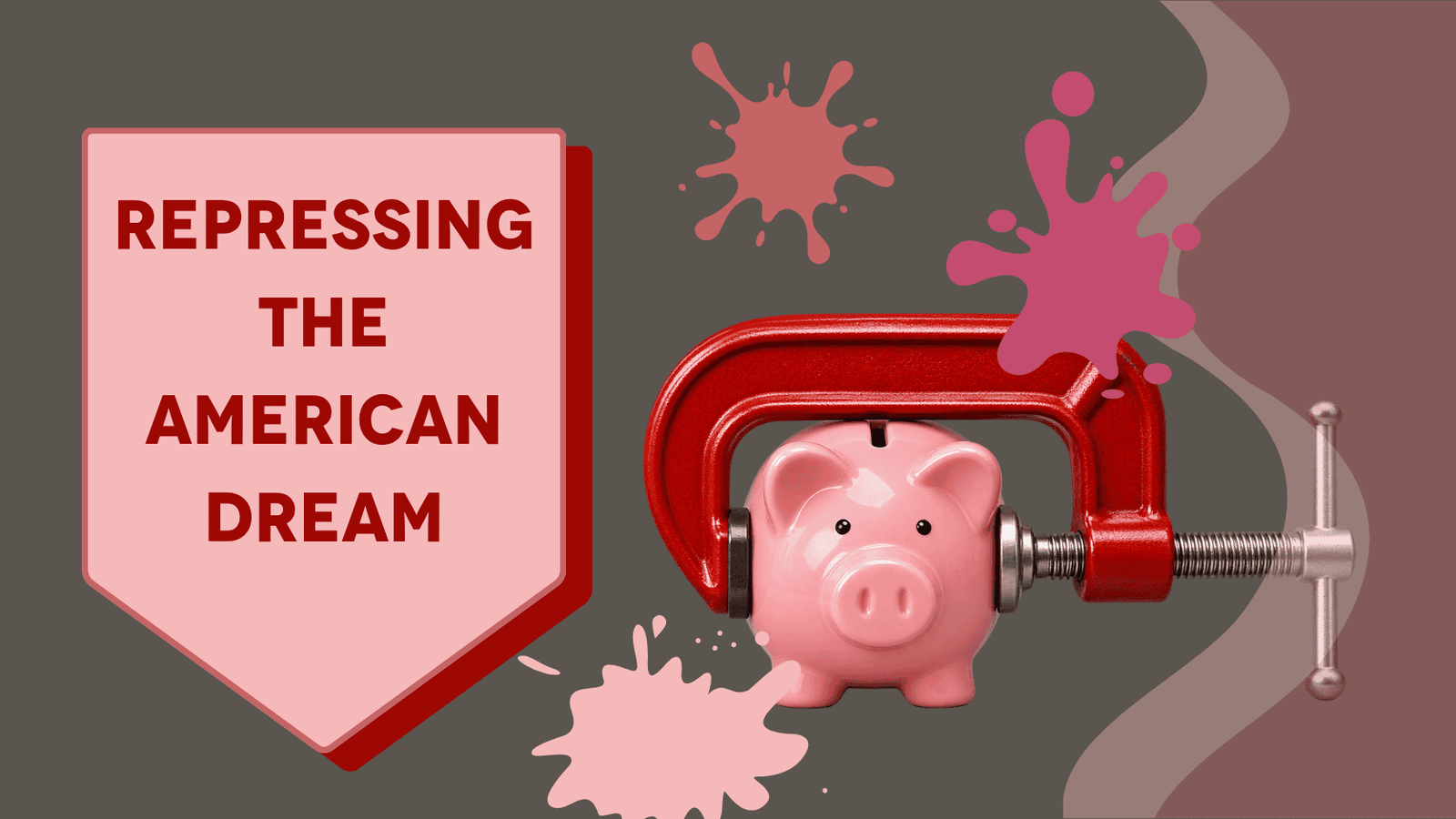
New IMF research warns that conditions for Financial Repression are returning. As America’s National Debt climbs, could the government increasingly shift the cost onto savers, retirees, and future generations without raising taxes?
For generations, the American Dream has rested on a relatively simple promise: work hard, save responsibly, invest for the future, and build a better life for yourself and your children.
But what happens when the Federal Government has accumulated so much Debt that reducing its borrowing costs becomes an increasingly powerful policy incentive?
What if one way to manage that debt is to reduce the returns Americans receive on their savings and investments?
And what if the government can achieve some of the economic benefits of raising taxes without ever calling it a tax and suffering the political fallout?
In July 2026, the International Monetary Fund (IMF) published a significant research paper titled The Coming Great Repression? New Measures and a Century of Evidence. The researchers examined more than a century of financial history across 17 advanced economies and found that governments have repeatedly relied on financial repression to help manage large public debt burdens. [1]
Financial repression is a collection of policies that can lower government borrowing costs by directing savings toward government debt, sometimes at below-market returns.
Economists describe its cost to savers as an implicit tax.
The IMF researchers found that Financial Repression peaked following World War II in the United States, declined as financial markets became more open, and increased again after the 2008 global financial crisis. They also found that conditions historically associated with greater financial repression, including high government debt, are present today.
For the United States, these findings are particularly relevant.
America faces historically high public debt, persistent federal deficits, and rapidly rising interest costs. The government is spending an increasing amount simply financing previous borrowing. Interest costs just to service the National Debt alone now cost more than the US Military budget.
The concern is not that Financial Repression is inevitable. It is that the economic conditions that historically made it attractive are increasingly present, and that adopting it can be a government policy choice.
For Americans saving for retirement, trying to purchase their first home, building businesses, or hoping to provide greater opportunities for their children, the consequences could be significant.
And unlike a conventional tax increase, the costs may be difficult to recognize.
America’s Debt Problem Is Making Difficult Choices Harder
The United States has accumulated substantial federal debt over decades of spending, taxation, borrowing, economic crises, and policy decisions by successive administrations and Congresses from all political spectrums.
For many years, relatively low interest rates helped make that debt easier to finance.
But the federal government’s financial outlook has become increasingly challenging.
According to the Congressional Budget Office’s (CBO) February 2026 projections, federal debt held by the public is expected to rise from approximately 101% of gross domestic product (GDP) in 2026 to 120% by 2036, surpassing the previous historical peak of 106% following World War II. [2] The total National Debt and Unfunded liabilities make those numbers even higher.
The projected annual deficit increases from approximately $1.9 trillion in 2026 to $3.1 trillion by 2036.
Perhaps most concerning is the growing cost of servicing that debt.
CBO projects net federal interest expenses will increase from approximately $1 trillion in 2026 to $2.1 trillion annually by 2036. As a share of the economy, interest costs rise from 3.3% to 4.6% of GDP.
These are projections under CBO’s baseline assumptions, not guaranteed outcomes. Future economic developments and fiscal policies could change the results.
Nevertheless, the direction of the underlying fiscal pressure is clear.
As debt increases, interest expenses consume a greater share of federal budget resources. Those expenses contribute to deficits, requiring additional borrowing unless offset by higher revenues or lower spending elsewhere.
The result can become a self-reinforcing cycle:
More Debt → Higher Interest Costs → Larger Deficits → Additional Borrowing → More Debt
The federal government does not refinance all of its outstanding debt at once, and changes in interest rates affect the cost of borrowing gradually as securities mature and new debt is issued.
Still, the cumulative pressure is substantial.
For policymakers, the choices are difficult: raise taxes, reduce spending, encourage stronger economic growth, or continue borrowing.
Each carries economic and political consequences.
But history suggests another possibility.
What the IMF’s New Research Reveals
The IMF’s July 2026 working paper examines financial repression across 17 advanced economies dating back to 1920. [1]
The researchers developed new methods to measure how government policies create demand for public debt from financial institutions that may have limited alternatives.
Their findings indicate that financial repression has been a recurring feature of government debt management, particularly following periods of heavy borrowing.
It was especially prevalent in the decades after World War II, when many advanced economies faced extraordinary debt burdens.
During that period, financial regulations, restrictions on capital movement, and other arrangements helped governments borrow at lower costs than might otherwise have prevailed.
The researchers found that financial repression contributed significantly to reducing government debt burdens following the war.
They also found that financial repression increased again after the 2008 global financial crisis, generating fiscal savings for governments even during a period when surprise inflation was not consistently reducing debt.
Perhaps most importantly, the paper identifies conditions associated with financial repression that resemble aspects of the present economic environment. This doesn’t mean we should set the panic bells off now, but it does warrant heightened awareness, and diligence.
The researchers conclude that financial repression may become more prevalent as governments confront high debt and difficult fiscal choices.
There are important qualifications:
- This is an IMF working paper, not an official recommendation that governments implement financial repression.
- The research does not establish that the United States has decided to pursue such a strategy
- It does not establish that future US policies will replicate the postwar experience.
- Modern financial markets are also more open and internationally connected, making certain historical mechanisms more difficult to implement.
Nevertheless, the findings raise an important question:
If America’s Government increasingly needs cheaper financing, who will ultimately bear the economic cost?
For readers unfamiliar with the concept, Tax Project Institute’s companion article, Financial Repression: Explainer, examines how these policies work, their historical use, their relationship to inflation, and their effects on government debt and household wealth. [4]
A Hidden Tax Americans May Never See
One of the most consequential characteristics of Financial Repression is that it can impose a financial burden on citizens without a conventional tax increase.
The IMF research explicitly describes financial repression as an implicit tax on domestic savers. [1]
Consider the distinction. When Congress raises income taxes, the change is generally visible to taxpayers. Legislators debate the measure, vote on it, and can be held accountable for the resulting policy. Financial repression can operate much less visibly. Rather than collecting additional taxes directly, government policies can encourage or require financial institutions to hold public debt at below-market returns.
The government benefits from a dependable source of financing and lower borrowing costs, but nothing is free and the economic benefit comes at a cost.
Banks and other institutions may earn less than they otherwise could. Depositors may receive lower interest rates. Investors may face fewer alternatives. Private businesses may have less access to financing.
In effect, economic value is transferred toward the government without necessarily appearing as tax revenue.
The government can receive an economic benefit similar to a tax, while citizens bear some of the cost without ever receiving a tax bill.
This does not mean financial repression is legally identical to taxation. Nor does it mean that every low savings rate, banking regulation, or period of inflation is evidence of financial repression. Interest rates can and do decline through ordinary market forces, and regulations may serve legitimate purposes such as financial stability. The relevant question is whether public policy choices systematically suppress market returns or redirect capital toward government financing, imposing economic costs on others.
That distinction is central to understanding why Financial Repression deserves public scrutiny.
Inflation Makes the Hidden Cost Worse
Financial Repression can become particularly costly when interest rates on savings and bonds remain below inflation.
Consider a hypothetical household with $100,000 in savings earning 2% annually while inflation runs at 4%.
After one year, the account contains $102,000.
But measured in the previous year’s purchasing power, those savings are worth approximately $98,077.
Despite earning interest, the household has lost roughly $1,923 in real purchasing power.
And that is before considering any income taxes owed on the interest earned.
Over longer periods, the effect can compound.
If the same 2% return and 4% inflation persisted for 10 years, the account would grow to approximately $121,899, but its purchasing power would decline to roughly $82,400 in today’s dollars.
That represents a loss of about 17.6% in real purchasing power.
This example illustrates negative real returns, not a forecast or evidence that financial repression caused them.
When policies deliberately maintain returns below market levels, and particularly when those returns are also below inflation, savers can bear a substantial economic burden. For a government with large amounts of fixed-rate nominal debt, inflation can also reduce the real value of existing obligations. Governments selling bonds and raising revenue, often due to high debt, can be the cause of inflationary pressure.
Debt may remain unchanged in nominal dollars while becoming smaller relative to the dollar value of economic output, especially if nominal GDP grows faster than debt.
This can improve measures such as debt-to-GDP without the government necessarily paying down the nominal principal.
But reducing the real value of government debt also means reducing the real value of the corresponding financial claims held by its creditors.
The cost has not disappeared. It is just redistributed to debt holders, savers, and tax payers.
For households relying on savings, bonds, and fixed retirement income, that distinction matters.
Financial Repression Is a Policy Choice
High government debt does not automatically produce Financial Repression.
Countries can address debt through changes in taxes, spending, economic growth, and broader fiscal reforms.
Financial repression represents another possible approach: using financial policies and regulations to influence the demand for government debt and its financing costs.
That makes government policy central to the issue of how to tackle high debt and the choices officials make to address it.
Depending on the particular mechanism, relevant decisions may involve Congress, the Treasury, the Federal Reserve, or financial regulatory agencies.
Their legal responsibilities, authority, and independence differ. The Federal Reserve, for example, has monetary-policy responsibilities distinct from Congress’s taxing and spending powers.
Nevertheless, the combined financial and regulatory framework can affect how much the government pays to borrow and where private savings are invested. Some policies can intentionally reduce borrowing costs. Others may produce similar effects even when their stated objectives involve banking stability or monetary operations.
The IMF researchers acknowledge that financial repression can emerge through existing regulatory arrangements without an explicit decision to implement a debt-reduction strategy. [1]
This matters because it would be inaccurate to suggest that every policy favoring government securities reflects a deliberate attempt to impose an implicit tax. However, it would be equally problematic to ignore the economic consequences simply because a policy has another stated objective.
Whether intentional or incidental, government policies that benefit public financing at the expense of private returns or destruction of purchasing power deserve transparent evaluation.
Why Might Politicians Find It Attractive?
Raising taxes is politically difficult. Reducing government spending can be equally challenging, particularly when it affects popular programs or services. Both approaches generally attract public attention, opposition, and political accountability. While raising taxes or cutting expenses/services maybe the prudent policy, politicians have learned it is generally not the popular policy.
Financial Repression is different.
Its costs are often indirect, gradual, and difficult for individual households to identify. A saver earning less on deposits may blame the bank or prevailing economic conditions. A business unable to obtain financing, and subsequent loss of opportunity, may blame tighter credit markets. A retiree losing purchasing power may recognize inflation without understanding how financial regulation or public borrowing policies could influence investment returns.
That relative lack of visibility and direct connections to policy actions can make Financial Repression politically attractive compared with explicit tax increases or spending reductions. This is an economic incentive, not evidence that particular politicians have secretly adopted such a strategy.
And it raises a fundamental question of accountability.
Should government be able to obtain the economic equivalent of additional revenue through Financial policies without the public clearly understanding who pays?
For a country founded on representative government and accountable taxation, the answer deserves serious national discussion. Adam Smith’s Four Canons of Taxation outlines Certainty as one of the canons denoting taxes should be clear and plain.
“The tax which each individual is bound to pay ought to be certain, and not arbitrary. The time of payment, the manner of payment, the quantity to be paid, ought all to be clear and plain.”[1]
Adam Smith
Taxing the American Dream
The American Dream is not simply about earning a living. It is about building a better life through work, saving, investment, entrepreneurship, and the opportunity to pass greater financial security to the next generation.
Financial repression can impact those goals.
1. Saving for the Future
Americans are encouraged to save for emergencies, education, a home, and retirement.
Policies that suppress returns and capital can make saving less rewarding.
Households holding savings deposits, certificates of deposit, bonds, or other conservative financial assets may experience lower returns than would otherwise be available. If inflation exceeds those returns, the purchasing power of savings can decline even while balances increase lowering purchase power overall.
The effect is not necessarily equal across households. Individuals with substantial holdings in assets that appreciate during inflation may be better protected than those relying primarily on fixed-income investments. Wage earners without appreciating assets may suffer the most with higher costs, reduced savings opportunities, and the loss of purchasing power not being matched by wage growth.
For Americans who have spent years saving responsibly, prolonged periods of negative real returns can make it harder to accumulate wealth, and potentially nullifying the compounding effect of savings and investment.
2. Retirement Security
Financial repression can be particularly consequential for retirees.
As people approach retirement, many shift toward more conservative investments intended to provide stability and predictable income.
If those investments earn persistently low inflation-adjusted returns, retirement savings may not provide the purchasing power households expected. This does not mean every retirement portfolio would lose value. Diversification, inflation-protected securities, and other investments can offer varying degrees of protection. However, Financial Repression can place additional pressure and stress on retirees who rely heavily on fixed income.
Americans who have spent decades saving for financial independence may find that their savings dollars support less of the retirement they planned.
3. Homeownership
Owning a home has historically been an important pathway to building wealth in America.
Financial Repression could affect that opportunity through the allocation of credit. When banks and other financial institutions are encouraged or required to hold more government debt, fewer resources may be available for private lending. Depending on the specific policies, this could influence mortgage availability, lending standards, and access to financing. It does not necessarily mean mortgage interest rates would rise. Some repression mechanisms suppress rates, while others influence credit availability or the allocation of lending.
The concern is that government financing priorities can compete with household and private-sector borrowing needs. For younger Americans seeking their first home, additional constraints on credit could make an already difficult financial goal harder to achieve. Combine tougher lending standards, potentially higher rates, and the already high property costs and you have dwindling opportunity.
4. Entrepreneurship and Private Investment
Small businesses depend on access to savings, credit, and investment capital.
The IMF research associates Financial Repression with the crowding out of private credit and investment. [1]
When more financial resources are directed toward government debt, less may be available for private businesses. That can discourage investment, constrain entrepreneurship, and potentially affect innovation, productivity, and job growth.
The long-term consequences matter because economic growth ultimately depends on productive investment, business development, and improvements in efficiency.
Policies that make government borrowing cheaper while restricting private capital formation may create a tradeoff between short-term fiscal relief and long-term economic opportunity.
5. The Next Generation
Perhaps the most concerning potential impact is on younger Americans.
They inherit not only the government’s outstanding debt but also the economic consequences of the policies used to manage it.
If financial repression reduces private investment, lowers inflation-adjusted savings returns, or constrains access to credit, future generations may find it more difficult to build financial security.
These outcomes are potential risks, not certainties.
But they demonstrate why America’s debt challenge is about far more than the federal balance sheet.
It is also about the opportunities available to Americans who have yet to begin their working lives.
We Have Been Here Before, but Today Is Different
Following World War II, the United States faced federal debt exceeding 100% of GDP.
Over subsequent decades, the debt burden declined substantially relative to the economy.
That reduction was due to several factors including economic growth, fiscal policy, inflation, and financial repression.
The IMF’s historical research indicates that Financial Repression was an important contributor to debt reduction during the postwar period. [1]
However, the financial system of that era was very different. Banking regulations were more restrictive, international capital movement was more limited, and savers had fewer investment alternatives. Those conditions made it easier for governments to influence financial institutions’ holdings of public debt.
Today’s global financial markets offer investors substantially more alternatives. Capital can move more readily, and attempts to suppress returns may encourage investors to seek opportunities elsewhere, including out of the country and into other non traditional value stores.
That can make traditional financial repression more difficult to sustain and potentially increase its economic costs. Still, some existing financial regulations and institutional arrangements generate substantial demand for government debt.
The IMF research suggests that changes within those frameworks could influence government financing costs without requiring a return to all the formal controls used in the postwar era. History therefore provides a warning about the incentives governments have to implement these type of policies, not a prediction that the United States will repeat a particular strategy, but the conditions are in place for them to consider implementing Financial Repression today.
Why the Risk Is Increasingly Relevant
The United States is not alone in confronting significant debt pressures.
Governments across advanced and developing economies face rising borrowing requirements, large fiscal commitments, and increasing pressure on public budgets.
An IMF article published in March 2026, High Debt, Hard Choices, highlighted the difficult fiscal environment facing governments and the tradeoffs involved in stabilizing public debt. [3]
The United States faces several particularly relevant conditions:
- Federal debt near historic highs relative to GDP.
- Persistent large budget deficits. The use has had 25 consecutive years of budget deficits (spending more than it makes)
- Rising interest expenses that compete with other spending priorities. Interest payments now exceed US Military spending.
- Major long-term commitments, particularly Social Security and Medicare.
- Political difficulty in achieving agreement on significant fiscal adjustments.
Together, these conditions can increase the appeal of policies that reduce financing costs without immediately visible tax increases or spending cuts.
That does not establish that the United States is implementing a comprehensive financial repression program. Nor does the IMF research claim that financial repression is inevitable, it does demonstrate that governments have historically turned to such measures when confronted with economic and fiscal pressures resembling aspects of today’s environment.
The risk is not merely that America’s debt is large. It is that the growing cost of that debt can make policies that quietly shift costs onto citizens more attractive.
There Are Other Ways Out of Debt
Financial repression is not the only way to address a large national debt.
Governments have several potential approaches, each with costs, limitations, and tradeoffs.
Tax Project Institute examines these alternatives in Ways Out of Debt: U.S. Options for National Debt. [5]
The broad approaches include increasing government revenue (taxes), reducing or slowing spending growth, economic growth, selling public assets, and pursuing policies that influence the real burden of debt.
Some choices impose visible costs.
Higher taxes directly reduce disposable income or investment returns.
Spending reductions may affect public services, benefits, or government programs.
Other approaches can distribute costs less visibly.
Increases in Government Money supply can add to inflation and reduce the real value of outstanding fixed-rate debt while eroding purchasing power.
Financial repression can reduce government financing costs by channeling savings toward government securities at below-market returns.
The mechanisms are distinct, but both can transfer financial value in ways that are less obvious than direct taxation.
Moreover, cheaper government financing does not necessarily solve the underlying problem of persistent deficits.
If revenues continue to fall short of expenditures, financial repression may reduce immediate borrowing costs while allowing debt to continue accumulating.
That could delay fiscal adjustments rather than eliminate the need for them.
Related concerns are explored in Tax Project Institute’s Fiscal Dominance: Explainer, which examines how government debt pressures can influence monetary-policy decisions. [6]
Fiscal Dominance and Financial Repression are related but distinct. Fiscal dominance concerns the influence of government financing needs on monetary policy, while financial repression encompasses a broader range of regulatory and financial arrangements. These can be used in conjunction and understanding both is important to helping you understand America’s fiscal situation.
Protecting the American Dream Requires Transparency
America’s National Debt is often presented as a figure measured in trillions of dollars. (Over $40 Trillion and counting)
But ultimately, its consequences are experienced by people.
Taxpayers, savers, workers, retirees, homeowners, investors, and future generations can all be affected by how the government chooses to manage its obligations. The can has been kicked down the road for generations, and some future generation will wind up paying that price.
Financial repression introduces an additional concern because its economic burden can be difficult to see.
Unlike a conventional tax, the costs may appear gradually through reduced returns, diminished purchasing power, or restricted investment and borrowing opportunities.
Those costs are not always attributable to government policy. Market conditions can produce similar results. When government policy deliberately or indirectly creates those outcomes to support public financing, citizens deserve to understand the consequences.
The IMF’s July 2026 research is significant because it identifies both the historical role of financial repression and conditions that could encourage its increased use.
For Americans, that should prompt greater attention to the choices being made, the alternatives available, and the financial consequences that may follow.
The country is not without options. It can address fiscal imbalances through transparent decisions about taxation, spending, growth, and long-term budget priorities. It can debate those decisions openly and evaluate their consequences. The US can postpone difficult reforms, potentially increasing the attractiveness of policies that reduce government financing costs while shifting some of the burden into the financial system.
The question is not simply how America will manage its debt. It is who will bear the costs, whether those costs will be visible, and how today’s decisions will affect the opportunities available to future generations.
The American Dream depends on the ability to work, save, invest, own a home, build a business, and create lasting financial security.
Those opportunities should be central to the national conversation about government debt.
Americans deserve to know not only how much their government borrows, but how they may ultimately be asked to pay for it, including costs that never appear on a tax return.
References
[1] Bolhuis, M. A., Koosakul, J., Shenai, N., & Yang, J. (2026). The coming great repression? New measures and a century of evidence (IMF Working Paper No. 2026/160). International Monetary Fund. https://doi.org/10.5089/9798229056885.001
[2] Congressional Budget Office. (2026, February 11). The budget and economic outlook: 2026 to 2036. https://www.cbo.gov/publication/61882
[3] Dabla-Norris, E., & Valdés, R. (2026, March). High debt, hard choices. Finance & Development, International Monetary Fund. https://www.imf.org/en/publications/fandd/issues/2026/03/high-debt-hard-choices-era-dabla-norris
[4] Tax Project Institute. (2026). Financial repression: Explainer. https://taxproject.org/financial-repression-explained/
[5] Tax Project Institute. (2025, June 14). Ways out of debt: US options for national debt. https://taxproject.org/ways-out-of-debt-us-options-for-national-debt/
[6] Tax Project Institute. (2026). Fiscal dominance: Explainer. https://taxproject.org/fiscal-dominance/