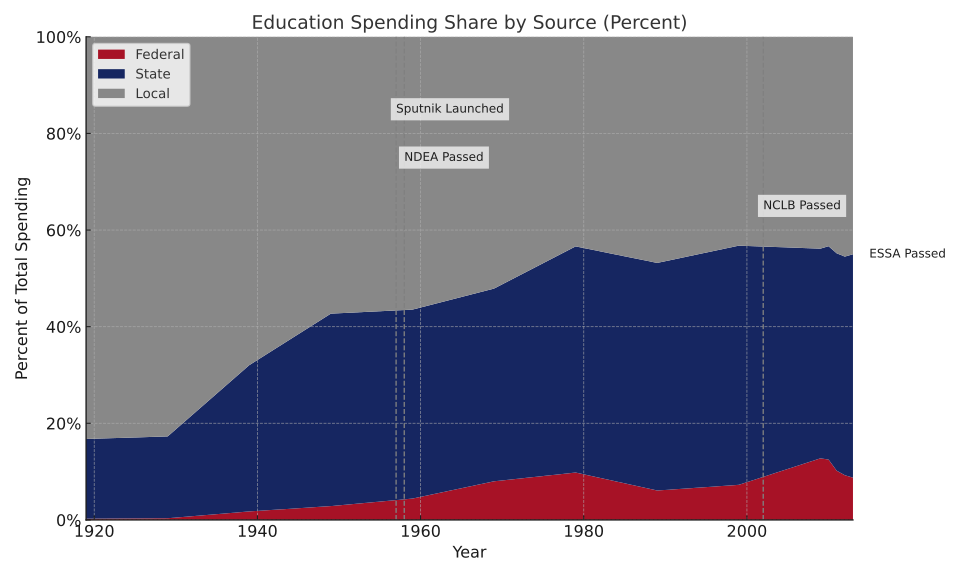
The current administration is discussing disbanding the Department of Education, but what role has the Federal Government played in education over its history? This article examines Federal Education spending across eras to provide perspective on what role the Government provides. For most of American history, the bulk of school funding has come from local and state sources, with the federal government barely involved through the 1950’s contributing only a small portion, typically less than 1%, and even today federal funding remains a relatively small amount, typically under 10%. In fact, there was no Department of Education until 1979. While local property taxes once dominated education finance, the balance gradually shifted as states took on more responsibility. Even after landmark federal interventions like the National Defense Education Act and the creation of the Department of Education, federal dollars have remained a minor share. Yet despite the modest financial contribution, the federal role in shaping curriculum, standards, and civil rights enforcement has grown significantly. What has changed over time, and will the United States, in a new Cold War with China, have another Sputnik moment?
1. Early Federal Involvement
Before 1957, federal aid was episodic and capital‑focused. The Morrill Acts of 1862 and 1890 handed states land to build “agriculture and mechanical arts” colleges [1]. The federal involvement was basically to provide land, and capital for building schools, with no role in the curriculum or instruction. The Smith‑Hughes Act (1917) funded vocational labs. The GI Bill (1944) paid tuition for returning soldiers. Yet curriculum stayed strictly local. In 1950, federal dollars made up 0.8 % of K‑12 revenue [2]. This period is characterized as little to no federal involvement in education, mostly Local and State responsibilities.
2. Cold War Fears
Up until this period, the federal government had little involvement in education other than land and capital. That changed significantly during the Cold War. On October 4th 1957: The USSR launches Sputnik 1 the first satellite into space [3]. This caused great concern that the United States was falling behind in the space race, and the military technology race and for the first time education, or lack there of specifically in the STEM and language areas, was thought of as a National Defense threat. In 1958 Congress passed the National Defense Education Act (NDEA), pouring $1.1 billion into science, math, and foreign‑language programs and significantly increasing federal education spending[4]. For the first time the federal government paid for textbooks, lab kits, and teacher training expanding beyond land and capital. Even with the considerable expansion of federal spending, the federal share barely cracks 4 %. Local boards still sign teachers’ paychecks, but Washington gains a powerful new lever: curriculum strings attached to cash. In fact, the NDEA included a requirement in Title X that mandated all beneficiaries of the act complete an affidavit disclaiming belief in the overthrow of the U.S. government. [9]
3. The Department of Education Era (1979–2000)
Until this period, there was no formal Education department in the federal government. However, in 1979 President Jimmy Carter created a formal Department of Education with the Department of Education Organization Act (1979) elevating education to Cabinet level department [5]. The new agency centralizes data with the National Center for Education Statistics (NCES), enforces civil‑rights statutes, and distributes Title I dollars. Federal education spending share edges up to ~ 6 % by 1985 [2]. Meanwhile, state courts force equalization, lifting state outlays and reducing local dominance to where we are today with near equal amounts of state and local funding.
4. No Child Left Behind & the Accountability Era (2001–2015)
In 2002 the George W Bush administration passed the No Child Left Behind Act (NCLB) that significantly increased federal involvement in state and local education programs. The act tied Title I funds to annual tests in reading and math [6]. Stimulus grants (2009) and Race to the Top drive significantly increasing federal funding to ~10 % including historical highs of over ~12%. The NCLB acts goal were to standardize national testing standards, and increase accountability with the federal government providing much more oversight.
5. Every Student Succeeds Act to Present: Outsized Influence, Modest Dollars
In 2015 the Barrack Obama administration passed the Every Student Succeeds Act (ESSA) reducing many of the oversight and accountability requirements and giving those back to the state and local schools. Today, Washington covers ~ 8 % of all K‑12 costs [2]. Yet strings remain: civil‑rights guidance, IDEA mandates, school‑nutrition standards, and data reporting shape district behavior. However, federal spending has come down off its NCLB era spending highs, and ESSA eliminated most of the reporting and accountability measures of NCLB.
6. Historical Funding
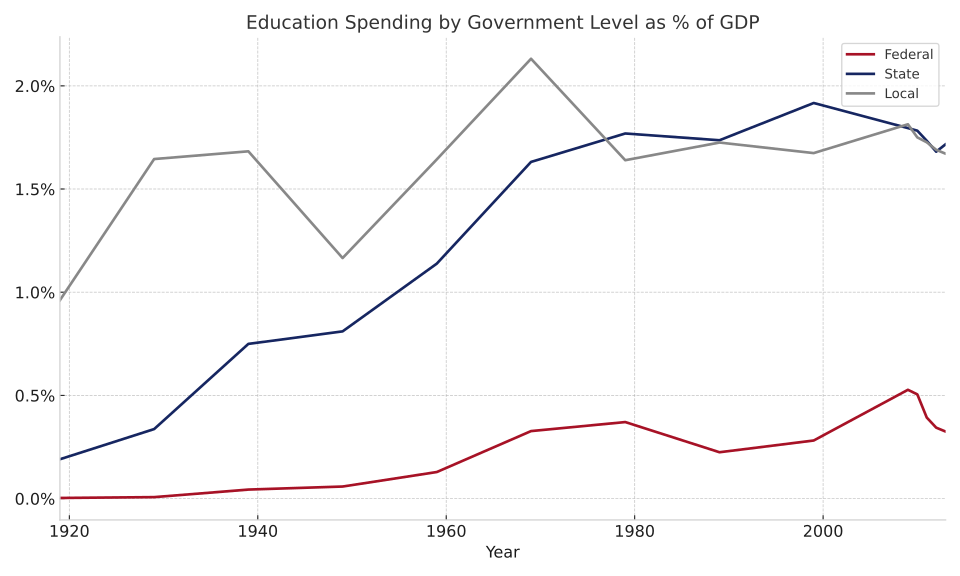
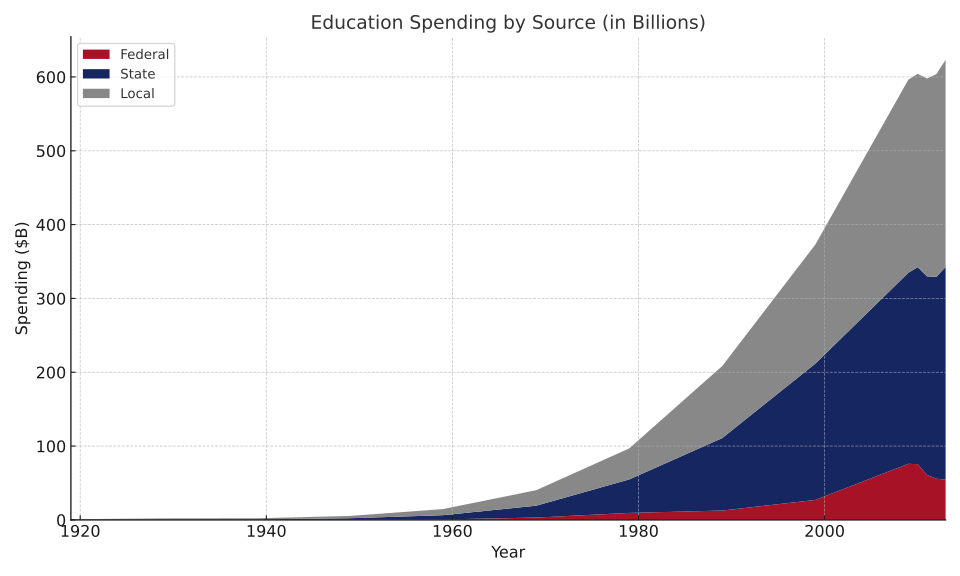
As shown in Figure 1, Federal spending was relatively low and in the pre Sputnik era, and remains relatively low versus overall education spending. For the early era of education the majority of spending was from local funding sources, with the states catching up and providing more control and roughly equal funding to local spending in the 70’s. We then see federal funding spike in the NCLB era, and since taper off. However, as shown in Figure 2, 3 Federal education spending remains a small portion of education spending overall, and by percentage.
The Programme for International Student Assessment (PISA) offers a global yardstick every three years to measure student educational attainment across countries. It provides a standardized approach to measuring student achievement across the world. U.S. per‑student spending ranked near the top or #1 in the world, yet academic achievement ranked in the middle, with U.S. students appearing to be falling further behind in Math.
U.S. Spending & PISA Ranking by Era
Era
Spend/Student (2020 USD)
Spend Rank
Math
Reading
Science
Fed Policy Context
2000
$8,800
4th
19th
15th
14th
Pre‑NCLB
2009
$11,000
2nd
25th
17th
17th
NCLB Peak
2018
$13,600
1st
37th
13th
18th
ESSA Era
Table 2 Source: PISA
Observation: Spending doubled (in real terms) since 2000, and U.S. had highest per capital spending yet math rank fell significantly.
U.S Ranking vs World, 2018
Country
Spend/Student
Spend Rank
Math
Reading
Science
U.S.
$13,600
1st
37th
13th
18th
Finland
$10,500
5th
16th
7th
6th
South Korea
$11,100
4th
7th
9th
10th
Canada
$12,000
2nd
12th
6th
8th
OECD Avg.
$9,500
—
~20th
~15th
~15th
Table 3 Source: PISA
8. Conclusion
Sputnik did not create federal education spending, but it redefined its purpose—from land and capital grants to investment in National Defense evolving to todays strategic curriculum investment. Each subsequent era—Carter’s Department of Education, Bush’s No Child Left Behind, to Obama’s ESSA have upped federal requirements more than federal dollars. Our Constitution does not mention Education, and under the 10th Amendment any power not defined in the Constitution is delegated to the States. As such, given the less than 10% of funding the Federal government provides, state and local municipalities have the choice to comply with federal mandates by choosing to take federal funding or not. As debates over abolishing the Department of Education resurface, history reminds us: Washington’s share is small, but its influence is impactful. Given the cash strapped status of many States, many may feel they are trapped into taking money and complying just to fill budget gaps. However, the real test is whether the nation can align high spending with high outcomes—before the next Sputnik moment.
Citations
USDA National Agricultural Library, “Land‑Grant Colleges and the Morrill Act.”
National Center for Education Statistics, Revenues for Public Elementary and Secondary Schools, Table 235.10 (2023).
NASA, “Sputnik and the Dawn of the Space Age.”
National Defense Education Act of 1958, Public Law 85‑864.
Department of Education Organization Act, Public Law 96‑88 (1979).
No Child Left Behind Act, Public Law 107‑110 (2002).
Every Student Succeeds Act, Public Law 114‑95 (2015).
U.S. Office of Management and Budget, Historical Tables, FY 2024.
In the complex landscape of federal spending, transparency and accountability are paramount. Recent revelations regarding trillions of dollars in untraceable funds have ignited a renewed call for rigorous oversight. Enter the Locating Every Disbursement in Government Expenditure Records (LEDGER) Act, a bill sponsored by Senator Rick Scott (R-FL) and Roger Marshall (R-KS), aiming to overhaul the U.S. Department of the Treasury’s payment tracking system. This legislation promises to shed light on the often opaque world of government disbursements and bring increased visibility to taxpayer dollars.
A Push for Fiscal Responsibility
The LEDGER Act was introduced as a measure to increase transparency in federal spending. The bill aims to provide greater clarity on how taxpayer dollars are spent, and to reduce the possibility of waste, fraud, and abuse. This legislation is part of an ongoing effort to push for greater fiscal responsibility within the Federal Government. The pending legislation, while still not law, if passed could significantly strengthen transparency, and accountability.
The Impetus: DOGE Report $4.7 Trillion Dollar Revelation
The genesis of the LEDGER Act can be traced to a Government Accountability Office (GAO) report, often referred to as the “DOGE” report (Department of the Treasury’s Government-wide Funds). This report denoted $4.7 trillion in federal payments lacking proper traceability codes, raising serious concerns about the government’s ability to track and account for its spending.
The GAO’s findings delved into the Treasury’s processes for recording and categorizing federal payments. They found that a significant portion of disbursements were not being assigned the necessary codes to identify the purpose, source, and recipient of the funds. The Treasury uses Treasury Account Symbols (TAS) to tie payments to budget-level items, however, many TAS fields, that are optional, were left blank. This created a massive blind spot, making it impossible to trace the money trail in a detailed, transaction-by-transaction manner. The GAO found this by analyzing the raw data coming from the treasury, and finding gaps in the transactions with TAS data recorded, that would allow for proper tracking.
This revelation highlighted a significant gap in the Treasury’s financial management. Without proper traceability codes, it becomes exceedingly difficult to follow the money trail, increasing the risk of waste, fraud, and abuse. The DOGE revelation served as a reminder of the need for enhanced transparency and accountability in Federal spending.
What the LEDGER Act Does: A Transaction-Level Revolution
The LEDGER Act seeks to address the shortcomings identified in the DOGE report by mandating the implementation of a comprehensive traceability code system for all federal payments. While there are no specific implementation details at this time, if passed the bill is passed, based it’s stated intent and the GAO report’s findings, it is likely the bill will require the Treasury to track each individual payment transaction with specific metadata. This metadata would likely include:
Purpose of Payment: A clear description of what the funds were used for.
Funding Source: Identification of the specific agency, program, or appropriation that funded the payment.
Vendor or Recipient: Details about the entity or individual receiving the payment.
Contract or Grant Numbers: Relevant identifiers for contracts or grants associated with the payment.
Date and Time of Transaction: Precise timestamps for each payment.
This level of granularity would create an audit trail, allowing for detailed analysis of federal spending patterns. The LEDGER Act is likely to enhance the Treasury Account Symbol (TAS) system, by making the optional fields required, and adding greater detail to the TAS system. The administration has since mandated the use of this field. See our Article on Modernizing Government Financial Systems and use of Hyperledger technology.
Implementation: A Transformation of Treasury Operations
If passed, the LEDGER Act would require a significant transformation of the Treasury’s payment processing systems. The Treasury would be tasked with:
Developing and Implementing Traceability Codes: Creating a standardized system of codes that can be applied to all federal payments.
Integrating with Existing Systems: Modifying existing payment systems to accommodate the new traceability code requirements.
Establishing Data Standards: Defining clear and consistent data standards for the traceability codes to ensure accuracy and uniformity.
Creating a Centralized Database: Developing a centralized database to store and manage the transaction-level data.
Developing Reporting Tools: Creating tools that allow agencies, auditors, and oversight bodies to generate reports and analyze spending patterns.
Providing Training: Training federal employees on the new traceability code system and data entry procedures.
Oversight and Auditing: Creating a system that allows for regular audits and oversight of the new systems.
This would likely involve investment in technology, software development, and training. The Treasury would need to work closely with other Federal agencies to ensure seamless integration and data sharing.
A New Era of Visibility and Accountability
The LEDGER Act promises to usher in a new era of visibility and accountability in federal spending. By providing transaction-level data, it would enable:
Enhanced Auditing: Accountants and auditors would have access to detailed transaction records, making it easier to identify errors, irregularities, and potential fraud.
Improved Management: Agency managers would have real-time insights into spending patterns, allowing them to make more informed decisions.
Increased Government Oversight: Oversight bodies and lawmakers would have the tools to scrutinize federal spending and hold agencies accountable.
Greater Public Transparency: The public would have access to more detailed information about how their tax dollars are being spent.
Government Accounting:
Our Federal Government has a maze of accounting systems, and tools to track Federal Spending. The Federal government discloses portions of this data on various websites based on the type of spending. They are generally broken down in these categories:
Awards: These represent funds given to non-federal entities, such as contractors, grantees, and loan recipients. Significant budget items included in awards are; federal contracts to private companies for military equipment, or infrastructure, and grants to state and local governments for programs.
Accounts: These represent all federal spending, including internal agency operations, such as employee salaries, and operating expenses. Significant budget items included in accounts are; military personnel pay, Social Security payments, and Medicare payments.
Public Disclosure and how the LEDGER Act changes differ from Other Systems
The LEDGER Act’s focus on transaction-level detail sets it apart from existing Federal spending data systems:
Federal Procurement Data System (FPDS): This system focuses specifically on Federal procurement awards, which are contracts for goods and services. While FPDS provides detailed information on these contracts, it does not track other forms of federal spending, such as grants or loans, and it does not provide transaction-level details. (FPDS.gov)
USASpending.gov: This website aggregates data from FPDS and other sources to provide a broader view of federal spending. However, it only includes a subset of total federal spending. It excludes classified information, personally identifiable information (PII), and some proprietary data. Furthermore, according to the GAO USAspending.gov has billions in transactions each year that are listed as unreported by agencies, where no data or visibility is made to the public, highlighting a lack of transparency. While it does show some account level spending, it is designed to show award spending and does not contain transaction level detail. (USAspending.gov)
U.S. Treasury Fiscal Data: This data provides a comprehensive overview of the entire federal budget, including revenue, spending, and debt. However, it does not offer the granular, transaction-level detail that the LEDGER Act would provide. It shows high level financial information. (FiscalData.Treasury.gov)
The LEDGER Act would complement these systems by providing a deeper layer of accountability. It would allow for a more comprehensive understanding of how federal funds are being used, from the initial award to the final payment.
Is this a Big Deal?
At the Tax Project Institute our goal is to educate the public on what citizens contribute to our country and the transparency of how our government spends their contributions. While it may seem somewhat shocking that there is so little oversight that $4.7 Trillion dollars is untraceable, it really should not come as much of a surprise given that the TAS codes had been made optional. Additionally, the Government has a number of checks in place, like the GAO and our Improper Payments (including Fraud) Tracking Systems (Figure 1), that perform audits and account for weaknesses in controls and processes, and call out places for Government improvement. What is most concerning is the lack of accountability and controls to address these findings that these processes find. For example Government agencies are required by law to report spending to USASpending.gov but yet in a GAO audit only 103 of 152 agencies reported (68%) (Figure 2).
As of this date, the USASpending.gov site shows trillions in “Unreported” data from 2017 (as far back as it goes) to date.
Year
Unreported Amount (Billions)
2017
$97.9
2018
$43.8
2019
$31.8
2020
$70
2021
$131.8
2022
$137.1
2023
$147.4
2024
$164.5
2025
$37.9
We should note, that there has been significant progress in these numbers recently, indicating a new emphasis and progress in this area. You can use the USASpending.gov site or the enhanced version available from the Tax Project Institute (Requires Free Registration)
So bottom line, is it a Big Deal? – no, while shocking the revelations really aren’t anything new, but the chance of getting the ONLY source of Federal Government Wide spending at the transaction level, with enforcement of record keeping to trace all payments to budget line items is a very big deal indeed and could go down ultimately as a landmark in Government Transparency.
Conclusion: A Step Towards Ongoing Fiscal Transparency
The LEDGER Act represents a significant step towards greater fiscal responsibility and transparency in federal spending. By mandating transaction-level tracking, it would provide unprecedented visibility into how taxpayer dollars are being used. While implementation may require significant effort and investment, the potential benefits in terms of accountability and oversight are substantial.
The bill’s success, if passed, will depend on the Treasury’s ability to develop and implement a robust process to ensure ongoing enforcement of traceability code system. However, if successful, the Locating Every Disbursement in Government Expenditure Records (LEDGER) Act would be a crucial piece of ongoing government transparency, ensuring that taxpayer dollars are used wisely and efficiently.
There is a common saying in business, “If it isn’t monitored, then it isn’t managed.” In essence, oversight is crucial for effective management. The Tax Project is dedicated to examining transparency and the responsible use of taxpayer dollars. This article analyzes claims made by an independent source (referred to as “DOGE”) regarding data within the Social Security system. This analysis is provided as an example for how it might be Monitored and Managed, and helped in the placing of the public’s Trust, had it been made public to begin with.
We will caution that the following analysis is based on public statements and data released by DOGE, and their analysis of Social Security. The Tax Project cannot independently verify the validity of this data, and therefore the conclusions presented here should be viewed as an example and not as an expert analysis.
“Sunlight is said to be the best of disinfectants; electric light the most efficient policeman.” Louis D. Brandeis
DOGE Claim
The following analysis provides context for a data release by DOGE, who posted their analysis on the number of individuals marked as “alive” in the Social Security system, categorized by age group (Image Attached). Here is the post:
The Tax Project has included the data, and used OCR, as a way to clarify the analysis, and show that it can be reviewed and verified.
According to the data provided by DOGE, the total number of individuals listed as “alive” in the Social Security system is 398 Million (398,416,213). The Tax Project acknowledges that this data has not been independently verified and presents this analysis as an example of the potential benefits of increased transparency in government data.
A comparative analysis with U.S. Census Bureau population estimates (~341.4 million) suggests a discrepancy of approximately 57 million individuals. Further research is needed to understand the factors contributing to this difference. Potential explanations include differences in data collection methodologies, reporting lags, or the inclusion of non-citizens within the Social Security database.
Age Group Discrepancies
The data also highlights notable figures within specific age groups:
Individuals aged 100 and Over: The dataset indicates that over 20 Million (20,789,524) individuals are within this range. This contrasts with estimates from a Pew Research study, which suggests there are roughly 101,000 Americans aged 100 or older. This would represent roughly 5-6% of US Population over 100, overstating the Pew data by over 200 times (20,000%).
Individuals aged 100-109: The dataset indicates 4 Million (4,734,407) individuals within this age range.
Individuals aged 120-129: According to the provided data, there are 3 Million (3,472,849) individuals listed within this age range. This raises questions, as the oldest verified living human lived to be 122 years old, and the oldest living American lived to 119.
Individuals aged 130 and Over: The dataset indicates that roughly 9 Million ( 8,955,261) individuals are within this range. Given the oldest living American if you combine the 120-129 age group and this 130 and over group that would be over 12 Million individuals in the dataset older than the oldest recorded American.
Anomalies: The data reports 1.3 Million people over age 150, including one individual in the 360-369 age range or roughly 3 times maximum expected lifespan of an individual.
Potential Implications
These discrepancies raise questions about the accuracy and reliability of the data within the Social Security system, and if true erode the public trust. While the data does not directly indicate improper payments, the presence of a significant number of individuals listed in age ranges exceeding known human lifespans warrants further scrutiny. Erroneous data may potentially impact resource allocation and be subject to abuse and mismanagement. Data validation and reconciliation are necessary to ensure funds are properly allocated. Based on the 20 million excess population of 100+ year old persons in the database at the average Social Security annual benefit of $23,700 the potential misallocation could be over $470 Billion a year. While it is highly unlikely that the actual figure of improper payments, if any, is any where near this figure the discrepancies create opportunities for poor outcomes.
Transparency and Data Management
The Tax Project advocates for increased transparency in government data management practices. Making Social Security data more accessible to public scrutiny could potentially facilitate independent verification and improve data quality. Robust data validation processes are essential to ensuring the responsible and productive use of taxpayer dollars. Greater transparency could include:
Regular, independent audits of Social Security data management practices.
The creation of a publicly accessible data portal (while protecting individual privacy) to allow for external analysis.
Improved data documentation and metadata to clarify data collection methodologies and potential limitations.
The Tax Project continues to focus on transparency, and helping the public understand the use of their Tax dollars. We hope that this kind of transparency becomes available in the future so that all Americans can inspect and understand where their money is spent.
The American government’s pursuit of efficiency is a long and winding road, paved with good intentions and often obstructed by bureaucracy, funding battles, and a simple lack of visibility. As documented in our Government Efficiency Timeline, the quest to streamline processes and reduce waste has been a constant throughout our history. The Tax Project Institute, while remaining policy-neutral, strongly supports efforts at transparency and accountability in government, recognizing that sunlight is the best disinfectant.
One of the most significant challenges in evaluating government efficiency initiatives is their inherent lack of visibility. Take, for instance, the recent accusations of transparency against the Department of Government Efficiency (DOGE). This opacity is not unique to DOGE. While many applaud the transactional level detail DOGE is providing (albeit on X , although we are excited to see their Website evolve), which is often much more detail than prior administrations. However, others will point to these being done outside of the blanket approvals of Congress, and while more transactionally transparent, their overall macro aims, goals, directions, and intentions are not.
Many well-intentioned efficiency drives have been bogged down in commissions, buried within lengthy reports, tangled in congressional gridlock, agency bureaucracy, and, ultimately, fall victim to funding cuts, or the slow intentional death by red tape. A disheartening number of these efforts never see the light of day, resulting in wasted resources and missed opportunities. The absence of a national Score Card available to the public, tracking these endeavors further exacerbates the problem. Without a clear record of initiatives launched, progress made (or not made), and obstacles encountered, it is nearly impossible to learn from past experiences or hold individuals accountable.
A Transparent Path Forward: Shining a Light
Given the tools now available to industry, this is where modern technology can offer a powerful solution. While not proposing solutions, the Tax Project Institute believes that leveraging technologies such as blockchain, Hyperledger or Dogecoin’s decentralized Proof-of-Work (PoW) mechanism, could revolutionize the way we track and manage government efficiency initiatives. Imagine a system where each efficiency effort is logged as a transactional entry on an immutable mechanism like Hyperledger or PoW. This would create a transparent and verifiable record of the initiative’s progress that can’t be changed once entered, including:
Task Assignment: Clearly identifying the individuals or teams responsible for specific tasks.
Timestamps: Recording key milestones and deadlines.
Dependencies: Highlighting any prerequisites or related efforts.
Status Tracking: Documenting the current state of the initiative (e.g., “In Progress,” “Completed,” “Stalled,” “Cancelled”).
Workflow: Project level visibility into where in a workstream an initiative stands.
Decisions: A list of decisions that impacted the delivery of the transaction, and who made them.
Justification: For any project that is cancelled, providing documented justification and reasoning for why it was cancelled.
Accountable Persons: For any initiative, who is the person accountable for delivering the result.
Accounting: Accurate accounting of bottom line results of efforts in clear metrics (e.g. Cost savings, Cost Avoidance, Productivity Gains, etc.)
Modernizing Transparency
Such a system would provide a transparent public national record of all intended efforts, allowing anyone to see who was tasked with what, when, how, and whether the effort succeeded or failed. This fosters accountability by making it easy for anyone to independently verify, track progress, and identify bottlenecks. Furthermore, a blockchain-based system would enable a streamlined workflow, ensuring that all stakeholders have access to the same, accurate information. Could America be on the precipice of a major Modernization in efficiency tracking and visibility, will the Technologist Elon Musk usher in a new Era of transparency?
The Tax Project Institute envisions a future where government efficiency initiatives are not shrouded in secrecy but rather are visible, trackable, and accountable. By shining a light on these efforts, we can empower citizens to hold their government accountable and drive meaningful progress towards a more efficient and effective public sector. This is not about pushing specific policies; it is about promoting transparency and providing the tools necessary for informed decision-making.
Transparency in government ensures accountability and trust between citizens and their leaders by making the workings of governance open to public scrutiny. Over the years, significant strides have been made to embed this principle into U.S. law, marking milestones in the journey toward openness. The Freedom of Information Act (FOIA) of 1966 laid the groundwork, granting citizens the right to access federal records and fostering a culture of accountability. The FOIA Improvement Act of 2016 strengthened this by requiring agencies to operate with a presumption of openness. In recent years, laws like the OPEN Government Data Act have further advanced transparency by mandating federal agencies to make data open and machine-readable, emphasizing the strategic use of public data for innovation and civic engagement. This timeline explores the evolution of these landmark efforts, showcasing the progress made and the challenges that remain in ensuring an informed and empowered citizenry.
Requires federal agencies to publish their data in machine-readable formats. Part of the Evidence Act to make data available to improve Policy decisions.
Significance:
Mandates Open Data by default
Creates framework to manage data as an asset
Creates central data inventory on Data.gov
Encourages public, and Economic benefit by making data available
Tax Project Institute is a fiscally sponsored project of MarinLink, a California non-profit corporation exempt from federal tax under section 501(c)(3) of the Internal Revenue Service #20-0879422.