See how well you understand the Finances of America. Every American should understand the basic components of how our Government manages the finances of the Country. Only through knowledge are we able to understand the financial state of the country, and thus the health of the country and from this knowledge the ability to make informed decisions.
“Knowledge will forever govern ignorance; and a people who mean to be their own governors must arm themselves with the power which knowledge gives.”
James Madison
Test Government Finance Knowledge
About how much Revenue does the U.S. Federal government collect in a typical recent year?
Order of magnitude: Federal revenues are in the mid single-digit trillions, not billions. For example, in Fiscal year 2024 the federal government collected about $4.9 trillion in revenue. That was just under 20% of U.S. GDP for that year. Learn more: Federal Revenue overview.
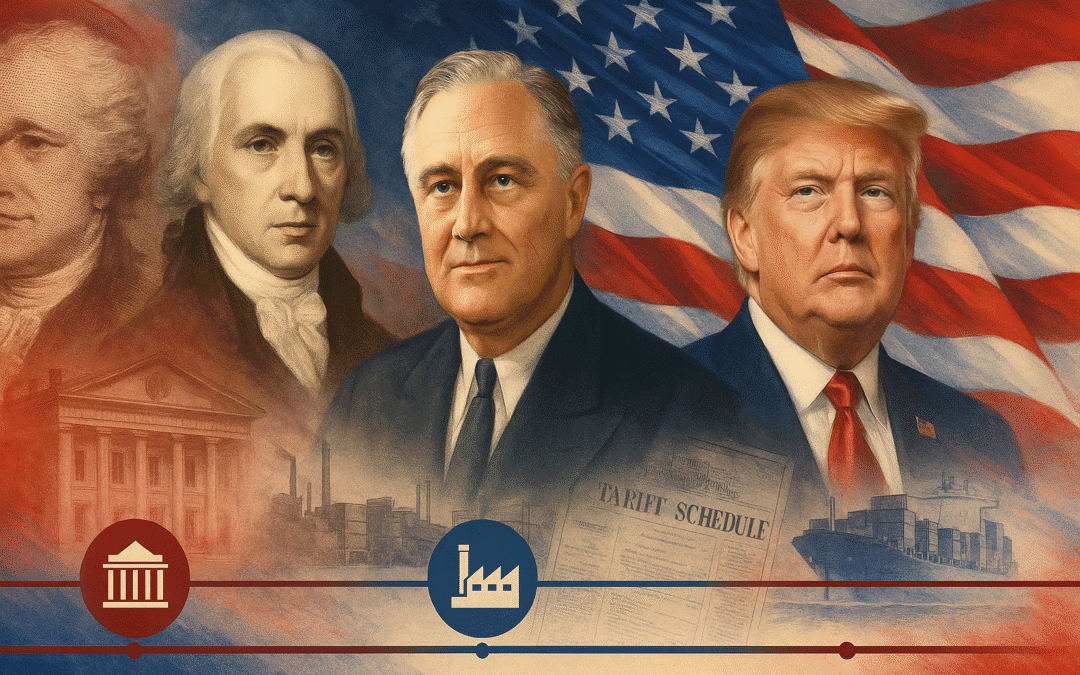
The history of Tariffs is a history of the United States from early trade done by local British and Colonial import/exporters to the uniform standards of the Tariff Act of 1789 introduced by James Madison and advocated and implemented by Alexander Hamilton that became the primary revenue source for the young nation. From Congressional lists and schedules updated every 5-6 years by Congress to the dynamically negotiated agreements done by the Executive branch we have today. From an instrument of revenue to a tool for international trade, geopolitical power, and protection of National interests, Tariffs have been used throughout US History. From the disastrous effects of the Smoot-Hawley act to the triumphs of Post World War II Bretton Woods frameworks leading to our current Global Trade.
The First Congress establishes tariff duties as the primary federal revenue source. Congress sets detailed product-specific rates, leading to centralized customs collection at major ports.Significance
Major source of Revenue for United States
Establishes Congressional Authority over Tariffs
First attempt to standardize and provide uniformity to Tariffs across Colonies
Tariff Act of 1828 – a.k.a. Tariff of Abominations – Protective tariffs aimed at Northern industries cause tensions increasing cost of living in the South, leading to the Nullification Crisis when Vice President John Calhoun anonymously penned the Nullification Doctrine which emphasized a state’s right to reject federal laws within its borders and questioned the constitutionality of taxing imports without the explicit goal of raising revenue. Congress still sets rates but political conflicts highlight tariff complexity.
Significance
Establishes use of Tariffs as a Protectionism mechanism to protect domestic industry.
Establishes Congressional Authority over Tariffs
Created Political tension between the winners and losers of any Tariff policy.
The McKinley Tariff Act of 1890 was a high protective tariff raising rates on many imports. Congress remains central in setting rates, with protectionism as a goal. Introduces role of Executive Branch.
Significance
Introduced the concept of reciprocity, lowering tariffs if other country lowered theirs
Introduced role of Executive Branch to manage reciprocity agreements
Wilson-Gorman Tariff Act of 1894 attempts reduction of rates on imported goods and introduces a federal income tax. The income tax is struck down by the Supreme Court until it was re introduced after the passage of the 16th Amendment in 1913, reinforcing tariffs role as major revenue in early America.
Significance
Reduced tariffs on imported goods, reflecting a shift towards lower tariffs
Introduced the concept of Income taxes to offset lower tariff revenue
Contributed to the debate on protectionism vs. free trade, impacting economic policy and government revenue sources.
Creation of the U.S. Tariff Commission: A bipartisan body established to advise Congress with expertise, marking increasing professionalization in tariff policy.
Significance
Predecessor to the US International Trade Commission (USITC)
Led by Frank Taussig, Harvard Professor
Created as part of the Revenue Act of 1916 which introduced Income Taxes
Replaced ad hoc lobby driven policies with analytic and scientific studies and recommendations
Smoot-Hawley Tariff Act – further high tariff rates designed to help farmers exacerbate international trade tensions and the Great Depression. Congressional tariff-setting continues but criticism grows.
Significance
Started Global Trade War – caused retaliatory tariffs and significantly reduced International trade
Considered to contribute to worsening the Great Depression
Global trade levels dropped roughly 2/3rds from 1929 to 1934
Reciprocal Trade Agreements Act (RTAA): Congress delegates authority to the president to negotiate bilateral trade agreements and adjust tariffs within limits dynamically. Beginning of executive role in tariff management.
Significance
Congressional delegation of bilateral trade agreements to the Executive Branch
Allowed President to negotiate +/- 50% of existing Smoot-Hawley Tariff rates
Set Reciprocity as fundamental to negotiating Tariffs that US tariff cuts only if US got a cut in return
Moved Tariffs from Congressional lists to Executive bargaining
Unconditional Multi Lateral Most Favored Nation (MFN) clauses – if you cut Tariff X every country gets the best rate – default multi lateral
GATT (General Agreement on Tariffs and Trade) created a post World War II pact that set the rules for non-discriminatory, tariff-based trade among market economies.
Significance
Locked in Most Favored Nation non-discrimination (Article I): any tariff cut for one member extends to all.
Created bound tariff schedules (Article II), making cuts durable and harder to reverse.
Ran multilateral “rounds” that progressively lowered global tariffs.
Established early dispute settlement norms and a rules-based trading system.
Laid the institutional foundation for the World Trade Organization (WTO)
IEEPA (International Emergency Economic Powers Act) a 1977 U.S. law that lets the President, after declaring a national emergency tied to a foreign threat, block property and restrict transactions to protect national security, foreign policy, or the economy.
Significance
Requires the President to declare a national emergency about a foreign threat.
Allows assets to be frozen and block or allow specific transactions (through OFAC).
Common used for sanctions to limit trade and finance with certain countries, people, or sectors.
Executive branch must report to Congress, and courts can review.
Modern Trump tariffs: The Executive branch imposes broad tariffs using delegated authority and emergency powers to negotiate reciprocal deals. The deals create leverage for US interests, and represent a shift from multilateral deals to US first agreements.
Significance
Broad Tariffs as a negotiating tool in the strong Executive model of negotiation
Goal to reset trade expectations with partners where free trade is reciprocal
Used in geopolitical great power check to limit economic and military threat of potentially hostile peers
Leveraging Emergency Powers (IEEPA) to act on non trade and economic interests like Border Security, and Fentanyl enforcement.
How the U.S. Could Reduce Debt Without Breaking the Economy
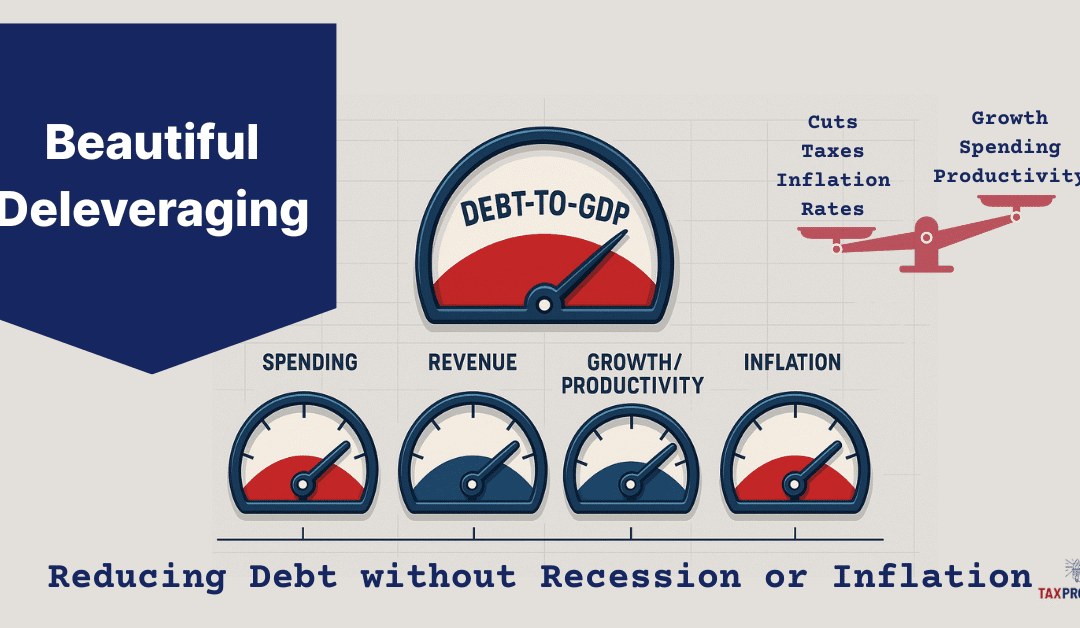
The U.S. National Debt just passed $38 trillion according to the US Treasury’s Debt to the Penny. [1][2] Not all debt is bad, but if it gets too large then debt can matter a lot, even those denominated in a fiat currency, because interest costs compound and grow they can crowd out other national priorities. Growing up your parents may have told you that it’s a lot easier to get into something, then to get out. That is especially true for debt, easy to get in, and painful to get out. Now that we have reached the point where interest payments are over $1 trillion annually, the US has crossed into that uncomfortable territory. The real challenge is to bring debt growth under control without causing a recession or a bout of high inflation. Ray Dalio, a billionaire hedge fund manager who has written books on Why Nations Succeed and Fail, and How Countries go Broke, popularized the idea of a “Beautiful Deleveraging” – a balanced, multi-year process that reduces the painful process of deleveraging when lowering debt burdens through a mix of growth, moderate inflation, controlled austerity, and targeted debt adjustments, rather than a painful deleveraging that could lead to recession, extreme reductions in services, tax increases, and austerity measures. [3][4]
This piece frames what a Beautiful Deleveraging could look like for the United States, why it’s hard, the challenges faced, and how policy could balance the Deflationary forces of tightening with the Inflationary tools sometimes used to ease the adjustment—aiming for a soft landing that improves the country’s long-run fiscal and economic health, while minimizing the pain along the way.
Current Status
National Debt: The National Debt stands at just over $38 trillion (gross) with over $30 trillion of which is Debt held by the public. [2]
Deficits: Structural Annual deficits running over $1trillion at around ~6% of GDP. [5][6]
Interest Costs: Net Interest over $1 trillion annually. The Congressional Budget Office (CBO) Long-Term Budget Outlook (March 2025), Net Interest reaches 5.4% of GDP by 2055, up from ~3.2% of GDP around 2025. [7][8] Independent analysis by the Committee for a Responsible Federal Budget (CRFB) highlights a related pressure point: by the 2050s, net interest would consume roughly 28% of federal revenues, absent policy changes. [9]
According to CBO’s latest long-term outlook, by 2055 total Federal outlays (spending) are projected at about 26.6% of GDP, with Net Interest (interest paid on National Debt) near 5.4% of GDP. That means that roughly one-fifth (~20%) of Federal spending will be used to pay interest on the debt. At that scale, interest costs rival or exceed most standalone programs and risk crowding out other priorities if unaddressed. [7][8][9]
What “Beautiful Deleveraging” Means
In Economic terms, Beauty is about reducing debt while avoiding (or at least minimizing) the painful parts of deleveraging and therefore managing that successfully can be Beautiful. Dalio’s Deleveraging framework was originally developed to explain past debt cycles and emphasizes a balanced mix of tools so that the economy can reduce debt without crashing demand and involves these components:
Spending Restraint (public and private demand constraint),
Income growth (real GDP growth),
Debt Restructuring or Terming out (Monetary intervention when necessary), and
A measured amount of Money/Credit creation (Moderating and managing inflation).
These components, when executed with great skill, political courage, and balance, can help the economy grow enough to ease debt ratios while avoiding a deflationary spiral. [3][4]
For a sovereign like the U.S., that balance translates into a policy with credible fiscal consolidation, productivity-oriented growth policies, and a monetary policy that avoids both runaway inflation and hard-landing deflation. Because the U.S. issues debt in its own currency with deep capital markets, it has more room to maneuver than most, but it is not immune to arithmetic: if interest rates (R) run above growth (G) (See our Article on R > G), debt ratios tend to rise unless deficits are reduced. CBO’s long-term projections foresee precisely this pressure in their future outlook. [9]
Pain Points: Why Deleveraging Is Hard
There is a reason it’s hard, in general large broad spending cuts, and more and higher taxes are not popular. While the components and levers are well known, it takes a healthy amount of political courage to propose policies that maybe unpopular, a great deal of skill and coordination to execute these policies, and likely a good amount of luck and good timing for a sustained period likely across several administrations. A deleveraging can proceed along two of these painful paths, spending cuts and tax increases, and each has tangible real-world consequences:
Spending cuts: Less public consumption and investment, fewer or slower growth in transfers, and potentially fewer (e.g. program eliminatinos) or lower service levels (e.g., processing times, enforcement, infrastructure maintenance). In macro terms, cuts are deflationary, they reduce aggregate demand, which can cool inflation but also growth and employment in the short run.
Tax increases: Higher effective tax rates reduce disposable income and/or after-tax returns to investment, is also deflationary. Design matters: broadening the base (fewer exemptions) generally distorts behavior less than steep marginal rate hikes, but either path tightens demand.
Because both mechanisms have a contractionary/deflationary impact and create conditions that can lead to recession, economic hardship, and job loss, a multi-year consolidation approach is part of Dalio’s framework. Instead of a fiscal cliff and extreme austerity based spending cuts; Dalio’s approach phases changes over time; and pairs tighter budgets with growth-friendly policies (innovation, expansion, permitting, skills, productivity increases) that lift the supply side. The goal is to keep nominal GDP growth (real growth + inflation) from collapsing, otherwise debt-to-GDP can rise even while you cut, because the revenue denominator shrinks.
Deleveraging Menu (and Their Trade-offs)
The Tax Project has outlined (See our Article: “Ways Out of Debt”) a non-exhaustive review of policy options to deleverage. Below we provide a summary group them by mechanism. [10]
1) Consolidation via Revenues (Tax Increases)
Summary: Revenue measures (Tax Increases) are deflationary near-term but can be structured to minimize growth drag (e.g., emphasize consumption/external taxes with offsets, or reduce narrow, low-value tax expenditures).
2) Consolidation via Outlays (Spending Cuts)
Summary: Spending cuts can be deflationary; pairing it with supply-side reforms (education/skills, streamlined permitting for productive investment, R&D incentives, labor force productivity growth) can mitigate growth losses and raise potential output over time.
3) Pro-Growth, Supply-Side Reforms (Growth)
Summary: Growth and Supply side reforms (e.g. Productivity, Innovation, Permitting, Energy inputs) that generate real productive growth is the least painful way to lower debt-to-GDP without relying on high inflation.
4) Inflation and Financial Repression (Print Money)
Summary: Modest inflation can ease real debt burdens, part of Dalio’s balance, while managing highly destructive excess inflation. That is why the “beautiful” approach uses only modest inflation alongside real growth, fiscal and monetary management, not inflation as the main lever. [7][9]
The Sooner we Start, the Easier it is
The bottom line is, the longer we wait the harder it gets, the problem will not go away on its own, it only gets worse over time. The 2025 CBO long-term outlook provides a forecast, and it doesn’t paint a great picture:
Debt Outlook: Debt held by the public rises toward 156% of GDP by 2055, under current-law assumptions. [8][11]
Outlays vs Revenues: Outlays (spending) climbs from ~23.7% of GDP (2024) to 26.6% (2055); revenues rise more slowly to 19.3% – expanding an already large and persistent structural gap. [8][12]
Net interest: Reaches 5.4% of GDP by 2055—roughly one-fifth of total federal outlays and around 28% of Federal revenues. [7][8][9]
Those numbers underscore the reason to start now: the later the adjustment, the harder the challenge required to stabilize debt. Conversely, a timely package that the public views as credible and fair can anchor long-term rates lower than otherwise, reducing the interest burden mechanically.
A “Beautiful” U.S. Deleveraging
The Tax Project does not propose or advocate specific policies, however a workable plan using the Dalio Framework would likely include a mix of the following components aimed to stabilize debt-to-GDP within a decade and then bend it downward while sustaining growth and guarding against excessive inflation relapse. A balanced approach:
A multi-year fiscal framework enacted up front allowing for a ordered and measured deleveraging.
Credible guardrails: Deficit targets linked to the cycle; a primary-balance path that improves gradually, with automatic triggers to correct slippage.
Composition: Roughly balanced between base-broadening revenues and spending growth moderation in the largest programs (phased in).
Quality: Protect high-return public investment; target lower-value spending and tax expenditures first.
Administration: Resource the revenue authority to improve compliance; align incentives and simplify.
A growth package to offset the deflationary impulse.
Supply-side reforms with high ROI: energy and infrastructure permitting; skilled immigration; workforce skills; competition policy that fosters innovation and productivity tools.
Private-sector: Reduce regulatory frictions that impede capex expenditures in goods and critical infrastructure.
Monetary-Fiscal Coordination in the background—not Fiscal Dominance.
Monetary-Fiscal Coordination: The Federal Reserve keeps inflation expectations anchored; it does not finance deficits but it can smooth the adjustment by responding to the real economy and anchoring medium-term inflation near target. Over time, a credible Fiscal policy promoting growth helps bring Rates (R) down toward Growth (G), easing the arithmetic. [7][9]
Contingency tools (use sparingly)
“Terming out” Treasury debt Lock in more fixed, long-term loans and rely a bit less on short-term IOUs. Why it helps: If rates rise, less of the debt has to be refinanced right away, so interest costs don’t spike as fast. If the term premium is reasonable and the Fed is in an accommodative stance, shorter term lower rate treasuries maybe attractive to reduce Net Interest expenses.
Targeted restructuring (not the federal debt—specific borrower groups) Adjust terms for groups where relief prevents bigger damage (e.g., income-based student loan payments, disaster-area mortgage deferrals). Why it helps: Stops small problems from snowballing into defaults and job losses while the government tightens its own budget.
This mix qualifies as “beautiful” by balanacing inflationary and deflationary elements. It shares the burden across levers; it avoids hard financial shocks; it relies primarily on real growth + structural balance rather than high inflation or sudden austerity. Done credibly, long-term rates fall relative to a laissez-faire (do nothing) approach, lowering interest costs directly and via lower risk premia. The country benefits both intermediate (by not inducing a recession and harsh economic measures), and long term freeing up revenue to more productive uses than Debt payments, and supporting growth.
Managing the Macro Balance: Deflation vs Inflation
All this sounds good, but the practical art is to offset deflationary consolidation with pro-growth supply measures, not with high inflation. Consider the balancing act between these different variables:
Consolidation (deflationary): Fiscal discipline reduces demand, manages structural gaps, good for taming inflation; risky for growth if overdone or badly timed.
Growth Reforms (disinflationary over time): Expand supply, lower structural inflation pressure; raise real GDP and productivity, improving the debt to GDP ratio.
Monetary Stance: Should keep inflation expectations managed; if growth softens too much, gradual monetary easing is available if inflation is on target.
Inflation temptation: Modest inflation can reduce some of the burden mechanically, but leaning on inflation as the adjustment tool can backfire if markets demand higher interest rate (term) premiums; nominal rates can rise more than inflation, worsening R > G and Net interest. CBO’s baseline already shows interest outlays rising markedly even without an inflationary strategy. [7][9]
A “Beautiful Deleveraging“ aims too creates a “soft landing” keeping nominal GDP growth positive, inflation expectations managed, and real growth strong enough that debt-to-GDP falls without creating undue Economic hardships. Managing each of these variables with the often blunt tools available, many of which don’t manifest for months, or years is quite the magic trick, requiring patience, skill, and acumen.
Risks and Pitfalls
The road ahead can be bumpy and full of challenges, managing the risks is key to a successful deleveraging. Here are some areas that can derail a “Beautiful Deleveraging.”
Front-loaded austerity that slams demand into a downturn or recession; a gradual path anchored by rules and automatic stabilizers is safer and creates less hardships. It means that we will endure less pain over a longer period. Some may want to rip the band aid off and take the measures all at once.
Policy whiplash (frequent reversals) that destroys credibility and raises risk premia (higher Interest rates); stable consistent policies beat one-off “grand bargains” and political vacillations.
Over-reliance on rosy outlooks; plans should make conservative growth assumptions, and reasonable baselines.
“Kicking the can” down the road with laissez-faire policies until interest dominates the budget, leaving painful, crisis-style adjustments as the only option is the biggest of all the Risks. CBO’s outlooks illustrates how waiting raises the eventual cost, and negative consequences. [7][8][9]
Is it Worth it?
On the surface, that’s an easy question, however the answer may pit generations against each other each with their own point of view and different perspectives. Current generations at or near retirement who may not see the worst effects of a laissez-faire policy may see the risk of recession, and cut backs in service as an unacceptable change to their Social Contract which they may have worked a lifetime under a set of expectations that they counted on. Younger generations, may see it as generational theft, placing an undue burden on them for debt they had little or no part in creating. Both are valid perspectives, however, the long term effects of a “Beautiful Deleveraging” will deliver these positive durable payoffs for the Country:
Out of Doom Loop: High debt is a trap, as out of control interest expenses rise, debt grows and the gap between revenue and debt rises in a self reinforcing doom loop. Breaking that loop is key to a healthy economy.
Lower Interest burden: As debt drops, so does Net Interest expenses. Instead of crowding out other expenses, revenue is freed up to other National Priorities (e.g. Healthcare, Education, Infrastructure, Social Services, Surplus, Sovereign Wealth). [7][9]
Greater Macro resilience: With manageable debt exogenic shocks, pandemics, wars, financial events, give the Government financial space to manage these events without taking on negative levels of debt.
Higher Trend growth: When consolidation is paired with genuine productivity reforms, lower debt ratios are correlated with higher growth, supporting living standards and the tax base. [14][15][16]
Summary
A “Beautiful Deleveraging” is but one way to approach the intractable problem of high debt. It represents a reasonable approach that balances near term realities with long term impacts. Our choices now will define the America of the future, and the quality of life younger Americans will have and future generations will inherit. Will it be painless? Probably not, it will likely require some sacrifice and discipline. The challenge wasn’t created in a short period, and it won’t be solved in a short period. Is it achievable? If we face the truth with candor about trade-offs, accept phased steps that the public deems fair, and have a bias toward investments that raise long-term productive capacity, than it is possible. The biggest question is the will of the American people. That, more than any single policy, will determine our future. At the Tax Project we will always bet on informed Citizens making the best choices for America – we will always bet on America. That defines the essence of a “Beautiful Deleveraging.” [3][4][10]
Citations
[1] U.S. Department of the Treasury, America’s Finance Guide: National Debt (accessed Oct. 2025): “The federal government currently has $37.98 trillion in federal debt.” (fiscaldata.treasury.gov)
[2] Joint Economic Committee (JEC) Debt Dashboard (as of Oct. 3, 2025): Gross debt ~$37.85T; public ~$30.28T; intragovernmental ~$7.57T. (jec.senate.gov)
[3] Ray Dalio, What Is a “Beautiful Deleveraging?” (video explainer). (youtube.com)
[4] Ray Dalio, short-form clip on “beautiful deleveraging.” (youtube.com)
[5] Reuters coverage of CBO near-term deficit path (FY2024-2025). (reuters.com)
[6] Associated Press summary of CBO’s 10-year outlook (debt +$23.9T over decade; drivers). (apnews.com)
[7] Congressional Budget Office, The Long-Term Budget Outlook: 2025 to 2055—headline results: net interest 5.4% of GDP by 2055; outlays path. (cbo.gov)
[8] Peter G. Peterson Foundation, summary of the 2025 Long-Term Outlook: outlays to 26.6% of GDP; interest path and historical context. (pgpf.org)
[9] Committee for a Responsible Federal Budget (CRFB), analysis of CBO 2025 outlook: interest consumes ~28% of revenues by 2055; R > G later in the horizon. (crfb.org)
[10] Tax Project Institute, Ways Out of Debt: US Options for National Debt (June 14, 2025). (taxproject.org)
[11] Reuters recap of CBO long-term debt ratio (public debt ~156% of GDP by 2055). (reuters.com)
[12] CBO, Budget and Economic Outlook: 2025 to 2035 (context for near-term path). (cbo.gov)
[15] Cecchetti, S. G., Mohanty, M. S., & Zampolli, F. (2011). The Real Effects of Debt (BIS Working Paper No. 352). Bank for International Settlements.
[16] Eberhardt, M., & Presbitero, A. F. (2015). Public debt and growth: Heterogeneity and non-linearity. Journal of International Economics, 97(1), 45-58.
Confused about the National Debt, why you hear so many different numbers, and what they mean. Here’s a plain English explainer to help you make sense of it all. The National Debt is the total amount the U.S. Federal government owes to its creditors. It does NOT include the Debt held by State and Local Governments. Think of the National Debt as the running total of past annual deficits (when the government spends more than it collects in taxes and other income) minus any surpluses (when it collects more than it spends). The debt grows when there’s a deficit and shrinks—at least relatively—when there’s a surplus or when growth/inflation outpace new borrowing. [1][5]
Terms you should know:
DEFICIT: A deficit is a one-year budget shortfall (this year’s shortfall, which can occur every fiscal year).
NATIONAL DEBT: The debt is a accumulated total of all Deficits minus any Surpluses (the total outstanding IOUs accumulated over time).
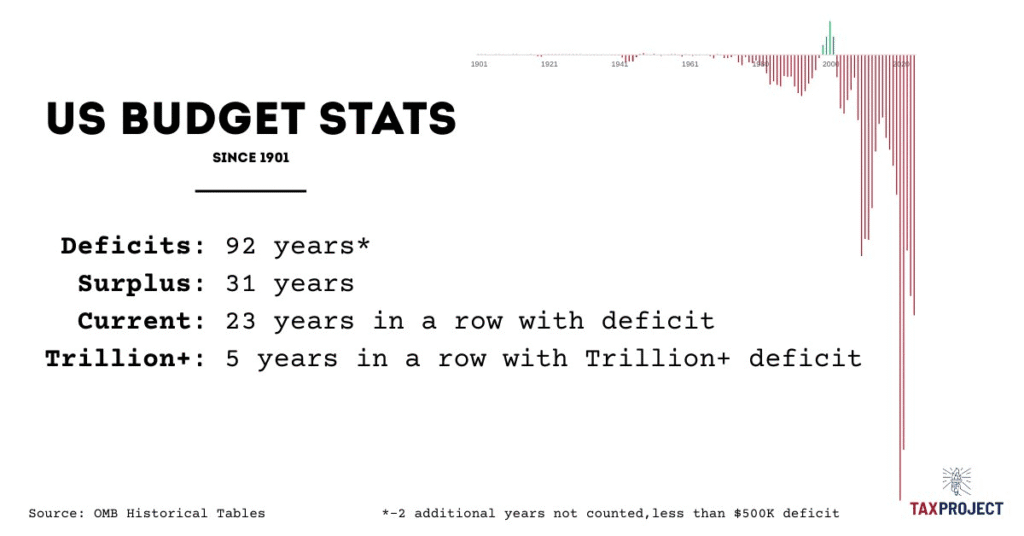
Figure 1 Historical Federal Budget Deficits and Surpluses Source: OMB
The U.S. Treasury’s Debt to the Penny website publishes the official daily total and its two big parts (explained below). You can look up yesterday’s number, last month’s, or data back to 1993. [2]
When people talk about the “National Debt,” they often mean one of three closely related figures:
Debt held by the public This is U.S. Treasury securities (Bills, Notes, Bonds, TIPS, etc.) held outside federal government accounts—by households, businesses, pension funds, mutual funds, state and local governments, foreign investors, and the Federal Reserve (America’s central bank). It’s the broadest “market” concept and is the figure economists often use when comparing debt to the size of the economy (debt-to-GDP). [3][4]
Treasury defines it as “all federal debt held by individuals, corporations, state or local governments, Federal Reserve Banks, foreign governments, and other entities outside the United States Government.” [3]
Intragovernmental holdings These are Treasuries held within the federal government – mainly trust funds such as Social Security and Medicare. When these programs run surpluses, they invest in special Treasury securities; when they run cash shortfalls, Treasury redeems those securities to pay benefits, and the government borrows from the public if needed. [4][1]
Total Public Debt Outstanding This is simply the addition of (1) Debt held by the public + (2) Intragovernmental holdings. This is the top-line number on Debt to the Penny. [2][4]
Total Public Debt Outstanding = Debt held by the public + Intragovernmental holdings
Why the distinctions matter:
Debt held by the public is what markets price and what drives interest costs the government pays to outside holders (including the Federal Reserve).
Intragovernmental debt reflects promises among parts of the federal government; it affects future cash needs but doesn’t have the same market dynamics.
Total Public Debt Outstanding is the full legal amount subject to the debt limit (with a few technical exclusions), which matters for statutory debt-limit debates. [4][5] When there are discussion in Congress about the Debt ceiling this is the number discussed.
How deficits add to the National Debt
Each fiscal year, Congress sets taxes and spending. If outlays (spending) exceed receipts (revenue), the government runs a deficit and must borrow by issuing new Treasury securities. Those new securities add to Debt held by the public, and thus to the total debt. The Congressional Budget Office (CBO) publishes baselines and explains the arithmetic and risks of rising Net interest (what the government pays in interest). In 2024, Net Interest on the Debt alone was over $1 Trillion, making it the 3rd largest budget item, larger than National Defense. [5][7][18][22]
In years with a surplus, Treasury can redeem (pay down) outstanding securities or reduce the need to issue new ones—slowing debt growth. But because recent years have seen persistent deficits, the debt has generally climbed. [22]
“Debt to the Penny”
For the Official US National Debt numbers, you can go straight to Treasury’s Debt to the Pennypage. On the site you can:
See today’s total (updated daily except during weekends and holidays) and the split between debt held by the public and intragovernmental holdings.
Download historical CSVs to chart the series yourself.
Check big shifts around tax dates, debt-limit suspensions, or major fiscal packages. [2][15]
Who does what: Role of Treasury vs. the Federal Reserve
The U.S. Treasury (through the Bureau of the Fiscal Service and the Office of Debt Management) issues Treasury bills, notes, and bonds to finance the government at the lowest cost over time. It auctions securities on a regular calendar and redeems them at maturity. Treasury also manages cash (the Treasury General Account at the Fed) to pay the government’s bills. [4][2]
The Federal Reserve (the “Fed”) is the central bank. It does not set taxes or spending and does not decide how much debt the government issues. The Fed’s role here is monetary policy: it influences interest rates and financial conditions. The Fed has a dual mandate to maintain stable prices (control inflation), and manage Employment (manage environment to keep unemployment low). It buys and sells Treasuries only in the secondary market (from dealers), not directly from the Treasury, to maintain its independence and implement policy. [6]
“The Fed does not purchase new Treasury securities directly from the U.S. Treasury, and purchases…from the public are not a means of financing the federal deficit.” [6]
The New York Fed executes these operations for the System Open Market Account (SOMA), the consolidated portfolio of Treasuries and other securities the Fed holds. [12]
What is Quantitative Easing (QE)?
Quantitative easing (QE) is a policy the Fed uses in severe downturns or when short-term interest rates are already near zero. When the Fed is using QE, the Fed buys longer-term securities, such as Treasuries and agency mortgage-backed securities, to push down longer-term interest rates and support the economy. The Fed conducted several large purchase programs after the 2008 Financial Crisis and again during 2020-21 COVID Pandemic. [8][21][14]
Mechanically, when the Fed buys a Treasury, it pays by crediting banks’ reserve accounts at the Fed. That swaps a Treasury security held by the public for a bank reserve (a deposit at the Fed). Crucially, this transaction does not change the total amount of Treasury debt outstanding—it changes who holds it (more at the Fed, less in private hands). [10][6]
“When the Federal Reserve adds reserves…by buying Treasury securities…This process converts Treasury securities held by the public into reserves…[and] does not affect the amount of outstanding Treasury debt.” [10]
Federal Reserve Balance Sheet
Does QE “add to the National Debt”?
No. QE doesn’t authorize or cause Treasury to borrow more or add to the Debt. The deficit determines how much debt Treasury must issue. QE affects yields and liquidity by changing the composition of holders (more at the Fed/SOMA, fewer in private portfolios), not the quantity of debt the government has issued. The Fed repeatedly emphasizes it does not buy securities directly from Treasury or to finance deficits. [6][7][9] (Federal Reserve)
QE can, however, indirectly affect the budget over time through interest rates (lower yields can reduce Treasury’s borrowing costs; the reverse is true when QT—quantitative tightening—lets the portfolio roll off and rates are higher). Several primers walk through these channels. [17][18][7]
How interest flows work when the Fed holds Treasuries
Here’s the accounting workflow in plain English:
Treasury pays interest on all outstanding Treasuries—whether they’re held by a pension fund, a foreign central bank, or the Federal Reserve. That shows up in the budget as Net interest outlays (spending). [18]
When the Fed holds Treasuries (in SOMA), the interest it receives becomes part of the Fed’s net income.
After covering its expenses, the Fed historically remits (gives back) its profits to the Treasury (these are “remittances”). In years when those profits are large, Treasury effectively gets back a chunk of the interest it paid—reducing the government’s overall cost ex post (after the fact). [9][20]
In times (like 2023-25) when the Fed’s interest expenses (mainly interest it pays banks on reserve balances and reverse repos) are greater than its interest income the Fed stops remitting, records a “deferred asset” (an IOU to itself), and resumes remittances only after it returns to positive net income. That deferred asset does not require taxpayer funding; it’s paid down by future Fed profits before any cash flows back to Treasury. [1][5]
“When the Fed’s income exceeds its costs, it sends the excess earnings to the Treasury…When its costs exceed its income, it creates a ‘deferred asset’…and resumes sending remittances after that is paid down.” [1]
Bottom line: whether private investors or the Fed hold a given Treasury, Treasury’s legal obligation to pay interest is the same. The difference is that Fed-held interest often returns back to Treasury (when Fed profits are positive), lowering the government’s ultimate net cost over time. [9][20]
Review of National Debt Concepts
Debt grows because of deficits. Congress’s tax and spending choices determine if there will be an annual deficit or surplus; deficits add to debt. Surpluses reduce the debt. [5][22]
Debt has two big parts. Debt held by the public (including the Fed) plus intragovernmental holdings (trust funds) equals Total Public Debt Outstanding. [2][4] (Fiscal Data)
QE doesn’t “create” more Treasury debt. It changes who holds it and influences rates and liquidity; the Fed buys in the secondary market and does not finance deficits. [6][10][7]
Interest flows are circular when the Fed holds Treasuries. Treasury pays interest; the Fed usually remits (returns) net income back to Treasury; during periods of negative net income, remittances pause and a deferred asset records what will be repaid from future profits. [1][5][20]
You can verify every number daily on Treasury’s Debt to the Penny site, and pair it with monthly public debt reports for detail. [2][4]
FAQ and Common Misconceptions
“If the Fed buys Treasuries, isn’t that just ‘printing money’ to fund the government?” No. The Fed buys from dealers in the open market, not from Treasury. Fed purchases swap Treasuries for bank reserves; they don’t change the amount of debt or directly finance the deficit. [6][10][7]
“Doesn’t the debt count everything the government owes, including future Social Security benefits?” The debt is legal obligations already issued (Treasury securities). Future promises (like future benefits) affect the budget and future borrowing, but they aren’t counted as debt until the government issues securities to pay for them. These are called Unfunded Liabilities (See our Article). Check the Debt to the Penny site for what is counted. [2][4][5]
“Why do some charts focus only on debt held by the public?” Because that’s the portion traded in markets, driving interest costs and macro impacts. It’s also the number most used in economic comparisons (for example, debt-to-GDP). [5]
Debt Guru: How to read the daily debt like a pro
Visit Debt to the Penny site and note Total Public Debt Outstanding.
Compare the split between public and intragovernmental. Persistent deficits typically raise the public share over time.
If rates are rising (or have risen), expect net interest in the budget to climb; CBO’s primers explain why interest costs can grow faster than the economy when debt is large. [2][18][22]
If you want more depth on how the Fed runs these operations, the New York Fed’s archive on large-scale asset purchases and the Board’s description of the System Open Market Account are the canonical sources. [8][12]
Putting it all into Context
If you want to understand how big the National Debt is, how it relates to other things like the size of our economy, how the budget deficits and surpluses compare in charts over the years historically and how that impacts the debt in charts, check out that and more in the Tax Project Institute’s Smarter Citizen App (A Free Citizen App, just register – no credit card and you’re in!)
Treasury security: An IOU the U.S. government sells to borrow money (Bills mature in a year or less; Notes in 2–10 years; Bonds in 20–30 years; TIPS are inflation-protected). Holders earn interest and get their principal back at maturity. [3]
Debt held by the public: Treasury IOUs owned by investors outside the federal government, including the Federal Reserve. [3]
Intragovernmental holdings: Treasury IOUs held by government accounts (e.g., Social Security trust funds). [4]
QE (quantitative easing): The Fed’s large purchases of longer-term securities to lower long-term interest rates when the economy needs help and short-term rates are generally already lower. [21][8]
Remittances: Fed profits (if any) sent to Treasury after covering expenses; paused when the Fed’s interest expenses exceed income (recorded as a “deferred asset”). [5][1]
References
[1] Board of Governors of the Federal Reserve System. (2024, July 19). How does the Federal Reserve’s buying and selling of securities relate to the borrowing decisions of the federal government?https://www.federalreserve.gov/ (Federal Reserve)
[2] U.S. Department of the Treasury, Fiscal Data. (n.d.). Debt to the Penny (daily dataset; coverage back to 1993). Retrieved October 16, 2025, from https://fiscaldata.treasury.gov/ (Fiscal Data)
[3] U.S. Department of the Treasury. (n.d.). Public Debt FAQs (definitions of debt held by the public & intragovernmental holdings). Retrieved October 16, 2025, from https://treasurydirect.gov/ (TreasuryDirect)
[4] U.S. Department of the Treasury, Fiscal Data. (n.d.). Monthly Statement of the Public Debt (MSPD) (monthly dataset). Retrieved October 16, 2025, from https://fiscaldata.treasury.gov/ (Fiscal Data)
[8] Board of Governors of the Federal Reserve System. (2025, September 23). Interest on Reserve Balances (IORB): FAQs (includes note that asset purchases convert Treasuries to reserves without changing outstanding Treasury debt). https://www.federalreserve.gov/ (Federal Reserve)
[10] Board of Governors of the Federal Reserve System. (2016, August 25). Is the Federal Reserve “printing money” in order to buy Treasury securities?https://www.federalreserve.gov/ (Federal Reserve)
[12] Board of Governors of the Federal Reserve System. (n.d.). Fed Balance Sheet—Table 1 (popup): U.S. Treasury, General Account (definition of the Treasury General Account). Retrieved October 16, 2025, from https://www.federalreserve.gov/ (Federal Reserve)
[13] Board of Governors of the Federal Reserve System. (n.d.). H.4.1—Factors Affecting Reserve Balances (current and archived releases). Retrieved October 16, 2025, from https://www.federalreserve.gov/ (Federal Reserve)
[14] Federal Reserve Bank of St. Louis (FRED Blog). (2023, November 20). Federal Reserve remittances to the U.S. Treasury.https://fredblog.stlouisfed.org/ (FRED Blog)
[15] Board of Governors of the Federal Reserve System (via FRED). (n.d.). Liabilities & Capital: Earnings Remittances Due to the U.S. Treasury (RESPPLLOPNWW) (weekly series). Retrieved October 16, 2025, from https://fred.stlouisfed.org/series/RESPPLLOPNWW (FRED)
[16] Board of Governors of the Federal Reserve System. (2024, March 26). Federal Reserve Board releases annual audited financial statements (deferred-asset explanation). https://www.federalreserve.gov/ (Federal Reserve)
[17] Anderson, A., Ihrig, J., Kiley, M., & Ochoa, M. (2022, July 15). An Analysis of the Interest Rate Risk of the Federal Reserve’s Balance Sheet (Part 2). Board of Governors of the Federal Reserve System, FEDS Notes. https://www.federalreserve.gov/ (Federal Reserve)
[19] U.S. Department of the Treasury, Fiscal Data. (n.d.). America’s Finance Guide: National Debt (dataset links and coverage notes—e.g., Debt to the Penny since 1993). Retrieved October 16, 2025, from https://fiscaldata.treasury.gov/ (Fiscal Data)
[20] Data.gov (U.S. General Services Administration). (n.d.). Debt to the Penny (dataset catalog entry and composition note). Retrieved October 16, 2025, from https://catalog.data.gov/ (Data.gov)
[22] U.S. Department of the Treasury, Fiscal Data. (n.d.). Historical Debt Outstanding (long-run series). Retrieved October 16, 2025, from https://fiscaldata.treasury.gov/ (Fiscal Data)
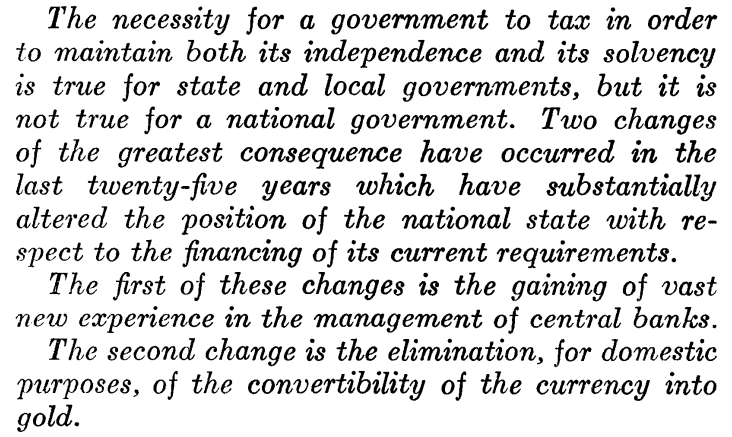
The United States in the mid-1940s, the country had just financed the most expensive and bloody war in history. Something new is occurring: paychecks for the first time begin withholding income tax out of those paychecks as they are earned. The so called “Gold Standard” where Gold backs every dollar as a legal promise is gone for Americans. The Federal Reserve is learning how to steer interest rates for a peacetime economy. Beardsley Ruml, a former Macy’s finance chief turned New York Federal Reserve chair steps into this backdrop and writes an article in the January 1946 American Affairs publication with a simple but provocative statement:
“Taxes for revenue are obsolete.”
Beardsley Ruml
He isn’t trolling – he meant what he said. He’s telling readers that the way money works has changed, and if we keep thinking about Federal taxes like a family checking account, “first earn, then spend”, we misunderstand how money works in a fiat currency not backed by a hard asset (like gold) and what taxes actually do in a monetary system. The government no longer needs to wait for tax revenue to spend. Stop for a second and think about this statement, it is a Matrix like moment where Morpheus asks Neo if he wants the Red Pill or the Blue Pill. The Red Pill represents the truth and how fiat currency actually works, and the Blue Pill represents just ignoring the truth and going back to your comfortable understanding of how money works. A full copy of Ruml’s Thesis can be found here.
Fiat currency is money that is not backed by a physical commodity like gold or silver, but is instead backed by the government that issued it. Its value comes from the public’s trust and the government’s authority, which decrees it as legal tender. Examples of fiat currency include the U.S. Dollar, the European Union’s Euro, and the Japanese yen.
The Backdrop for Ruml’s Thesis
When Beardsley Ruml wrote “Taxes for Revenue Are Obsolete,” he was synthesizing his experiences of how American money actually worked, and the changes going on around him. As a Federal Reserve chair, participant in Bretton Woods, and someone who shaped policy, like Pay as you go payroll, he had a first hand view.
1933–1934: Off domestic gold—constraint shifts inside the border
In the early New Deal years, the U.S. ended domestic gold convertibility and reorganized the gold regime under the Gold Reserve Act. Inside the country, dollars were no longer legally IOUs for a fixed weight of metal. The binding constraint on federal finance began to migrate from gold reserves to inflation, real capacity, and statute (law). Ruml’s essay explicitly ties his thesis to this inconvertible-currency reality: a national state “with a central banking system… [whose] currency is not convertible into any commodity.” [1]
“Final freedom from the domestic money market exists… where [there is] a modern central bank, and [the] currency is… not convertible into gold.” [1]
1942–1943: Pay-as-you-go withholding—taxes become continuous
With wartime employment booming, Ruml helped push paycheck withholding (the Current Tax Payment Act of 1943), turning the income tax from an April settlement into a real-time flow. Withholding didn’t just improve administration; it made taxes a live instrument for managing purchasing power across the year, reinforcing Ruml’s view that taxes should be judged by effects—on prices, distribution, and behavior rather than as a cash bucket to “fund” future outlays (spending). [5]
1944–1946: Bretton Woods and the New York Fed vantage point
As Bretton Woods took shape (par exchange rates, gold convertibility for foreign official holders, capital controls), Ruml was chairman of the New York Fed (wartime through 1946). He watched the Fed support Treasury borrowing for war finance and then toward peacetime normalization. In that setting, Ruml saw operationally how Treasury spending settled through the Federal Reserve, and how taxes and bond sales later lowered purchasing power and supported interest-rate control. He previewed his thesis in a 1945 address and then published the 1946 essay, sharpening the claim that taxes are essential for what they do, not to generate revenue before spending. [1]
“All federal taxes must meet the test of public policy and practical effect.” [1]
1951: The Treasury–Fed Accord—roles clarified
Ruml’s essay was given before the Treasury–Fed Accord, but the Accord (1951) confirmed the institutional direction he was pointing toward: monetary-policy independence to target rates and prices, separate from Treasury’s debt-management imperatives. After pegging wartime yields, the Fed reclaimed the ability to resist fiscal pressure when inflation called for tighter settings—strengthening the case that budgets should be judged by employment, prices, and distribution, not balanced-budget rituals. [3]
Ruml died in 1960, but his logic became even more straightforward after Nixon suspended official dollar–gold convertibility and major currencies moved to floating exchange rates. From then on, the United States was unambiguously a fiat-currency issuer: spending cleared through the Fed first; taxes and bond sales followed to manage inflation, distribution, market structure, and interest rates. Ruml’s once-provocative line read less like heresy and more like a plain description of operations—with the real constraints now fully on inflation, capacity, and institutional credibility. [4]
“The public purpose… should never be obscured in a tax program under the mask of raising revenue.” [1]
So the events and experiences: moving internally away from gold backed assets at home (1933–34), real-time taxation (1943), Fed Monetary Autonomy (1951), and externally away from gold (1971–73) together explain how Ruml could say, without gimmicks, that taxes are essential for what they do: price stability, distribution, behavior, and currency demand—rather than as a prerequisite to spend. He believed the question for any program was:Can the real economy deliver, and how will policy manage the price-and-capacity path along the way?[1][3][4][5]
Follow the dollar: how “mark-up” works
To see understand Ruml’s Thesis more concretely, we can use by example a single payment.
A federal contractor finishes a bridge repair job. Treasury authorizes payment to the contractor. The Federal Reserve, which is the government’s bank, marks up the contractor’s checking account at their commercial bank. Two things happen at once:
The contractor’s deposit goes up (their balance goes up, they have more spendable money).
The contractor’s commercial bank’s reserve balance at the Fed goes up (the bank’s settlement cash).
No one at the IRS had to collect that exact amount yesterday for this payment to clear today. In other words, the government did not have to wait for revenue before spending. The payment clears because the United States operates the dollar system. Once that payment is made, taxes later can remove some of those dollars from private hands; and bond sales can swap some deposits/reserves for Treasury securities to help the Fed keep interest rates where it wants them.
That’s the basics of Ruml’s claim. In a fiat system with a central bank, spending isn’t bottlenecked by prior tax receipts. The real limits are inflation and real capacity – how many workers, machines, homes, kilowatts, and microchips the economy actually has.
“Federal taxes can be made to serve four principal purposes…” [1]
Ruml’s Four Functions for federal taxes then are as follows:
Price stability (control inflation by removing purchasing power when the economy runs hot)
Distribution (redistributing wealth (purchasing power) based on policy)
Behavior/structure (altering behavior with economic incentives e.g. carbon, tobacco, alcohol, etc.)
Currency demand/legitimacy (creating demand for currency by requiring Federal taxes be paid in Dollars)
Questions from Ruml’s thesis
Not only was Ruml’s thesis provocative, if true it brings up a whole set of new questions, and challenges a lot of our notions of money and taxes.
Question: If spending can come before tax revenue, and the government doesn’t need it to spend, why are we paying taxes at all? This is the heart of Ruml’s Thesis, that while the government did not need taxes to allow the government funding to spend, taxes did play an important role. Ruml believed taxes were a way to manage price stability (inflation): they help keep prices in check by reducing purchasing power (demand), they shape who holds purchasing power, and they anchor the currency by requiring dollars to settle tax bills. Without taxes, you could spend for a time but you would lose price stability and the public’s confidence in the stability of the dollar itself.
Question: Why do politicians still ask “How will you pay for it?” if taxes aren’t needed to spend? Because you hit walls long before you “run out of money”:
You can’t print money for Imports. If spending weakens the value of the dollar, import prices jump or supplies dry up. That impacts living standards fast. [18][19][20]
Boom–bust finance. Prolonged easy fiscal + easy money can inflate asset and credit bubbles; when they pop, banks retrench and recessions deepen—costlier than using modest drains (purchasing power reductions) earlier. [9]
Tax-base erosion (seigniorage limit). If people expect rising prices and weak policy response, they flee into hard assets/FX; real tax intake falls just when control is needed (seen in hyperinflations). [16][17]
Real-world choke points. Money doesn’t increase productivity, create nurses, build cars, ports, or grid lines; increasing demand into bottlenecks yields price instability, not output. [10][12][13][14]
Interest-cost feedback. Rate hikes to cool inflation raise government interest bills, shifting income toward bondholders and forcing tougher trade-offs later. [11][9]
Predictable Policy keep costs low. Predictable authorizing/phase-out rules lower risk and support long-term contracts; junk the rules and borrowing costs/investment worsen even before inflation moves. [11][9]
Ruml’s point isn’t spend in excess, it’s that taxes aren’t required to spend. Taxes and pacing are the governors that keep prices stable, protect access to vital imports, prevent financial bubbles, and align demand with what the real economy can actually deliver. [1][2][3][6][7]
Question: Why not just make everyone a billionaire? This is an interesting thought exercise, if everyone was a billionaire would the purchasing power of the currency be the same? Since money is a claim on real output, not actual output (productivity) if everyone was a billionaire most certainly the purchasing power of the fiat currency would be substantially lower. More money without more productivity (nurses, houses, energy, widgets, etc.) brings higher prices (inflation), not greater prosperity. Ruml’s thesis keeps taxes (and other monetary mechanisms to reduce purchasing power) in the toolkit precisely to match purchasing power to capacity.
Japan: Use Case and cautionary tale
Japan is the cleanest real-world test of part of Ruml’s thesis. For decades, Japan’s gross public debt sat well above 200% of GDP—yet long-term interest rates were near zero under Bank of Japan (BOJ) policy. The Yen has had no solvency crisis, of major uncontrolled inflation. That supports Ruml’s point that a nation which issues debt in its own currency faces inflation and capacity constraints more than a “running out of money” constraint [12][13].
However, during the same period shows why Ruml’s mechanics don’t solve the growth problem by themselves:
The “lost decades.” Japan endured a multi decade stretch of weak real growth and disinflation/deflation. Even with easy financing conditions Japan was not able to create growth and productivity improvements or new sectors on their own [14][16].
Balance-sheet hangover. After the 1990s asset bust, households and firms deleveraged for years—private demand stayed weak even when public deficits filled part of the gap.
Wages and demographics. An aging population, shrinking workforce, and corporate practices contributed to sluggish productivity and flat real wages for many workers [14][16].
Foreign Exchange (FX) and imported prices. Episodes of yen weakness raised import costs (notably energy), squeezing households and complicating the path out of very low inflation.
Policy evolution. The BOJ cycled through low rates including zero and even negative interest rates for 8 years!, Quantitative Easing, and yield-curve control, then gradual adjustments. These tools stabilized finance but didn’t create robust growth, reminding us that supply-side capacity (energy, housing, innovation, corporate reform) still determines living standards.
Monetary sovereignty may avoid immediate solvency issues in your own currency, but prosperity still depends on productivity, demographics, and the supply side. The policy art isn’t printing more money; it’s about managing the balance between demand and capacity so money meets output rather than outruns it. [12][14][16]
Where Ruml’s Thesis fails
Ruml presumes monetary sovereignty – you tax and spend in your own currency, with credible institutions, and you don’t owe large amounts in someone else’s money, or require external inputs like energy, food, or other goods and raw materials. It also assumes you don’t outspend the productive capacity of the country. If and when those conditions vanish, significant and detrimental impacts could fall upon the country. There are a number of examples of hyper inflation, that have damaged the economic and well being of countries.
Weimar Republic Germany (1921–23). Huge reparation obligations (external), political fracture, and aggressive central-bank financing into a collapsing anchor produced hyperinflation. The issue wasn’t “deficits” in the abstract; it was external liabilities + institutional breakdown + supply dislocation [18].
Zimbabwe (2000s). Radical output collapse (agriculture and supply chains), governance failures, and money creation against shrinking real capacity drove prices into hyperinflation. Too many nominal claims, too little real output [19].
Sri Lanka (2022). A foreign-currency crisis: depleted FX reserves, weak tax base, and large hard-currency debts. You cannot print your own fiat money when your liabilities are in dollars/euros; the constraint becomes imports and external financing, not domestic “solvency” [20][21][22].
Ruml’s Thesis exists when you issue your own currency, are not dependent on externalities or foreign debt, and spending does not outpace productive capacity and credibility in currency is maintained. Lose those – and inflation, devaluation, and/or default can take the driver’s seat.
How most Economists think about Ruml’s Thesis
Most modern economists agree on the operational basics: in a fiat currency system, the Treasury and central bank can ensure payments clear in the home currency; taxes/bonds then drain purchasing power and help the central bank hit an interest-rate target. That’s not controversial [6].
Where Economists caution starts – real life, not the textbook:
Prices can jump if demand outruns supply. If new spending hits an economy short on cars, nurses, chips, or houses, prices rise. That happened in 2020–22 during the COVID Pandemic: demand recovered while supply was jammed. Changing taxes or budgets is slow, so economists like built-in brakes (automatic stabilizers) and phased rollouts. [6][7][2]
Higher interest rates make debt cost more. The U.S. can always pay in dollars, but when the Fed hikes to fight inflation, the interest bill on government debt climbs. If that bill grows faster than the economy or tax revenue, Congress faces tougher trade-offs. Last year Net Interest on the US National Debt was over $1 trillion. The 1951 Accord exists so the Fed can fight inflation even if it makes borrowing costlier. [3][10][11]
Consumer Sentiment and Beliefs matter. Prices stay more stable when people trust leaders will cool inflation off if needed. If policy looks like “spend without limits,” businesses and workers build in higher inflation into their cost models and pass that along, and it’s harder to bring back down once its gone up.
Not every side effect shows up in the Consumer Price Index (CPI). Inflation can manifest itself in many ways that trickle down to the ordinary consumer in ways that aren’t tracked well by major indexes like the CPI. Big deficits with low rates can push up stock and house prices and widen wealth gaps, even if everyday inflation isn’t high. That can erode support for useful programs. [10]
At full tilt, something has to give. When the economy is already near full capacity, more public spending creates demand that competes with private demand for the same workers, resources, and materials. The result isn’t “no money”; it’s higher prices or shifting resources away from something else. This can be managed with taxes destroying demand, phased timing reducing demand peaks, or adding supply.
America, and most countries are deeply intwined in Global Trade We import energy, food, critical resources, and key parts from a Global Supply chain. If the dollar weakens or suppliers get nervous, import prices rise and shortages can appear. Building domestic capacity (energy, logistics, housing) and self sufficiency can offset that, but it also comes at a cost.
Where Economists actually stand on Ruml’s thesis
Broad agreement on the plumbing: Most economists accept that in a fiat system the government can pay first in its own currency, and that taxes/bonds are tools to manage demand and interest rates. That’s mainstream (see the Bank of England explainer). [6][7]
Support for using deficits in slumps: In recessions or emergencies, many economists favor deficit spending to protect jobs and speed recovery. (Ruml’s taxes aren’t required for spending fits this.) [6][7]
Caution about pushing it too far: Many are wary of treating “spend first” as a green light without a clear plan for inflation, ensuring demand doesn’t outpace supply and productive capacity, and the outside world (Global trade, key economic inputs from outside the U.S.). They stress guardrails, automatic stabilizers, and credible roles for the Fed and Congress (the spirit of the 1951 Accord). [3][10][11]
Split on the stronger claims (often linked to MMT):
Critics say relying mainly on taxes to stop inflation is too slow and political, and they worry about fiscal dominance (pressuring the Fed to accommodate debt). They also flag open-economy risks and asset-price side effects. [9]
Supporters respond that good design (automatic tax/benefit adjusters, phasing, targeted drains) can handle those issues, and that recognizing the fiat mechanics helps us focus on real limits (people, machines, energy) rather than imaginary cash limits. [9]
Economist View Summary:
They mostly agree on the mechanics.
They agree deficits can be useful tools.
They differ on how far you can push spending before you risk inflation, financial stress, or FX problems
They differ on whether taxes can be used quickly and fairly enough to cool inflation off. [6][7][3][10][11][9]
A Ruml-style way to judge any Spending program
The Congressional Budget Office estimates the cost and budget impact of programs. Using a Ruml Thesis style way to evaluate programs might look something like this.
Capacity: Do we have the people, skills, materials, energy, and productive capacity? If not, what’s the plan to expand supply?
Inflation plan: If demand overheats, what automatic brakes kick in—phasing, adjustable credits, temporary surtaxes? [2]
Distribution: Who gets the new purchasing power and who gives something up?
External exposure: Are we import or FX sensitive in the relevant inputs? Do we hold external exposures?
Institutional alignment: Are fiscal choices made with a central bank focused on price stability (the post-1951 lesson)? [3]
Summary: Ruml’s answer to the question
In summary we ask the title question: “Are taxes needed,?” Ruml’s answer—in his own words—is that their revenue role is not the point in a fiat system:
“Taxes for revenue are obsolete.” [1]
They are needed for what they do: to keep prices stable, shape distribution and behavior, and anchor demand for the dollar:
“Federal taxes can be made to serve four principal purposes…” [1]
And the standard for judging them is not myth or ritual but outcomes:
“All federal taxes must meet the test of public policy and practical effect.” [1]
Read that together and you have the summary of his thesis: the United States does not tax so that it can spend; it taxes so that the money it spends produces stable prices, fair distribution, incent certain behaviors, and ensure a credible currency. While his beliefs were provocative at the time, and still controversial, the mechanics of his thesis remain true and you can see his influences in the roots of Neo Chartalism, Functional Finance and all the way to Modern Monetary Theory (MMT) today.
Tax Project Institute is a fiscally sponsored project of MarinLink, a California non-profit corporation exempt from federal tax under section 501(c)(3) of the Internal Revenue Service #20-0879422.