The terms “surplus”, “deficit” and “debt”, or “National Debt”, are often used at the same time, and sometimes interchangeably, but they represent distinct concepts in government finance. Understanding the difference is crucial for grasping the fiscal health of our nation. This article discusses the differences, helps define them and put them in terms Citizens can use.
What is a Surplus & Deficit?
Imagine your household budget for a given period, say a month. You have money coming in (your income) and money going out (your expenses).
Deficit: If in that period you spend more money than you earn, you have a deficit. You’ve spent more than your current income . For a government, a budget deficit occurs when its total expenditures (spending on programs, services, etc.) exceed its total revenues (money collected from taxes, fees, and other sources) within a specific fiscal year (typically October 1 to September 30 in the U.S.) [3]. That is to say Total Expenses exceed Total Revenue.
Deficit
Inadequacy or insufficiency. “a deficit in revenue.”
The amount by which a sum of money falls short of the required or expected amount; a shortage. “budget deficit.”
Deficiency in amount or quality; a falling short; lack. “a deficit in taxes, revenue, etc.”
Surplus: Conversely, if you earn more money than you spend in a given month, you have a surplus. The government experiences a budget surplus when its revenues exceed its expenditures in a fiscal year. This means that your Total Revenue exceeds your Total Expenses and you have money left over [3].
Surplus
Being more than or in excess of what is needed or required: synonym: superfluous. “surplus revenue.”
Being or constituting a surplus; more than sufficient. “surplus revenues; surplus population; surplus words.”
An amount or quantity in excess of what is needed.
What is a National Debt?
Now, let’s extend that household analogy. If you consistently spend more than you earn each month, you’ll likely need to either a) Reduce Spending, b) Increase Revenue, c) Take from Savings, or d) Borrow money (use credit). Your use of credit might be a credit card, a loan from a bank, or borrowing from friends and family. This accumulated borrowing represents your total debt.
National Debt: The National Debt (or public debt) is the cumulative total of all the money the federal government has borrowed over its entire history to cover past deficits, minus any surpluses [1, 3]. When the government runs a deficit, it has to borrow money, usually by issuing Treasury bonds, bills, and notes. This new borrowing adds to the National Debt. When it runs a surplus, it can use that extra money to pay down a portion of the existing debt, or put into funding other programs and services.
While the US Government has mechanisms that you and I don’t have that make it different than a Credit Card, for our analogy the National Debt accumulates like the total balance on your credit card or loan statement, which reflects all the outstanding purchases (expenses) you’ve made over time and haven’t fully paid off (debt). Every time you have a monthly deficit (spend more than you earn and put it on credit), your overall credit card debt increases.
Debt
Something owed, such as money, goods, or services.”used the proceeds to pay off her debts; a debt of gratitude.”
An obligation or liability to pay or render something to someone else.”students burdened with debt.”
The condition of owing. “a young family always in debt.”
National Debt and Deficits in Context, why does it matter?
For the United States, carrying some debt is nothing new, with rare exception the U.S. has carried debt since its inception [2]. Carrying some debt is normal, and perhaps beneficial – say like a Mortgage and a Credit Card bill you pay each month. However, the scale and trajectory of the US National Debt have dramatically changed over the last few years. The US has had some economic shocks that increased the debt rapidly including the 2008 Great Recession, and the COVID Pandemic. What is different now with our current National Debt is that it is the highest it has ever been ($36.95 Trillion) [10] greater than our entire country’s annual economic output of $29.18 trillion in 2024 (Debt to GDP > 100%) [11]. Troubling is that this is a peace time debt surpassing World War II levels of spending. To some, more concerning is that each year we have a deficit in our budget, now exceeding over a trillion dollars annually, that appears to be a structural shortfall. Meaning, the government’s revenue is consistently below its expenses and commitments that isn’t one time or transient, and must borrow each year to meet its funding needs.
The last time the U.S. federal government ran an annual budget surplus was in 2001 [1, 3]. Since then, the nation has experienced a continuous string of deficits (over 20 years in a row). This persistent pattern isn’t just a result of temporary economic downturns; it’s driven by structural deficits.
Structural deficits refer to a persistent imbalance between government spending and revenues that exists even when the economy is operating at its full potential (i.e., not in a recession, or major economic shock) [1, 3]. These are not caused by the ups and downs of the business cycle but by fundamental, long-term mismatches in revenue and expenses [3]. Key drivers of structural deficits in the U.S. include:
Aging Population: As the population ages, programs like Social Security and Medicare face increasing demands, leading to higher spending. Fewer working-age individuals contribute taxes relative to the growing number of retirees receiving benefits [1].
Rising Healthcare Costs: Healthcare costs consistently outpace economic growth, putting upward pressure on government spending for programs like Medicare and Medicaid [1].
Tax Policies: Decisions to cut tax rates without corresponding spending reductions, or a tax base that doesn’t keep pace with the modern economy, can contribute to insufficient revenue.
Increased Spending Commitments: Long-term commitments to various government programs and services, without sustainable funding mechanisms, create an ongoing gap.
These underlying factors mean that even during periods of economic prosperity, the U.S. government is projected to continue spending more than it collects, contributing to the ever-growing national debt [1].
Are Deficits Bad? What about Interest?
Deficits, and Debt spending are not all bad. Government can step in to “prime the pump” in times of economic turbulence to smooth a business cycle, and some government investments add to overall productivity. However, while sometimes beneficial (e.g., during wars, pandemics, or severe economic crises to stimulate recovery), persistent and large deficits are generally not a good thing because they directly lead to a larger national debt, and a larger national debt brings its own set of challenges:
Increased Interest Payments: Just like you pay interest on your credit card debt, the government must pay interest on the National Debt [8]. As the debt grows, so does the amount of interest the government has to pay. If your credit card balance keeps growing, a larger and larger portion of your monthly payment goes just to interest, leaving less money to pay down the principal or for other essential spending.
Real-World Impact: For the U.S. federal budget, interest payments on the national debt have become one of the fastest-growing “programs” [8]. These payments are mandatory and siphon away funds that could otherwise be used for other programs like education, infrastructure, scientific research, defense, or reducing taxes [8]. In 2024 Interest expenses exceeded $1 trillion dollars, passing the US Military as the 3rd largest expense in the Federal budget [12].
Crowding Out Budget Items: As the Interest payments grow, if they get large enough it puts the government in a difficult situation. If they are unable offset the deficits with more Revenue they may be forced to reduce other programs, or add to the Debt compounding the challenge. This has the effect over time of crowding out other government expenses in order to pay the rising Interest expenses.
Higher Interest Rate Expenses: When the government borrows heavily to finance its deficits, it competes with private businesses for available capital in the financial markets [9]. This increased demand for capital can drive up interest rates from investors who are taking on more risk from a highly leveraged seller. Higher interest rates make it more expensive for the government to borrow money to finance the debt. This leads to increasing Interest expenses. For example if you’re constantly maxing out your credit cards, banks might be less willing to lend you money or increase your interest rate to compensate for their higher risk.
Reduced Fiscal Flexibility: A large and growing national debt limits the government’s ability to respond effectively to future crises (like recessions or natural disasters) or to make necessary investments [8]. With a significant portion of the budget already allocated to interest payments, policymakers have less room to maneuver. If your household expenses match your income, an unexpected medical emergency or job loss can be catastrophic if you have no financial buffer or ability to borrow more without extreme difficulty. This can lead to difficult choices, potentially requiring painful tax increases or spending cuts during times when economic stimulus or social support is most needed [8].
Risk of Fiscal Crisis: In extreme cases, if investors lose confidence in a government’s ability to manage its debt, they may demand much higher interest rates or stop lending altogether. This could lead to a fiscal crisis, where the government struggles to pay its bills, potentially causing economic instability, inflation, and a loss of trust in the nation’s financial system [8]. This situation is unlikely to happen in the US as the Reserve Currency in the World, and backed by the US Governments unlimited ability to tax.
US Advantages: The Reserve Currency and Fiat Money
It’s important to acknowledge that for countries like the United States, whose currency (the U.S. dollar) holds reserve currency status, there’s a unique advantage. As the world’s primary reserve currency, the dollar is widely used in international trade, finance, and as a store of value by central banks globally [5]. This creates a consistently high demand for U.S. Treasury bonds, even amidst large deficits, making it easier and often cheaper for the U.S. government to borrow money [5]. Foreign governments and investors are generally willing to lend to the U.S. at relatively low interest rates because U.S. Treasury securities are considered extremely safe and liquid [5]. However, this ability is not unlimited and we may get to a point where that is tested (See our article Return of the Bond Vigilantes).
Furthermore, because the U.S. government issues its debt in its own fiat currency (a currency not backed by a physical commodity like gold, but by government decree), it theoretically has the ability to “print” more money to pay its debts. This gives it a degree of flexibility that countries borrowing in foreign currencies do not possess [5].
However, most mainstream economists believe that while these factors allow for higher debt levels, they do not negate the long-term risks associated with persistent structural deficits and a continuously rising national debt. Even with the reserve currency advantage and the ability to issue debt in fiat currency, there are still significant potential downsides:
Inflation: While printing money can address debt, doing so excessively without a corresponding increase in goods and services (productivity) can lead to inflation, eroding the purchasing power of the currency [7].
Loss of Confidence: Even for a reserve currency, if debt levels become truly unsustainable or if the government appears unwilling to address its fiscal imbalances, investors could eventually lose confidence, leading to a depreciation of the currency and higher borrowing costs as demand moves away from the dollar.
Intergenerational Equity: Accumulating massive debt effectively transfers the burden of repayment (through future taxes or reduced services) to younger and future generations.
It’s worth noting that a minority school of thought, known as Modern Monetary Theory (MMT), holds a different perspective. MMT proponents argue that a sovereign government, which issues its own fiat currency, is not financially constrained in the same way a household or business is [6]. They contend that such a government can always create enough money to meet its obligations and finance spending, as long as it avoids inflation [6]. From this viewpoint, the primary limit on government spending is the availability of real resources in the economy, not the ability to finance deficits [6]. While MMT has gained some academic traction, its policy prescriptions and core tenets remain largely outside the economic mainstream and are considered outside of the mainstream by most economists, who emphasize the importance of fiscal sustainability and the risks of unchecked government spending and debt [7].
Conclusion
In conclusion, surpluses are annual measures of revenue outpacing expenses, deficits are an annual measure of overspending, and the national debt is the cumulative total of all borrowing less surpluses. Persistent deficits lead to growing debt, which in turn leads to higher interest payments, potential crowding out of private investment, reduced fiscal flexibility, and an increased risk of economic instability. While the U.S. dollar’s reserve currency status and the nature of fiat currency provide certain advantages in managing debt, most economists agree that these do not make the nation immune to the long-term structural problems that large and growing deficits entail [13][14]. Addressing these long-term fiscal challenges requires difficult policy choices to ensure a sustainable economic future.
Elon Musk’s DOGE Legacy: A Bold Shift Toward Reform
In a bold and controversial era of American governance, the leadership of Elon Musk at the newly formed Department of Government Efficiency (DOGE) —an informal but widely accepted moniker for his role in reshaping federal oversight and fiscal management—has become synonymous with disruption, reform, and no-holds-barred accountability. Love him or hate him, and there are plenty of both, Musk’s tenure may be remembered as one of the most consequential experiments in modern political and administrative history. His impact reaches far beyond flashy headlines or partisan interpretations: it is a story of technological transformation, fiscal reckoning, radical transparency, and the difficult balance between efficiency and public service.
Elon’s Motivation
As Musk steps away from the Trump administration, many can ponder what would motivate the worlds richest man [9] to take on such a task? To many, Elon Musk is an enigma, and this act only adds to that mystique. Musk, a long time Democrat, having voted for his first Republican in 2022 [8] took an abrupt turn to join the Trump administration. However, politics aside, why would someone that doesn’t need a job or money take on a task that is sure to draw the ire of a sizable portion of the electorate? The criticisms came at great personal costs, including protests, attacks on his companies that directly impacted his net worth (at least for a short period), and consumer pushback on his products. Some may believe that he needed the attention, and ego stroking, while others see it as a self less act of patriotism, someone acting as the adult in the room and making the hard choices that must be made to protect the long term health of the country. Whatever the motivation, this article looks at the legacy of what was accomplished and what he leaves behind.
Technological Overhaul and Accountability
One of Musk’s most immediate and lasting accomplishments was bringing Silicon Valley-style technology, AI and Data Science into the heart of the federal government’s operations. Under his leadership, sprawling bureaucracies that had long lagged behind the private sector were aggressively modernized. Artificial intelligence systems were deployed to streamline everything from fraud detection in benefits programs to auditing federal grants. Musk’s team instituted real-time dashboards across all major agencies, enforcing a level of visibility and data-driven performance management previously unimaginable in Washington [1].
Perhaps the most emblematic achievement of this transformation was Doge.gov, a centralized platform that delivered unprecedented transparency in real-time. The site allowed any American to see federal contracts, grants, property leases, and travel expenses with a level of detail that may previously have required Freedom of Information Act (FOIA) requests. This included line-by-line analysis of project deliverables, contract amendments, vendor histories, and financial benchmarks [2]. He made this available to all, and included API’s a mechanism so that organizations like the Tax Project and other media and research organizations could analyze and build their own applications and conclusions with the newly available data. Regardless of the public’s thoughts on Musk or DOGE, this has been a welcome and commendable addition to Government Transparency and the public discourse. (Check back soon for the Tax Project’s DOGE app release)
The Unmasking of Government Waste
With transparency came revelation—and often disbelief. The audits conducted under Musk’s leadership unearthed hundreds of egregious cases of waste, inefficiency, and fraud. In one widely publicized incident, auditors discovered that over 6,000 people listed as receiving Social Security payments were officially recorded as over 110 years old—with some records dating birth years back to the 1700s [3].
Another case involved foreign entertainers. Data analytics flagged a set of Department of State grants that had inexplicably been issued to individuals labeled as “youth outreach ambassadors.” Further review revealed that a handful of those grants had been awarded to rappers and social media influencers operating out of France, Nigeria, and Brazil, with no evidence of any deliverables tied to U.S. interests [4].
“We found hundreds of millions going to people who don’t exist, and billions going to programs that haven’t been evaluated since fax machines were cutting-edge.”
Elon Musk
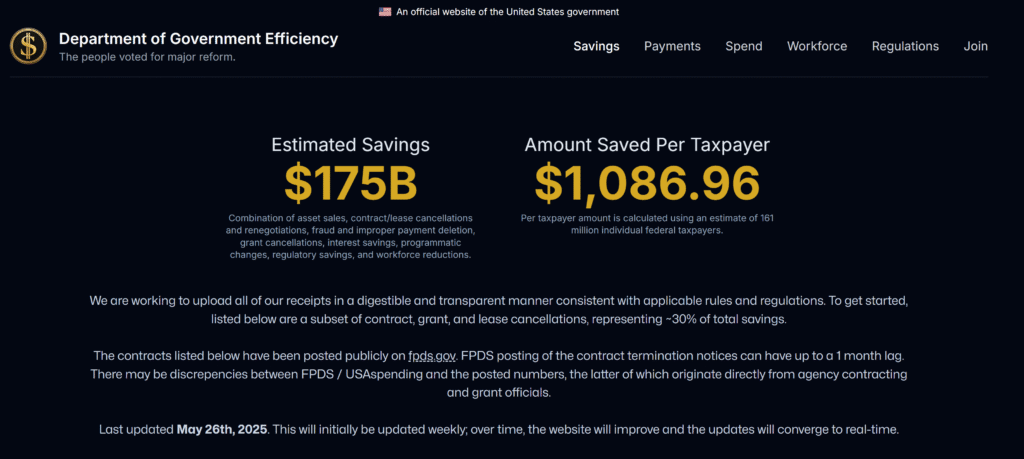
In total, the Doge.gov accountability initiative claims over $175 billion in cost savings and waste elimination over a five-year span, largely from program consolidation, fraud recovery, and sunsetting obsolete agencies and functions [2].
Perhaps Musk’s most ambitious—and controversial—goal was to confront America’s unsustainable fiscal trajectory. At the time of his rise, the federal government was running annual deficits approaching $2 trillion, and the national debt had exceeded $36 trillion. His administration implemented sweeping budget reforms, including mandatory zero-based budgeting, independent agency audits, and mandatory five-year cost-benefit reviews for all recurring programs [5].
He also ended the long-criticized “use it or lose it” budgeting practice that encouraged agencies to spend remaining funds at the end of the fiscal year. Instead, agencies that underspent were rewarded with multi-year budgeting flexibility and autonomy in reallocating savings. The impact was staggering. In just four years, the annual federal deficit was reduced by over 50%, and the growth rate of the national debt began to slow for the first time in decades [5].
But these victories came with painful trade-offs. Popular programs in arts, rural development, and public broadcasting faced sweeping cuts. Some veterans’ services were restructured into digital-first platforms, leaving older populations struggling with access. National parks experienced staffing shortages. Rural communities complained of reduced postal delivery and internet infrastructure delays. Public university research grants in non-STEM fields declined by over 40% [6].
Segments of the population that had long relied on these programs were furious. Critics accused Musk of treating the federal government like a tech startup—valuing performance over people, spreadsheets over stories.
His response? “A government that can’t pay its bills is a government that fails everyone.” [7]
A Legacy of Radical Transparency and Debate
Whatever one’s view of Musk’s methods, there is little debate that his time as DOGE left a permanent mark on the U.S. government’s operating culture. Transparency, once a campaign slogan, became structural policy. Every dollar saved by the federal government can now be traced on Doge.gov. Every contract has public deliverables. Every grant has a public-facing evaluation report. Government leases are posted with market comparisons and renewal dates.
He also fundamentally changed how Americans think about governance. Where once the budget was a black box, today there are visualizations, explanations, and performance indicators accessible from a smartphone [2]. His administration forced the American public to confront how little they had known—and how much had been hidden behind procedural complexity and bureaucratic walls.
Still, the country remains deeply divided on whether it was all worth it. Supporters hail Musk as a visionary reformer who saved the republic from fiscal ruin. Detractors argue he gutted the soul of the American social contract in the name of “efficiency.”
But no matter the perspective, Musk’s legacy in DOGE is clear: he dragged the federal government into the 21st century—sometimes kicking and screaming—while forcing a national reckoning with what Americans expect from their government, what they are willing to pay for, and what they can no longer afford to ignore.
[6] Government Accountability Office (GAO), “Impact of Federal Budget Reductions on Service Delivery,” Testimony before the Senate Appropriations Committee, September 2024. https://www.gao.gov/products/gao-24-604t
Now that the election is over and Donald Trump has been elected to return to the White House, the new administration is poised to name Elon Musk as the head of a newly formed Government agency: Department of Government Efficiency (DoGE). While this appointment may be viewed as either a refreshing change, or terrifying thought, at the Tax Project Institute we want to stick to our nonpartisan values and discuss what those changes might mean.
If, as expected, Elon Musk is appointed to head this agency it seems reasonable to assume he will bring new and potentially dramatically different approaches to Government spending and is likely to streamline government operations and slash federal spending as he has done with other organizations like Twitter. While other Government efficiency efforts have been done before, these ambitious goals include cutting the federal budget as stated by $2 trillion could and will dramatically reshape the scope and scale of Government, and potentially the services provided, as well as the impact of Government on the Economics of our country. This bold fiscal policy aims to address the nation’s spiraling deficit and ballooning national debt, while simultaneously promoting a more transparent, data-driven government will have deep and lasting impacts on our country if enacted.
Musk’s reputation for innovation and unconventional thinking is expected to drive a focus on technology and efficiency across federal agencies, potentially paving the way for significant cost reductions. However, achieving these cuts while maintaining essential services raises complex challenges, especially as the government confronts rising interest payments on the national debt and an ongoing annual deficit exceeding $1 trillion. This article delves into the prospects and concerns surrounding this new administration’s fiscal direction, particularly in the context of transparency and public accountability, alongside a list of aspirations that citizens have for a more open government.
Prospects and Challenges for a $2 Trillion Budget Reduction
The goal of reducing federal spending by $2 trillion is both promising and fraught with potential challenges. Given that the US Federal Government Revenue was $4.5 trillion1, the act of removing $2 trillion (more than 44%) would be a significant undertaking. As likely the most ambitious target proposed by any administration, this cut has far-reaching implications, particularly in relation to deficit reduction and debt management. Below are several anticipated effects, both positive and challenging, of enacting such a substantial fiscal policy.
1. Progress in Deficit and Debt Reduction: With the national debt surpassing $35 trillion and continuing to grow, and annual budget deficits more than $1 trillion, a $2 trillion reduction in Government spending could provide a substantial offset to the deficit, potentially balancing the budget over time with fiscal discipline. If successful, this could also ease the government’s debt burden, reducing the need for borrowing and interest payments that account for a growing share of federal expenditures. As we reduce our National Debt and Interest on Debt, that could free the country to increase spending on higher priority items of need.
2. Risk to Essential Public Services: Federal spending cuts of this magnitude are bound to affect a range of public services. Mandatory spending programs, such as Social Security, Medicare, and Medicaid, currently consume a large portion of the budget, leaving discretionary spending—including defense, education, and infrastructure—at risk of major reductions. The challenge for the new administration and the DoGE will be to identify areas for efficient cost-cutting without diminishing critical services. Roughly two thirds of the Federal Budget are considered Entitlements and are legally mandated by law. So, both Fiscal AND Legislative changes are likely required to achieve significant cuts, or major changes in Entitlement programs which will have to be addressed if cuts are expected to approach anything near $2 trillion. These could take the form in Social Security updates like changes to retirement eligibility, increases in contributions, or reductions in benefits. It may also include items to put them on better fiscal paths like having Social Security funds invest in capital markets versus Treasuries for higher and more sustainable returns. It could also include the creation of a Sovereign Wealth Fund.
3. Economic Ripple Effects: Federal spending creates demand and economic activity, particularly in times of downturns, by providing funding to numerous sectors. If the Government was making wise investments with good future returns for the Economy, then reducing the budget will slow contributions to GDP, with potential implications for employment and economic stability in areas reliant on federal contracts and support. While it is unlikely that significant portions of Government investments have positive ROI, there of course will be some. A careful balance is needed to avoid inadvertently disrupting the economy, especially in critical industries such as defense, education, and healthcare.
4. Interest Payments on the National Debt: The U.S. government currently spends a significant portion of its budget on interest payments for the national debt (basically the national credit card fees). Reducing the deficit and limiting further debt accumulation could help stabilize and over time reduce these interest obligations, freeing up funds for other initiatives. However, such an outcome hinges on the administration’s ability to sustain spending cuts without compromising economic performance or resorting to additional borrowing. The interest alone on our National Debt exceeded $1 trillion dollars2 this year, surpassing the US Military budget as the 3rd largest item on the Federal Budget. (See our Debt Clock to see what we could buy instead)
Hopes for Greater Transparency and Accountability
Beyond fiscal reform, the public’s expectation for transparency remains high. With Musk overseeing government efficiency initiatives it appears likely he will use a technology-driven approach to transparency that hopefully enhances public access to information. These priorities reflect a collective desire by Americans for an open government that promotes citizen engagement and holds itself accountable. Key areas of focus include:
1. Open and Accessible Government Data: Making government data more accessible is central to fostering public trust and enabling citizen oversight. This includes ensuring that data on federal spending, program effectiveness, and agency performance are freely available and easy to navigate. Providing open data also enables journalists, researchers, and citizens to independently monitor government actions, thereby enhancing accountability.
2. Reliable and Authoritative Data Sources: To improve the quality of publicly available information, there should be a single, authoritative source for government data, similar to how agencies like the Office of Management and Budget (OMB) and the Congressional Budget Office (CBO) provide budget and financial reports. Centralizing these data sources would improve consistency and reliability, helping the public make more informed assessments of government initiatives. There should not be a dozen budget values for the same data on a dozen government websites. Citizens should not have to navigate this maze and determine what is real.
3. Real-Time and Updated Data Access: Providing timely access to government data could allow for better tracking of government operations. Currently, data lags and gaps sometimes prevent the public from seeing an accurate picture of federal spending and performance. Real-time data availability would facilitate more immediate oversight, enabling citizens and watchdogs to identify trends and inefficiencies as they happen when agencies and officials can be held accountable. Negligence, Omission, Ignorance, or Incompetence should not shield those accountable for performing for the American citizen.
4. Centralized and Standardized Government Systems: One of the challenges in promoting transparency is the fragmentation of data across multiple departments and agencies each having their own separate systems and practices. A centralized system for government data, with standardized formats and reporting practices, would streamline access and reduce the burden of sifting through disparate data sources and simplify Government accounting and hopefully lead to increased efficiency.
5. Promoting an API Economy: Enabling API (Application Programming Interface) access to government data would encourage the development of tools, dashboards, and other applications that present this information in user-friendly formats. An API economy would allow developers to build tools for the public to access and analyze government data in new ways, expanding transparency efforts and driving innovation in how the public interacts with government information.
6. Reporting Transparency: Having the Government produce similar annual and quarterly reporting like that used for public corporations would greatly benefit transparency. In the private sector, public companies are required to file statements of financial health and transparency annually and quarterly. These 10K and 10Q statements are standardized and easily comparable between companies and provide a historical view that can be used to make assessments of past and future performance. Similarly, if the government provided a similar 10K/10Q reporting would be a major step forward in transparency. Some groups like USAFacts.org have attempted to produce a government 10K but an official 10K that would require an audited financial statement and officer signoff would be a major step forward in transparency and accountability.
The Department of Government Efficiency: Elon Musk’s Role
The creation of the DoGE, with Musk at its helm, would symbolize the new administration’s drive to bring private-sector efficiency to federal operations. Given Musk’s track record of disruptive innovation at companies like Tesla and SpaceX, his appointment may signal a move toward leveraging technology, automation, and streamlined processes to minimize waste and maximize productivity within government agencies. Below are some potential avenues Musk might explore to achieve these goals.
1. Technological Innovation for Cost Reduction: Musk’s experience with automation and artificial intelligence (AI) could translate into technological upgrades for government operations. Automation could reduce administrative costs, freeing up resources for other priorities, while AI could be used to analyze data and streamline decision-making processes. However, implementing such changes on a government-wide scale would require balancing efficiency with service quality.
2. Cultivating Private-Sector Accountability Standards: The private sector often enforces accountability and cost-efficiency as core values, and Musk’s leadership could promote a similar culture within federal agencies. This could lead to a reduction in wasteful spending and a renewed focus on delivering measurable results. However, government operations differ significantly from private enterprises, and accountability standards must consider the unique public-service mission of government work.
3. Balancing Efficiency with Public Needs: While the private sector emphasizes efficiency, the government must provide essential services and maintain levels of service in many areas where a private company would not be economically feasible, or large capital projects only possible with state level funding. As Musk’s DoGE explores ways to reduce costs, it will need to ensure that essential services remain accessible to all citizens. This balancing act may require adjustments to private-sector principles to fit the public-interest framework of government services, and a dialogue between the public and private sector on what services and quality levels are acceptable. Defining Government Services, Service Levels, and Scope for each Government agency would go along way at standardizing services to the public. There is likely to be widescale disagreements finding the balance.
A Path Toward Fiscal Responsibility and Public Trust
With the incoming administration’s ambitious goals for a government that is financially responsible, innovative, and accountable many are hoping that they play equal weight on balancing against the negative consequences if done poorly. The proposed $2 trillion budget cut, while fraught with challenges, represents a meaningful step toward addressing the national debt and reducing the deficit.
Yet, achieving these savings will require a delicate balance, as well as the guidance of a government that prioritizes public needs alongside fiscal restraint. As the new administration takes office, the public’s hope for openness, innovation, accountability, and balance against negative impacts remain high. These aspirations reflect a broader desire for a government that is both efficient and responsive to the needs of its citizens, paving the way for a future
Tax Project Institute is a fiscally sponsored project of MarinLink, a California non-profit corporation exempt from federal tax under section 501(c)(3) of the Internal Revenue Service #20-0879422.