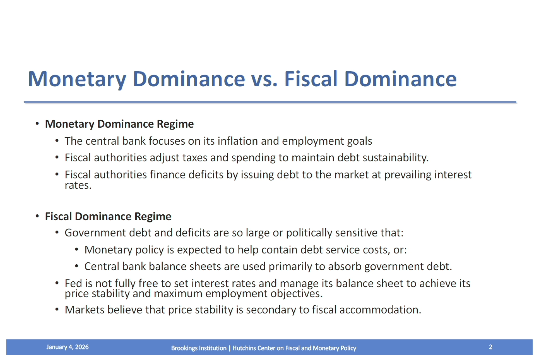
In a healthy Economic environment the Central Bank of a country, the Federal Reserve (Fed) in the United States, manages the Monetary Policy that manages the money supply, and sets interest rates to keep inflation under control and the job market healthy. The Federal Reserve is said to have a dual mandate to maintain stable pricing (manage Inflation), and maximum employment (stable Jobs). While elected officials in the Executive Branch and Congress manage the Fiscal Policy that sets taxes and the budget that determines spending. These functions are setup as independent processes with different goals.
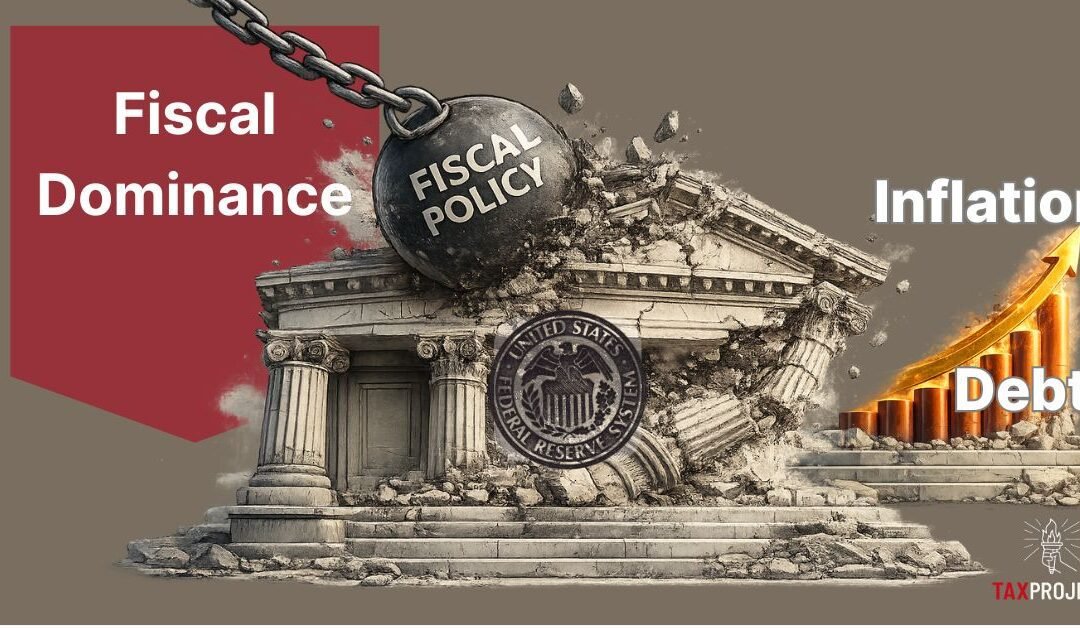
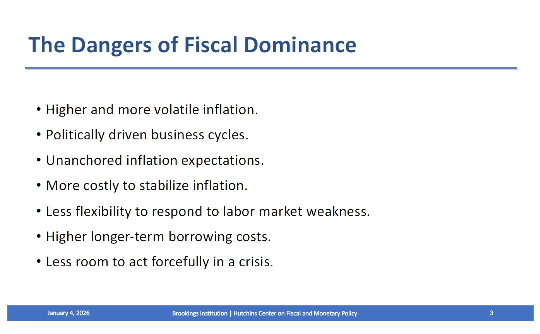
Fiscal Dominance is a term used when a Country’s Debt and Deficits get so large that Fiscal Policy begins to, either explicitly or implicitly, steer Monetary Policy. This can be a very troublesome situation to be in because it puts two competing responsibilities into conflict at times, and in general should be avoided where possible because of the risks involved. In high debt environments, interest payments on the debt can become very large and begin to crowd out other Government spending. As the interest rates raise, the debt payments grow and compound the challenges. This can put pressure on the Fed to go against their mandate to lower interest rates and thereby reduce the cost of the debt service payments. However, by lowering rates the Fed may lose control on Inflation which may rise higher than their target rate.
Former Treasury Secretary and Federal Reserve Chair Janet Yellen defines it as when deficits and debt put so much pressure on the government’s financing needs that Monetary Policy becomes “subordinate” to those needs, meaning the central bank is pushed to keep rates “lower than warranted” or buy government debt “to ease the government’s financing burden.” [1]
The challenge is that inflation becomes the easiest way out because it can immediately reduce the cost of debt service and quietly shrink the real value of what the Government owes. This is a lot easier for elected officials than raising taxes, cutting spending, or changing entitlement programs due to the unpopularity with constituents. However, through inflation it also shrinks the buying power of everyone’s dollars.
“If congress is unable or unwilling to address primary deficits the problems will compound and the temptation to rely on inflation or financial repression to reduce the debt burden will surely grow.”
Janet Yellen , “The Future of the Fed” January 4-5, 2026 [1]
Why does it Matter?
Since the COVID pandemic, after a long period of stable pricing, the US experienced higher than normal inflation, and most Americans now understand inflation, and what is being called the “Affordability Crisis” as something much more tangible and real. Inflation is no longer an abstract statistic. It is the slow (or sometimes fast) loss of what your money can buy. The Bureau of Labor Statistics tracks prices with the Consumer Price Index and explains inflation as when prices rise, the purchasing power of the dollar declines. [4]
The damage caused by inflation shows up everywhere: groceries, gas, rent, insurance, childcare, car repairs. If pay does not keep up with inflation then living standards slip. If you hold cash or earn a low interest rate on savings, inflation reduces the value of your money punishing savers, those on fixed income, and the most vulnerable.
You can also see inflation worry show up in markets. When people get uneasy about the future buying power of dollars, they often look for hedges. Gold is the classic example. Recently Gold has been hitting record highs above $5,000/oz in late January 2026, driven by safe-haven demand and uncertainty, along with expectations about interest rates and heavy Federal Reserve buying. [3]
None of this is to say Fiscal dominance is happening now, but as Janet Yellen recently said “the preconditions…are clearly strengthening.” (See Janet Yellen Statements here)
“the preconditions for fiscal dominance are clearly strengthening”
Janet Yellen, “The Future of the Fed” January 4-5, 2026 [1]
“I doubt Americans will wind up on the Fiscal Dominance course, but I definitely think the dangers are real and should be monitored.”
Janet Yellen , “The Future of the Fed” January 4-5, 2026 [1]
The risks are not about political parties, or politicians, but basic math. Here are some of the challenges:
When Debt is High, Interest Increases Hurt!
When the government owes a lot, even modest levels of debt can become expensive with high interest rates. That expense to pay the rising interest cost on debt competes with everything else the government wants to do. For every 1% increase in interest rates debt service costs increase nearly $400 billion annually. [6] (See Table 1 below)
The Congressional Budget Office’s (CBO) February 2026 outlook (summarized by the Committee for a Responsible Federal Budget) shows debt held by the public around 100% of GDP (i.e. the entire US Economy) and projected to rise to about 120% by 2036. It also shows Net Interest costs (the amount we pay on debt) more than doubling from ~$970 billion in 2025 to about ~$2.1 trillion by 2036, rising from about 3.2% of GDP to about 4.6% of GDP. [2]
High Interest Costs Squeeze Budgets
Unlike many budget expenses, interest is the part you pay because of past spending. It does not build roads, improve schools, or provide services directly. As it grows, it can crowd out other priorities or force harder choices later.
The current Net Interest is larger than the expense of the US Military, so doubling that cost would be a very large expense putting pressure on other spending. Whether someone sees those numbers as “manageable” or “dangerous,” they are big enough to create strong political pressure around interest rates.
This is where Fiscal Dominance risk starts to become realistic: if interest costs feel like they are exploding, it becomes politically tempting to push for lower rates regardless of inflation conditions.
The Catch-22: Debt Service vs Inflation
For younger folks a Catch-22 is a situation with no good options. You’re dammed if you do, and dammed if you don’t.
Here is the doom loop in simple steps:
Inflation is too high, or the risk of inflation is rising.
The Fed raises rates to slow inflation and protect the value of the dollar.
Higher rates raise the government’s interest bill over time.
The higher interest rate increases debt service cost that squeezes the budget.
Pressure rises to lower rates to “stop the bleeding” and lower interest costs.
If rates are cut too soon, inflation can come back, and the cycle repeats.
Yellen’s warning is that when the central bank is constrained from raising rates because it would increase debt service or cause fiscal stress, inflation expectations can become “unanchored,” and people may start to think inflation is the “path of least resistance” for managing high debts. [1]
That phrase is worth translating: once a society starts to believe “they will inflate rather than make hard choices,” the value of money becomes a political variable. That is when inflation becomes harder to control.
Interest rate
Estimated Net Interest
Delta vs Current
1%
$0.39T
-$0.93T
2%
$0.77T
-$0.54T
3%
$1.16T
-$0.15T
Current (3.4%)
$1.31T
$0.00T
4%
$1.55T
+$0.23T
5%
$1.93T
+$0.62T
10%
$3.86T
+$2.55T
15%
$5.80T
+$4.48T
20%
$7.73T
+$6.42T
Table 1 Estimated Net Interest
Can Both Sides be Right and Wrong?
It can be hard in our polarized environment not to think about this as either one side is Right or Wrong, however that misses the point. Both Fiscal and Monetary policy play important roles in the Economy and impact all Americans. Normally these can operate independently and support each other, a sort of Yin and Yang that balance each other out. The challenge when Debt and Spending get so large that they put Monetary and Fiscal responsibilities into conflict.
Fiscal Policy: Executive Branch and Congress
What they care about: Spending (Debt service) and Growth
Why they can be Right:
Lower Interest costs can reduce Net Interest expenses that crowd out other spending and make the budget fragile.
Lower rates can support growth that can expand the tax base and reduce immediate fiscal strain.
Why they can be Wrong:
By leaning on the Fed to lower Interest rates they may increase inflation and reduce the value of the dollar.
Monetary Policy: The Federal Reserve
What the Fed cares about: Stable Pricing (Inflation) and Maximum Employment (Jobs)
Why the Fed is Right:
Protecting purchasing power is not a luxury. When inflation is unstable, everyone lives with more uncertainty, borrowing costs and the Affordability crisis increase, and the value of the dollar diminishes.
Yellen makes the key point that “stabilizing prices becomes significantly more costly” once inflation expectations take hold. [1]
Why the Fed can be Wrong:
Tightening policy in a high-debt environment can create political backlash and institutional stress. Even if the Fed’s policy is “correct” on inflation, it can still trigger a fight over Fed independence that changes the rules of the game.
Short term priorities due to massively rising Debt Service costs may pose greater danger than long term rising inflation.
This is the core Catch-22: the fiscal side is not crazy to care about interest costs, and the Fed is not crazy to prioritize inflation. Inflation can be a lot like a heart attack, it can go quietly unnoticed but suddenly impact you. By letting inflation slowly (or quickly) devalue the dollar, everything gets more expensive and your savings are worth less.
What does Fiscal Dominance look like?
Fiscal dominance usually does not arrive with a press release. It shows up as a drift in behavior and expectations, such as:
Repeated pressure to cut rates mainly to reduce the government’s borrowing costs.
A growing expectation that the central bank will not do what it takes to control inflation if it would make the budget painful.
Challenges to the Federal Reserve autonomy
Investors demand compensation to cover the additional Risk Premia because they worry the government will rely on inflation to manage the debt, devaluing the dollar.
Yellen’s Listed Preconditions
Steep upward debt trajectory: CBO projects debt rising from ~100% of GDP in 2026 to over 150% in three decades—current levels already test sustainability.
Persistent large deficits: ~6% of GDP overall (~3% primary), unprecedented outside wars/recessions, with no credible medium-term fiscal adjustment plan from either party.
Debt service pressure on monetary policy: When debt hits ~120%+ GDP, rate hikes to fight inflation risk exploding interest costs, forcing Fed to prioritize debt financing over its dual mandate.
Yellen flags the same idea: fiscal dominance can raise borrowing costs if investors become concerned the government will rely on “inflation or financial repression” to manage debt. [1]
“Kick the can down the Road”
Many Western Democracies are trapped in a similar situation: High Debt, Growing Entitlements, Limited will to Raise Taxes or Cut Spending. It is politically far easier to postpone painful choices. Nobody wants higher taxes. Nobody wants spending cuts. Nobody wants entitlement changes. That political reality is not a moral failing; it is a constraint.
However, the longer we stay on our current fiscal path and our debt continues to grow, the more painful the eventual adjustment will be. This is not a problem that goes away on its own. Yellen states the hard version of this idea: if markets do not expect future budget surpluses to cover the debt, “the adjustment eventually comes via inflation or default.” [1]
For the U.S., “default” is not the scenario most people think about, although all three rating agencies have downgraded the US [5]. The more realistic concern is a mix of:
Higher Inflation – everything will cost more, and your money will be worth less
Higher Borrowing Costs – credit will cost more
Forced Fiscal Changes – some combination of tax increases and/or spending cuts
This is why Fiscal Dominance is not just a “Fed independence” topic. It is about whether the country chooses a gradual planned path or dramatic unplanned (but predictable) one. (See our Article: Ways out of Debt)
Summary
Fiscal Dominance is not a slogan and it is not “here” yet. It is a risk that grows when debt is high, and interest costs are large, and political incentives push for easier money even when inflation is not truly under control. The stakes are high, we can begin to manage it now, or we risk higher inflation and the devaluation of the dollar and the cost of everything increasing.
Citation
[1] Janet Yellen, “Remarks on the future of the Fed: Central bank independence and fiscal dominance” (Brookings, Jan 2026). (Brookings) [2] CBO February 2026 outlook summary (Committee for a Responsible Federal Budget, Feb 11, 2026). (CRFB) [3] “Gold jumps over 3% to record peak…” (Reuters, Jan 27, 2026). (Reuters) [4] BLS CPI FAQ and purchasing power notes (BLS). (Bureau of Labor Statistics) [5] CNN. May 2025. “The United States just lost its last perfect credit rating.” (CNN) [6] Based on US Treasury Debt to Penny 2/12/26, average rate on interest-bearing debt 12/4/25 Peterson Foundation
Confused about the National Debt, why you hear so many different numbers, and what they mean. Here’s a plain English explainer to help you make sense of it all. The National Debt is the total amount the U.S. Federal government owes to its creditors. It does NOT include the Debt held by State and Local Governments. Think of the National Debt as the running total of past annual deficits (when the government spends more than it collects in taxes and other income) minus any surpluses (when it collects more than it spends). The debt grows when there’s a deficit and shrinks—at least relatively—when there’s a surplus or when growth/inflation outpace new borrowing. [1][5]
Terms you should know:
DEFICIT: A deficit is a one-year budget shortfall (this year’s shortfall, which can occur every fiscal year).
NATIONAL DEBT: The debt is a accumulated total of all Deficits minus any Surpluses (the total outstanding IOUs accumulated over time).
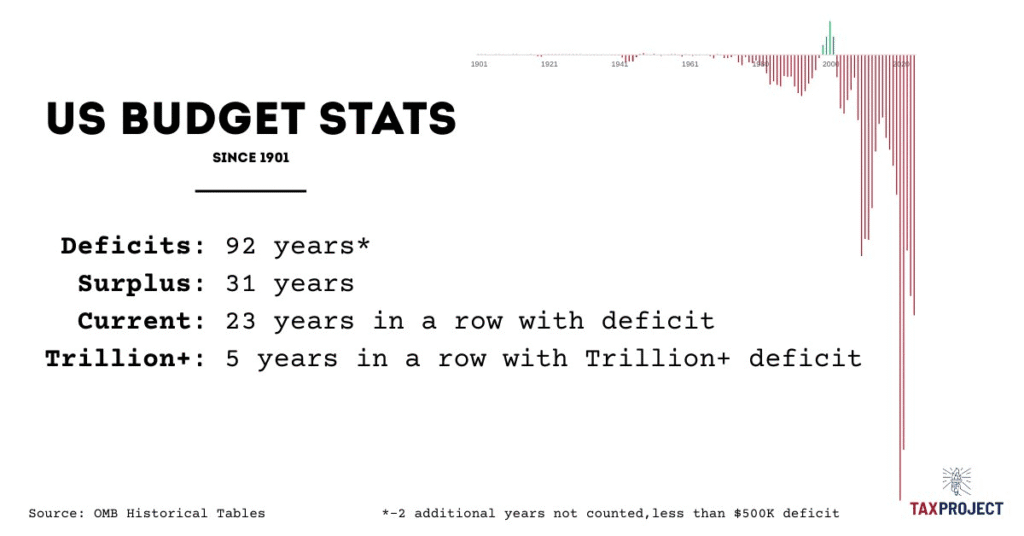
Figure 1 Historical Federal Budget Deficits and Surpluses Source: OMB
The U.S. Treasury’s Debt to the Penny website publishes the official daily total and its two big parts (explained below). You can look up yesterday’s number, last month’s, or data back to 1993. [2]
When people talk about the “National Debt,” they often mean one of three closely related figures:
Debt held by the public This is U.S. Treasury securities (Bills, Notes, Bonds, TIPS, etc.) held outside federal government accounts—by households, businesses, pension funds, mutual funds, state and local governments, foreign investors, and the Federal Reserve (America’s central bank). It’s the broadest “market” concept and is the figure economists often use when comparing debt to the size of the economy (debt-to-GDP). [3][4]
Treasury defines it as “all federal debt held by individuals, corporations, state or local governments, Federal Reserve Banks, foreign governments, and other entities outside the United States Government.” [3]
Intragovernmental holdings These are Treasuries held within the federal government – mainly trust funds such as Social Security and Medicare. When these programs run surpluses, they invest in special Treasury securities; when they run cash shortfalls, Treasury redeems those securities to pay benefits, and the government borrows from the public if needed. [4][1]
Total Public Debt Outstanding This is simply the addition of (1) Debt held by the public + (2) Intragovernmental holdings. This is the top-line number on Debt to the Penny. [2][4]
Total Public Debt Outstanding = Debt held by the public + Intragovernmental holdings
Why the distinctions matter:
Debt held by the public is what markets price and what drives interest costs the government pays to outside holders (including the Federal Reserve).
Intragovernmental debt reflects promises among parts of the federal government; it affects future cash needs but doesn’t have the same market dynamics.
Total Public Debt Outstanding is the full legal amount subject to the debt limit (with a few technical exclusions), which matters for statutory debt-limit debates. [4][5] When there are discussion in Congress about the Debt ceiling this is the number discussed.
How deficits add to the National Debt
Each fiscal year, Congress sets taxes and spending. If outlays (spending) exceed receipts (revenue), the government runs a deficit and must borrow by issuing new Treasury securities. Those new securities add to Debt held by the public, and thus to the total debt. The Congressional Budget Office (CBO) publishes baselines and explains the arithmetic and risks of rising Net interest (what the government pays in interest). In 2024, Net Interest on the Debt alone was over $1 Trillion, making it the 3rd largest budget item, larger than National Defense. [5][7][18][22]
In years with a surplus, Treasury can redeem (pay down) outstanding securities or reduce the need to issue new ones—slowing debt growth. But because recent years have seen persistent deficits, the debt has generally climbed. [22]
“Debt to the Penny”
For the Official US National Debt numbers, you can go straight to Treasury’s Debt to the Pennypage. On the site you can:
See today’s total (updated daily except during weekends and holidays) and the split between debt held by the public and intragovernmental holdings.
Download historical CSVs to chart the series yourself.
Check big shifts around tax dates, debt-limit suspensions, or major fiscal packages. [2][15]
Who does what: Role of Treasury vs. the Federal Reserve
The U.S. Treasury (through the Bureau of the Fiscal Service and the Office of Debt Management) issues Treasury bills, notes, and bonds to finance the government at the lowest cost over time. It auctions securities on a regular calendar and redeems them at maturity. Treasury also manages cash (the Treasury General Account at the Fed) to pay the government’s bills. [4][2]
The Federal Reserve (the “Fed”) is the central bank. It does not set taxes or spending and does not decide how much debt the government issues. The Fed’s role here is monetary policy: it influences interest rates and financial conditions. The Fed has a dual mandate to maintain stable prices (control inflation), and manage Employment (manage environment to keep unemployment low). It buys and sells Treasuries only in the secondary market (from dealers), not directly from the Treasury, to maintain its independence and implement policy. [6]
“The Fed does not purchase new Treasury securities directly from the U.S. Treasury, and purchases…from the public are not a means of financing the federal deficit.” [6]
The New York Fed executes these operations for the System Open Market Account (SOMA), the consolidated portfolio of Treasuries and other securities the Fed holds. [12]
What is Quantitative Easing (QE)?
Quantitative easing (QE) is a policy the Fed uses in severe downturns or when short-term interest rates are already near zero. When the Fed is using QE, the Fed buys longer-term securities, such as Treasuries and agency mortgage-backed securities, to push down longer-term interest rates and support the economy. The Fed conducted several large purchase programs after the 2008 Financial Crisis and again during 2020-21 COVID Pandemic. [8][21][14]
Mechanically, when the Fed buys a Treasury, it pays by crediting banks’ reserve accounts at the Fed. That swaps a Treasury security held by the public for a bank reserve (a deposit at the Fed). Crucially, this transaction does not change the total amount of Treasury debt outstanding—it changes who holds it (more at the Fed, less in private hands). [10][6]
“When the Federal Reserve adds reserves…by buying Treasury securities…This process converts Treasury securities held by the public into reserves…[and] does not affect the amount of outstanding Treasury debt.” [10]
Federal Reserve Balance Sheet
Does QE “add to the National Debt”?
No. QE doesn’t authorize or cause Treasury to borrow more or add to the Debt. The deficit determines how much debt Treasury must issue. QE affects yields and liquidity by changing the composition of holders (more at the Fed/SOMA, fewer in private portfolios), not the quantity of debt the government has issued. The Fed repeatedly emphasizes it does not buy securities directly from Treasury or to finance deficits. [6][7][9] (Federal Reserve)
QE can, however, indirectly affect the budget over time through interest rates (lower yields can reduce Treasury’s borrowing costs; the reverse is true when QT—quantitative tightening—lets the portfolio roll off and rates are higher). Several primers walk through these channels. [17][18][7]
How interest flows work when the Fed holds Treasuries
Here’s the accounting workflow in plain English:
Treasury pays interest on all outstanding Treasuries—whether they’re held by a pension fund, a foreign central bank, or the Federal Reserve. That shows up in the budget as Net interest outlays (spending). [18]
When the Fed holds Treasuries (in SOMA), the interest it receives becomes part of the Fed’s net income.
After covering its expenses, the Fed historically remits (gives back) its profits to the Treasury (these are “remittances”). In years when those profits are large, Treasury effectively gets back a chunk of the interest it paid—reducing the government’s overall cost ex post (after the fact). [9][20]
In times (like 2023-25) when the Fed’s interest expenses (mainly interest it pays banks on reserve balances and reverse repos) are greater than its interest income the Fed stops remitting, records a “deferred asset” (an IOU to itself), and resumes remittances only after it returns to positive net income. That deferred asset does not require taxpayer funding; it’s paid down by future Fed profits before any cash flows back to Treasury. [1][5]
“When the Fed’s income exceeds its costs, it sends the excess earnings to the Treasury…When its costs exceed its income, it creates a ‘deferred asset’…and resumes sending remittances after that is paid down.” [1]
Bottom line: whether private investors or the Fed hold a given Treasury, Treasury’s legal obligation to pay interest is the same. The difference is that Fed-held interest often returns back to Treasury (when Fed profits are positive), lowering the government’s ultimate net cost over time. [9][20]
Review of National Debt Concepts
Debt grows because of deficits. Congress’s tax and spending choices determine if there will be an annual deficit or surplus; deficits add to debt. Surpluses reduce the debt. [5][22]
Debt has two big parts. Debt held by the public (including the Fed) plus intragovernmental holdings (trust funds) equals Total Public Debt Outstanding. [2][4] (Fiscal Data)
QE doesn’t “create” more Treasury debt. It changes who holds it and influences rates and liquidity; the Fed buys in the secondary market and does not finance deficits. [6][10][7]
Interest flows are circular when the Fed holds Treasuries. Treasury pays interest; the Fed usually remits (returns) net income back to Treasury; during periods of negative net income, remittances pause and a deferred asset records what will be repaid from future profits. [1][5][20]
You can verify every number daily on Treasury’s Debt to the Penny site, and pair it with monthly public debt reports for detail. [2][4]
FAQ and Common Misconceptions
“If the Fed buys Treasuries, isn’t that just ‘printing money’ to fund the government?” No. The Fed buys from dealers in the open market, not from Treasury. Fed purchases swap Treasuries for bank reserves; they don’t change the amount of debt or directly finance the deficit. [6][10][7]
“Doesn’t the debt count everything the government owes, including future Social Security benefits?” The debt is legal obligations already issued (Treasury securities). Future promises (like future benefits) affect the budget and future borrowing, but they aren’t counted as debt until the government issues securities to pay for them. These are called Unfunded Liabilities (See our Article). Check the Debt to the Penny site for what is counted. [2][4][5]
“Why do some charts focus only on debt held by the public?” Because that’s the portion traded in markets, driving interest costs and macro impacts. It’s also the number most used in economic comparisons (for example, debt-to-GDP). [5]
Debt Guru: How to read the daily debt like a pro
Visit Debt to the Penny site and note Total Public Debt Outstanding.
Compare the split between public and intragovernmental. Persistent deficits typically raise the public share over time.
If rates are rising (or have risen), expect net interest in the budget to climb; CBO’s primers explain why interest costs can grow faster than the economy when debt is large. [2][18][22]
If you want more depth on how the Fed runs these operations, the New York Fed’s archive on large-scale asset purchases and the Board’s description of the System Open Market Account are the canonical sources. [8][12]
Putting it all into Context
If you want to understand how big the National Debt is, how it relates to other things like the size of our economy, how the budget deficits and surpluses compare in charts over the years historically and how that impacts the debt in charts, check out that and more in the Tax Project Institute’s Smarter Citizen App (A Free Citizen App, just register – no credit card and you’re in!)
Treasury security: An IOU the U.S. government sells to borrow money (Bills mature in a year or less; Notes in 2–10 years; Bonds in 20–30 years; TIPS are inflation-protected). Holders earn interest and get their principal back at maturity. [3]
Debt held by the public: Treasury IOUs owned by investors outside the federal government, including the Federal Reserve. [3]
Intragovernmental holdings: Treasury IOUs held by government accounts (e.g., Social Security trust funds). [4]
QE (quantitative easing): The Fed’s large purchases of longer-term securities to lower long-term interest rates when the economy needs help and short-term rates are generally already lower. [21][8]
Remittances: Fed profits (if any) sent to Treasury after covering expenses; paused when the Fed’s interest expenses exceed income (recorded as a “deferred asset”). [5][1]
References
[1] Board of Governors of the Federal Reserve System. (2024, July 19). How does the Federal Reserve’s buying and selling of securities relate to the borrowing decisions of the federal government?https://www.federalreserve.gov/ (Federal Reserve)
[2] U.S. Department of the Treasury, Fiscal Data. (n.d.). Debt to the Penny (daily dataset; coverage back to 1993). Retrieved October 16, 2025, from https://fiscaldata.treasury.gov/ (Fiscal Data)
[3] U.S. Department of the Treasury. (n.d.). Public Debt FAQs (definitions of debt held by the public & intragovernmental holdings). Retrieved October 16, 2025, from https://treasurydirect.gov/ (TreasuryDirect)
[4] U.S. Department of the Treasury, Fiscal Data. (n.d.). Monthly Statement of the Public Debt (MSPD) (monthly dataset). Retrieved October 16, 2025, from https://fiscaldata.treasury.gov/ (Fiscal Data)
[8] Board of Governors of the Federal Reserve System. (2025, September 23). Interest on Reserve Balances (IORB): FAQs (includes note that asset purchases convert Treasuries to reserves without changing outstanding Treasury debt). https://www.federalreserve.gov/ (Federal Reserve)
[10] Board of Governors of the Federal Reserve System. (2016, August 25). Is the Federal Reserve “printing money” in order to buy Treasury securities?https://www.federalreserve.gov/ (Federal Reserve)
[12] Board of Governors of the Federal Reserve System. (n.d.). Fed Balance Sheet—Table 1 (popup): U.S. Treasury, General Account (definition of the Treasury General Account). Retrieved October 16, 2025, from https://www.federalreserve.gov/ (Federal Reserve)
[13] Board of Governors of the Federal Reserve System. (n.d.). H.4.1—Factors Affecting Reserve Balances (current and archived releases). Retrieved October 16, 2025, from https://www.federalreserve.gov/ (Federal Reserve)
[14] Federal Reserve Bank of St. Louis (FRED Blog). (2023, November 20). Federal Reserve remittances to the U.S. Treasury.https://fredblog.stlouisfed.org/ (FRED Blog)
[15] Board of Governors of the Federal Reserve System (via FRED). (n.d.). Liabilities & Capital: Earnings Remittances Due to the U.S. Treasury (RESPPLLOPNWW) (weekly series). Retrieved October 16, 2025, from https://fred.stlouisfed.org/series/RESPPLLOPNWW (FRED)
[16] Board of Governors of the Federal Reserve System. (2024, March 26). Federal Reserve Board releases annual audited financial statements (deferred-asset explanation). https://www.federalreserve.gov/ (Federal Reserve)
[17] Anderson, A., Ihrig, J., Kiley, M., & Ochoa, M. (2022, July 15). An Analysis of the Interest Rate Risk of the Federal Reserve’s Balance Sheet (Part 2). Board of Governors of the Federal Reserve System, FEDS Notes. https://www.federalreserve.gov/ (Federal Reserve)
[19] U.S. Department of the Treasury, Fiscal Data. (n.d.). America’s Finance Guide: National Debt (dataset links and coverage notes—e.g., Debt to the Penny since 1993). Retrieved October 16, 2025, from https://fiscaldata.treasury.gov/ (Fiscal Data)
[20] Data.gov (U.S. General Services Administration). (n.d.). Debt to the Penny (dataset catalog entry and composition note). Retrieved October 16, 2025, from https://catalog.data.gov/ (Data.gov)
[22] U.S. Department of the Treasury, Fiscal Data. (n.d.). Historical Debt Outstanding (long-run series). Retrieved October 16, 2025, from https://fiscaldata.treasury.gov/ (Fiscal Data)
The conversation around wealth, particularly the wealth of billionaires or the Top 1%, has intensified. With some pointing to inequality, many ponder whether the ultra-rich hold the key to solving some of the most pressing financial challenges faced by the Nation including the funding of public services through taxation.
Amid discussions on tax reforms and increasing the tax burden on the wealthiest, a crucial question arises: Can Billionaires and their fortunes significantly impact U.S. tax revenue needs if fully utilized?
Assessing the Solution
As of April 2023, there were approximately 2,600 billionaires globally1, with approximately 750 of them residing in the United States. This number is surprisingly low to many people, and the perception from Media may give the impression that many more people live the lifestyle of the rich and famous, like the Kardasians, than actually do. Cryptozoologist Grover Krantz estimated that there were roughly 2000 BigFoot creatures in North America, and if you believe that then you literally have a greater chance of meeting BigFoot than an actual Billionaire in person.2 However, if you did meet them the collective net worth of all U.S. billionaires was estimated at about $4.5 trillion according to Forbes data3.
This is a staggering figure for sure, yet alone for less than 1000 people, the kind of wealth that is hard to comprehend for the average American. However, one’s beliefs and feelings regarding Wealthy individuals and how their wealth should be used and our right to use it is distinct from the elephant in the room: are Billionaires the solution to our Tax problems, and budget shortfalls?
Take it All
To answer this hypothetical question let’s say we appropriated, not just raised their Taxes, but took the entire fortunes of all U.S. billionaires and completely wiped them out, would it cover the U.S. tax needs, and for how long?
For fiscal year 20234, the U.S. federal government spent around $6.2 trillion even though we collected only $4.5 trillion through taxation with the 2024 Federal budget at $6.9 trillion.5 This figure far exceeds the total net worth of U.S. billionaires, and that doesn’t even include State, and Local Taxes which would be over $10 trillion annually spent by our Government as a whole. Thus, even if we theoretically seized and liquidated all billionaire assets, it would only cover a portion of a single year’s federal expenditures, and clearly not be a long term structural solution, what would you do in year 2, year 3?
Challenges with the Solution
Even if you thought this hypothetical situation was a great idea, disregarding the substantial legal and ethical issues taking all of a citizens property create, the challenges and problems it presents make even the thought of using all billionaire wealth as a one time boost would prove even less valuable and daunting on a practical basis. First of all, most ultra Wealthy individuals do not derive most of their networth through income like everyone else which makes their wealth harder to tax and retrieve. They have things like art, equity in companies, stamp collections, Real Estate, and physical capital equipment like Yachts. These things are not cash, they could be assessed at wildly different prices, and at great effort by Federal agencies like the IRS, and much of their wealth may not be easily convertible to Cash. If their cumulative wealth is liquidated, and in this case all at once, it would potentially greatly reduce the value of their assets. I mean, if you took all US Billionaires away, who really is going to buy that $50 million dollar Picasso – how big is that market without Billionaires? If all of the shares they have were sold all at once on the open market, prices of these companies would plummet immediately and drastically, greatly altering their theoretical value and estimated net worth impacting individual investors, mom and pops, retirement plans and pension funds all at the same time.
Bottom line, even if you were successful at capturing their assets they would likely be a small portion of their originally estimated value. All this makes the assumption that you would have access to all their assets, and that they wouldn’t hide their wealth, move it offshore, to another country, someplace outside of US reach. Given that they are likely the ones with the means, and ability to pull this off with armies of lawyers, accountants, foreign officials, and banks in their pocket, it would be hard to imagine all their wealth being exposed. However, if the capital, jobs, and innovation that these individuals put into our country disappeared overnight the economic disaster that would ensue after the impact to many of the worlds largest companies through seizure of billionaires assets (which include privately owned companies) and loss of their intellectual and monetary capital, could and probably would have major impacts on the US economy, and likely have a global impact.
Tax Some, but not all, but clearly more
So now that we understand the challenges and implications of taking it all, we can assess the more practical solution of taking some, but not all, but clearly more than we do today from Billionaires. While this is a more likely scenario, and potentially more sustainable, it too has a number of challenges. First, if taking all their wealth wasn’t enough, how is taking a much smaller percentage going to help? Let’s assume that all the tax loopholes are plugged up, and the rates on millionaires increase, President Biden has proposed a minimum 25% tax on the ultra wealthy.6 Given that more than 2/3rds of the approximate 750 Billionaires in the US have less than $5 Billion in Net Worth, if you were able to generate a very substantial $250 Million per year each from this group would net roughly $150 Billion a year. This scenario still isn’t likely given that many of the challenges and implications previously discussed still apply to this scenario, and taking 5% or more of their net worth per annum may not be sustainable. However, since it’s all theoretical it’s a nice budget filler, although it still doesn’t address our needs with annual budget shortfalls over a Trillion dollars. The Interest line item alone on our National Debt was more than 4 times this amount, and growing rapidly ($659 Billion).7 The Kiel Institute for the World Economy estimates that since February of 2022 the US has sent $75 Billion in aid to Ukraine alone8, and that does not include the $95.3 Billion dollar Ukrainian and Israeli aid package recently passed in the US Senate together more than the budget filler for just these one time aid packages.9
The Answer
A portion of the population may support these routes, though maybe not realizing the challenges and implications, whether it be because of the squeeze of higher taxes and the need/want for more services and the inability of the lower and middle class to pay for these, or the thought that the wealthy don’t pay their fair share (See our article on Fair Share), or that Wealth Inequality is unfair in general and they don’t like it, that the tax system has so many legal loopholes that wealthy individuals can exploit to have lower taxes than the poor, plain simple old fashioned jealousy, or the fact that it’s a lot easier to spend other people’s money. Whatever the reason, the concept is clear: Let the ultra rich cover the burden.
Political Calculus
Sadly, Politicians have already done the math, and they understand that it doesn’t work out. They know that Billionaires aren’t the magic bullet, but it makes for great campaign rhetoric and easy sound bites for those willing to believe it and it’s a lot easier and less politically risky than actual solutions. Unfortunately, there is no easy solution to properly fund the US government without significant “investment” from ordinary taxpayers and more responsible fiscal management by our Government. The solutions are Simple, but not Easy. Just like a family that is spending more than they make, the only two solutions are to spend less, or make more. While simple, those are never easy; cutting spending, government shrinkage, and/or higher taxes across the board don’t sit well with the electorate.
“I could end the deficit in five minutes. You just pass a law that says anytime there is a deficit of more than 3% of GDP, all sitting members of Congress are ineligible for re-election.”10
Warren Buffett
Summary
While the wealth of billionaires is vast, it’s a drop in the bucket of our trillion dollar annual budget deficit and $34 trillion dollar national debt challenges, viewing it as a panacea for the U.S.’s fiscal challenges overlooks the complexity of the economy and the nature of wealth. Tax policy is a tool that can influence wealth distribution and revenue generation, but it requires a balanced approach that considers economic growth, fairness, and sustainability. Simply put, there’s no magic bullet when it comes to tax policy and fiscal sustainability. Like a complex puzzle, it demands careful consideration of each piece to create a coherent and effective solution and the will and stomach to handle it. Billionaires may not be the answer, but they can surely be part of the answer, along with a lot of other ordinary people. Our choices as Citizens of how many services we want, how much we want to pay for them, and who should bear the burden are the balancing act that shapes our democracy.
Tax Project Institute is a fiscally sponsored project of MarinLink, a California non-profit corporation exempt from federal tax under section 501(c)(3) of the Internal Revenue Service #20-0879422.