Whether you love or loathe the Trump administration or Elon Musk, one thing’s for sure: the DOGE platform is changing the game on government transparency.
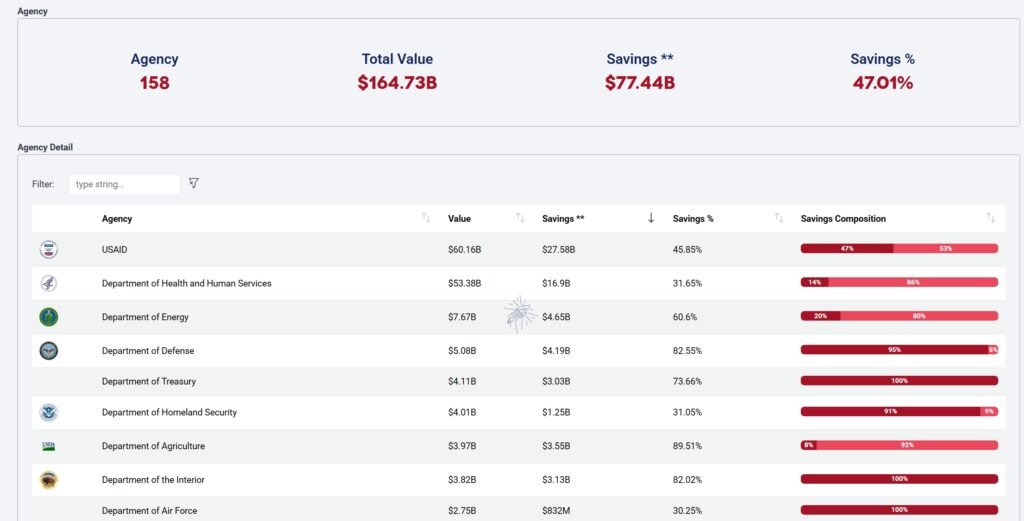
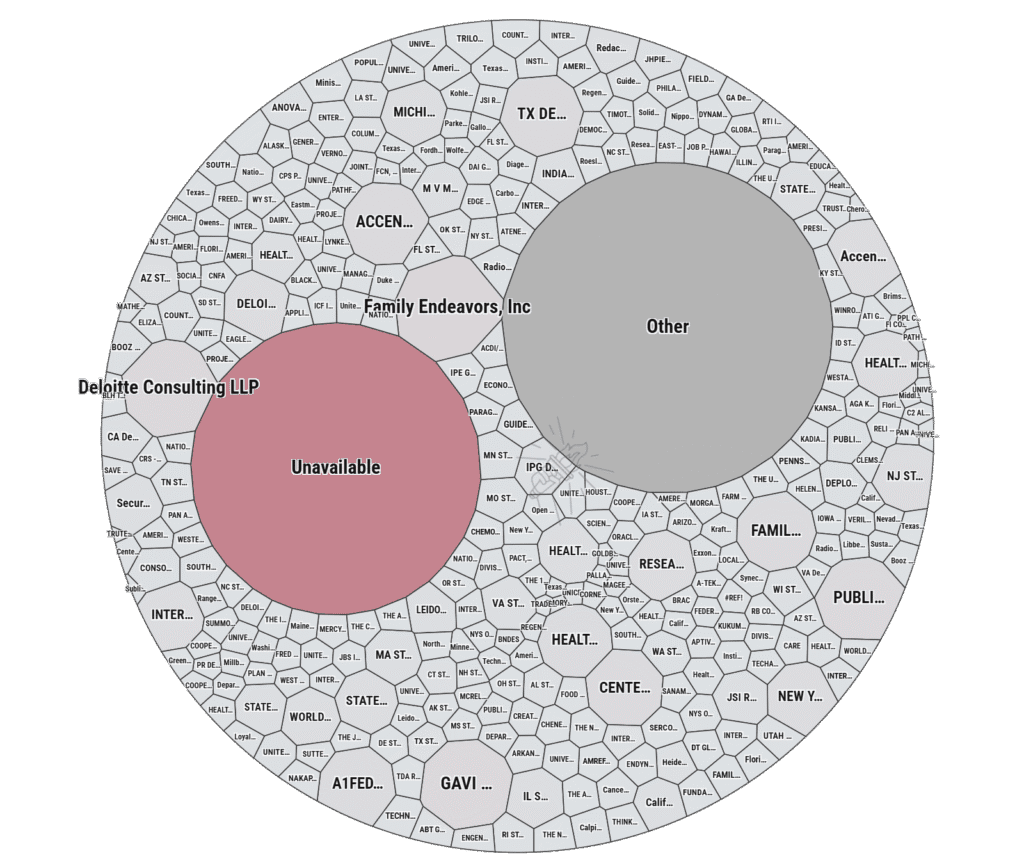
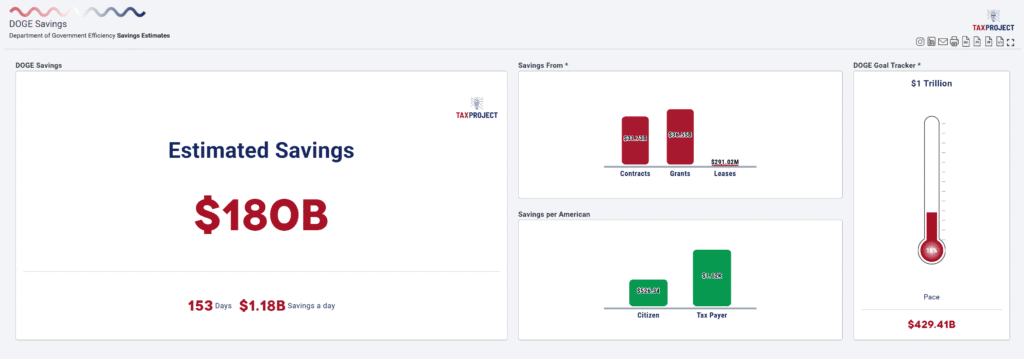
The DOGE website was a big step forward in transparency, but we’ve dialed it up to 11. The Tax Project’s DOGE Savings App gives you unprecedented access to:
Transactional-level detail on DOGE savings items
Real-time savings data straight from DOGE systems
Interactive visualizations like you’ve never seen before
No spreadsheets. Not just summaries. Just raw, searchable, visually intuitive, actionable insight.
Controversial?
DOGE for better or worse, has been the subject of a ton of controversy for sure, but this isn’t about politics — it’s about progress. Love them or hate them, DOGE has blown open the black box of government finance. The fact that this data is being exposed at all is a huge leap forward for Transparency and Open Government.
And with the DOGE API, anyone can build, analyze, or audit. That’s radical transparency — no matter what side you’re on. At the Tax Project, we’re about showing the data, and let informed citizens come up with their own opinions. You’re the boss, we just serve the data.
Why it Matters?
Track DOGE identified savings
Dig into who’s spending what — and where
See where the cuts are coming from
See which Agencies took the biggest cuts
See how much was spent on Vendors and how much was cut
Look at Contracts, Grants, and Lease details
Drill down into interactive Visual Charts
Support Transparency. Be Informed.
The DOGE Savings App is coming, and this is our Pre Release. Transparency is trending. Are you in?
Elon Musk’s DOGE Legacy: A Bold Shift Toward Reform
In a bold and controversial era of American governance, the leadership of Elon Musk at the newly formed Department of Government Efficiency (DOGE) —an informal but widely accepted moniker for his role in reshaping federal oversight and fiscal management—has become synonymous with disruption, reform, and no-holds-barred accountability. Love him or hate him, and there are plenty of both, Musk’s tenure may be remembered as one of the most consequential experiments in modern political and administrative history. His impact reaches far beyond flashy headlines or partisan interpretations: it is a story of technological transformation, fiscal reckoning, radical transparency, and the difficult balance between efficiency and public service.
Elon’s Motivation
As Musk steps away from the Trump administration, many can ponder what would motivate the worlds richest man [9] to take on such a task? To many, Elon Musk is an enigma, and this act only adds to that mystique. Musk, a long time Democrat, having voted for his first Republican in 2022 [8] took an abrupt turn to join the Trump administration. However, politics aside, why would someone that doesn’t need a job or money take on a task that is sure to draw the ire of a sizable portion of the electorate? The criticisms came at great personal costs, including protests, attacks on his companies that directly impacted his net worth (at least for a short period), and consumer pushback on his products. Some may believe that he needed the attention, and ego stroking, while others see it as a self less act of patriotism, someone acting as the adult in the room and making the hard choices that must be made to protect the long term health of the country. Whatever the motivation, this article looks at the legacy of what was accomplished and what he leaves behind.
Technological Overhaul and Accountability
One of Musk’s most immediate and lasting accomplishments was bringing Silicon Valley-style technology, AI and Data Science into the heart of the federal government’s operations. Under his leadership, sprawling bureaucracies that had long lagged behind the private sector were aggressively modernized. Artificial intelligence systems were deployed to streamline everything from fraud detection in benefits programs to auditing federal grants. Musk’s team instituted real-time dashboards across all major agencies, enforcing a level of visibility and data-driven performance management previously unimaginable in Washington [1].
Perhaps the most emblematic achievement of this transformation was Doge.gov, a centralized platform that delivered unprecedented transparency in real-time. The site allowed any American to see federal contracts, grants, property leases, and travel expenses with a level of detail that may previously have required Freedom of Information Act (FOIA) requests. This included line-by-line analysis of project deliverables, contract amendments, vendor histories, and financial benchmarks [2]. He made this available to all, and included API’s a mechanism so that organizations like the Tax Project and other media and research organizations could analyze and build their own applications and conclusions with the newly available data. Regardless of the public’s thoughts on Musk or DOGE, this has been a welcome and commendable addition to Government Transparency and the public discourse. (Check back soon for the Tax Project’s DOGE app release)
The Unmasking of Government Waste
With transparency came revelation—and often disbelief. The audits conducted under Musk’s leadership unearthed hundreds of egregious cases of waste, inefficiency, and fraud. In one widely publicized incident, auditors discovered that over 6,000 people listed as receiving Social Security payments were officially recorded as over 110 years old—with some records dating birth years back to the 1700s [3].
Another case involved foreign entertainers. Data analytics flagged a set of Department of State grants that had inexplicably been issued to individuals labeled as “youth outreach ambassadors.” Further review revealed that a handful of those grants had been awarded to rappers and social media influencers operating out of France, Nigeria, and Brazil, with no evidence of any deliverables tied to U.S. interests [4].
“We found hundreds of millions going to people who don’t exist, and billions going to programs that haven’t been evaluated since fax machines were cutting-edge.”
Elon Musk
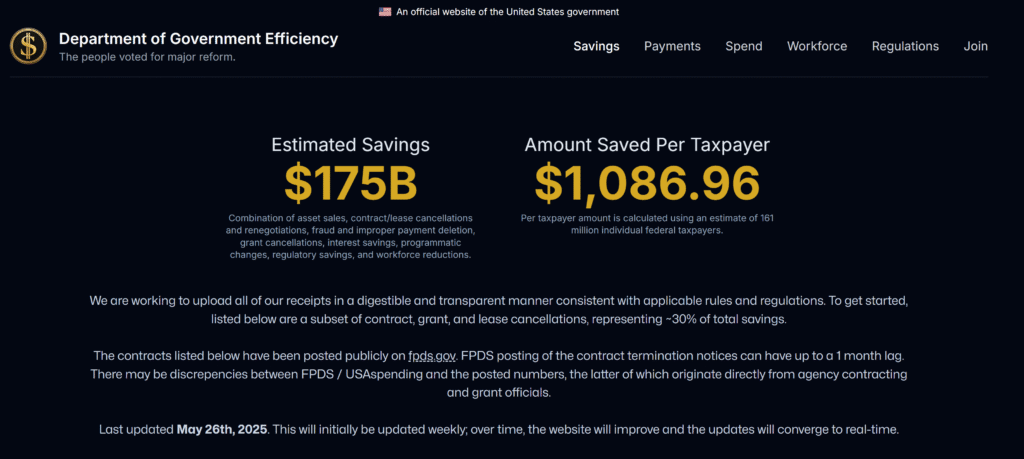
In total, the Doge.gov accountability initiative claims over $175 billion in cost savings and waste elimination over a five-year span, largely from program consolidation, fraud recovery, and sunsetting obsolete agencies and functions [2].
Perhaps Musk’s most ambitious—and controversial—goal was to confront America’s unsustainable fiscal trajectory. At the time of his rise, the federal government was running annual deficits approaching $2 trillion, and the national debt had exceeded $36 trillion. His administration implemented sweeping budget reforms, including mandatory zero-based budgeting, independent agency audits, and mandatory five-year cost-benefit reviews for all recurring programs [5].
He also ended the long-criticized “use it or lose it” budgeting practice that encouraged agencies to spend remaining funds at the end of the fiscal year. Instead, agencies that underspent were rewarded with multi-year budgeting flexibility and autonomy in reallocating savings. The impact was staggering. In just four years, the annual federal deficit was reduced by over 50%, and the growth rate of the national debt began to slow for the first time in decades [5].
But these victories came with painful trade-offs. Popular programs in arts, rural development, and public broadcasting faced sweeping cuts. Some veterans’ services were restructured into digital-first platforms, leaving older populations struggling with access. National parks experienced staffing shortages. Rural communities complained of reduced postal delivery and internet infrastructure delays. Public university research grants in non-STEM fields declined by over 40% [6].
Segments of the population that had long relied on these programs were furious. Critics accused Musk of treating the federal government like a tech startup—valuing performance over people, spreadsheets over stories.
His response? “A government that can’t pay its bills is a government that fails everyone.” [7]
A Legacy of Radical Transparency and Debate
Whatever one’s view of Musk’s methods, there is little debate that his time as DOGE left a permanent mark on the U.S. government’s operating culture. Transparency, once a campaign slogan, became structural policy. Every dollar saved by the federal government can now be traced on Doge.gov. Every contract has public deliverables. Every grant has a public-facing evaluation report. Government leases are posted with market comparisons and renewal dates.
He also fundamentally changed how Americans think about governance. Where once the budget was a black box, today there are visualizations, explanations, and performance indicators accessible from a smartphone [2]. His administration forced the American public to confront how little they had known—and how much had been hidden behind procedural complexity and bureaucratic walls.
Still, the country remains deeply divided on whether it was all worth it. Supporters hail Musk as a visionary reformer who saved the republic from fiscal ruin. Detractors argue he gutted the soul of the American social contract in the name of “efficiency.”
But no matter the perspective, Musk’s legacy in DOGE is clear: he dragged the federal government into the 21st century—sometimes kicking and screaming—while forcing a national reckoning with what Americans expect from their government, what they are willing to pay for, and what they can no longer afford to ignore.
[6] Government Accountability Office (GAO), “Impact of Federal Budget Reductions on Service Delivery,” Testimony before the Senate Appropriations Committee, September 2024. https://www.gao.gov/products/gao-24-604t
In the complex landscape of federal spending, transparency and accountability are paramount. Recent revelations regarding trillions of dollars in untraceable funds have ignited a renewed call for rigorous oversight. Enter the Locating Every Disbursement in Government Expenditure Records (LEDGER) Act, a bill sponsored by Senator Rick Scott (R-FL) and Roger Marshall (R-KS), aiming to overhaul the U.S. Department of the Treasury’s payment tracking system. This legislation promises to shed light on the often opaque world of government disbursements and bring increased visibility to taxpayer dollars.
A Push for Fiscal Responsibility
The LEDGER Act was introduced as a measure to increase transparency in federal spending. The bill aims to provide greater clarity on how taxpayer dollars are spent, and to reduce the possibility of waste, fraud, and abuse. This legislation is part of an ongoing effort to push for greater fiscal responsibility within the Federal Government. The pending legislation, while still not law, if passed could significantly strengthen transparency, and accountability.
The Impetus: DOGE Report $4.7 Trillion Dollar Revelation
The genesis of the LEDGER Act can be traced to a Government Accountability Office (GAO) report, often referred to as the “DOGE” report (Department of the Treasury’s Government-wide Funds). This report denoted $4.7 trillion in federal payments lacking proper traceability codes, raising serious concerns about the government’s ability to track and account for its spending.
The GAO’s findings delved into the Treasury’s processes for recording and categorizing federal payments. They found that a significant portion of disbursements were not being assigned the necessary codes to identify the purpose, source, and recipient of the funds. The Treasury uses Treasury Account Symbols (TAS) to tie payments to budget-level items, however, many TAS fields, that are optional, were left blank. This created a massive blind spot, making it impossible to trace the money trail in a detailed, transaction-by-transaction manner. The GAO found this by analyzing the raw data coming from the treasury, and finding gaps in the transactions with TAS data recorded, that would allow for proper tracking.
This revelation highlighted a significant gap in the Treasury’s financial management. Without proper traceability codes, it becomes exceedingly difficult to follow the money trail, increasing the risk of waste, fraud, and abuse. The DOGE revelation served as a reminder of the need for enhanced transparency and accountability in Federal spending.
What the LEDGER Act Does: A Transaction-Level Revolution
The LEDGER Act seeks to address the shortcomings identified in the DOGE report by mandating the implementation of a comprehensive traceability code system for all federal payments. While there are no specific implementation details at this time, if passed the bill is passed, based it’s stated intent and the GAO report’s findings, it is likely the bill will require the Treasury to track each individual payment transaction with specific metadata. This metadata would likely include:
Purpose of Payment: A clear description of what the funds were used for.
Funding Source: Identification of the specific agency, program, or appropriation that funded the payment.
Vendor or Recipient: Details about the entity or individual receiving the payment.
Contract or Grant Numbers: Relevant identifiers for contracts or grants associated with the payment.
Date and Time of Transaction: Precise timestamps for each payment.
This level of granularity would create an audit trail, allowing for detailed analysis of federal spending patterns. The LEDGER Act is likely to enhance the Treasury Account Symbol (TAS) system, by making the optional fields required, and adding greater detail to the TAS system. The administration has since mandated the use of this field. See our Article on Modernizing Government Financial Systems and use of Hyperledger technology.
Implementation: A Transformation of Treasury Operations
If passed, the LEDGER Act would require a significant transformation of the Treasury’s payment processing systems. The Treasury would be tasked with:
Developing and Implementing Traceability Codes: Creating a standardized system of codes that can be applied to all federal payments.
Integrating with Existing Systems: Modifying existing payment systems to accommodate the new traceability code requirements.
Establishing Data Standards: Defining clear and consistent data standards for the traceability codes to ensure accuracy and uniformity.
Creating a Centralized Database: Developing a centralized database to store and manage the transaction-level data.
Developing Reporting Tools: Creating tools that allow agencies, auditors, and oversight bodies to generate reports and analyze spending patterns.
Providing Training: Training federal employees on the new traceability code system and data entry procedures.
Oversight and Auditing: Creating a system that allows for regular audits and oversight of the new systems.
This would likely involve investment in technology, software development, and training. The Treasury would need to work closely with other Federal agencies to ensure seamless integration and data sharing.
A New Era of Visibility and Accountability
The LEDGER Act promises to usher in a new era of visibility and accountability in federal spending. By providing transaction-level data, it would enable:
Enhanced Auditing: Accountants and auditors would have access to detailed transaction records, making it easier to identify errors, irregularities, and potential fraud.
Improved Management: Agency managers would have real-time insights into spending patterns, allowing them to make more informed decisions.
Increased Government Oversight: Oversight bodies and lawmakers would have the tools to scrutinize federal spending and hold agencies accountable.
Greater Public Transparency: The public would have access to more detailed information about how their tax dollars are being spent.
Government Accounting:
Our Federal Government has a maze of accounting systems, and tools to track Federal Spending. The Federal government discloses portions of this data on various websites based on the type of spending. They are generally broken down in these categories:
Awards: These represent funds given to non-federal entities, such as contractors, grantees, and loan recipients. Significant budget items included in awards are; federal contracts to private companies for military equipment, or infrastructure, and grants to state and local governments for programs.
Accounts: These represent all federal spending, including internal agency operations, such as employee salaries, and operating expenses. Significant budget items included in accounts are; military personnel pay, Social Security payments, and Medicare payments.
Public Disclosure and how the LEDGER Act changes differ from Other Systems
The LEDGER Act’s focus on transaction-level detail sets it apart from existing Federal spending data systems:
Federal Procurement Data System (FPDS): This system focuses specifically on Federal procurement awards, which are contracts for goods and services. While FPDS provides detailed information on these contracts, it does not track other forms of federal spending, such as grants or loans, and it does not provide transaction-level details. (FPDS.gov)
USASpending.gov: This website aggregates data from FPDS and other sources to provide a broader view of federal spending. However, it only includes a subset of total federal spending. It excludes classified information, personally identifiable information (PII), and some proprietary data. Furthermore, according to the GAO USAspending.gov has billions in transactions each year that are listed as unreported by agencies, where no data or visibility is made to the public, highlighting a lack of transparency. While it does show some account level spending, it is designed to show award spending and does not contain transaction level detail. (USAspending.gov)
U.S. Treasury Fiscal Data: This data provides a comprehensive overview of the entire federal budget, including revenue, spending, and debt. However, it does not offer the granular, transaction-level detail that the LEDGER Act would provide. It shows high level financial information. (FiscalData.Treasury.gov)
The LEDGER Act would complement these systems by providing a deeper layer of accountability. It would allow for a more comprehensive understanding of how federal funds are being used, from the initial award to the final payment.
Is this a Big Deal?
At the Tax Project Institute our goal is to educate the public on what citizens contribute to our country and the transparency of how our government spends their contributions. While it may seem somewhat shocking that there is so little oversight that $4.7 Trillion dollars is untraceable, it really should not come as much of a surprise given that the TAS codes had been made optional. Additionally, the Government has a number of checks in place, like the GAO and our Improper Payments (including Fraud) Tracking Systems (Figure 1), that perform audits and account for weaknesses in controls and processes, and call out places for Government improvement. What is most concerning is the lack of accountability and controls to address these findings that these processes find. For example Government agencies are required by law to report spending to USASpending.gov but yet in a GAO audit only 103 of 152 agencies reported (68%) (Figure 2).
As of this date, the USASpending.gov site shows trillions in “Unreported” data from 2017 (as far back as it goes) to date.
Year
Unreported Amount (Billions)
2017
$97.9
2018
$43.8
2019
$31.8
2020
$70
2021
$131.8
2022
$137.1
2023
$147.4
2024
$164.5
2025
$37.9
We should note, that there has been significant progress in these numbers recently, indicating a new emphasis and progress in this area. You can use the USASpending.gov site or the enhanced version available from the Tax Project Institute (Requires Free Registration)
So bottom line, is it a Big Deal? – no, while shocking the revelations really aren’t anything new, but the chance of getting the ONLY source of Federal Government Wide spending at the transaction level, with enforcement of record keeping to trace all payments to budget line items is a very big deal indeed and could go down ultimately as a landmark in Government Transparency.
Conclusion: A Step Towards Ongoing Fiscal Transparency
The LEDGER Act represents a significant step towards greater fiscal responsibility and transparency in federal spending. By mandating transaction-level tracking, it would provide unprecedented visibility into how taxpayer dollars are being used. While implementation may require significant effort and investment, the potential benefits in terms of accountability and oversight are substantial.
The bill’s success, if passed, will depend on the Treasury’s ability to develop and implement a robust process to ensure ongoing enforcement of traceability code system. However, if successful, the Locating Every Disbursement in Government Expenditure Records (LEDGER) Act would be a crucial piece of ongoing government transparency, ensuring that taxpayer dollars are used wisely and efficiently.
Tariffs Are Taxes: Their Impact, History, and Economic Consequences
Tariffs, fundamentally, are taxes imposed by a government on imported goods and services, albeit indirect taxes. They serve multiple purposes: protecting domestic industries from foreign competition, generating revenue for the government, and sometimes acting as leverage in trade negotiations. While tariffs can shield local businesses from overseas competitors, they can result in higher prices for consumers with broader economic effects including inflation.
How Tariffs Affect Consumers and Businesses
When tariffs are applied to imported goods, those costs get added to the cost of goods and generally prices increase to maintain profit margins. All taxes are passed off to either the investor (in the form of lower returns), the employee (in the form of lower wages), the consumer (in the form of higher costs), or the owner (in the form of lower profits). As a result, domestic businesses that rely on imported materials or products face higher production costs. These increased costs are frequently passed on to consumers through higher retail prices. For example, a 25% tariff on imported steel leads to increased costs for automobile manufacturers, appliance producers, and construction firms, all of which depend on steel as a raw material. Consumers then pay more for cars, home appliances, and housing due to these higher input costs.
The effects can also ripple through industries that rely on foreign supply chains. If tariffs are placed on Chinese-made semiconductors, American electronics manufacturers may struggle to maintain competitive pricing, leading to reduced consumer demand, potential job losses, and slower economic growth. Tariffs not only affect direct buyers of imported goods but also the broader economy by influencing business investment decisions and supply chain structures.
Current U.S. Tariff Environment
As of early 2025, the United States has imposed significant tariffs on imports from major trading partners. On February 1, 2025, President Trump announced executive orders imposing a 25% tariff on imports from Canada and Mexico and a 10% tariff on imports from China, effective February 4, 2025. These measures were introduced under the rationale of addressing national security concerns, including unlawful migration and fentanyl flows.
These tariffs are expected to increase federal tax revenue by $142 billion in 2025, translating to an additional tax burden of $1,072 per U.S. household. While this may boost government revenues in the short term, economists predict that these tariffs will raise inflation by 0.7% to 1.2% and reduce GDP growth by 0.6 percentage points. Inflationary pressures stemming from tariffs can further erode consumer purchasing power, creating a cycle of higher costs and reduced economic activity.
Tariffs and Inflation: How Prices Rise
Tariffs contribute to inflation by increasing the cost of imported goods, which then pushes domestic producers to raise their prices. This phenomenon, known as “cost-push inflation,” occurs when businesses pass increased costs onto consumers. If a tariff makes imported aluminum more expensive, U.S.-based beverage companies using aluminum cans must pay more, which results in higher prices for drinks like soda and beer.
Additionally, when consumers face higher prices for goods affected by tariffs, they may demand higher wages to maintain their standard of living. This can lead to a wage-price spiral, where rising wages increase production costs, further driving up prices in a self-reinforcing cycle. Historically, such inflationary cycles have been difficult to break and can require significant monetary policy interventions, such as interest rate hikes by the Federal Reserve.
The History of U.S. Tariffs and Taxation
Historically, tariffs were the primary source of Federal revenue in the United States. Between 1798 and 1913, they accounted for anywhere from 50% to 90% of Federal income. For example, in 1865, excise taxes made up about 63% of Federal revenue, while tariffs contributed 25.4%. So in the not too distant past, and for more than half our countries existence, there were no income taxes and most taxes came from tariffs and excise taxes. (See our article on External Revenue Service)
However, with the introduction of the Federal income tax in 1913, reliance on tariffs as a major revenue source declined. Over the past 70 years, tariffs have rarely contributed more than 2% of total federal revenue. In fiscal year 2024, U.S. Customs and Border Protection collected $77 billion in tariffs, which amounted to only 1.57% of total federal revenue.
Comparing Tariffs to Other Forms of Taxation
Unlike income taxes, which are based on earnings, or sales taxes, which apply broadly to consumer purchases, tariffs target specific goods and services entering the country. This selective nature makes tariffs an indirect tax, meaning consumers may not immediately recognize their effects, even though they ultimately bear the cost through higher prices.
For example, a household that buys imported electronics, furniture, or clothing may notice price increases but may not immediately attribute them to tariffs. In contrast, a direct income tax increase is immediately visible in a worker’s paycheck. Because tariffs often function as a hidden tax, their economic impact can be underestimated by the general public.
Recent Tariff Developments and Economic Outlook
With the resurgence of tariffs under the Trump administration, concerns about their long-term economic impact are growing. Analysts predict that the latest tariff measures could strain U.S.-Canada-Mexico trade relations, with potential retaliatory tariffs from affected countries. If Canada and Mexico impose countermeasures, U.S. exporters—especially in agriculture and manufacturing—could face declining international sales.
Additionally, tariffs on China may disrupt global supply chains, increasing costs for U.S. companies that depend on Chinese manufacturing. Businesses may respond by shifting production to other countries, but such transitions take time and can lead to temporary shortages and price volatility.
Conclusion
While tariffs have historically played an essential role in U.S. economic policy, their modern implications highlight the complexity of global trade. While they can protect domestic industries and generate government revenue, they often lead to higher consumer prices, inflation, and strained trade relations. The recent tariffs imposed in 2025 illustrate the careful balancing act policymakers must navigate to safeguard national interests without disrupting economic stability.
Understanding tariffs in the broader context of taxation history and economic policy helps provide a clearer picture of their long-term effects. As tariffs continue to be used as a tool for trade and economic policy, their impact on consumers, businesses, and inflation will remain a critical issue for policymakers and the public alike.
There is a common saying in business, “If it isn’t monitored, then it isn’t managed.” In essence, oversight is crucial for effective management. The Tax Project is dedicated to examining transparency and the responsible use of taxpayer dollars. This article analyzes claims made by an independent source (referred to as “DOGE”) regarding data within the Social Security system. This analysis is provided as an example for how it might be Monitored and Managed, and helped in the placing of the public’s Trust, had it been made public to begin with.
We will caution that the following analysis is based on public statements and data released by DOGE, and their analysis of Social Security. The Tax Project cannot independently verify the validity of this data, and therefore the conclusions presented here should be viewed as an example and not as an expert analysis.
“Sunlight is said to be the best of disinfectants; electric light the most efficient policeman.” Louis D. Brandeis
DOGE Claim
The following analysis provides context for a data release by DOGE, who posted their analysis on the number of individuals marked as “alive” in the Social Security system, categorized by age group (Image Attached). Here is the post:
The Tax Project has included the data, and used OCR, as a way to clarify the analysis, and show that it can be reviewed and verified.
According to the data provided by DOGE, the total number of individuals listed as “alive” in the Social Security system is 398 Million (398,416,213). The Tax Project acknowledges that this data has not been independently verified and presents this analysis as an example of the potential benefits of increased transparency in government data.
A comparative analysis with U.S. Census Bureau population estimates (~341.4 million) suggests a discrepancy of approximately 57 million individuals. Further research is needed to understand the factors contributing to this difference. Potential explanations include differences in data collection methodologies, reporting lags, or the inclusion of non-citizens within the Social Security database.
Age Group Discrepancies
The data also highlights notable figures within specific age groups:
Individuals aged 100 and Over: The dataset indicates that over 20 Million (20,789,524) individuals are within this range. This contrasts with estimates from a Pew Research study, which suggests there are roughly 101,000 Americans aged 100 or older. This would represent roughly 5-6% of US Population over 100, overstating the Pew data by over 200 times (20,000%).
Individuals aged 100-109: The dataset indicates 4 Million (4,734,407) individuals within this age range.
Individuals aged 120-129: According to the provided data, there are 3 Million (3,472,849) individuals listed within this age range. This raises questions, as the oldest verified living human lived to be 122 years old, and the oldest living American lived to 119.
Individuals aged 130 and Over: The dataset indicates that roughly 9 Million ( 8,955,261) individuals are within this range. Given the oldest living American if you combine the 120-129 age group and this 130 and over group that would be over 12 Million individuals in the dataset older than the oldest recorded American.
Anomalies: The data reports 1.3 Million people over age 150, including one individual in the 360-369 age range or roughly 3 times maximum expected lifespan of an individual.
Potential Implications
These discrepancies raise questions about the accuracy and reliability of the data within the Social Security system, and if true erode the public trust. While the data does not directly indicate improper payments, the presence of a significant number of individuals listed in age ranges exceeding known human lifespans warrants further scrutiny. Erroneous data may potentially impact resource allocation and be subject to abuse and mismanagement. Data validation and reconciliation are necessary to ensure funds are properly allocated. Based on the 20 million excess population of 100+ year old persons in the database at the average Social Security annual benefit of $23,700 the potential misallocation could be over $470 Billion a year. While it is highly unlikely that the actual figure of improper payments, if any, is any where near this figure the discrepancies create opportunities for poor outcomes.
Transparency and Data Management
The Tax Project advocates for increased transparency in government data management practices. Making Social Security data more accessible to public scrutiny could potentially facilitate independent verification and improve data quality. Robust data validation processes are essential to ensuring the responsible and productive use of taxpayer dollars. Greater transparency could include:
Regular, independent audits of Social Security data management practices.
The creation of a publicly accessible data portal (while protecting individual privacy) to allow for external analysis.
Improved data documentation and metadata to clarify data collection methodologies and potential limitations.
The Tax Project continues to focus on transparency, and helping the public understand the use of their Tax dollars. We hope that this kind of transparency becomes available in the future so that all Americans can inspect and understand where their money is spent.
Tax Project Institute is a fiscally sponsored project of MarinLink, a California non-profit corporation exempt from federal tax under section 501(c)(3) of the Internal Revenue Service #20-0879422.