Confused about the National Debt, why you hear so many different numbers, and what they mean. Here’s a plain English explainer to help you make sense of it all. The National Debt is the total amount the U.S. Federal government owes to its creditors. It does NOT include the Debt held by State and Local Governments. Think of the National Debt as the running total of past annual deficits (when the government spends more than it collects in taxes and other income) minus any surpluses (when it collects more than it spends). The debt grows when there’s a deficit and shrinks—at least relatively—when there’s a surplus or when growth/inflation outpace new borrowing. [1][5]
Terms you should know:
DEFICIT: A deficit is a one-year budget shortfall (this year’s shortfall, which can occur every fiscal year).
NATIONAL DEBT: The debt is a accumulated total of all Deficits minus any Surpluses (the total outstanding IOUs accumulated over time).
Figure 1 Historical Federal Budget Deficits and Surpluses Source: OMB
The U.S. Treasury’s Debt to the Penny website publishes the official daily total and its two big parts (explained below). You can look up yesterday’s number, last month’s, or data back to 1993. [2]
When people talk about the “National Debt,” they often mean one of three closely related figures:
Debt held by the public This is U.S. Treasury securities (Bills, Notes, Bonds, TIPS, etc.) held outside federal government accounts—by households, businesses, pension funds, mutual funds, state and local governments, foreign investors, and the Federal Reserve (America’s central bank). It’s the broadest “market” concept and is the figure economists often use when comparing debt to the size of the economy (debt-to-GDP). [3][4]
Treasury defines it as “all federal debt held by individuals, corporations, state or local governments, Federal Reserve Banks, foreign governments, and other entities outside the United States Government.” [3]
Intragovernmental holdings These are Treasuries held within the federal government – mainly trust funds such as Social Security and Medicare. When these programs run surpluses, they invest in special Treasury securities; when they run cash shortfalls, Treasury redeems those securities to pay benefits, and the government borrows from the public if needed. [4][1]
Total Public Debt Outstanding This is simply the addition of (1) Debt held by the public + (2) Intragovernmental holdings. This is the top-line number on Debt to the Penny. [2][4]
Total Public Debt Outstanding = Debt held by the public + Intragovernmental holdings
Why the distinctions matter:
Debt held by the public is what markets price and what drives interest costs the government pays to outside holders (including the Federal Reserve).
Intragovernmental debt reflects promises among parts of the federal government; it affects future cash needs but doesn’t have the same market dynamics.
Total Public Debt Outstanding is the full legal amount subject to the debt limit (with a few technical exclusions), which matters for statutory debt-limit debates. [4][5] When there are discussion in Congress about the Debt ceiling this is the number discussed.
How deficits add to the National Debt
Each fiscal year, Congress sets taxes and spending. If outlays (spending) exceed receipts (revenue), the government runs a deficit and must borrow by issuing new Treasury securities. Those new securities add to Debt held by the public, and thus to the total debt. The Congressional Budget Office (CBO) publishes baselines and explains the arithmetic and risks of rising Net interest (what the government pays in interest). In 2024, Net Interest on the Debt alone was over $1 Trillion, making it the 3rd largest budget item, larger than National Defense. [5][7][18][22]
In years with a surplus, Treasury can redeem (pay down) outstanding securities or reduce the need to issue new ones—slowing debt growth. But because recent years have seen persistent deficits, the debt has generally climbed. [22]
“Debt to the Penny”
For the Official US National Debt numbers, you can go straight to Treasury’s Debt to the Pennypage. On the site you can:
See today’s total (updated daily except during weekends and holidays) and the split between debt held by the public and intragovernmental holdings.
Download historical CSVs to chart the series yourself.
Check big shifts around tax dates, debt-limit suspensions, or major fiscal packages. [2][15]
Who does what: Role of Treasury vs. the Federal Reserve
The U.S. Treasury (through the Bureau of the Fiscal Service and the Office of Debt Management) issues Treasury bills, notes, and bonds to finance the government at the lowest cost over time. It auctions securities on a regular calendar and redeems them at maturity. Treasury also manages cash (the Treasury General Account at the Fed) to pay the government’s bills. [4][2]
The Federal Reserve (the “Fed”) is the central bank. It does not set taxes or spending and does not decide how much debt the government issues. The Fed’s role here is monetary policy: it influences interest rates and financial conditions. The Fed has a dual mandate to maintain stable prices (control inflation), and manage Employment (manage environment to keep unemployment low). It buys and sells Treasuries only in the secondary market (from dealers), not directly from the Treasury, to maintain its independence and implement policy. [6]
“The Fed does not purchase new Treasury securities directly from the U.S. Treasury, and purchases…from the public are not a means of financing the federal deficit.” [6]
The New York Fed executes these operations for the System Open Market Account (SOMA), the consolidated portfolio of Treasuries and other securities the Fed holds. [12]
What is Quantitative Easing (QE)?
Quantitative easing (QE) is a policy the Fed uses in severe downturns or when short-term interest rates are already near zero. When the Fed is using QE, the Fed buys longer-term securities, such as Treasuries and agency mortgage-backed securities, to push down longer-term interest rates and support the economy. The Fed conducted several large purchase programs after the 2008 Financial Crisis and again during 2020-21 COVID Pandemic. [8][21][14]
Mechanically, when the Fed buys a Treasury, it pays by crediting banks’ reserve accounts at the Fed. That swaps a Treasury security held by the public for a bank reserve (a deposit at the Fed). Crucially, this transaction does not change the total amount of Treasury debt outstanding—it changes who holds it (more at the Fed, less in private hands). [10][6]
“When the Federal Reserve adds reserves…by buying Treasury securities…This process converts Treasury securities held by the public into reserves…[and] does not affect the amount of outstanding Treasury debt.” [10]
Federal Reserve Balance Sheet
Does QE “add to the National Debt”?
No. QE doesn’t authorize or cause Treasury to borrow more or add to the Debt. The deficit determines how much debt Treasury must issue. QE affects yields and liquidity by changing the composition of holders (more at the Fed/SOMA, fewer in private portfolios), not the quantity of debt the government has issued. The Fed repeatedly emphasizes it does not buy securities directly from Treasury or to finance deficits. [6][7][9] (Federal Reserve)
QE can, however, indirectly affect the budget over time through interest rates (lower yields can reduce Treasury’s borrowing costs; the reverse is true when QT—quantitative tightening—lets the portfolio roll off and rates are higher). Several primers walk through these channels. [17][18][7]
How interest flows work when the Fed holds Treasuries
Here’s the accounting workflow in plain English:
Treasury pays interest on all outstanding Treasuries—whether they’re held by a pension fund, a foreign central bank, or the Federal Reserve. That shows up in the budget as Net interest outlays (spending). [18]
When the Fed holds Treasuries (in SOMA), the interest it receives becomes part of the Fed’s net income.
After covering its expenses, the Fed historically remits (gives back) its profits to the Treasury (these are “remittances”). In years when those profits are large, Treasury effectively gets back a chunk of the interest it paid—reducing the government’s overall cost ex post (after the fact). [9][20]
In times (like 2023-25) when the Fed’s interest expenses (mainly interest it pays banks on reserve balances and reverse repos) are greater than its interest income the Fed stops remitting, records a “deferred asset” (an IOU to itself), and resumes remittances only after it returns to positive net income. That deferred asset does not require taxpayer funding; it’s paid down by future Fed profits before any cash flows back to Treasury. [1][5]
“When the Fed’s income exceeds its costs, it sends the excess earnings to the Treasury…When its costs exceed its income, it creates a ‘deferred asset’…and resumes sending remittances after that is paid down.” [1]
Bottom line: whether private investors or the Fed hold a given Treasury, Treasury’s legal obligation to pay interest is the same. The difference is that Fed-held interest often returns back to Treasury (when Fed profits are positive), lowering the government’s ultimate net cost over time. [9][20]
Review of National Debt Concepts
Debt grows because of deficits. Congress’s tax and spending choices determine if there will be an annual deficit or surplus; deficits add to debt. Surpluses reduce the debt. [5][22]
Debt has two big parts. Debt held by the public (including the Fed) plus intragovernmental holdings (trust funds) equals Total Public Debt Outstanding. [2][4] (Fiscal Data)
QE doesn’t “create” more Treasury debt. It changes who holds it and influences rates and liquidity; the Fed buys in the secondary market and does not finance deficits. [6][10][7]
Interest flows are circular when the Fed holds Treasuries. Treasury pays interest; the Fed usually remits (returns) net income back to Treasury; during periods of negative net income, remittances pause and a deferred asset records what will be repaid from future profits. [1][5][20]
You can verify every number daily on Treasury’s Debt to the Penny site, and pair it with monthly public debt reports for detail. [2][4]
FAQ and Common Misconceptions
“If the Fed buys Treasuries, isn’t that just ‘printing money’ to fund the government?” No. The Fed buys from dealers in the open market, not from Treasury. Fed purchases swap Treasuries for bank reserves; they don’t change the amount of debt or directly finance the deficit. [6][10][7]
“Doesn’t the debt count everything the government owes, including future Social Security benefits?” The debt is legal obligations already issued (Treasury securities). Future promises (like future benefits) affect the budget and future borrowing, but they aren’t counted as debt until the government issues securities to pay for them. These are called Unfunded Liabilities (See our Article). Check the Debt to the Penny site for what is counted. [2][4][5]
“Why do some charts focus only on debt held by the public?” Because that’s the portion traded in markets, driving interest costs and macro impacts. It’s also the number most used in economic comparisons (for example, debt-to-GDP). [5]
Debt Guru: How to read the daily debt like a pro
Visit Debt to the Penny site and note Total Public Debt Outstanding.
Compare the split between public and intragovernmental. Persistent deficits typically raise the public share over time.
If rates are rising (or have risen), expect net interest in the budget to climb; CBO’s primers explain why interest costs can grow faster than the economy when debt is large. [2][18][22]
If you want more depth on how the Fed runs these operations, the New York Fed’s archive on large-scale asset purchases and the Board’s description of the System Open Market Account are the canonical sources. [8][12]
Putting it all into Context
If you want to understand how big the National Debt is, how it relates to other things like the size of our economy, how the budget deficits and surpluses compare in charts over the years historically and how that impacts the debt in charts, check out that and more in the Tax Project Institute’s Smarter Citizen App (A Free Citizen App, just register – no credit card and you’re in!)
Treasury security: An IOU the U.S. government sells to borrow money (Bills mature in a year or less; Notes in 2–10 years; Bonds in 20–30 years; TIPS are inflation-protected). Holders earn interest and get their principal back at maturity. [3]
Debt held by the public: Treasury IOUs owned by investors outside the federal government, including the Federal Reserve. [3]
Intragovernmental holdings: Treasury IOUs held by government accounts (e.g., Social Security trust funds). [4]
QE (quantitative easing): The Fed’s large purchases of longer-term securities to lower long-term interest rates when the economy needs help and short-term rates are generally already lower. [21][8]
Remittances: Fed profits (if any) sent to Treasury after covering expenses; paused when the Fed’s interest expenses exceed income (recorded as a “deferred asset”). [5][1]
References
[1] Board of Governors of the Federal Reserve System. (2024, July 19). How does the Federal Reserve’s buying and selling of securities relate to the borrowing decisions of the federal government?https://www.federalreserve.gov/ (Federal Reserve)
[2] U.S. Department of the Treasury, Fiscal Data. (n.d.). Debt to the Penny (daily dataset; coverage back to 1993). Retrieved October 16, 2025, from https://fiscaldata.treasury.gov/ (Fiscal Data)
[3] U.S. Department of the Treasury. (n.d.). Public Debt FAQs (definitions of debt held by the public & intragovernmental holdings). Retrieved October 16, 2025, from https://treasurydirect.gov/ (TreasuryDirect)
[4] U.S. Department of the Treasury, Fiscal Data. (n.d.). Monthly Statement of the Public Debt (MSPD) (monthly dataset). Retrieved October 16, 2025, from https://fiscaldata.treasury.gov/ (Fiscal Data)
[8] Board of Governors of the Federal Reserve System. (2025, September 23). Interest on Reserve Balances (IORB): FAQs (includes note that asset purchases convert Treasuries to reserves without changing outstanding Treasury debt). https://www.federalreserve.gov/ (Federal Reserve)
[10] Board of Governors of the Federal Reserve System. (2016, August 25). Is the Federal Reserve “printing money” in order to buy Treasury securities?https://www.federalreserve.gov/ (Federal Reserve)
[12] Board of Governors of the Federal Reserve System. (n.d.). Fed Balance Sheet—Table 1 (popup): U.S. Treasury, General Account (definition of the Treasury General Account). Retrieved October 16, 2025, from https://www.federalreserve.gov/ (Federal Reserve)
[13] Board of Governors of the Federal Reserve System. (n.d.). H.4.1—Factors Affecting Reserve Balances (current and archived releases). Retrieved October 16, 2025, from https://www.federalreserve.gov/ (Federal Reserve)
[14] Federal Reserve Bank of St. Louis (FRED Blog). (2023, November 20). Federal Reserve remittances to the U.S. Treasury.https://fredblog.stlouisfed.org/ (FRED Blog)
[15] Board of Governors of the Federal Reserve System (via FRED). (n.d.). Liabilities & Capital: Earnings Remittances Due to the U.S. Treasury (RESPPLLOPNWW) (weekly series). Retrieved October 16, 2025, from https://fred.stlouisfed.org/series/RESPPLLOPNWW (FRED)
[16] Board of Governors of the Federal Reserve System. (2024, March 26). Federal Reserve Board releases annual audited financial statements (deferred-asset explanation). https://www.federalreserve.gov/ (Federal Reserve)
[17] Anderson, A., Ihrig, J., Kiley, M., & Ochoa, M. (2022, July 15). An Analysis of the Interest Rate Risk of the Federal Reserve’s Balance Sheet (Part 2). Board of Governors of the Federal Reserve System, FEDS Notes. https://www.federalreserve.gov/ (Federal Reserve)
[19] U.S. Department of the Treasury, Fiscal Data. (n.d.). America’s Finance Guide: National Debt (dataset links and coverage notes—e.g., Debt to the Penny since 1993). Retrieved October 16, 2025, from https://fiscaldata.treasury.gov/ (Fiscal Data)
[20] Data.gov (U.S. General Services Administration). (n.d.). Debt to the Penny (dataset catalog entry and composition note). Retrieved October 16, 2025, from https://catalog.data.gov/ (Data.gov)
[22] U.S. Department of the Treasury, Fiscal Data. (n.d.). Historical Debt Outstanding (long-run series). Retrieved October 16, 2025, from https://fiscaldata.treasury.gov/ (Fiscal Data)
The “Debasement Trade” is a prominent investment strategy in current finance, defined by the systematic movement of capital out of assets denominated by sovereign promises, such as fiat currencies and traditional fixed-income securities, and into assets characterized by verifiable, finite supply, often referred to as “hard assets” [1]. This strategy is fundamentally a defensive measure, designed to preserve the real value of wealth against the risk of the currency’s diminishing purchasing power, which results from accelerating national debt and large/rapid monetary expansion [2]. The shift reflects a growing, fundamental loss of confidence in the long-term fiscal solvency of major economies, especially the United States, whose currency serves as the global reserve.
I. Historical Context: Debasement as a Sovereign Tool
The act of currency debasement, the reduction of a currency’s intrinsic value without altering its face value, has been a recurring fiscal strategy throughout history. While the methods have evolved, the economic rationale remains consistent: to increase the effective money supply to meet government financial needs, typically to fund large expenditures or manage mounting debts [3].
Physical Debasement: The Precedent
In the ancient and medieval worlds, debasement was a physical process. The Roman Empire offers a classic example, where successive emperors reduced the silver content of the denarius over several centuries [4]. By substituting precious metals with cheaper base alloys, the government could mint a greater volume of currency from the same reserves, allowing the Treasury to stretch its resources for state expenses. This practice, however, led directly to rising prices (inflation) as merchants recognized the coin’s diminished intrinsic worth.
Another significant example occurred in 16th-century England under King Henry VIII, a period often cited as the “Great Debasement” [5]. To finance ongoing conflicts, the silver purity of English coinage was drastically reduced (From over 90% to as low as 25%). This act, while providing short-term funding for the Crown, destabilized domestic and international trade, leading to public mistrust and prompting the widespread hoarding of older, purer coins—an economic phenomenon later formalized as Gresham’s Law (“bad money drives out good”) [5].
The Structural Shift to Fiat Debasement
The transition to a fiat monetary system fundamentally redefined debasement. Following President Nixon’s 1971 decision to suspend the convertibility of the U.S. dollar into gold, the global financial system moved entirely away from the commodity-backed anchors of the Bretton Woods agreement [6] (See our Article on Bretton Woods). In this modern context, debasement is not about physical manipulation but about administrative action: the unconstrained expansion of the money supply through central bank policy. The erosion of a currency’s value is now primarily a function of excessive issuance relative to underlying economic productivity [7].
US M2 Money Supply
Figure 1 Source: Federal Reserve
II. The Conditions of the Modern Debasement Trade
The current period is characterized by macroeconomic conditions that have accelerated investor concern and institutionalized the Debasement Trade as a key portfolio consideration.
The Scale of Sovereign Indebtedness
The primary catalyst is the unprecedented scale of the U.S. National Debt, which is over $37 trillion [8]. Unlike previous debt cycles, the current trajectory is sustained by structural spending (23 consecutive years with deficit, last 5 $trillion+), regardless of the political party in power [9]. This fiscal reality presents governments with a limited set of options: implement politically unpalatable spending cuts or tax hikes, or employ the politically more palatable solution of allowing the currency’s value to decline.
The Debasement Trade is predicated on the rational assumption that policymakers will inevitably choose the latter, utilizing monetary tools to reduce the real burden of the debt and its service costs [1]. Through inflation, the real value of the debt owed to bondholders is effectively diminished over time, a process often described as “financial repression.”
Investor Flight to Scarcity
The response from institutional investors has been explicit. Citadel CEO Ken Griffin has been a vocal proponent of this thesis, characterizing the current market environment as a “debasement trade” [10]. Griffin notes a tangible shift in capital, with investors seeking to “de-dollarize” and “de-risk their portfolios vis-a-vis US sovereign risk” by accumulating non-fiat assets [10].
This trend is observable through market data:
Currency Depreciation: The U.S. dollar index (DXY) has experienced significant periods of sharp depreciation against major currencies and, more dramatically, against hard assets like gold [11].
Reserve Diversification: Globally, the dollar’s share as the primary reserve currency held by central banks has been steadily declining, reaching multi-decade lows [12]. This signals a structural move by foreign governments to reduce reliance on the U.S. dollar, further supporting the debasement thesis [13].
US Dollar Valuation
Figure 2 Source: Federal Reserve
III. Monetary Policy, QE, and Hyper-Liquidity
The mechanics of modern debasement are inextricably linked to central bank interventions, specifically Quantitative Easing (QE).
Quantitative Easing and Money Supply Growth
QE, a policy initiated following the 2008 Financial Crisis and dramatically expanded during the 2020 COVID pandemic response, involves the central bank (the Federal Reserve) creating new electronic money to purchase vast amounts of government and mortgage bonds [14]. This injects large amounts of money (hyper-liquidity) into the financial system, resulting in an exponential, historically unprecedented surge in the M2 money supply (See Figure 1) [14].
This expansion is the engine of modern debasement. When the volume of money in circulation grows at a pace far exceeding the underlying growth in the economy’s productive capacity, the result is an inevitable loss of the currency’s value [15].
Inflation as the Mechanism of Debasement
The consequence of this imbalance is widespread inflation, which acts as the functional manifestation of currency debasement. Inflation is not merely a rise in prices but a measurable loss of the currency’s ability to retain its value [15]. Some consider this type of inflation a hidden tax (See our Article on Is Inflation a Stealth Tax?). Data confirms this erosion: significant cumulative price increases over recent five-year periods have fundamentally lowered the purchasing power of the dollar [10].
The Debasement Trade views inflation as structural rather than temporary—a direct result of governments financing massive deficits through the printing press, effectively taxing the population through reduced purchasing power rather than legislative mandate.
US Inflation
Figure 3 Source: Federal Reserve
IV. Political Debate and the Precedent of the Plaza Accord
The current anxiety surrounding debasement is focused on specific policy discussions within Washington concerning the intentional manipulation of the dollar’s value.
The Deliberate Devaluation Thesis
Certain U.S. economic advisors, notably within the Trump administration, have argued that the dollar’s status as the world’s reserve currency creates a structural “overvaluation” that persistently harms U.S. trade competitiveness [16]. Proponents of this view suggest that managing a controlled depreciation of the dollar is a necessary measure to correct global trade imbalances and support domestic manufacturing [16].
This thesis has led to policy suggestions, sometimes grouped conceptually under the name “Mar-a-Lago Accord.” These suggestions include strategies such as utilizing tariffs to adjust global currency levels or even taxing foreign holders of U.S. Treasury debt [16]. Such discussions signal a willingness by policymakers to consider actions to achieve fiscal and trade goals, even at the expense of currency stability (Inflation).
Purpose: The Plaza Accord was a multilateral agreement signed by the G5 nations (France, West Germany, Japan, the United Kingdom, and the United States) [17]. Its specific goal was to engineer an orderly depreciation of the U.S. dollar against the Japanese yen and German Deutsche Mark. At the time, the U.S. dollar was considered significantly overvalued due to high U.S. interest rates and robust capital inflows, which led to a massive U.S. trade deficit [18].
Mechanism: The participating nations agreed to coordinate currency market interventions, specifically selling U.S. dollars, to achieve the desired depreciation [18].
Outcome and Relevance: The Accord successfully achieved its short-term goal, weakening the dollar significantly [18]. However, it ultimately failed to deliver long-lasting correction to the underlying U.S. trade imbalances because the structural domestic factors—namely, low private savings and high government borrowing—remained unaddressed [19].
The historical parallel is crucial: while a new “accord” might temporarily achieve a devaluation target, the Debasement Trade argument suggests that without fundamental fiscal discipline, any managed decline will merely lead to renewed instability and require further monetary interventions.
The Official Stance
Despite the policy discussions, U.S. Treasury Secretary Scott Bessent has publicly distinguished between short-term currency fluctuations and long-term policy [20]. He maintains that the core of the U.S. “strong dollar policy” is to take long-term steps to ensure the dollar remains the world’s reserve currency, focusing on U.S. economic growth and stability, rather than obsessing over the exchange rate [20]. This distinction is intended to reassure global markets that the U.S. is not actively pursuing the dollar’s demise, even if domestic fiscal and monetary choices suggest otherwise.
V. Implications for Citizens and the Move to Hard Assets
The consequences of currency debasement are most keenly felt by the average citizen, whose financial well being may depend on the dollar’s stability. This is especially true after the post COVID rapid inflation period felt by most Americans who are now keenly aware of the negative impacts of inflation.
Inflationary Wealth Transfer
Debasement operates as a stealthy wealth transfer mechanism [21].
Erosion of Fixed Income: Citizens holding dollar-denominated assets, such as savings accounts, fixed pensions, and bonds, see the real value of their wealth diminish steadily [7]. This is especially punitive for retirees and those on fixed incomes.
Asset Price Distortion: While nominal asset prices (stocks, real estate) reach record highs in dollar terms, this surge is often an illusion. When these assets are measured against hard assets like Gold or Bitcoin, the appreciation is significantly tempered, reflecting the currency’s dilution rather than pure economic growth [22].
This disparity: those who are asset-rich (owners of real estate, commodities, or equities) are protected, while the working class and cash holders are negatively effected as their wages and savings buy less in real terms.
The Embrace of Hard Assets
The Debasement Trade is the strategic answer to this inflationary trap. Investors are choosing assets defined by their scarcity:
Gold (Traditional Hedge): Gold has served as a reliable store of value and inflationary hedge for millennia, its value enduring precisely because it cannot be created by a central bank [23]. Surges in the gold prices directly reflect the decline in the dollar’s relative value [12].
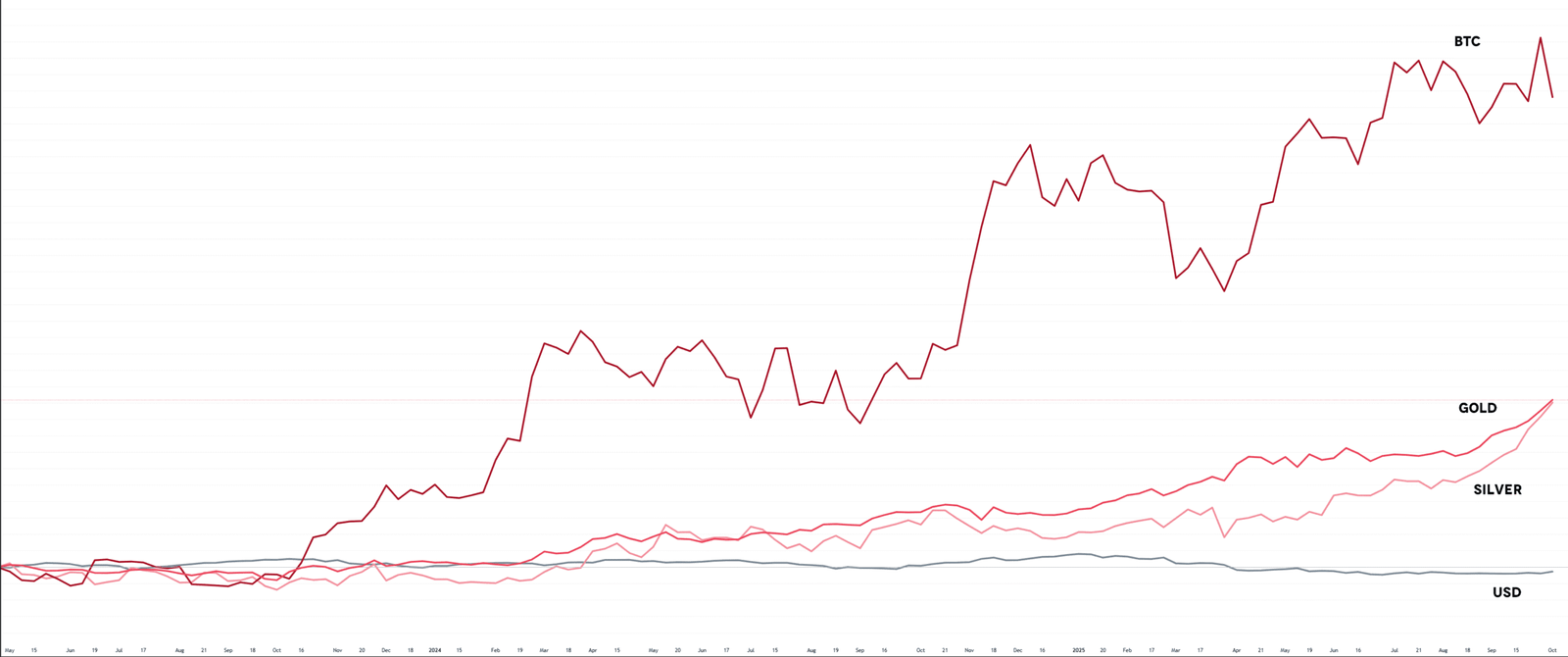
Bitcoin (Digital Scarcity): Bitcoin has been increasingly adopted as a contemporary hard asset [1]. Its maximum supply of 21 million coins is secured by cryptography and network consensus, rendering it immune to sovereign fiscal or monetary manipulation [2]. Its inclusion in the Debasement Trade reflects a redefinition of “hard money,” moving beyond the physical limitations of precious metals to the mathematical certainty of code [22]. The dramatic appreciation of Bitcoin is viewed by many investors not as a speculative frenzy, but as a rational re-pricing of mathematical scarcity relative to infinitely expanding fiat currency [1].
USD vs Hard Assets
Figure 4 Source: TradeView
VI. Conclusion: A Structural Shift
The Debasement Trade is more than a momentary market tactic; it is a structural investment shift reflecting deep seated concerns over fiscal integrity of the world’s leading economies. Driven by high and persistent debt accumulation, coupled with the unconstrained power of central banks to expand the money supply through QE, the trade represents a fundamental shift in investor trust, from faith in government promises to reliance on the verifiable scarcity of hard assets. As long as the structural imbalance between monetary creation and productive capacity persists, the strategic movement toward assets like gold and Bitcoin will continue to be a defining feature of the global financial landscape.
Webull (syndicated from Bloomberg/Benzinga). (2025, July 3). U.S. Treasury Secretary Bessent refuted claims that the recent depreciation of the U.S. dollar would affect its status as the world’s major currency. https://www.webull.com/news/13098149616067584 (Webull)
As you grow older, you become more self assured, knowledgeable and more independent – able to make many decisions on your own. At some point in your teenage years, you may come to believe in your infallibility, and how correct you are in all things. As you get older, life has a way of teaching you new lessons, and if we were smart and true to ourselves there were probably lessons that our parents tried to teach us many years before and we were too smart at the time to listen. When you become a parent, you come to realize many more of those lessons after the fact. One big lesson for parents is that you can’t make decisions for your children all of the time, for one they won’t always listen, and two – they need to learn on their own. You try to protect them from the things that will really hurt them or having lasting effects, but sometimes a little blood and skinned knees can be way more instructive than any parental chat.
“When I was a boy of fourteen, my father was so ignorant I could hardly stand to have the old man around. But when I got to be twenty-one, I was astonished at how much the old man had learned in seven years.”
Mark Twain
Wisdom of the Mom: What we can learn from mothers
One lesson we learned, and we didn’t even realize we were being taught, was the “You Slice, You Choose” game. The “game” was simple, usually there was something desirable like a Pie and your mother would designate one person to slice, and another person got to choose which slice to take. Simple, but devious – at first glance without a lot of thought a young lad may think if I get to slice, I can slice a bigger piece of the pie. A wiser, more experienced child will realize that any deviation by the slicer from the center was a gain for them as they would invariably choose the larger slice. Overtime, as everyone knew the game the slices became more and more even, and the “game” self enforced fairness without any policing or intervention from parental units. After a while, you could swear that each slice was done by a computer aided laser in the planning and precision of the pie slice so perfectly even down the middle. Many years later, you marvel at the wisdom of mothers and wonder what other ancient mysteries and riddles could these geniuses have solved if their life mission wasn’t wasted helping you slice pie.
Mom and the Budget
Every year now it seems like the Federal Budget is now in play as a game piece to be negotiated by both parties trying to gain advantage over each other. Even though everyone knows the dates and when the deadline is, it always seems to go right up to the end, and in this case over the deadline. Such is the case in the partisan environment we live in today. However, I’m struck that it’s really nothing more than a high stakes game of “You Slice, You Choose.” That may over simplify it by quite a bit, but the fundamentals are the same.
Pie Analogy
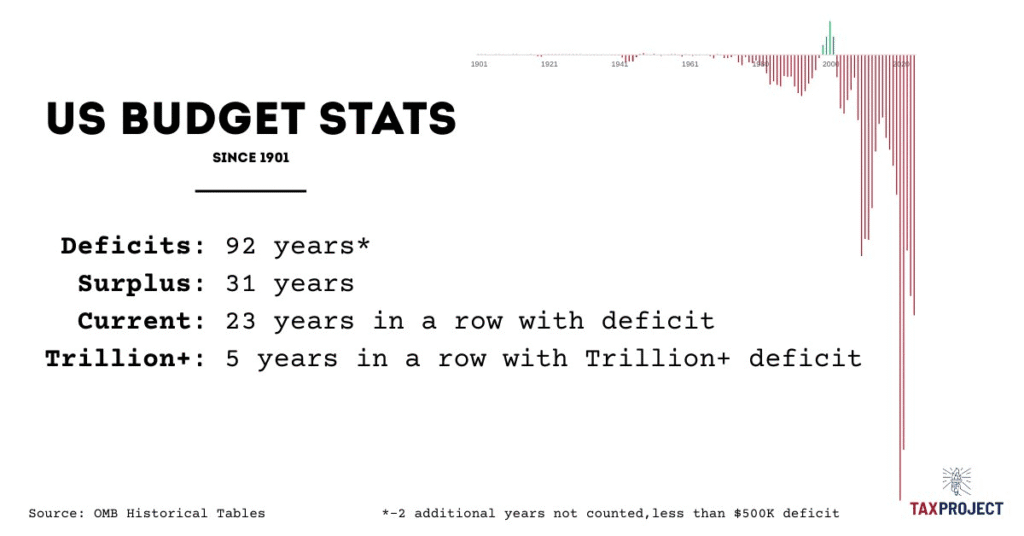
Our Federal Revenue is the ingredients for the pie. Our Federal budget is the size of the pie. Some years the pie will be larger than what you can eat, known as a budget surplus, and you can put some in the fridge for later. Other years you can borrow extra ingredients to have a bigger pie now at the expense of smaller pies in later years, known as a budget deficit. Much like pies in our household, there was never enough. Since 1901 we’ve had 92 years of budget deficits.
Figure 1
Our debt keeps growing, as well as the interest on the debt. Each year eating more and more pie.
Pie Dynamics
Before you even slice the pie, you realize several pie dynamics are at play. The amount of ingredients each year, the more ingredients the bigger the pie – so as Revenue grows, so does the size of the pie. The size of pie we make is dependent on the quantity of ingredients we have, and if we choose to leave some pie for later (surplus), or we decide to borrow ingredients from the future (deficits) with the potential consequence of having to reduce the size of future pies.
Pie Slicing
After you understand the pie dynamics, you can begin the process of slicing. However, before you slice you want to have any idea of how you want to divvy up the pie, and knowing with the Federal Budget almost 3/4’s (74%) of the pie is already gone before you slice it allocated to Mandatory and Net Interest components. The Net interest is all the extra pie we had in previous years. The more we add to the deficit, the larger it get. As it keeps growing, the smaller and smaller the pie available is in the future. Unless new laws are passed, the debate is in the quarter of the pie designated as Discretionary. However, even many of those don’t feel discretionary like National Defense – you could cut it back, but you probably aren’t going to eliminate it.
Figure 2
Pie – Choosing your Slice
So the only thing left is tough choices. Slicing can be a painful process, because when it comes time to choose – you realize that something you may have wanted more of shrunk, and something you wanted less of grew and you are stuck with that choice. Unlike in the family edition of the “You Slice, You Choose” game, both parties participate in the slicing and choosing. There is no self reinforcing fairness mechanism other than the active participation of engaged and informed citizens. This is the game Congress must play each year.
Pie in the Sky
Increasingly, people bring up MMT (Modern Monetary Theory). Using our pie analogy, according to MMT as long as inflation is in check, your pie can be as big as you want it to be. We wish these Economists were available to instruct our parents. Alas, in our household there was no magic infinitely growing pie, just tough choices. Until such time as an infinite pie becomes available, we’ll have to face touch choices as a country.
You Slice, You Choose
Summary
The Federal Budget is much more complicated, and the outcomes and consequences much more serious than a game of “You Slice, You Choose” but the lessons from Mom are none the less instructive. We all have to choose between tough choices, we all have to make reasonable assumptions and trade offs, and create mechanisms for fairness and balance that reinforce themselves automatically and fairly. In the game of life understanding Government Financial Literacy gives us the tools to understand the rules of the game, how to participate, and understand the dynamics, and trade offs that must be made in order for all of us to thrive. We learn many lessons in life, some of them stick with you. Thanks mom, I miss you every day.
As of 2:01 am ET, Oct 1, 2025 the Federal Government is “shutdown.” That may sound scary, especially for those who depend on Federal services, however a Federal shutdown is not just an on/off switch. Many parts of the Federal Government, and all State, and Local Government remain open. So basically, a Federal “Shutdown” doesn’t mean the government disappears. It means Congress didn’t pass the annual funding bills (or stop-gap spending measures) on time, so some activities must pause until funding resumes. This happens from time to time and is temporary. This article provides a simple guide to help you understand what continues, what closes, and what runs at reduced service. Where helpful, each item notes whether it’s Mandatory (paid automatically by permanent law), Discretionary (normally needs a yearly appropriation), or Fee-funded/Other (runs on fees or multi-year/no-year funds). For a deeper background on spending types, see our explainer on mandatory vs discretionary vs entitlements, and for how funding normally works, see our Federal Budget process overview.
Guiding Government Principles
Here are the rough guidelines for how the Federal Government operates. About 70% of the budget is mandated by statute (law), and continues automatically. The Discretionary budget is what is in jeopardy during a shutdown, and in general most critical functions are setup to continue.
By law, Federal agencies can’t spend money without an appropriation (Antideficiency Act). Limited exceptions allow operations that protect life and property, fulfill constitutional duties, or are otherwise authorized by law.
Programs with permanent (mandatory) funding, multi-year/no-year money, or legally available fees can generally continue. Each department publishes a “lapse plan” that spells this out.
Figure 1 Source: CBO
OPEN (operating normally or near normal)
Social Security, SSI, Medicare, Medicaid, and CHIP (Mandatory)
Monthly benefit payments continue because these programs are funded by permanent law and trust funds, not the annual spending bills at issue. Field offices and call centers may be short-staffed, so expect slower customer service, but checks and covered health services continue. [1][2]
U.S. Postal Service (Fee-funded/Other)
Post offices stay open and mail runs on schedule. USPS finances operations mainly through postage and product revenue rather than annual appropriations. [3]
Air Travel Safety and Security (FAA air traffic control; TSA screening) (Discretionary) (excepted)
Flights continue. Air traffic controllers (Federal Aviation Administration) and Transportation Security Administration screeners work to protect life and property. You may see delays if support staff are furloughed. [4]
U.S. Customs and Border Protection continues inspections and tariff collection, the Federal Emergency Management Agency continues disaster payments, and many U.S. Citizenship and Immigration Services functions continue because they’re fee-funded. [5]
Passports and Visas (Fee-funded/Other)
The Department of State can continue a range of consular services funded by fees. Availability varies by embassy/consulate; plan for backlogs. [6]
Internal Revenue Service(Multi-year funds)
The IRS has multi-year funding under recent law and announced it will continue operations at least through the initial business days of the lapse (filing, refunds, enforcement, and phones). If the lapse is prolonged, watch for updated notices. [7]
Active-duty military continue to report for duty. Certain civilian personnel supporting protection of life/property or critical missions also continue; other civilian roles may be furloughed. Pay may be delayed until Congress acts, but operations (training, deployments, ongoing missions) continue under the Department of Defense’s lapse guidance. [8][9]
Debt Service (Mandatory)
Net Interest payments on the National Debt continue by statute, no risk of default.
PAUSED OR REDUCED (still there, but slower or narrower)
National parks, monuments, and public lands (Discretionary)
Many park units aim to keep basic access to open-air areas (roads, trails, memorials) where it’s safe, sometimes using limited recreation fee balances, while visitor centers, tours, and most programming pause. Conditions vary by park; services like trash, bathrooms, and rescues may be minimal. Check your park’s alerts before traveling. [10]
Economic statistics, many Grants, and routine Federal Agency services (Discretionary)
Non-emergency activity at departments such as Education, Labor, Commerce, Environmental Protection Agency, and Interior often scales down: new grants, routine guidance, some inspections, and many back-office services pause or slow until funding resumes. Each agency posts a contingency (“lapse”) plan with specifics. [11]
SNAP and WIC nutrition programs (Primarily Mandatory)
Supplemental Nutrition Assistance Program (SNAP) benefits are generally issued on schedule due to mandatory funding and advance planning; Special Supplemental Nutrition Program for Women, Infants, and Children (WIC) can rely on limited contingency funds but is more vulnerable in a prolonged lapse. Check the U.S. Department of Agriculture updates for your state. [12]
TANF Assistance (Temporary Assistance for Needy Families) (Mandatory)
TANF is a federally funded, state-run program that provides cash aid and work supports to low-income families with children. In shutdowns, states often continue TANF using prior-year federal funds on hand and state “maintenance-of-effort” dollars, but administrative processes at the federal level can slow and a very long lapse can strain state cash-flow. For current status, check your state human services agency and the federal Office of Family Assistance. [13][14]
Federal courts (Fees/carryover & Discretionary)
Federal courts typically remain open initially using fee balances and carryover funds, then tighten operations if a lapse lasts. Check your district/circuit court’s website for local notices (Administrative Office of the U.S. Courts). (General framework summarized in CRS.) [15]
Federal worker pay and services (Varies by function)
Many “excepted” employees work without pay (back pay typically follows under current law); others are furloughed and stop work. The Office of Personnel Management posts guidance for agencies and employees. [16]
CLOSED (fully halted unless tied to excepted activities)
Activities that rely only on annual discretionary funds and are not excepted
Examples include most routine agency trainings, many museum operations, some research labs, and new grant awards. They pause entirely until funding resumes. For program-by-program detail, consult each agency’s posted plan. [11]
Important context (State and Local Government services)
A federal shutdown is about federal appropriations. State and local governments remain open, and community services like most public schools, city services, state colleges, and local public safety continue to operate. Some state/local programs that depend heavily on federal grants can feel indirect effects if a lapse lasts, but day-to-day state/local government is not shut down by a federal lapse. [17]
Quick reference during Shutdown
Benefits: Social Security, Supplemental Security Income (SSI), Medicare/Medicaid, and Children’s Health Insurance Program (CHIP) continue; expect slower phones/appointments. [1][2]
Travel: Flights, air traffic control (FAA), and airport screening (TSA) continue; build in extra time. [4]
Parks: Assume limited services; check park alerts before you go. [10]
Passports/Visas: Many services continue (fee-funded). Verify appointment status at travel.state.gov. [6]
TANF: Payments commonly continue via state administration and available funds; confirm with your state human services agency. [13][14]
Military/Defense: Operations continue; some civilians furloughed; pay subject to later congressional action. [8][9]
Shutdowns are disruptive, but they end when Congress passes new funding or a short-term extension. Until then, the rules above should help you navigate what’s open, what’s closed, and what’s simply slowed.
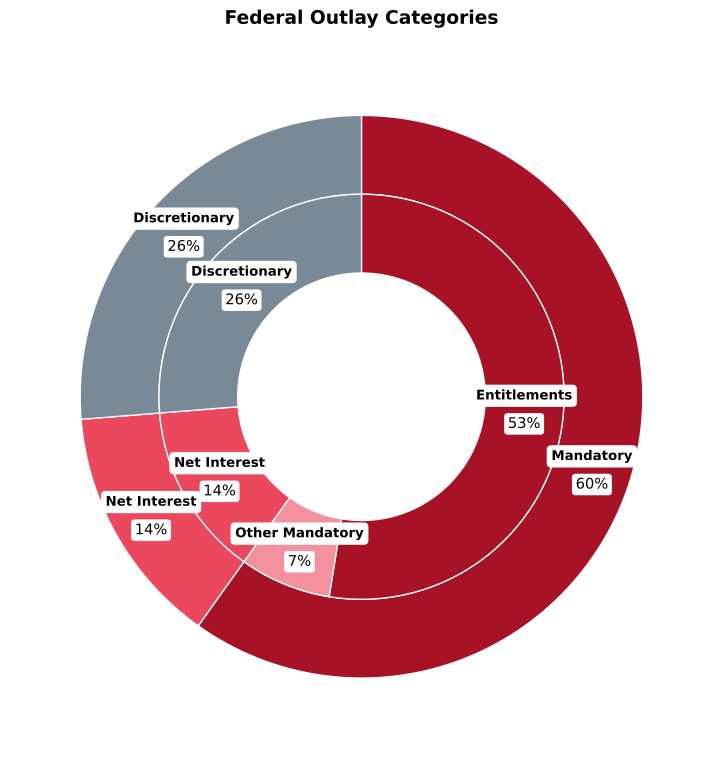
When it comes to the Federal budget, several terms are used and it is important to understand what they are in order to know how they are funded, and how they shape the overall Federal budget. So, if you are interested in understanding the Federal budget, understanding these terms is a must. Most federal spending fits into three categories. Understanding how and why these categories work can help you understand the Federal Budget process and what programs keep paying even during funding lapses, why others pause, and where most dollars are actually spent. They can also help you understand what constraints Congress is under, knowing each of these categories will help you understand how little discretion there is in the budget without legal changes. For a high level understanding of these three categories in FY2024: Mandatory Spending programs were a bit over $4.1 trillion (~60%), Discretionary Spending programs about $1.8 trillion (~26%), and Net Interest (i.e. interest paid on the National Debt) about $1.0 trillion (~14%), for roughly $6.8 trillion in total Federal outlays (spending). Net interest is shown as its own category in official presentations. [1][2][3]
What each Category Means
Mandatory Spending: This category of spending, as its name implies, is required by statute (law). Budget items in this category are automatically authorized for funding unless the law is changed. The statute (law) sets which programs are mandatory and the eligibility requirements and formulas for how much is authorized. Mandatory spending was about $4.1T in FY2024—roughly 60% of total outlays. [2][3]
Entitlements: This category is a subset of Mandatory Spending. Entitlements are Mandatory Spending programs that confer a legal right to benefits to citizens, for example: Social Security, Medicare, and Medicaid are Entitlements. Entitlements make up the bulk of Mandatory Spending; Social Security and Medicare alone account for more than half of mandatory outlays. [2]
Net Interest: The interest the U.S. pays on its National Debt. It’s authorized by permanent law (a permanent, indefinite appropriation) [4], which is why many sources describe it as “technically mandatory,” but it is shown as its own category in the budget, separate from both mandatory and discretionary. In FY2024 it was about $1.0 trillion (~14% of total outlays). [1][3]
Discretionary Spending: This is the remaining non-compulsory spending, everything Congress has not defined by statute (law). Short of changing the law on Mandatory Spending programs, this is the part of the budget Congress can adjust annually. Discretionary spending is just over one-quarter of total outlays (~26%). Congress decides discretionary levels each year during the Federal budget process in 12 separate appropriations bills produced by the Appropriations Committees. (See our Article on Federal Budget Process.) [1][5]
Figure 1: Federal Budget Categories FY 2024 Source: CBO
What’s inside each Category
Mandatory Spending
Programs
Description
Entitlement
FY 2024 Budget Amount
% of Total Federal Spending
Social Security (Old-Age, Survivors, and Disability)
Provides benefits to retired workers, the disabled, and their spouses, children, and survivors. Funded by payroll taxes.
Yes
$1.45T
21.4% [2]
Medicare
A federal health insurance program primarily for people age 65 or older and certain younger people with disabilities.
Yes
$0.9T
12.7% [2]
Medicaid and CHIP
A federal-state health care program for low-income and needy individuals, including children, pregnant women, the elderly, and people with disabilities.
Yes
$0.6T
9.1% [2]
Veterans’ disability compensation and pensions
Provides benefits to veterans who have a service-connected disability. Pensions are paid to low-income wartime veterans.
Yes
$0.2T
2.8%
Federal civilian and military retirement
Provides retirement benefits to federal government civilian employees and military personnel, including pensions, disability, and survivor benefits.
No
$0.2T
2.9%
Unemployment Insurance (federal share)
A joint federal-state program that provides temporary, partial wage replacement to unemployed workers.
Yes
$0.03T
0.5%
SNAP and other nutrition programs
Provides benefits to low-income households to supplement their food budgets. Other programs include school lunch, and food assistance for seniors.
The part of tax credits that can be paid as a refund.
Yes
$0.16T
2.4%
Affordable Care Act (a.k.a. Obamacare)
Provides tax credits and other subsidies to help eligible individuals and families afford health insurance.
Yes
$0.11T
1.6%
Farm programs (e.g., crop insurance subsidies)
Provides subsidies and other support to farmers and agricultural producers.
No
$0.03T
0.5%
Other Mandatory Programs
A collection of smaller, non-entitlement mandatory outlays not separately itemized, such as deposit insurance, payments for natural resources, and other government-wide programs.
No
$0.3T
4.1%
Subtotal Mandatory Spending
$4.1T
~60%
Net Interest
Program
Description
FY 2024 Budget Amount
% of Total Federal Spending
Net Interest
Debt Service – Interest payments on US National Debt
$1.0T
~14%
Discretionary Spending
Programs
Description
FY 2024 Budget Amount
% of Total Federal Spending
National Defense
Funds for the Department of Defense (military operations, personnel, weapons procurement, research), and other defense-related activities in other agencies.
$0.9T
~13% [1]
Health and Human Services
Discretionary funds for health research (e.g., NIH), public health, and human service programs, separate from Medicare and Medicaid entitlements.
$0.1T
~2%
Education
Provides funding for federal education initiatives, grants, and programs at all levels.
$0.1T
~1%
Transportation
Supports highway and airport construction, mass transit, and other infrastructure projects (note: highways/aviation have mandatory contract authority, but spend-out is shaped by annual limits).
$0.1T
~1%
Veterans’ Health Care
Funds health care services provided through the Veterans Health Administration (separate from mandatory disability compensation).
$0.1T
~2%
Homeland Security
Funds for agencies responsible for homeland security, including border patrol and immigration enforcement.
$0.06T
~1%
Housing & Urban Development
Public housing, community development, and housing assistance programs.
$0.06T
~1%
Energy & Environment
Department of Energy, Environmental Protection Agency, and other natural resource and environmental programs.
$0.06T
~1%
International Affairs
State Department, USAID, and foreign aid.
$0.06T
~1%
Other Discretionary
Various government agencies and programs, including general government administration, science, and space exploration (e.g., NASA/NSF).
$0.3T
~5%
Subtotal Discretionary
~$1.8T
~26%
Summary
Knowing Federal Budget terms is useful for understanding how and where Federal money is spent. In FY2024 the Federal Government spent ~$6.8 trillion and took in ~$4.9 trillion, with a deficit of ~$1.8 trillion. The majority of the spending goes to Mandatory programs, most of which are Entitlement programs providing services and benefits to citizens. Net interest—about $1.0T—is reported as its own category and paid under permanent law. As the Mandatory components grow, there is less room for Discretionary items that Congress can administer without reductions in mandatory spending, increases in tax revenue, or additional borrowing. When you look at discretionary spending, many people would consider those categories essential – Education, Environment, Transportation, National Defense – core services of government. Understanding these components clarifies the difficult trade-offs between fiscal sustainability and key government services. [1][2][3][4][5]
Citations
[1] Congressional Budget Office (CBO), The Federal Budget in Fiscal Year 2024: Infographic; and Discretionary Spending in FY2024: Infographic (discretionary ≈ $1.8T; composition; total outlays context). [2] CBO, Mandatory Spending in Fiscal Year 2024: An Infographic (mandatory ≈ $4.1T; Social Security + Medicare > half of mandatory). [3] CBO, Monthly Budget Review: Summary for Fiscal Year 2024 (total outlays ≈ $6.8T; net interest ≈ $0.95T, rounded to $1.0T). [4] 31 U.S.C. § 3123, Payment of obligations and interest on the public debt (interest paid under permanent, indefinite appropriation). [5] CBO primers on budget categories and the annual appropriations process (12 appropriations bills produced by the Appropriations Committees).
Tax Project Institute is a fiscally sponsored project of MarinLink, a California non-profit corporation exempt from federal tax under section 501(c)(3) of the Internal Revenue Service #20-0879422.