Most presidential farewell addresses look backward. They recount accomplishments, defend decisions, and try to shape how history will remember a presidency. George Washington’s Farewell Address was different. It was less a retrospective than guidance to a young Nation. Published in September 1796 as a public letter rather than delivered as a live speech like today, it offered guidance on how to preserve the American republic after its founding generation stepped away.[1][2]
The address, with editing help from James Madison and Alexander Hamilton, displays remarkable foresight and still carries unusual weight today into the thinking of our founders. The U.S. Senate, to this day, continues the tradition of reading Washington’s Farewell Address each year, a practice that began during the Civil War in 1862 and later became an annual observance. The endurance of that ritual says something important: Americans have long viewed the address not as a ceremonial relic, but as a durable statement of civic instruction.[3][4]
The address speaks to several areas that were warnings to our young Nation, a recipe of sorts for the preservation of our union, knowing that each area created perils to the future of the American experiment. Among its most striking warnings was on the uses and perils of Debt.
Washington did not argue that all public borrowing is bad. In fact, he said the opposite at the outset. Public credit, he wrote, should be cherished as “a very important source of strength and security.”[5] That is a practical, not ideological, statement. A nation with sound credit has built trust and can respond to crisis, finance urgent needs, and command greater confidence at home and abroad.
However, Washington framed limits around that principle. Public credit should be used “as sparingly as possible.” Expenses should be avoided where possible through peace. Necessary spending to prepare for danger can be justified if it prevents larger future costs. What he opposed was the casual accumulation of debt and the temptation to push the burden onto future generations.[5]
His warning remains one of the clearest fiscal statements from the founding era: debt may at times be necessary, but necessity is not the same thing as normalization.
Generational Responsibility
The moral center of Washington’s debt passage is not really about accounting. It is about responsibility across generations. He urged the country to avoid “the accumulation of debt” and not to throw upon posterity “the burden which we ourselves ought to bear.”[5]
That line matters because it frames debt as more than a balance sheet item. It raises a civic question. What obligations is one generation entitled to hand to the next? Washington’s answer was not that future generations should never bear any burden. Wars and emergencies could make borrowing unavoidable. His point was that citizens and leaders should not do so lightly, and certainly not for convenience, or political ease.[5]
That is a more serious standard than much of modern fiscal debate. Too often, debt is discussed as polar absolutes that are either harmless or inherently catastrophic. Washington took a narrower and more disciplined view. Debt was neither good nor bad in itself. It was a tool. Its legitimacy depended on purpose, restraint, and repayment.
Debt then Taxes
Washington also stated a harder truth that remains politically unwelcome: debt does not remove costs. It delays and redistributes them. In the Farewell Address, he wrote that “towards the payment of debts there must be revenue; that to have revenue there must be taxes.” So in that way he calls out the obvious, with debt spending, it must be paid for an that invariably means taxes. He added that taxes are always, to some extent, “inconvenient and unpleasant,” and that citizens should judge revenue measures with candor because these choices are inherently difficult.[5]
“towards the payment of debts there must be revenue; that to have revenue there must be taxes.”
George Washington, Farewell Address
That passage is unusually blunt. Washington was telling the public that self-government requires honesty. Borrowing may spare current voters from immediate sacrifice, but it does not repeal the underlying math. Public debt must be serviced through some combination of taxation, reduced future flexibility, inflationary pressure, or tradeoffs elsewhere in the budget. His point was not just aimed at officeholders. He said public opinion itself must cooperate.[5]
That is one reason the address remains so relevant. Washington understood that fiscal irresponsibility in a republic is rarely the work of leaders alone. It often reflects a public culture that wants the benefits of government without the costs.
Why this mattered in 1796
Washington’s warning came from recent experience, not abstract theory. The United States emerged from the Revolutionary War with serious debts and fragile finances. Building national credit was one of the major tasks of the early federal government. A weak republic with poor credit would be less secure, less stable, and less capable of handling future emergencies. That helps explain why Washington treated public credit as an asset worth preserving.[2][5]
At the same time, the 1790s had already shown how contentious taxation could become. The new federal government had to raise revenue, and those efforts were politically explosive. Washington had seen firsthand that taxes were unpopular, that national obligations were real, and that public finance could become a direct test of whether citizens were willing to sustain the institutions they claimed to support.[5]
So his debt warning was built on a dual lesson from the founding era: a republic needs credit, but it also needs fiscal discipline.
George Washington
Why it matters more now
That warning lands differently when federal debt has grown to levels the founding generation could scarcely have imagined. According to Treasury’s Debt to the Penny data, total federal debt outstanding stood over $39.0 trillion as of April 2, 2026.[6] (See the Tax Project’s Debt Clock app)
That number alone does not settle every policy argument. Modern states can carry large debts for long periods. But scale matters. At some point, debt begins to reduce fiscal room, raise financing burdens, and constrain future choices. It becomes harder to respond to recession, war, or emergency when so much capacity is already spoken for. Washington’s concern was not simply that debt exists. It was that a free people might grow accustomed to living on borrowed capacity and presenting the bill later.[5][6] Washington’s warning makes more sense in some ways in modern context as the interest payments on the current US National Debt now exceed $1 trillion dollars annually, taking around one fifth of all Federal Revenue.[7]
That is why his words feel more current, not less. The address speaks directly to a recurring temptation in democratic politics: promise now, pay later.
What can be learned from it
Washington’s debt passage offers several practical civic lessons.
First, public credit is valuable and should not be deployed casually. A nation that cannot borrow credibly when needed is weaker.[5]
Second, not all borrowing is equal. Borrowing for emergency defense or genuine necessity is different from making debt a routine substitute for discipline.[5]
Third, peace is a fiscal virtue. Washington linked debt restraint to avoiding unnecessary wars and unnecessary expenses. Constant conflict is not only costly in blood and treasure; it is corrosive to public finances.[5]
Fourth, intergenerational fairness matters. His sharpest moral language was directed at shifting today’s burden onto tomorrow’s citizens.[5]
Fifth, debt does not eliminate the need for taxes or tradeoffs. It only changes when and how the burden is felt. More Debt leads to taxation. [5]
These are not partisan lessons. They are structural ones. They apply regardless of party, era, or ideology – this is simple economics.
A Farewell Address for our Nation’s Future
Washington’s Farewell Address endures because it was never merely about departure. It was about preservation. Its debt warning was not a call for austerity at all costs, nor an argument that government should never borrow. It was a call for prudence, honesty, and responsibility in a self-governing republic.
That is why the text is still read in the Senate today, on the 250th anniversary of America. It reminds each generation that constitutional government depends not only on institutions, but on habits – restraint in peace, seriousness in crisis, and a willingness of the public to bear costs rather than simply defer them.[3][4][5]
Washington’s most enduring debt lesson is also his simplest: credit is useful, but it should be used carefully; borrowing may be necessary, but it should not become normal; and a nation should be slow to ask its descendants to pay for what it was unwilling to pay for itself.[5]
References
[1] Library of Congress. “Religion and the Federal Government, Part 1.” States that the address was published on September 19, 1796, in David Claypoole’s American Daily Advertiser and reprinted widely. (Library of Congress)
[2] Library of Congress. An Inquiry into the Formation of Washington’s Farewell Address. Notes that the address was dated September 17, 1796, and published on September 19 in Claypoole’s Daily Advertiser. (Library of Congress)
[3] U.S. Senate. “About Traditions & Symbols | Washington’s Farewell Address.” Explains that the Senate reading tradition began on February 22, 1862, during the Civil War. (U.S. Senate)
[4] U.S. Senate. “Washington’s Farewell Address.” States that the Senate later made the observance annual and describes the modern reading practice. (U.S. Senate)
[5] Yale Law School, Avalon Project. “Washington’s Farewell Address 1796.” Contains the full text, including the passages on public credit, debt, taxes, religion, and education. (Avalon Project)
[6] U.S. Treasury, TreasuryDirect. “Debt to the Penny.” Shows total federal debt outstanding of $39,000,264,506,637.00 as of April 2, 2026. (treasurydirect.gov)
[7] Fortune. “The $38 trillion national debt is to blame for over $1 trillion in annual interest payments from here on out, CRFB says” (Fortune)
This tool is for discussion purposes only to understand the impact, timing, financial, and job impacts of AI to help understand the changes. We hope this will be used responsibly to start discussions on how to address what could be one of the largest impact on society since the industrial revolution.
AI Transition Scenario Calculator
Basic AI modeling tool to estimate how AI could change jobs, federal revenue, and the scale of UBI/UHI-style support over time.
Inputs
Timeline
Track 1 – AI adoption speed
How quickly AI spreads through the economy
Track 2 – Job impact
How adoption turns into job displacement
Track 3 – Government response (money)
Revenue stress + support programs (simplified)
Baseline economy (no major AI shock)
%
%
%
Outputs
Peak job displacement
–
Max baseline – scenario jobs.
End-year displacement
–
Baseline – scenario jobs.
End-year federal revenue
–
Scenario federal revenue.
End-year UBI/UHI cost
–
UBI and UHI shown.
Run the model to see results.
Chart 1 – Jobs, federal revenue, AI adoption
Jobs (scenario)Jobs (baseline)Federal revenue ($, scaled)AI adoption (0-100)
Chart 2 – UBI and UHI annual cost
UBI costUHI costDisplacement (jobs)
AI Transition Scenario Calculator: What It Is and How to Use It
The AI Transition Scenario Calculator is a simple planning tool. It helps you explore how widespread AI adoption could affect three big things over the next 10-20 years:
Jobs (how many roles could be displaced)
US federal revenue (how tax receipts might change if the workforce changes)
Support programs (the potential scale of UBI and UHI-style support)
This is not a prediction engine. It is a way to test “what if” scenarios and understand the size of possible change under different assumptions.
What the tool is doing (in plain terms)
The calculator starts with a timeline (start year and end year). Then it creates an “adoption curve” for AI – meaning AI spreads slowly at first, faster in the middle years, and then levels off.
From there, it estimates:
How much of the job market is exposed to automation
How strongly that exposure turns into net job displacement
How job changes might affect federal revenue
How large UBI (cash support) and UHI (health coverage support) costs could be if tied to displaced jobs
The charts let you hover over each year to see values and percentages.
How to use it
Step 1: Set the timeline Pick the years you want to model. A common choice is 20 years (example: 2026 to 2046).
Step 2: Track 1 – AI adoption speed
Midpoint year: when AI is roughly “half adopted” in your scenario
Adoption speed (1-100): how fast the curve ramps up
1-25 = Low, 26-70 = Moderate, 71-100 = Severe
Max adoption level: how high adoption gets by the end of your timeline
Step 3: Track 2 – Job impact
Share of jobs that could be automated: long-run exposure
How strongly AI replaces jobs (1-100): whether automation mostly changes tasks (low) or removes whole roles faster than new ones appear (high)
Step 4: Track 3 – Government response (money)
Federal revenue as % of GDP: starting point for receipts
How much displacement hurts revenue (1-100): how sensitive receipts are to job loss
Ability to capture AI-era revenue: how well new mechanisms replace lost revenue
UBI and UHI amounts: annual support per displaced person (model assumption)
Step 5: Run and compare scenarios Click Run, then hover the charts year-by-year. Use Save/Load in the browser for quick testing, or Export/Import JSON to share scenarios.
Disclaimers
This tool provides illustrative scenarios, not forecasts.
It uses simplified relationships and does not model all economic feedback loops (inflation, interest rates, trade, migration, wars, policy shifts, business cycles, etc.).
“Job displacement” here is an estimate of net roles affected, not a direct measure of unemployment.
Results should be used for planning conversations, sensitivity testing, and education – not for personal financial decisions or policy design without deeper analysis.
The Tax Project Institute is not an official Government agency
Estimates are for illustrative purposes and not for official use.
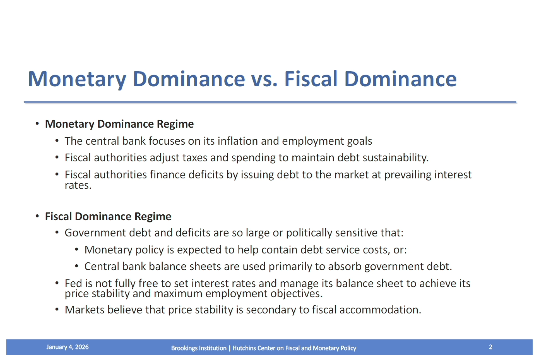
In a healthy Economic environment the Central Bank of a country, the Federal Reserve (Fed) in the United States, manages the Monetary Policy that manages the money supply, and sets interest rates to keep inflation under control and the job market healthy. The Federal Reserve is said to have a dual mandate to maintain stable pricing (manage Inflation), and maximum employment (stable Jobs). While elected officials in the Executive Branch and Congress manage the Fiscal Policy that sets taxes and the budget that determines spending. These functions are setup as independent processes with different goals.
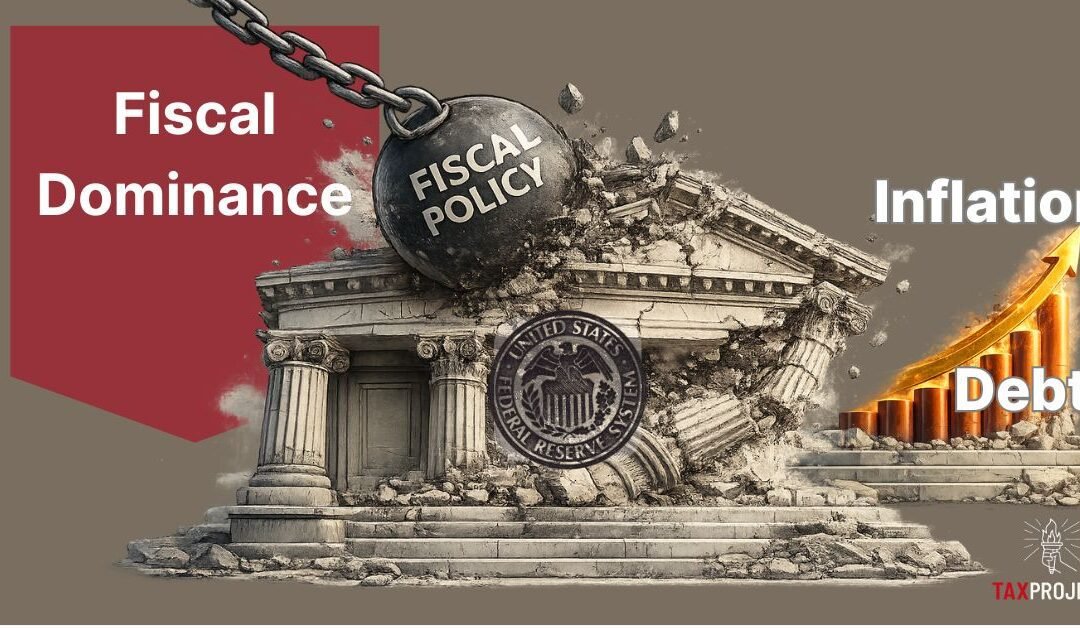
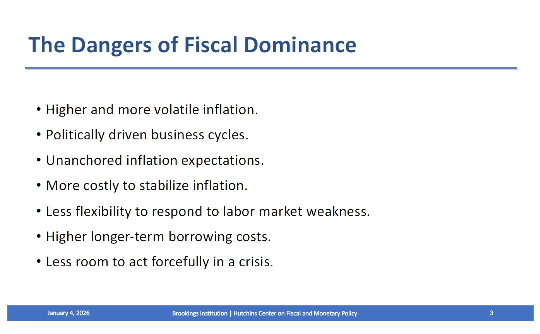
Fiscal Dominance is a term used when a Country’s Debt and Deficits get so large that Fiscal Policy begins to, either explicitly or implicitly, steer Monetary Policy. This can be a very troublesome situation to be in because it puts two competing responsibilities into conflict at times, and in general should be avoided where possible because of the risks involved. In high debt environments, interest payments on the debt can become very large and begin to crowd out other Government spending. As the interest rates raise, the debt payments grow and compound the challenges. This can put pressure on the Fed to go against their mandate to lower interest rates and thereby reduce the cost of the debt service payments. However, by lowering rates the Fed may lose control on Inflation which may rise higher than their target rate.
Former Treasury Secretary and Federal Reserve Chair Janet Yellen defines it as when deficits and debt put so much pressure on the government’s financing needs that Monetary Policy becomes “subordinate” to those needs, meaning the central bank is pushed to keep rates “lower than warranted” or buy government debt “to ease the government’s financing burden.” [1]
The challenge is that inflation becomes the easiest way out because it can immediately reduce the cost of debt service and quietly shrink the real value of what the Government owes. This is a lot easier for elected officials than raising taxes, cutting spending, or changing entitlement programs due to the unpopularity with constituents. However, through inflation it also shrinks the buying power of everyone’s dollars.
“If congress is unable or unwilling to address primary deficits the problems will compound and the temptation to rely on inflation or financial repression to reduce the debt burden will surely grow.”
Janet Yellen , “The Future of the Fed” January 4-5, 2026 [1]
Why does it Matter?
Since the COVID pandemic, after a long period of stable pricing, the US experienced higher than normal inflation, and most Americans now understand inflation, and what is being called the “Affordability Crisis” as something much more tangible and real. Inflation is no longer an abstract statistic. It is the slow (or sometimes fast) loss of what your money can buy. The Bureau of Labor Statistics tracks prices with the Consumer Price Index and explains inflation as when prices rise, the purchasing power of the dollar declines. [4]
The damage caused by inflation shows up everywhere: groceries, gas, rent, insurance, childcare, car repairs. If pay does not keep up with inflation then living standards slip. If you hold cash or earn a low interest rate on savings, inflation reduces the value of your money punishing savers, those on fixed income, and the most vulnerable.
You can also see inflation worry show up in markets. When people get uneasy about the future buying power of dollars, they often look for hedges. Gold is the classic example. Recently Gold has been hitting record highs above $5,000/oz in late January 2026, driven by safe-haven demand and uncertainty, along with expectations about interest rates and heavy Federal Reserve buying. [3]
None of this is to say Fiscal dominance is happening now, but as Janet Yellen recently said “the preconditions…are clearly strengthening.” (See Janet Yellen Statements here)
“the preconditions for fiscal dominance are clearly strengthening”
Janet Yellen, “The Future of the Fed” January 4-5, 2026 [1]
“I doubt Americans will wind up on the Fiscal Dominance course, but I definitely think the dangers are real and should be monitored.”
Janet Yellen , “The Future of the Fed” January 4-5, 2026 [1]
The risks are not about political parties, or politicians, but basic math. Here are some of the challenges:
When Debt is High, Interest Increases Hurt!
When the government owes a lot, even modest levels of debt can become expensive with high interest rates. That expense to pay the rising interest cost on debt competes with everything else the government wants to do. For every 1% increase in interest rates debt service costs increase nearly $400 billion annually. [6] (See Table 1 below)
The Congressional Budget Office’s (CBO) February 2026 outlook (summarized by the Committee for a Responsible Federal Budget) shows debt held by the public around 100% of GDP (i.e. the entire US Economy) and projected to rise to about 120% by 2036. It also shows Net Interest costs (the amount we pay on debt) more than doubling from ~$970 billion in 2025 to about ~$2.1 trillion by 2036, rising from about 3.2% of GDP to about 4.6% of GDP. [2]
High Interest Costs Squeeze Budgets
Unlike many budget expenses, interest is the part you pay because of past spending. It does not build roads, improve schools, or provide services directly. As it grows, it can crowd out other priorities or force harder choices later.
The current Net Interest is larger than the expense of the US Military, so doubling that cost would be a very large expense putting pressure on other spending. Whether someone sees those numbers as “manageable” or “dangerous,” they are big enough to create strong political pressure around interest rates.
This is where Fiscal Dominance risk starts to become realistic: if interest costs feel like they are exploding, it becomes politically tempting to push for lower rates regardless of inflation conditions.
The Catch-22: Debt Service vs Inflation
For younger folks a Catch-22 is a situation with no good options. You’re dammed if you do, and dammed if you don’t.
Here is the doom loop in simple steps:
Inflation is too high, or the risk of inflation is rising.
The Fed raises rates to slow inflation and protect the value of the dollar.
Higher rates raise the government’s interest bill over time.
The higher interest rate increases debt service cost that squeezes the budget.
Pressure rises to lower rates to “stop the bleeding” and lower interest costs.
If rates are cut too soon, inflation can come back, and the cycle repeats.
Yellen’s warning is that when the central bank is constrained from raising rates because it would increase debt service or cause fiscal stress, inflation expectations can become “unanchored,” and people may start to think inflation is the “path of least resistance” for managing high debts. [1]
That phrase is worth translating: once a society starts to believe “they will inflate rather than make hard choices,” the value of money becomes a political variable. That is when inflation becomes harder to control.
Interest rate
Estimated Net Interest
Delta vs Current
1%
$0.39T
-$0.93T
2%
$0.77T
-$0.54T
3%
$1.16T
-$0.15T
Current (3.4%)
$1.31T
$0.00T
4%
$1.55T
+$0.23T
5%
$1.93T
+$0.62T
10%
$3.86T
+$2.55T
15%
$5.80T
+$4.48T
20%
$7.73T
+$6.42T
Table 1 Estimated Net Interest
Can Both Sides be Right and Wrong?
It can be hard in our polarized environment not to think about this as either one side is Right or Wrong, however that misses the point. Both Fiscal and Monetary policy play important roles in the Economy and impact all Americans. Normally these can operate independently and support each other, a sort of Yin and Yang that balance each other out. The challenge when Debt and Spending get so large that they put Monetary and Fiscal responsibilities into conflict.
Fiscal Policy: Executive Branch and Congress
What they care about: Spending (Debt service) and Growth
Why they can be Right:
Lower Interest costs can reduce Net Interest expenses that crowd out other spending and make the budget fragile.
Lower rates can support growth that can expand the tax base and reduce immediate fiscal strain.
Why they can be Wrong:
By leaning on the Fed to lower Interest rates they may increase inflation and reduce the value of the dollar.
Monetary Policy: The Federal Reserve
What the Fed cares about: Stable Pricing (Inflation) and Maximum Employment (Jobs)
Why the Fed is Right:
Protecting purchasing power is not a luxury. When inflation is unstable, everyone lives with more uncertainty, borrowing costs and the Affordability crisis increase, and the value of the dollar diminishes.
Yellen makes the key point that “stabilizing prices becomes significantly more costly” once inflation expectations take hold. [1]
Why the Fed can be Wrong:
Tightening policy in a high-debt environment can create political backlash and institutional stress. Even if the Fed’s policy is “correct” on inflation, it can still trigger a fight over Fed independence that changes the rules of the game.
Short term priorities due to massively rising Debt Service costs may pose greater danger than long term rising inflation.
This is the core Catch-22: the fiscal side is not crazy to care about interest costs, and the Fed is not crazy to prioritize inflation. Inflation can be a lot like a heart attack, it can go quietly unnoticed but suddenly impact you. By letting inflation slowly (or quickly) devalue the dollar, everything gets more expensive and your savings are worth less.
What does Fiscal Dominance look like?
Fiscal dominance usually does not arrive with a press release. It shows up as a drift in behavior and expectations, such as:
Repeated pressure to cut rates mainly to reduce the government’s borrowing costs.
A growing expectation that the central bank will not do what it takes to control inflation if it would make the budget painful.
Challenges to the Federal Reserve autonomy
Investors demand compensation to cover the additional Risk Premia because they worry the government will rely on inflation to manage the debt, devaluing the dollar.
Yellen’s Listed Preconditions
Steep upward debt trajectory: CBO projects debt rising from ~100% of GDP in 2026 to over 150% in three decades—current levels already test sustainability.
Persistent large deficits: ~6% of GDP overall (~3% primary), unprecedented outside wars/recessions, with no credible medium-term fiscal adjustment plan from either party.
Debt service pressure on monetary policy: When debt hits ~120%+ GDP, rate hikes to fight inflation risk exploding interest costs, forcing Fed to prioritize debt financing over its dual mandate.
Yellen flags the same idea: fiscal dominance can raise borrowing costs if investors become concerned the government will rely on “inflation or financial repression” to manage debt. [1]
“Kick the can down the Road”
Many Western Democracies are trapped in a similar situation: High Debt, Growing Entitlements, Limited will to Raise Taxes or Cut Spending. It is politically far easier to postpone painful choices. Nobody wants higher taxes. Nobody wants spending cuts. Nobody wants entitlement changes. That political reality is not a moral failing; it is a constraint.
However, the longer we stay on our current fiscal path and our debt continues to grow, the more painful the eventual adjustment will be. This is not a problem that goes away on its own. Yellen states the hard version of this idea: if markets do not expect future budget surpluses to cover the debt, “the adjustment eventually comes via inflation or default.” [1]
For the U.S., “default” is not the scenario most people think about, although all three rating agencies have downgraded the US [5]. The more realistic concern is a mix of:
Higher Inflation – everything will cost more, and your money will be worth less
Higher Borrowing Costs – credit will cost more
Forced Fiscal Changes – some combination of tax increases and/or spending cuts
This is why Fiscal Dominance is not just a “Fed independence” topic. It is about whether the country chooses a gradual planned path or dramatic unplanned (but predictable) one. (See our Article: Ways out of Debt)
Summary
Fiscal Dominance is not a slogan and it is not “here” yet. It is a risk that grows when debt is high, and interest costs are large, and political incentives push for easier money even when inflation is not truly under control. The stakes are high, we can begin to manage it now, or we risk higher inflation and the devaluation of the dollar and the cost of everything increasing.
Citation
[1] Janet Yellen, “Remarks on the future of the Fed: Central bank independence and fiscal dominance” (Brookings, Jan 2026). (Brookings) [2] CBO February 2026 outlook summary (Committee for a Responsible Federal Budget, Feb 11, 2026). (CRFB) [3] “Gold jumps over 3% to record peak…” (Reuters, Jan 27, 2026). (Reuters) [4] BLS CPI FAQ and purchasing power notes (BLS). (Bureau of Labor Statistics) [5] CNN. May 2025. “The United States just lost its last perfect credit rating.” (CNN) [6] Based on US Treasury Debt to Penny 2/12/26, average rate on interest-bearing debt 12/4/25 Peterson Foundation
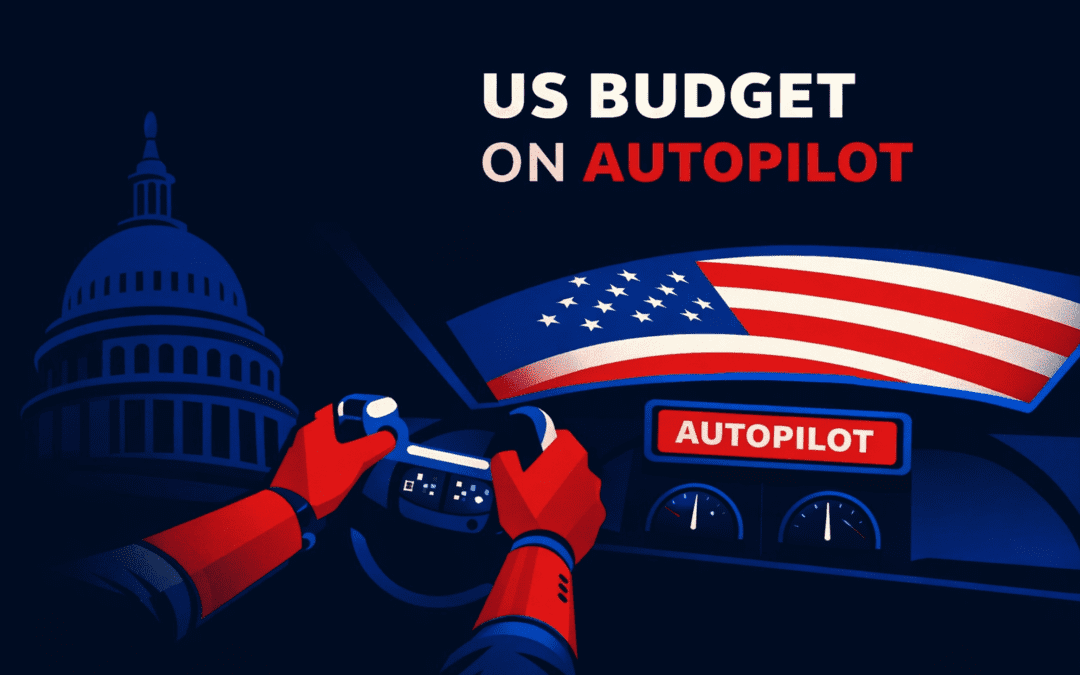
The US Federal budget appears as something Congress actively “sets” each year. In reality, a growing share runs on autopilot – governed by laws passed in prior years and by interest costs tied to past borrowing. That shift matters because it reduces flexibility. When the adjustable slice gets smaller, even well-intentioned efforts to “balance the budget,” “cut waste,” or “fund new priorities” run into a hard constraint: there is less room to move without changing the underlying laws. [1][2]
Office of Management and Budget (OMB) historical data shows a long, clear trend: discretionary spending used to represent most Federal outlays (spending) as recently as the 1960s, and today it represents roughly a quarter. [2] Figure 1 illustrates the same core idea: over time, the “annual choice” (a.k.a. Discretionary) portion shrinks while Mandatory spending and Net Interest take up more and more of the total.
Figure 1. Discretionary vs Mandatory & Net Interest (share of total federal outlays).
Figure 1: US Federal Budget Discretionary % Source: OMB
As the Discretionary component of the budget continues to shrink as a percentage of the budget Congress is left with less flexibility, and fewer tools to combat Fiscal challenges. While this was done intentionally in many cases to ensure that funding for critical programs like Social Security, and Medicare are funded, it has the effect of hamstringing the legislative branch in a number of ways.
1) Smaller Steering Wheel
Discretionary spending is the part of the budget Congress decides through the annual appropriations process. It funds many of the visible functions people associate with government: agencies, staffing, operations, contracts, grants, and a wide range of public services. [3]
As discretionary becomes a smaller share of total outlays, the annual appropriations process controls less of the overall budget. Congress is still making choices, but with fewer degrees of freedom – all but roughly one quarter of the budget is on auto pilot before they even start. The practical result is simple: fewer options exist inside the discretionary part of the budget that can be changed quickly without changing the law.
This is the first flexibility problem. Many public debates treat the entire budget as negotiable every year. It is not. A rising share is effectively pre-committed by statute and by the interest payments on our National Debt. [2][3] Because of this there is less room to swing, move budget to areas that may require it without taking on additional debt, and larger budget deficits.
2) “Automatic” but not “Unchangeable”
Mandatory spending runs based on permanent law: eligibility rules, benefit formulas, payment rates, and automatic adjustments. It does not require an annual appropriations vote to continue. [3] These are essentially the auto pilot components of the Federal Budget.
However, Mandatory spending can be changed. The challenge is that it usually requires changing the underlying statute, which often involves complex policy design, distributional tradeoffs, and longer legislative timelines often met with gridlock in our current political environment. That makes it harder to adjust Mandatory programs as a “quick fix” when budget pressure arises.
This creates a mismatch between politics and mechanics: discretionary levels can be adjusted in annual funding bills, while major changes to large mandatory programs, that take up the majority of the budget, typically require separate authorizing legislation and sustained political agreement. [3] This has the practical effect of making most of the budget off limits each year unless there is consensus on changing components of the mandatory budget, which both parties are often hesitant to do.
3) Entitlements Growth
A major reason the autopilot share grows is that many Mandatory programs are built to scale and expand cost automatically. Spending can rise because:
More people become eligible (demographics)
Per-person costs rise (especially in health care)
Benefit formulas and thresholds adjust over time (indexing, inflation)
Refundable credits and income-tested benefits expand and contract with economic conditions [4]
This is not inherently “good” or “bad.” It is what happens when programs are designed to deliver stable benefits based on rules. But it does mean the budget baseline rises even if Congress takes no new action in a given year.
When that baseline grows faster than revenues, pressure concentrates on the smaller discretionary slice. The consequences show up in visible ways: funding fights, recurring rhetoric about “cuts,” and a sense that budgeting is constant crisis management. The underlying driver is often structural: the baseline is doing what the laws tell it to do. [2][4] The challenge is that the Entitlements component of the budget, in particular Health Care, has grown dramatically over the last few decades and is taking an increasingly larger piece of the budget.
4) Net Interest competes with everything else
Net interest is the cost of financing the US National Debt, in other words the interest paid on the National Debt in the form of Treasury securities (net of certain interest income). [3] It is not a program most people interact with directly, but it draws from the same pool of Federal Budget resources.
When debt levels are high and interest rates rise, interest costs can increase even if no benefit is expanded and no agency is funded more. That creates a second flexibility squeeze: interest is effectively a prior obligation. It gets paid first, and it reduces the dollars available for everything else. The US paid over $1 trillion in Interest on our National Debt, more than the entire US Military budget. [5]
This is one reason budget debates can feel increasingly zero-sum. When more of the budget is committed to mandatory programs and interest, the share left for annual choices becomes smaller, and tradeoffs become more challenging. [2][3]
5) Limited Efficiency Drives
Efforts to improve government efficiency, reduce overhead, and cut waste matter. But they run into arithmetic challenge, even if they eliminated the entire Discretionary budget, roughly three quarters of spending would still occur. While this isn’t practical, or likely, it provides perspective on the limitations of any cost cutting efforts, including the most recent DOGE efforts.
When discretionary spending is only roughly a quarter of federal outlays, it limits how large savings can be if reforms stay mostly inside discretionary programs. Even aggressive discretionary cuts face tradeoffs because discretionary spending includes many visible services and operational functions people rely on. [2][3] The discretionary budget includes many things that would probably surprise many citizens that they are discretionary including Education, the Military, Homeland Security, housing assistance, and medical programs like the CDC, and NIH to name just a few.
Meanwhile, the biggest structural drivers of the budget’s composition shift sit mostly in Mandatory programs and Net interest – areas that do not respond to short-term “efficiency” campaigns in the same way. [2][3]
That is why many high-profile cost-cutting efforts generate headlines but produce smaller results than promised: the biggest budget pressures are often located in the portions that require statutory change or longer-term fiscal adjustments.
What this means for citizens watching budget debates
The practical takeaway is straightforward: the annual budget fight is real, but it is increasingly a fight over a smaller share of total federal spending that limits Congressional flexibility. Big claims about “fixing the budget” without addressing larger Mandatory programs and Net Interest costs should be treated with skepticism – not because reform is impossible, but because the control levers are different. [2][3]
A budget with less discretionary share has less flexibility. That makes it harder to:
Respond quickly to new priorities without borrowing and increasing deficits adding to the National Debt
Reduce deficits through easy cuts
Avoid political brinkmanship in appropriations
Hold decision-makers accountable for the full budget (because only part is voted on annually) [2][3]
The budget autopilot challenge is fundamentally a governance challenge: when most spending is determined outside the annual appropriations cycle, meaningful change requires changing the rules – not just negotiating the yearly slice. [3] The growth of Entitlements and Mandatory spending and Interest are putting more an more pressure on the Fiscal Budget each year, leading to annual structural deficits in budget over $1 trillion a year. In FY 2025 the US Federal Budget was $7 trillion on revenue of $5.2 trillion with a $1.8 trillion deficit added to the $38 trillion National Debt. [6] The long term trend is clear, growing Mandatory spending will continue to consume more and more of the budget and lead to increasingly structural deficits which will compound the challenge as interest payments and entitlements continue to grow. Meaningful change will likely require adjustments to Mandatory programs and reduction in annual deficits through spending cuts and/or tax increases. See our article on Ways out of Debt HERE.
See how well you understand the Finances of America. Every American should understand the basic components of how our Government manages the finances of the Country. Only through knowledge are we able to understand the financial state of the country, and thus the health of the country and from this knowledge the ability to make informed decisions.
“Knowledge will forever govern ignorance; and a people who mean to be their own governors must arm themselves with the power which knowledge gives.”
James Madison
Test Government Finance Knowledge
About how much Revenue does the U.S. Federal government collect in a typical recent year?
Order of magnitude: Federal revenues are in the mid single-digit trillions, not billions. For example, in Fiscal year 2024 the federal government collected about $4.9 trillion in revenue. That was just under 20% of U.S. GDP for that year. Learn more: Federal Revenue overview.
Order of magnitude: Federal revenues are in the mid single-digit trillions, not billions. For example, in Fiscal year 2024 the federal government collected about $4.9 trillion in revenue. That was just under 20% of U.S. GDP for that year. Learn more: Federal Revenue overview.
Tax Project Institute is a fiscally sponsored project of MarinLink, a California non-profit corporation exempt from federal tax under section 501(c)(3) of the Internal Revenue Service #20-0879422.