

AI Transition – Run your own scenarios*
This tool is for discussion purposes only to understand the impact, timing, financial, and job impacts of AI to help understand the changes. We hope this will be used responsibly to start discussions on how to address what could be one of the largest impact on society since the industrial revolution.
AI Transition Scenario Calculator
Basic AI modeling tool to estimate how AI could change jobs, federal revenue, and the scale of UBI/UHI-style support over time.
Inputs
Outputs
AI Transition Scenario Calculator: What It Is and How to Use It
The AI Transition Scenario Calculator is a simple planning tool. It helps you explore how widespread AI adoption could affect three big things over the next 10-20 years:
- Jobs (how many roles could be displaced)
- US federal revenue (how tax receipts might change if the workforce changes)
- Support programs (the potential scale of UBI and UHI-style support)
This is not a prediction engine. It is a way to test “what if” scenarios and understand the size of possible change under different assumptions.
What the tool is doing (in plain terms)
The calculator starts with a timeline (start year and end year). Then it creates an “adoption curve” for AI – meaning AI spreads slowly at first, faster in the middle years, and then levels off.
From there, it estimates:
- How much of the job market is exposed to automation
- How strongly that exposure turns into net job displacement
- How job changes might affect federal revenue
- How large UBI (cash support) and UHI (health coverage support) costs could be if tied to displaced jobs
The charts let you hover over each year to see values and percentages.
How to use it
Step 1: Set the timeline
Pick the years you want to model. A common choice is 20 years (example: 2026 to 2046).
Step 2: Track 1 – AI adoption speed
- Midpoint year: when AI is roughly “half adopted” in your scenario
- Adoption speed (1-100): how fast the curve ramps up
- 1-25 = Low, 26-70 = Moderate, 71-100 = Severe
- Max adoption level: how high adoption gets by the end of your timeline
Step 3: Track 2 – Job impact
- Share of jobs that could be automated: long-run exposure
- How strongly AI replaces jobs (1-100): whether automation mostly changes tasks (low) or removes whole roles faster than new ones appear (high)
Step 4: Track 3 – Government response (money)
- Federal revenue as % of GDP: starting point for receipts
- How much displacement hurts revenue (1-100): how sensitive receipts are to job loss
- Ability to capture AI-era revenue: how well new mechanisms replace lost revenue
- UBI and UHI amounts: annual support per displaced person (model assumption)
Step 5: Run and compare scenarios
Click Run, then hover the charts year-by-year. Use Save/Load in the browser for quick testing, or Export/Import JSON to share scenarios.
Disclaimers
- This tool provides illustrative scenarios, not forecasts.
- It uses simplified relationships and does not model all economic feedback loops (inflation, interest rates, trade, migration, wars, policy shifts, business cycles, etc.).
- “Job displacement” here is an estimate of net roles affected, not a direct measure of unemployment.
- Results should be used for planning conversations, sensitivity testing, and education – not for personal financial decisions or policy design without deeper analysis.
- The Tax Project Institute is not an official Government agency
- Estimates are for illustrative purposes and not for official use.
AI Job Loss Transition Modeling Calculator

What is Universal High Income?
By now we have all heard the dystopian predictions of AI and its potential major impact on jobs in the future, which gave way to discussions of Universal Basic Income (UBI) (See our Article on UBI). However, there is a alternate utopian future now being discussed, with a decidedly cheerier outlook. Elon Musk introduced the concept of “Universal High Income” or UHI in short. In late 2023 he wrote that, in a “positive AI future,” there will be “universal high income, not basic,” and that scarcity would largely disappear aside from what society chooses to keep scarce. He added a second idea that changes the tone: even if material needs are solved, it is “less clear how we will find meaning in a world where work is optional.” [1] Essentially in this scenario Musk envisions a world where abundance addresses basic needs for food, shelter, health and well being but poses a philosophical question about how people fill the need for purpose if work is no longer required. We’re pretty far away from UHI, but it creates an interesting discussion point of how would that work, and is UHI even possible? A world where all a persons needs are met, except the emotional and psychological. While not pure utopia, if given a choice, it is a world that many might choose to live in.
Musk has been making versions of this point for years. At the World Government Summit in 2017 he argued that AI and robots would steadily eliminate the kinds of jobs humans can do better than machines, and that “some kind of universal basic income is going to be necessary.” [2] More recently, interviews and press roundups continue to frame his view as: automation displaces work, universal income becomes a stabilizer, and the long-run end state might be “high” income, not merely “basic.” [3] In late 2025 he pushed the idea into science-fiction territory: a future where AI and robotics make “money irrelevant,” while conceding there will still be real constraints like electricity and physical resources. [4]
Taken together, “universal high income” is best read as a claim about an economic paradigm change, not just a single policy tweak or technology enabled by AI. It implies a world where machine productivity is so large, and so widely deployable as to be universal, that the main question stops being “How do we produce enough?” and becomes “How do we distribute access to what we can produce, without breaking the price system or the social fabric?” If that is the question, then UHI is not something you can evaluate with a single talking point about incentives or fairness. You have to walk through the mechanics: what it would mean in practice, what would enable it, what would block it, and how the tax system would have to evolve to carry the load. In researching this topic, it is a huge problem with many complex facets that our way beyond this article. However, this article attempts to frame the discussion on UHI, and discuss the mechanics, what is required, what it may cost, and how it may come to fruition. It, like the imagined scenario, is very much a philosophical thought experiment. However, the Societal impacts and questions are immense, and we have only begun to frame just the tip of the iceberg, so thinking about this now is important in the context that our world maybe dramatically changing in the next 2, 5, 10, 20 years? Whatever the timeframe, disruption on this order of magnitude is not likely to be digested well over any time frame.
Defining Universal High Income
What really is UHI? The first question you need to ask is how do you define what UHI is, what is “high” when it comes to income. “Basic” at least frames a concrete debate about necessities. “High” could mean a comfortable middle class lifestyle, or it could mean “enough cash that nobody needs to work” or the even more luxurious where all material needs are met. Those are not the same world in terms of economics. The moment you say “high,” you are no longer talking about protecting people from destitution. You are talking about underwriting broad discretionary consumption, or at least broad financial security, and excess surplus being utilized for leisure and comfort. That increases the fiscal scale, but it also increases the risk that the policy becomes a transfer mechanism into the most supply-constrained parts of the economy. For example housing in desirable places, specialized healthcare, scarce education seats, or any goods and services where supply is low and political drag blocks or slows change. In other words, the basics of supply and demand do not change because of the AI paradigm change.
This is where many UHI conversations fail: they treat income as if it is the same thing as output. It is not. Income is a claim on output. If the economy cannot expand real output in the places people spend incremental dollars (increased demand), a universal income program can become a price amplifier rather than a living-standard booster (translated: inflation). In Musk’s framing, this is precisely what the “ultra-high productivity” condition is supposed to solve. In a true abundance regime, higher purchasing power does not just chase fixed quantities; it matches a world where quantities can expand cheaply do to the abundance of automated labor and productivity surplus.
For this article, and throughout we will use the fourth quintile (80th percentile) of income from the US Census of just over $175,000 for our UHI Income scenario. There are 20% of the population above this amount, but a good place to start. We recognize there is no right answer and geographically in cities like New York City and San Francisco this amount may not seem like High income. However, for our scenarios this is a good basis for analysis.
Conditions to Support UHI
So what actually has to be true for that abundance regime to exist?
Physical Operations: The first requirement is that AI productivity cannot remain trapped in software. A world where chatbots and coding assistants are abundant, but housing remains blocked by zoning and construction constraints, is not a world where “high income” generates a higher standard of living for everyone. The second requirement is that robotics scales beyond factory islands and pilot programs. Many of the costs households care about are embedded in physical operations: construction, care, logistics, maintenance, and the long tail of services that are partly physical and partly human. If robots do not get cheap, safe, ubiquitous, and evolve to replace the dexterity of all human labor to truly create abundance the “high income” promise becomes a narrow slice of the economy (digital goods) plus a widening set of bottlenecks (everywhere else). Bottom line is Robots, AI and automation need to go hand in hand in the physical world for this to have a chance at success.
Energy: The next requirement is energy. An AI and robotics heavy economy is energy hungry because compute and industrial throughput both consume power. In essence you are substituting electrical energy for the chemical energy in our Brains and Muscles. Not only that, you are doing it at a level that would have to far exceed what the biological (human) entities are producing today, meaning a lot more energy. Even in Musk’s 2025 “money becomes irrelevant” framing, he still points to electricity and mass as constraints. [4] That matters because it gives you a clean way to think about feasibility: if the economy cannot obtain abundant, reliable energy and convert it into output at scale, then “high income” is just a redistribution story, and redistribution alone does not give you abundance, or create the conditions to support UHI. Economically, this makes sense – the highest correlation to wealth for a nation has always been Energy. Wealthier countries use more energy, and to get to UHI and Super Abundance we’re going to need a lot of Energy.
Policy: Finally, and most importantly is policy design, UHI will need a distribution mechanism that mirrors the productive capacity mechanism. Even if machines produce more, households do not automatically receive claims on that production. If ownership of the productive capital is concentrated (very likely to be the case), the income gains can concentrate too. In that world, “universal high income” is not a natural consequence of technology. It is an explicit choice to socialize a portion of the gains and distribute them broadly. This maybe one of the biggest hurdles, as the AI investments now are massive, and expecting such investments that enable the Productivity gains is unrealistic if those making the investments don’t see a return on those investments. This is likely to be one of, if not the biggest hurdle. How to distribute fairly, with no consensus on fair, and how to incentivize the change from the people most likely to make it happen knowing that they will enjoy a greater share of that prosperity. It makes sense, but our increasingly egalitarian society has philosophical challenges with the concept. Hence, we anticipate this to be an intractable challenge.
Abundance: All of the above are nothing without the hyped and needed productivity gains. Massive gains in productivity are required to achieve UHI goals, without which none of this will be possible. We estimate in Table 3 below some possible Economic gains that would be required for different levels of support for UBI/UHI, and they are significant (massive). The automation, and Physical Operations above will need to create super abundance. This will be no small feat, one of the critiques of Marxism is Marx’s concepts of “realm of necessity” where basic needs are met and the “realm of freedom” where labor is minimized and abundance of goods is secured, the so called “higher phase” of communism. [17][18][19] While the “higher phase” has always been Utopian in concept, no country employing this scheme has ever reached this phase of super abundance. Which is why Utopia at the root literally means “Nowhere”, in other words it does not exist. If super abundance can occur with AI maybe Utopia can exist? In any case, this super abundance phase is a baseline requirement for UHI.
How will UHI Revenue be Generated?
As with any major social program, the main challenge is how do you fund it? There are no shortages in Governments creativity to tax various activities, but it is clear that Income Tax (currently the largest source of Government Revenue), and Payroll taxes are not sufficient. As AI is predicted to reduce the number of workers, some type of offset would be required to fund Government as it exists today, much less anything close to UHI. It should be noted that some of the optimists in the industry believe AI related jobs will increase the need for workers at a rate greater than the job displacement. So the question of funding is open: do you fund UHI primarily through taxes (tax-and-transfer), or through a social-dividend model (collective ownership of assets that pay out dividends), or through a hybrid of both, or some other mechanism? One model could be to tax the Labor Equivalent AI/Robotic automation at the same rate as labor. As it gets deployed, the equivalent labor units would be taxed accordingly, as more labor was put to work, the higher the revenue.
“There’ll be more jobs created than jobs lost.”
Eric Schmidt, former CEO of Google
The IMF’s framework for evaluating universal basic income is useful here because it forces you to specify design choices rather than argue based on vibes. It frames UBI debates around definition, objectives, arguments for and against, and an analytic approach to assess it. [5] The OECD makes a similar point in plainer terms: more universal income support would likely be introduced in stages, and it requires a parallel debate about financing and how the benefits of growth are shared. [6] Those points become even more binding at “high” benefit levels, because the program grows from “social policy” into a “core macro-fiscal architecture.”
In a tax-and-transfer model, government raises revenue in the usual ways and pays a universal cash benefit. The simplest administrative approach in the United States would often run through the tax system because it already handles refundable credits: provisions that can exceed a taxpayer’s income tax liability and therefore function as cash payments. [10] That is not a theoretical footnote. It is a proven delivery mechanism in use today through Earned Income Tax Credits (EITC). The Congressional Budget Office (CBO) notes that refundable credits have evolved over time, have substantial fiscal costs, and interact with both the economy and the tax system. [11] If you are building a national payment mechanism with identity verification, reconciliation, and enforcement capacity, the IRS and the tax filing ecosystem are already part of that machinery.
Revenue Mechanisms: Evolving our Institutions including the IRS
While the IRS exists and may have some of the plumbing, building a UHI-scale program will stress our current tax system in ways existing credits do not. It changes how and what the IRS taxes, and will change how people perceive taxation. It changes what “tax rates” mean, because you can simultaneously have high gross tax collection and high gross transfers. And it changes the politics of compliance, because citizens begin to experience taxation and benefits as one integrated system.
In that integrated system, the choice of tax base becomes the real debate. If the UHI story is that labor becomes less important as machines do more work, then a labor-heavy tax system becomes less suitable over time. You end up looking for tax bases that will still exist and still scale in an AI automated economy, like taxing automation.
Consumption
Consumption-based taxation rises in that conversation for a reason: consumption doesn’t disappear just because wage income declines. In a high-productivity machine economy, you would expect the capacity to consume to expand, regardless of whether the cash comes from wages, capital income, or transfers. Consumption taxes are widely used globally. The OECD’s treatment of consumption taxes and VAT design highlights how many variations exist across countries, and how these regimes are used to raise revenue and sometimes pursue redistribution objectives. [13] The United States is an outlier in that it relies on retail sales taxes at the state and local level rather than a federal sales tax or VAT (i.e. We tax at the end instead of every intermediate step in the process). [12] That matters mechanically: if a future UHI policy conversation pivots to a VAT-style instrument as a stable funding base, that is not just “raise a tax.” It would likely require building a major new federal tax infrastructure that would need major decisions on how it interacts with state and local sales taxes and state autonomy.
Consumption taxes have a second mechanical advantage in a UHI world: they can be paired naturally with universal payments. One way to describe the combined system is that the government taxes consumption broadly and returns a uniform per-capita rebate or dividend. The higher your consumption, the more tax you pay; the UHI payment is the same for everyone. That creates a built-in progressivity as a matter of arithmetic, without means tests. The political question is whether a country wants to do that, and the technical question is how to implement it cleanly without loopholes and without driving activity into informal (illicit) channels.
Profits & Capital
When you move away from consumption, the other obvious base is capital income and profits, because those are the flows that grow when machine productivity is captured by owners. The challenge is that many profit and capital income streams are mobile, can be shifted across borders, and are sensitive to the details of tax law. Designing a UHI on unstable or highly avoidable bases creates a program that is large, politically salient, and constantly under attack. That does not make it impossible, but it pushes policymakers toward either broad-based instruments (like consumption) or toward social-dividend models that try to avoid framing the entire program as annual redistribution.
Social Dividend
The social-dividend model is where Alaska becomes a crucial real-world anchor. Alaska’s Permanent Fund is not UHI, and it was not designed for an AI economy, but it demonstrates something important: a universal cash payment can be durable and broadly legitimate if it is framed as a dividend from a shared asset base. The Alaska Permanent Fund Corporation (APFC) describes its “Percent of Market Value” (POMV) draw framework, which uses an average market value over prior years to smooth payouts and create a more stable, predictable draw. [7] The APFC also explains the fund structure and how the POMV draw is set in statute (and subject to appropriation), emphasizing stability and predictability. [8]
That governance structure is not a technical detail. It is the heart of why the program has survived. A rules-based draw ties payouts to the fund’s value rather than to political mood, and smoothing reduces volatility that would otherwise undermine public trust. If you imagine a UHI-like dividend in an AI economy, you can see the appeal: rather than “taxing the winners to pay everyone,” the system becomes “society owns a slice of the productive base and pays a dividend.”
The difficulty is scale. Alaska can do this because it has a resource-rent story and a distinct fund. A national UHI dividend at “high income” levels implies either an enormous asset base, an enormous stream of rents, or some mechanism by which society accumulates ownership claims on the AI-and-robotics capital stock over time. That mechanism could be explicit (for example, levies that fund a national wealth fund) or implicit (for example, a mix of profit taxes and capital taxes routed into an investment fund). But once you say that out loud, you are back in the same place: the distribution system is a choice, and it has to be implemented through law, enforcement, and governance design.
Labor Equivalents
This form of tax might be an excise tax, or even potentially a payroll type tax, it will likely be a new tax but maybe use one of these mechanisms. In essence as humans are replaced by AI and automation, their Labor Equivalent (Robot or AI person replacement) would be taxed like an Employee. So any type of productivity would be included in this, and as the productivity gained so would the Labor Equivalents. This would essentially tax this as a growing labor force that it is, and the taxes from this growing workforce could offset/pay for the job displacement. This would be a new and untested model, that would require lots of definition, monitoring, and tracking, but could also be the most effective way to capture the gains and benefits. Ultimately, this could be closer to a more advanced form of a VAT tax.
AI Capital Ownership Grab?
After thinking through the mechanisms by which you generate and collect revenue, depending on the policy choices you run into some very fundamental questions. America has been founded on Capitalist ideals and has become very successful doing so. Our social contract embedded in our Constitution is based in part on Locke’s principles of Life, Liberty, and Property. (See our Article on Social Contracts) AI and the rise of mass employment reductions will put that to the test. Throughout our history people have put their surplus capital at risk seeking higher returns on that capital and either reaping the rewards or losses from those risks. This is where UHI becomes less like a redistribution program and more like a constitutional question about who owns the future productive capacity of the country. Most, if not all, of the AI productivity gains will likely come from private technology enablers, private capital, and private productivity gains in industry and services – the government role in extracting revenue comes into question. The Constitution, in particular the 16th Amendment, give Congress the enormous ability to tax incomes, and Article 1, Section 8, Clause 1 gives Congress the ability to “lay and collect Taxes, Duties, Imposts and Excises.” If the government attempts to tax AI capital (e.g. Robots, automated car fleets, AI Compute Clusters, Data Centers) then those will likely be seen as Direct Taxes and potentially require apportionment (taxes distributed equally per capita). This would make it very challenging to tax, and the system to do so may not prove workable. It may attempt to tax AI productivity as an Excise tax, which would require uniformity in taxation. This would be complicated, but likely possible as you would not require apportionment and could tax the producers. The most complicated is if the Government tried to seize the productive means of capacity and take ownership of AI capital. While not technically impossible, there is a very narrow use of Eminent Domain. The Fifth Amendments Takings Clause allows the taking of private property for a public use with just compensation. One could argue that AI capital could be of public benefit and use. However, just compensation when you would literally be taking it for the productivity gains would be hard to imagine what that payout would be, anything less than equal could be argued is not just, and if the payments are anything near equal the government essentially receives no benefit. Whatever the case, you would likely run into Constitutional issues confiscating private property.
“The Congress shall have power to lay and collect taxes on incomes, from whatever source derived, without apportionment”
US Constitution, 16th Amendment
Market Dynamics, Supply Constraints
Regardless of the fabulous productivity gains AI may produce, one thing is almost a certainty – Market Dynamics will not change. In Musk’s best-case framing, scarcity evaporates and everyone can have what they want. [1] In real world markets, scarcity does not “evaporate.” Some goods become abundant and nearly free (especially digital goods and some non resource constrained manufactured items). Other goods remain scarce because the constraints are physical, geographic, or political. Land in attractive places stays scarce. Physical resources like gold remain scarce. Time from skilled people stays scarce until robotics replaces it convincingly. Certain medical procedures stay scarce because training and regulation are slow. In that world, UHI could raise baseline security while still leaving competition intact. Or it could pour fuel on inflation if supply constraints are not addressed. We saw what happened during the COVID pandemic when stimulus drove demand ahead of supply chains and inflation took major jumps.
If UHI payments generate significant new demand (as likely) is could create real distortions in the marketplace. For example, if you give everyone a lot more cash, and the supply of housing in attractive areas doesn’t expand, you bid up rents and home prices, transferring the benefit to property owners. If healthcare bottlenecks remain, you bid up care costs. If education capacity remains fixed, you bid up the price of credentials and of proximity to the best school zones. A UHI that ignores supply constraints risks becoming an engine that permanently raises the floor on nominal income (non inflation adjusted income) while leaving real living standards only modestly improved.
Because of that, inflation and scarcity management are not “side issues.” They are core to the question of whether “high” is achievable. The neutral way to say it is: a high universal cash benefit must be paired with either (a) real supply expansion in the most binding categories, or (b) acceptance that prices will rise in those categories of scarcity and “high income” will buy less than expected. Even Musk’s own framing concedes that physical constraints remain. [4]
To Work or Not to Work? Will UHI really free Citizens from work?
The labor-market question sits in the background of all this, and Alaska model again offers useful evidence – with careful caveats. Jones and Marinescu’s research on the Alaska Permanent Fund Dividend, published in the American Economic Journal: Economic Policy, finds that a universal and permanent cash transfer did not significantly decrease aggregate employment. [9] Their results also show differences across tradable and non-tradable sectors, suggesting local demand effects can matter. [9] This evidence is frequently used in UBI debates to argue that small-to-moderate universal dividends do not collapse work incentives.
However, to state clearly: Alaska’s dividend is not “high income.” The labor response to a modest, expected annual payment is not necessarily the labor response to a benefit large enough to replace wages for most households. At higher payment levels, the margin changes more people can afford to stop working, reduce hours, or shift toward unpaid activities. In a Musk abundance world, that might be fine – if robots fill the gap and the real economy keeps producing. In a partial automation regime, it might create shortages in hard to automate services and push up prices in those services, again eroding the “high” promise. The way many people would envision what a High Income environment would involve at a minimum a reduction and/or greater flexibility in work, if not a full cessation of any work that was not deemed discretionary.
Funding UHI – What will it take?
This is the BIG question – how much money will take to provide Universal High Income. There have been no shortage of prognostications on the AI job displacement. Leaving aside the timing, which has also been all over the board, we need to understand scale of the job displacement, and figures for replacing them at UBI (Basic Needs), UBI (Median Income), and UHI (High Income – Upper Middle Class). Given a review of the literature and some of the the estimates we have taken these samples as our basis for review. From the review you can see the challenges, first of which is the time frames have already passed on several and we have either already lost those jobs or the estimates were off. Likely a combination of both. As you can see the estimates range widely up to 47% at risk, or 800 million jobs displaced. Even the wording is not the same, at risk doesn’t mean they will be replaced, displaced on the other hand definitely means job loss. What isn’t estimated is the optimist views from Eric Schmidt, and Sam Altman that new jobs will be created and how much of a delta will that be in terms of net loss/gain. So four our exercise we will provide a rough estimate for each of the scenarios with a guesstimate of job displacement in the US to give us an order of magnitude sizing of costs, and a calculator to give for you to run your own scenarios.
| Source | Published | Geography | Time frame covered | What it’s estimating | Headline estimate |
|---|---|---|---|---|---|
| World Economic Forum – Future of Jobs Report 2025 (press release) | 2025-01-07 | Global | 2025-2030 | Gross job displacement (plus creation) across macrotrends incl. AI | 92 million jobs displaced by 2030 (and 170 million created; net +78m) [1](World Economic Forum) |
| World Economic Forum – Future of Jobs Report 2023 (press release) | 2023-04-30 | Global | 2023-2027 | Gross jobs eliminated (plus created) across macrotrends incl. AI | 83 million jobs eliminated by 2027 (and 69 million created; net -14m) [2](World Economic Forum) |
| World Economic Forum – Future of Jobs Report 2020 (press release / report) | 2020-10-20 | Global | 2020-2025 | Jobs displaced by shift in division of labor humans vs machines | 85 million jobs displaced by 2025 (and 97 million created) [3](World Economic Forum) |
| McKinsey Global Institute – Jobs lost, jobs gained | 2017-11-28 | Global | to 2030 | Individuals displaced by automation (not strictly “AI-only”) | 400 million to 800 million individuals could be displaced by 2030 [4](McKinsey & Company) |
| Goldman Sachs Research (Briggs/Kodnani) – GS Insights summary | 2023-04-05 | Global | Not a fixed year; forward-looking | Jobs exposed to automation (explicitly not equal to layoffs) | “Equivalent of 300 million full-time jobs” exposed to automation [5](Goldman Sachs) |
| MIT Project Iceberg (MIT + ORNL) – Iceberg Index report | 2025 (posted late Nov 2025) | United States | “Current technical capability” (not a forecast year) | Technical task exposure (capability overlap), not job-loss prediction | AI capable of tasks equal to 11.7% of US labor-market wage value (~$1.2T); explicitly not displacement outcomes/timelines [6] |
| Oxford (Frey & Osborne) – The Future of Employment | 2013 (widely cited; later journal version exists) | United States | “next 10-20 years” (from study framing) | Share of jobs at risk of computerisation | ~47% of total US employment at risk [7](Oxford Martin School) |
| IMF (Georgieva / IMF staff analysis summary) | 2024-01-14 | Global | Not a single endpoint year | Jobs exposed/impacted by AI (replace or complement) | ~40% of global employment exposed; ~60% in advanced economies [8](IMF) |
| OECD (task-based automation risk; synthesis in OECD paper) | 2021-01 (paper) | OECD countries | Not a single endpoint year | Share of jobs at high risk / deeply changed | 9%-14% at high risk; ~32% at risk of being “deeply changed” [9](OECD) |
Cost Estimates
Using a simple scenario to give us a rough order of magnitude scale of the costs involved. As reference, in 2024 the US Federal Government raised $4.9 Trillion in revenue. Using data from HHS, BLS, and the Census we took data for our UBI Basic, UBI Medium, and UHI High income use cases. [14][15][16] Our scenario uses a job loss of 50 million with 10 million jobs added for AI for a net loss of 40 million jobs. We assume full eligibility for all those that lost their job into the program, and that all take up the program. So the one year costs in this simple model are as follows:
| UBI (Basic) | UBI (Medium) | UHI (High) | |
|---|---|---|---|
| Annual Income Benefits | $15,060 | $60,000 | $175,700 |
| Plan Participants (Net) | 40 Million | 40 Million | 40 Million |
| % of 2024 US Federal Revenue | 12% | 49% | 143% |
| Annual Benefit Costs | $602.4 Billion | $2.4 Trillion | $7.028 Trillion |
As you can see, the costs are large but the UBI (Basic) is on the order of larger current federal programs, and lower than the interest we pay on our National Debt, so a big lift but something in the realm of possibility. The Medium and High scenarios would require half to almost one and a half times our current revenue. Of course, dollars in expenses only addresses how much we receive, the challenge is producing enough economic output to generate this type of additional revenue. Again, in the simplest form if we back of a napkin estimate this out, we can look at different rates of capture for economic output and how much we would need to increase to make this sustainable. The US Economy as measured in GDP is roughly $30 Trillion as a yardstick. To estimate we would use the formula:
Added Economic Gain Required = (Benefit Costs) / (Economic Gain Captured %)
Using this table we can estimate how much growth would be required to capture this amount of additional revenue. The more efficient the capture, the less money required.
| Economic Gain Captured | UBI (Basic) | UBI (Medium) | UHI (High) |
|---|---|---|---|
| 10% | $6 Trillion = $602B / 10% | $24 Trillion = $2.4T / 10% | $70 Trillion = $7T / 10% |
| 20% | $3 Trillion = $602B / 20% | $12 Trillion = $2.4T / 20% | $35 Trillion = $7T / 20% |
| 30% | $2 Trillion = $602B / 30% | $8 Trillion = $2.4T / 30% | $23.3 Trillion = $7T / 30% |
| 40% | $1.5 Trillion = $602B / 40% | $6 Trillion = $2.4T / 40% | $17.5 Trillion = $7T / 40% |
| 50% | $1.2 Trillion = $602B / 50% | $4.8 Trillion = $2.4T / 50% | $14 Trillion = $7T / 50% |
Based on the values from Table 3, if you guesstimate we can capture somewhere between 20-30% Economic Gain in AI economic productivity you can see that for the UBI (Medium) would require about $10 trillion in economic growth, or a third of current GDP. The UHI (High) case would be around $29 trillion in economic growth or roughly doubling of current GDP. Those are massive numbers, but oddly as it sounds – if AI delivers on the hype – maybe that kind of scale of gain is not that far off. Could AI produce another 150% jump in productivity? Given the historical precedence as show in Table 4 below, might not be too far fetched to think that it could be possible.
| Productivity Gain | Timing / Era | Yardstick | Total Effect | Anchor study |
|---|---|---|---|---|
| Industrial Revolution (British Steam power + mechanization) (British Industrial Revolutio | ~1780-1860 | Growth accounting: annual Total Factor Productivity (TFP) growth rate | Total Effect = 56.32% Implied cumulative TFP level increase over the period (output holding inputs fixed), computed from ~0.56%/yr over ~80 years. | Crafts (2002) – “Productivity Growth in the Industrial Revolution…” (Federal Reserve Bank of San Francisco) |
| Railroads (US) | Buildout mid-1800s; benchmarked at 1890 | “Social savings” / welfare-style % of GNP benchmark; plus General Equilibrium (GE) counterfactuals in later work | Total Effect = 2.70% Classic “social savings” estimate for 1890 (share of GNP). Also reported in later literature: 3.22% (rail-removal counterfactual annual losses, share of GNP) and table summaries that imply ~7.30% depending on scope/assumptions (freight + passenger). | Donaldson & Hornbeck (2016) – “Railroads and American Economic Growth…” (Dave Donaldson) and Crafts (2004) – LSE WP 06/04 “Social Savings…” (LSE) |
| Electrification + internal combustion (US “great inventions” era framing) | ~1920-1970 | Economy-wide TFP growth rate (high-productivity era framing) | Total Effect = 155.02% Implied cumulative TFP level increase over ~50 years, computed from ~1.89%/yr. (Interpretation: output holding inputs fixed.) | Gordon (2014) – Brookings “Is U.S. Economic Growth Over?” (Brookings) |
| Interwar diffusion/organizational surge (US) | 1929-1941 | Private nonfarm TFP growth rate | Total Effect = 31.53% Implied cumulative TFP level increase over ~12 years, computed from ~2.31%/yr. | Field (2006) – “Technological Change and U.S. Productivity Growth in the Interwar Years…” (CORE) |
| Postwar “Golden Age” (US) | 1948-1973 | Multifactor productivity (MFP) growth rates (BLS) | Total Effect = 52.41% Private nonfarm business: implied cumulative MFP level increase from 1.7%/yr over 25 years. Also reported: private business 2.0%/yr -> 64.06% implied cumulative level increase (same window). | BLS (1988) – “Multifactor Productivity Measures…” news release (Bureau of Labor Statistics) |
| Computers + IT + semiconductors (late-1990s US surge) | ~1995-2000 (late 1990s) | Growth accounting attribution: IT explains a large share of the step-up in productivity growth | Total Effect = 5.10% Implied level effect if labor productivity grows ~1pp/yr faster for ~5 years (computed as (1.01)^5 – 1). The paper’s core point is that IT use + computer production account for about two-thirds of the late-1990s “speed-up.” | Oliner & Sichel (2000) – “The Resurgence of Growth in the Late 1990s…” (Federal Reserve Bank of San Francisco) |
| Information & Communication Technology (ICT) as welfare/social-savings metric (US) | 1985-2001 (and 1992-1999) | Welfare-style “social savings” expressed as % of GDP (from IT price declines/usage gains) | Total Effect = 5.60% USA “change in social savings of ICT” reported as ~5.6% of GDP (1985-2001); also ~4.1% of GDP (1992-1999) in the same summary table. | Crafts (2004) – LSE WP 06/04 “Social Savings…” (LSE Research Online) and Bayoumi & Haacker (2002) – IMF WP 02/117 (IMF) |
UHI/UBI Scenario Cost Calculator (Rough Order of Magnitude)
If you would like to explore your own scenarios, we have provided a Calculator to Estimate additional scenarios with a few more knobs – enjoy!
What does it look like?
So what does “UHI done seriously” look like as a real program? This is likely to take and unfold over years, and the substantial base investments and development required will be substantial. We will refrain from timing estimates, but here are some of the items that have to be in place and functioning for an effective UHI program:
Administration
- Eligibility, Registration, Signup, ongoing Compliance in place, systems and organization ready
- Payment mechanism in place – the scale and schedule (weekly, or monthly) of payments will require major changes to mimic payroll
- Collections mechanism in place – based on the various funding mechanisms, likely new methods to track, measure, and bill must be in place
- Fraud Detection – at this level of scale, there is bound to be huge fraud
- Compliance Enforcement – the enforcement of payment fraud penalties, and collection fraud must be in place to ensure compliance
- Pay systems – once a user receives their benefits, the mechanism they pay vendors with their benefits, will it be new, a digital wallet, bitcoin, stablecoin, USDC, Visa, etc.
Policy
- All the Eligibility rules must be in place
- Eligibility must consider if the entire population is eligible or displaced workers only
- The payout/benefit formulas must be in place, and what level of payouts (Basic, Middle, or High)
- Payment mechanism authorization, what types and systems will be allowed and defined to Pay Beneficiaries
- Pay and Storage mechanism for beneficiaries must be defined to they know what types and systems will be allowed to use their Benefits
- Flexible payment Adjustments to payouts/benefits so that they are predictable and fair and dynamically match productivity output must be in place
- The policies for how and where to collect revenue must be in place
- Funding and authorization to staff, and administer the program and systems including potentially new agencies must be in place
- Funding Mechanisms – potentially new treasury functions to manage cash flow for payroll like operations managed by the Federal Reserve
- Taxation – potential overhaul of Federal, State, and Local taxation – revenue sources, and tax bases will be fundamentally altered. Income taxes could drop completely, property taxes may significantly change, the changes required will be profound.
- Authorization and Charter – government agency required to manage and regulate AI, similar to the Department of Transportation or Energy.
Infrastructure
- Power – a massive electrical, and power upgrade must be in place to support this level of productivity gains with electric power. Potential order of magnitude higher, including new grid upgrades, and high density power plants.
- Monitoring – a whole new set of monitoring and management systems that can track, monitor, audit, and account for the units of productivity, and labor equivalents that are being deployed (and therefore taxed), potentially through proxies like power or some other measurement of work/productivity. These could include a high number of new hardware systems like SCADA and software systems.
- AI Data Center Farms – all the compute for this extraordinary will need to be deployed
- Robot/Robotic Infrastructure – Universal, and Bespoke solutions to replace human dexterity, and the infrastructure to build, power, and maintain this new army of automation.
This isn’t a chicken and egg game, most if not all of these components will have to be in place to administer and deliver a real UHI program. It will take time, and there will likely be significant challenges.
Getting from A to B. How to get to UBI, and then from UBI to UHI?
All of that still leaves one of the biggest challenges, an actual migration plan. How do you get from where we are now to “universal basic income might be necessary” to “universal high income is possible” and benefits actually being paid. This is an enormous Change Management problem: How do we build that world, and what does the transition look like when millions of people are displaced from their jobs? Short answer: IT WON’T BE EASY
The amount of social, economic, and political upheaval this will create if the job displacement is anywhere near some of the estimates is hard to imagine. The livelihood of millions across the globe could be in a state of flux, this has the potential unfortunately to lead to unrest, political instability, and violence. The global nature, speed, and scale by which many have predicted could come about within a few years may make the Bolshevik and French Revolutions look like a mere petty skirmish in scale, and scope. I hope we’re wrong, but past historical events have shown that when basic needs are not being met it is one of the surefire ways to create unrest. The amount of planning, capital, public/private cooperation, and resources for such a transition are enormous and would require likely nothing less than a war time posture where the whole economy is engaged in the transition.
A Path Forward
There is no simple path to this massive undertaking, and this can only be described as an outline for a Path Forward, this massive effort deserves deeper context, but here are some steps. A transition to Universal High Income (UHI) will require phased sequencing: you need a legally authorized payment and delivery system that reaches nearly everyone, and a financing offset package that is credible.
Phase I
The first phase is foundation and definition. Congress (or the relevant legislature) sets a clear eligibility rule (e.g., all lawful residents over a defined age; or all adults plus a child supplement), defines how UHI interacts with existing benefits (which programs remain in-kind and means-tested, which convert to cash, which “stack” without reduction), and creates statutory guardrails so the program is not silently expanded via agency discretion. In parallel, the executive side builds the operating backbone: identity and anti-fraud controls, a single “default payment account” per person (Treasury direct deposit, prepaid debit, or instant-pay rails), and a process for address, banking, and life-event updates that does not depend on annual tax filing.
Phase II
Phase two is “turn on the pipes” with a small, universal payment and hard measurement. Rather than starting at the target UHI level on day one, implement a modest baseline amount nationwide for 12-24 months and publish the performance dashboard: delivery success rate, error rate, fraud and duplicate rates, customer support load, and administrative cost per recipient. At the same time, run a structured benefit-integration plan: map every major transfer program by objective (nutrition, housing, health, disability, old age, work supports), then decide what is protected (typically health coverage, disability supports, and certain in-kind benefits) and what can be simplified or converted without raising vulnerability. The goal is to avoid creating “winners and losers” by accident; if there are offsets, phase them in with explicit transition protections (temporary hold-harmless, slower tapering, or targeted supplements) so the shift is predictable rather than disruptive.
Phase III
Phase three is the fiscal and macro ramp, where credibility matters more than rhetoric. The payment level steps up on a published schedule (Payroll style payments), contingent on pre-defined triggers rather than political whim. Those triggers can include inflation and labor-market conditions (to avoid pro-cyclical overheating), and a debt-service or deficit guardrail (to avoid runaway interest-cost dynamics). Financing is implemented in the same staged way: the revenue changes and spending offsets begin before the largest payment increases, with transparent reconciliation so the public can see net cost and distributional impact. Mechanically, the ramp should be designed so households and employers have predictability: stable withholding or payroll adjustments where relevant, and a clear statement of what happens in recessions (automatic stabilizer behavior) and in inflation spikes (temporary pause or indexation).
Final Phase
The final phase is “steady state with continuous audit/compliance. Once UHI reaches its target level and the integration choices are complete, the system shifts from rollout to governance: annual actuarial-style reporting on net fiscal impact, periodic re-verification and fraud audits, and a standing commission-like review process that can recommend parameter changes (payment level, indexing method, eligibility boundaries) but cannot implement them without legislative action. The transition plan should also include an exit and repair mechanism: if measured outcomes deviate materially (poverty reduction, volatility in work participation, inflation pass-through, program take-up changes, AI productivity mismatches/shortfalls), the program has pre-authorized levers (temporary supplemental payments, taper adjustments, or targeted add-ons) so course correction is fast and rules-based to give beneficiaries consistent and predictable payouts.
Summary
This certainly is a lively topic, and depending on your perspective this is either a super exciting, or terrifying time period, or maybe some of both. Whatever the future holds, change is the only constant, and this change appears to be happening regardless of the concerns. We have made it through major productivity gains before and at the Tax Project we remain hopeful for the future. Informed discussion and debate will help us shape the future we all want to live in.
“The best way to predict your future is to create it.”
Abraham Lincoln
Citations and References
[1] Musk, E. (2023, December 25). There will be universal high income, not basic, in a positive AI future… X. (X (formerly Twitter))
[2] World Government Summit Observer. (2017, March 12). Elon Musk on why the world needs a universal basic income. (World Government Summit)
[3] Business Insider. (2024, June 22). Elon Musk predicts universal basic income will take off once AI replaces workers… (Business Insider)
[4] Business Insider. (2025, November 19). Elon Musk says AI and robotics will make money “irrelevant”. (Business Insider)
[5] Francese, M., & Prady, D. (2018, December 10). Universal Basic Income: Debate and Impact Assessment. IMF Working Paper WP/18/273. International Monetary Fund. (IMF)
[6] OECD. (2017). Basic income as a policy option. OECD Publishing. (OECD)
[7] Alaska Permanent Fund Corporation. (n.d.). Fund at a Glance. (Alaska Permanent Fund Corporation)
[8] Alaska Permanent Fund Corporation. (n.d.). Fund Structure. (Alaska Permanent Fund Corporation)
[9] Jones, D., & Marinescu, I. (2022). The Labor Market Impacts of Universal and Permanent Cash Transfers: Evidence from the Alaska Permanent Fund. American Economic Journal: Economic Policy. (American Economic Association)
[10] Congressional Research Service. (n.d.). The Child Tax Credit: How It Works and Who Receives It (R41873) – definition of refundable vs nonrefundable credits. (Congress.gov)
[11] Congressional Budget Office. (2013, January 24). Refundable Tax Credits. (Congressional Budget Office)
[12] OECD. (2024). Consumption Tax Trends – United States (note on US reliance on retail sales taxes rather than a federal VAT). (OECD)
[13] OECD. (2024). Consumption Tax Trends 2024 (overview of consumption tax regime design and VAT features). (OECD)
[14] HHS. (2024). HHS Poverty Guideline, 1 person (Federal Register)
[15] BLS. BLS Median Weekly Earnings for full time worker, annualized (Bureau of Labor Statistics)
[16] US Census. Census threshold at the top of the 4th household income quintile – 80th percentile (Census Bureau)
[17] University of Vermont, Kira Braham. (2015). Working in Utopia: Locating Marx’s “Realm of Necessity” in the Socialist Futures of Bellamy and Morris (University of Vermont)
[18] British Journal for the History of Philosophy (2014). FREEDOM AND NECESSITY IN MARX’S ACCOUNT OF COMMUNISM (British Journal for the History of Philosophy)
[19] Karl Marx. (1875). Critique of the Gotha Programme (Karl Marx)
Universal High Income: Explainer

What Is Universal Basic Income (UBI)?
Universal Basic Income (UBI) is a policy proposal in which all citizens receive regular, unconditional cash payments from the government, regardless of their employment status or income level. The goal of UBI is to provide individuals with financial security, alleviate poverty, and reduce inequality, especially in the face of rapid technological advancements that threaten to displace large portions of the workforce. Unlike other welfare programs, UBI is universal and unconditional, promoting a basic standard of living for everyone, regardless of their economic circumstances.
UBI has received significant attention in recent years, with proponents including economists, policymakers, and tech entrepreneurs arguing that it is essential to address the economic disruptions caused by automation and AI.
“Automation and AI are already taking over jobs, and the current system isn’t going to be able to keep up with the reality of the future economy. UBI is one of the only solutions that could mitigate this” [9]
Andrew Yang, 2020 Presidential Candidate
The Rise of AI and Its Impact on Employment
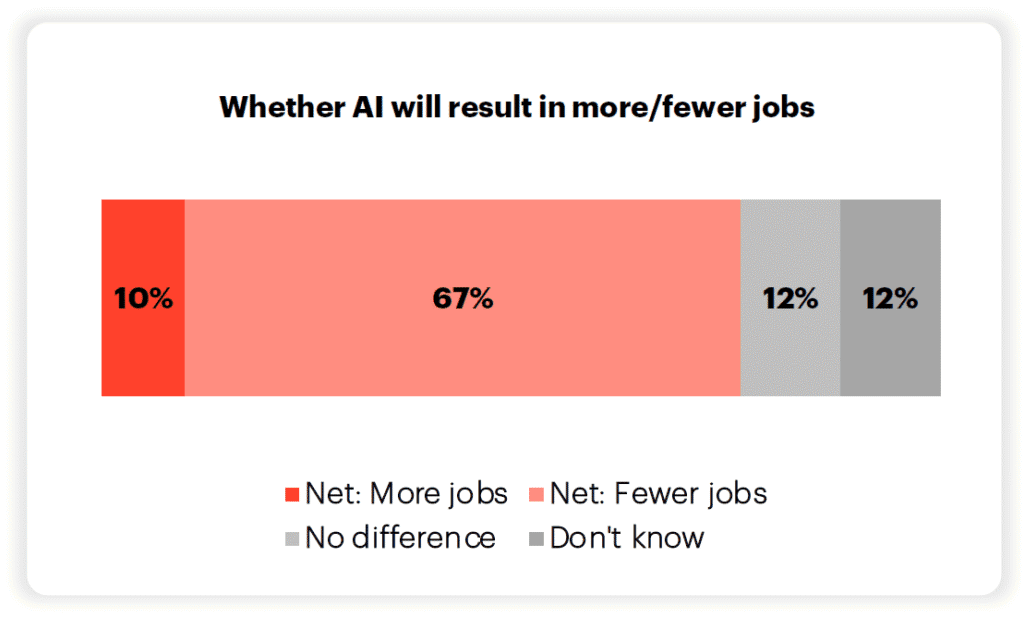
Artificial Intelligence (AI) is advancing at an unprecedented pace, and its impact on the labor market is already evident. According to a study by McKinsey, 45% of jobs in the United States could be automated by AI over the next 20 years, including jobs in transportation, customer service, and even professional sectors like finance and law [1]. While job loss due to automation has historically been restricted to routine and manual labor, AI’s increasing sophistication is now threatening jobs in professional sectors that were once thought to be immune to automation.
AI Surpassing Human Expertise in Every Field
AI has already surpassed human expertise in many fields, making it clear that automation will extend beyond low-skilled jobs. AI systems are now capable of performing highly specialized tasks such as diagnosing medical conditions, drafting legal documents, and predicting market trends with greater accuracy than human experts in some cases. As Elon Musk recently remarked, “AI is already greater than PhDs in all fields, and this is just the beginning. The speed of its advancement is far greater than anyone expected” [2]. This marks a dramatic shift, as AI systems are increasingly able to perform tasks that once required human judgment.
This rapid advance is also reflected in the speed at which AI systems are evolving. AI’s capabilities are no longer limited to simple pattern recognition or data sorting. They now include complex decision-making, creative tasks, and even emotional intelligence in areas like mental health therapy. These advancements underscore the fact that AI is not just a tool for automation but a transformative force that could reshape entire industries and displace millions of workers. These capabilities have already surpassed what many experts predicted, and the technology is progressing at a rapid pace.
“AI is already greater than PhDs in all fields, and this is just the beginning. The speed of its advancement is far greater than anyone expected”
Elon Musk
AI Growth: Outpacing Moore’s Law
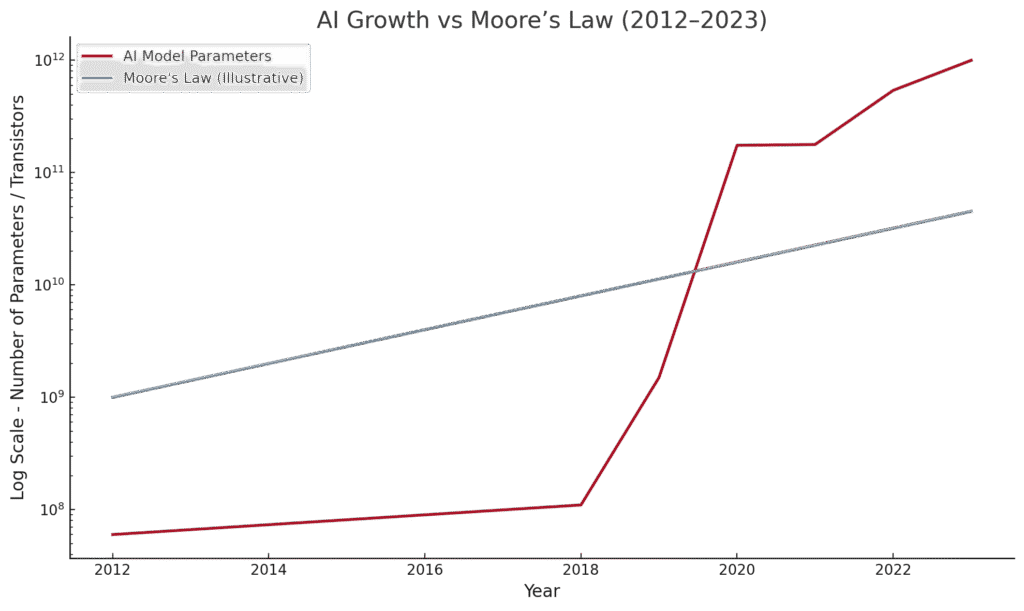
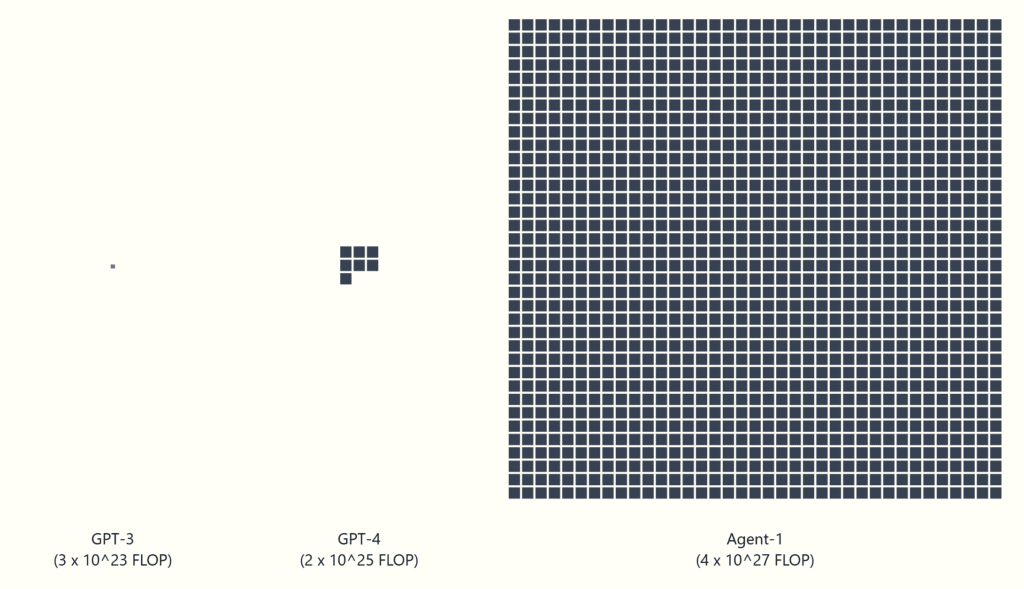
AI’s growth is outpacing Moore’s Law, which predicted that computing power would double approximately every two years. While Moore’s Law has been largely accurate in predicting advancements in semiconductor technology, AI’s computational power has been doubling every 3.4 months since 2012 [1]. This rapid acceleration is driven by breakthroughs in machine learning, deep learning, and AI-specific hardware, leading to unprecedented increases in AI’s ability to learn, adapt, and perform complex tasks.
As Elon Musk has pointed out, “The speed of AI’s development is far greater than anyone expected. This is not just a revolution in technology, but in society itself” [2]. Musk’s statement highlights the profound societal shifts that AI’s growth is causing. The exponential growth in AI’s capabilities means that the potential for job displacement is also accelerating, with industries across the board seeing increasing automation. This rapid growth, as Musk and others point out, is only set to continue, further stressing the urgency of preparing for a future where human labor may no longer be necessary in many sectors.
“The speed of AI’s development is far greater than anyone expected. This is not just a revolution in technology, but in society itself”
Elon Musk
Misaligned Predictions and the Reality of AI’s Advancement
Historically, AI experts have consistently underestimated the speed of AI’s progress. Predictions from just five years ago stated that AI would not surpass human capabilities in certain fields for at least another decade. However, AI is already outperforming professionals in legal analysis, medical diagnostics, and financial forecasting. Geoffrey Hinton, a leading figure in deep learning, recently stated, “AI is advancing much faster than I expected. The capabilities we are seeing today were considered impossible a few years ago” [3].
This rapid development highlights the unpredictable nature of AI’s growth. The pace of technological advancement far exceeds what was originally predicted, and the implications for the workforce are still being understood. As Sam Altman, CEO of OpenAI, pointed out, “In the next decade, AI will completely transform work—entire industries will be automated, and millions of jobs will disappear” [4].
“AI is advancing much faster than I expected. The capabilities we are seeing today were considered impossible a few years ago”
Geoffrey Hinton, AI Pioneer
The U.S. Economic Landscape: How Much Would UBI Cost?
The Financial Reality: U.S. Economic Stats
To understand the financial feasibility of UBI, we must first consider the size of the U.S. economy. As of 2024, the U.S. Gross Domestic Product (GDP) stands at approximately $29 trillion, and the federal government’s annual revenue is estimated at $4.9 trillion [5]. However, even with such a large economy, the existing fiscal structure is not equipped to support the cost of a nationwide UBI program without significant reforms. The potential cost of providing UBI to all citizens is significant, but there are also mechanisms through which this cost could be offset.
Estimating the Cost of UBI
To understand the potential cost of implementing UBI, let’s examine various payment scenarios:
- Poverty-Level UBI: To keep individuals above the U.S. poverty line, the $30,000 annual payment for a family of four would cost approximately $8.5 trillion per year if paid universally to all U.S. citizens.
- Middle-Class UBI: To bring individuals up to the middle-class income level (roughly $40,000 per person), the cost would rise to approximately $12 trillion annually.
The cost of funding such a program would depend on the total population receiving the benefit. With 330 million people in the U.S., these estimates reflect the financial burden on the government if UBI were to be implemented universally. However, funding such a program would require identifying new revenue sources, particularly given the U.S. government’s current budget constraints.
Job Loss Estimates: U.S. Job Displacement by AI
It’s important to consider the scale of job displacement AI is expected to cause. According to estimates from McKinsey, up to 45% of jobs in the U.S. could be automated over the next 20 years, with significant impacts on sectors such as transportation, customer service, and even professional services like healthcare and finance [1].
Integrating UBI with Existing Social Welfare Programs
One potential way to offset the costs of UBI is by merging it with existing social welfare programs, such as unemployment insurance, food assistance, and housing subsidies. These programs already provide a financial safety net to vulnerable populations. If we were to integrate UBI with these existing programs, the total cost could be reduced.
For example, in the U.S., social welfare programs account for approximately $2.5 trillion annually [5]. If we were to replace these programs with a streamlined UBI system, the cost of UBI could be reduced significantly, but it would still require additional revenue sources to cover the gap. Merging existing welfare programs with UBI could help offset costs and ensure that people are supported without increasing the total burden on the government.
So with back of the napkin calculations of $8.5-12 Trillion in costs offset by $2.5 trillion in existing programs $6-9.5 trillion funding gap, or 20-33% of GDP.
Macro Backdrop
Unfortunately, the timing for UBI may not be great when looking at the US Economic condition. Fresh off major economic shocks of COVID, and the 2008 Financial Crisis, the US National Debt has not been as high since World War II standing at a record $36.2 trillion. Top that off with annual trillion dollar budget deficits (the US hasn’t had a budget surplus since 2001) and you don’t get a rosy picture for the US taking on major ongoing entitlement programs, with UBI making Medicare and Social Security look like minor expenses.
If you take into account the backdrop of likely rising inflation costs due to Tariffs, rising Global Competition, a Cold War with China, escalating Military tensions in the world, the dropping demand for the US Dollar, and looming costs of Climate Change – you get a daunting challenge just maintaining the status quo, much less what would likely be the largest budget item in US history.
The Importance of UBI in a Future with Diminished Employment Opportunities
As AI continues to replace human labor across various sectors, the risk of widespread unemployment grows. UBI is increasingly being seen as a necessary solution to address the economic consequences of widespread job displacement. If AI is able to replace up to 45% of jobs in the U.S., as predicted by McKinsey, UBI may become a key tool in ensuring that displaced workers have the financial security to thrive in a rapidly changing economy.
UBI offers a way to cushion the financial blow for individuals who lose their jobs due to AI, ensuring that they maintain purchasing power and can continue to participate in the economy. Moreover, UBI could empower individuals to pursue education, entrepreneurship, or other forms of meaningful work without the hardship of financial insecurity.
A Neutral Perspective: Adapting to an Evolving Economic and Technological Landscape
While UBI is in general a very Social Program, in this context UBI is a neutral solution to the challenges posed by AI and automation, providing a financial safety net without advocating for any specific economic ideology. As the economy rapidly changes, UBI may become one of the few available mechanisms to ensure that all individuals have access to the resources necessary for a dignified life.
AI Displacement: A New Challenge
Unlike past technological revolutions, such as the Industrial Revolution or the rise of the internet, where workers were able to transition to new industries, AI represents a unique challenge. The rapid growth of AI means that entire job categories may be permanently eliminated, and it is unclear whether the job market will be able to absorb the displaced workers. This represents a new dynamic in the relationship between technology and employment, one that requires adaptive solutions like UBI.
“In the next decade, technology is going to radically disrupt jobs. We need to be ready for that transformation, and UBI is a step in the right direction” [9]
Andrew Yang
The Urgency: Preparing for the Rapid Rise of AI
The pace of AI development is accelerating, and its impact on the labor market is becoming more immediate. Experts predict that AI will continue to replace human labor at a faster rate than many anticipate. In fact, Sam Altman, CEO of OpenAI, recently remarked that AI will “completely transform work” within the next decade [4]. Industry experts, including those from PwC and McKinsey, have projected that by 2027, AI could replace as many as 50% of jobs in some sectors. Many experts have gone so far as to say that the AI revolution will be bigger than the Industrial Revolution in terms of its societal and economic impact.
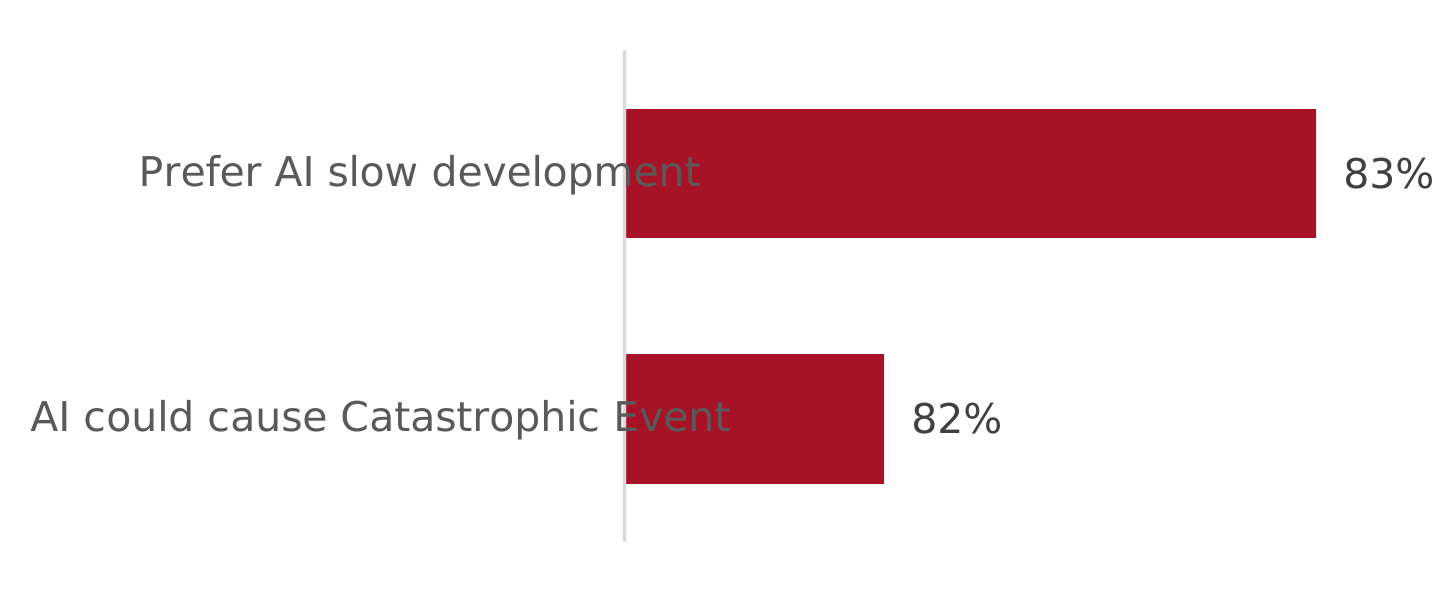
Polling data supports the concern that AI is advancing too quickly. 82% of respondents in a Artificial Intelligence Policy Institute survey expressed concern about the rapid development of AI and its potential consequences for jobs and society [11]. The challenge now is to ensure that we can prepare for these disruptions in time, and UBI may be one of the few mechanisms to manage this shift effectively.
AI 2027 Report highlights the projection that by 2027, AI will not only replace millions of jobs but will fundamentally reshape the global economy, placing more pressure on current social welfare systems to keep up with these transformations (10).
Conclusion: The Need for Proactive Solutions
The rapid development of AI presents both opportunities and risks. While AI promises to increase productivity and innovation, it also threatens to displace a large portion of the workforce, creating economic instability. Universal Basic Income could provide a solution to the challenges posed by AI-driven job displacement, ensuring that individuals have the financial resources to live with dignity, regardless of employment status.
As AI continues to accelerate, it is crucial that we begin planning for the future now. UBI may not be the perfect solution, but it could be one of the few mechanisms capable of ensuring economic stability and social cohesion in an increasingly automated world.
Disclaimer
Tax Project Institute does not take a stand on UBI as a policy, and is not advocating for it’s implementation. This article reflects our interest in calling out the evolving landscape that maybe presented in the coming years of what AI could bring about in terms of societal change, and how America may deal with such a large and rapid change.
References
- Brynjolfsson, E., & McAfee, A. (2018). The Second Machine Age: Work, Progress, and Prosperity in a Time of Brilliant Technologies. W. W. Norton & Company.
- Musk, E. (2024). Elon Musk on AI’s Capabilities and Risks. The New York Times. https://www.nytimes.com/2024/07/11/elon-musk-ai-experts.html
- Cryptoslate. (2024). AI Growth Outpaces Moore’s Law. https://cryptoslate.com/ai-growth-outpaces-moores-law-soaring-beyond-traditional-limits/?utm_source=chatgpt.com
- MIT Technology Review. (2023). AI Surpassing Human Expertise. https://www.technologyreview.com/2023/08/06/20251022/ai-surpassing-human-expertise-predictions
- Congressional Budget Office. (2024). The U.S. Federal Budget and Economic Outlook. https://www.cbo.gov/publication/57632
- OpenAI. (2024). AI’s Future Impact on Work. OpenAI Blog. https://openai.com/press-releases
- YouGov (2024) https://business.yougov.com/content/49938-us-artificial-intelligence-report-2024.
- PwC. (2020). The Impact of Artificial Intelligence on the Global Economy. PwC Report. https://www.pwc.com/gx/en/issues/artificial-intelligence/ai-predictions.html
- Yang, A. (2020). Andrew Yang on UBI and AI. https://www.yang2020.com/
- AI 2027. (2024). AI and the Future of Work: A 2027 Perspective. https://ai-2027.com/
- Artificial Intelligence Policy Institute (AIPI) https://theaipi.org/
Universal Basic Income: Preparing for the AI Future?

A Sovereign Wealth Fund (SWF) can be compared to a nation’s investment or retirement account, designed to accumulate and invest surplus funds from revenues like natural resources or budget surpluses. Much like personal savings and retirement accounts, the idea behind an SWF is to set aside money today, invest it in global markets, and use the returns for future financial stability. SWFs allow countries to manage long-term national wealth, using the fund’s earnings to pay for public services and provide financial security for future generations.
In a well-managed SWF, only a small portion of the total assets are withdrawn each year—usually around 3%, as seen in Norway. The rest of the fund continues to grow, invested in a diversified portfolio that includes stocks, bonds, real estate, and other assets. This sustainable withdrawal strategy ensures that the principal amount remains intact and continues to yield returns over time, making it an effective tool for securing long-term financial stability.
Norway’s Government Pension Fund Global: The Model SWF
One of the most successful examples of an SWF is Norway’s Government Pension Fund Global (GPFG), established in 1996. The GPFG, often referred to as Norway’s “Oil Fund,” was created to manage the country’s revenues from oil and gas exports. Instead of using these revenues to fund immediate government spending, Norway chose to invest them in a globally diversified portfolio, now valued at over $1.4 trillion, making it the largest sovereign wealth fund in the world.
The 3% Rule: A Sustainable Withdrawal Approach
The Norwegian GPFG operates under a 3% withdrawal rule, which is designed to keep the fund sustainable. The Norwegian government withdraws 3% of the fund’s value annually, which corresponds to the average expected return on investment. The withdrawn portion goes into Norway’s general budget to fund public services, while the rest of the fund continues to grow through reinvestment. This approach ensures that Norway’s future generations will benefit from the nation’s oil wealth, even when the oil runs out.
Because of this strategy, the GPFG covers a significant portion of the country’s public services, including healthcare, education, and infrastructure. Projections indicate that, at its current growth rate, the fund could potentially pay for **all** of Norway’s public services by 2050, freeing the government from the need to raise taxes or accumulate debt to fund social programs.
Why Doesn’t the United States Have a Sovereign Wealth Fund?
Despite being the wealthiest country in the world, the U.S. does not have a national sovereign wealth fund. The absence of such a fund can be attributed to a combination of factors, including the U.S. government’s fiscal policy, its approach to natural resource management, and its reliance on private capital markets.
1. Federal Deficits and Debt: For decades, the U.S. has run substantial budget deficits, making it difficult to generate surplus funds to invest. Instead of saving excess revenues, the U.S. government has financed its spending through borrowing, which limits the opportunity to build a reserve for future investment.
2. Private Sector Focus: The U.S. economy relies heavily on private markets, where institutional investors, pension funds, and private entities manage large pools of capital. The government tends to allow the private sector to take the lead in investments, while focusing on more immediate economic goals such as infrastructure development and job creation.
3. Natural Resource Management: Unlike Norway, which has a national approach to managing its oil wealth, the U.S. does not centralize revenues from its natural resources at the federal level. States like Alaska manage their own smaller sovereign wealth funds, such as the Alaska Permanent Fund, but there is no national equivalent that aggregates resources from across the country.
4. Political Priorities: Establishing a sovereign wealth fund requires a long-term approach to fiscal policy, and U.S. political priorities tend to favor short-term economic objectives. The idea of setting aside significant funds for future generations, at the expense of immediate spending or tax cuts, may not align with the current U.S. political climate.
Countries with Sovereign Wealth Funds
While the U.S. does not have an SWF, many other nations have established such funds to manage their wealth and invest in global markets. These funds help diversify the economy, generate returns for future use, and stabilize government finances.
– China: The China Investment Corporation (CIC), established in 2007, manages over $1 trillion in assets. It is funded by the country’s vast foreign exchange reserves and invests globally in a variety of sectors.
– United Arab Emirates: The Abu Dhabi Investment Authority (ADIA) is one of the largest SWFs, managing over $790 billion. It was created to manage the UAE’s oil wealth and now invests in a diverse array of industries and markets.
– Saudi Arabia: The Public Investment Fund (PIF) is a central part of Saudi Arabia’s Vision 2030, which seeks to diversify the economy away from oil. The PIF manages over $600 billion and focuses on technology, infrastructure, and other non-oil industries.
– Singapore: GIC Private Limited and Temasek Holdings are Singapore’s two major sovereign wealth funds, managing substantial portions of the country’s reserves. Both funds play an active role in the global financial markets and support Singapore’s long-term financial security.
The Benefits of a U.S. Sovereign Wealth Fund
Establishing a U.S. sovereign wealth fund would come with significant long-term benefits, many of which mirror the successes of countries like Norway. Below are some of the key advantages:
Funding Public Services Through Investments
One of the most compelling reasons to establish a U.S. SWF is the potential to fund public services through investment returns, rather than taxes. If the U.S. government could implement a sustainable withdrawal strategy similar to Norway’s 3% rule, it would be possible to reduce or even eliminate the need for high taxes to fund social programs.
For example, the returns from the SWF could cover the costs of Medicare, Social Security, public education, and infrastructure development. Rather than relying on taxpayers to finance these services, the government could draw from the fund’s earnings, allowing Americans to keep more of their income.
This system would create a virtuous cycle, as the SWF would grow over time, and its returns would increase. Over the long term, the fund could cover a larger portion of public services, reducing the tax burden on citizens and businesses while ensuring that essential services are well-funded.
Economic Stability and Growth
A U.S. SWF could also act as a stabilizing force during economic downturns. The fund could be used to support stimulus measures during recessions, providing much-needed capital for job creation and infrastructure projects when private investment dries up. By drawing on the SWF’s resources, the government could maintain its spending levels without resorting to deficit financing or raising taxes.
Furthermore, a U.S. SWF could play a pivotal role in supporting long-term economic growth. By investing in critical sectors such as technology, renewable energy, and healthcare, the SWF would help foster innovation, create jobs, and improve productivity. These investments would have a multiplier effect, attracting additional private capital and spurring economic activity.
The Role of Capital Markets
A large U.S. SWF would be a major player in global capital markets, providing liquidity and influencing corporate governance. As the SWF invests in U.S. and international companies, it could encourage better corporate governance practices, such as environmental sustainability and responsible leadership, which would benefit the broader economy.
The SWF could also be used strategically to invest in domestic industries that require capital but may not receive sufficient private investment. By supporting emerging industries, the SWF would help position the U.S. as a global leader in innovation, further enhancing the country’s competitive edge.
Public Services Funded by Investment, Not Taxes
One of the most exciting aspects of a U.S. SWF is the idea that public services could be funded by investment returns rather than taxes. This approach would fundamentally change how the U.S. government finances its operations, potentially reducing the tax burden on citizens and making public services more sustainable in the long term.
Imagine a future where Social Security, Medicare, and public education are all funded through the earnings of a massive SWF. This would free up personal and business income, stimulating economic growth and allowing individuals to keep more of their earnings. Over time, a system like this could reduce income inequality and provide a more equitable distribution of wealth.
Moreover, by taking a long-term approach to funding public services, the U.S. would be less vulnerable to political and economic volatility. A well-managed SWF would provide a steady stream of revenue that could be used to support public services even during periods of economic downturn.
Conclusion
Sovereign Wealth Funds offer an efficient and sustainable way to manage national wealth, ensuring long-term financial stability and funding public services. Norway’s GPFG is a prime example of how a well-managed SWF can contribute to a nation’s prosperity. While the U.S. does not currently have an SWF, the potential benefits of establishing one are immense.
By investing surplus revenues into a diversified portfolio, a U.S. SWF could reduce the need for taxes, stimulate economic growth, and fund essential services. In a world where wealth inequality is a growing concern, a U.S. SWF could help create a more equitable society by allowing the government to invest in the future while easing the financial burden on its citizens. Establishing such a fund could reshape the fiscal future of the United States, enrich the lives of All Americans, and ensure that future generations enjoy the benefits of today’s investments.
References
- Norway’s Government Pension Fund Global (GPFG)
https://www.nbim.no/en/the-fund/ - China Investment Corporation (CIC)
https://www.china-inv.cn/en/ - Abu Dhabi Investment Authority (ADIA)
https://www.adia.ae/ - Public Investment Fund (PIF) – Saudi Arabia
https://www.pif.gov.sa/ - GIC Private Limited – Singapore
https://www.gic.com.sg/ - Temasek Holdings – Singapore
https://www.temasek.com.sg/en/index - Alaska Permanent Fund Corporation
https://apfc.org/ - International Forum of Sovereign Wealth Funds (IFSWF)
https://www.ifswf.org/
Understanding Sovereign Wealth Funds: A National Investment Account
We are a non-profit

Tax Project Institute is a fiscally sponsored project of MarinLink, a California non-profit corporation exempt from federal tax under section 501(c)(3) of the Internal Revenue Service #20-0879422.

