Social Security has long been considered the “third rail” of American politics—untouchable and too risky to reform. After all, millions of Americans have worked a lifetime counting on certain commitments. Changing it after decades of hard work is a difficult political maneuver and not typically well tolerated. But as the program’s financial sustainability erodes, and younger generations increasingly question whether they’ll ever see a return on their payroll taxes (60% between 18-49 don’t believe [23]), calls for partial or full privatization are resurfacing. While once dismissed as politically radioactive, the idea of allowing individuals to invest part of their payroll taxes into private accounts is gaining traction—not only among free-market economists but also younger Americans facing record debt, housing costs, and generational inequity.
This article examines the Social Security program’s origin and challenges, the structure and results of its pay-as-you-go model, the growing unfunded liabilities, and the comparative outcomes of private investment alternatives. We explore real-world comparisons with other OECD Countries systems, provide Treasury Secretary Scott Bessent’s position, and quantify the impact of Social Security on the federal budget and intergenerational equity. The article looks at the Pros and Cons of each position, and provides a comparison.
Social Security Origins: A New Deal Legacy
Social Security was established in 1935 under President Franklin D. Roosevelt during the Great Depression. It was designed as a social insurance program to provide financial support to retirees, widows, and the disabled. The system relies on current workers’ payroll taxes to pay benefits to current retirees, forming a “pay-as-you-go” structure (PAYGO, PAYG) rather than a traditional investment-based pension. The PAYGO system relies on the Government to pay these as budget expenses from tax revenue versus a Private Retirement Account that accumulates value over time and pays for itself.
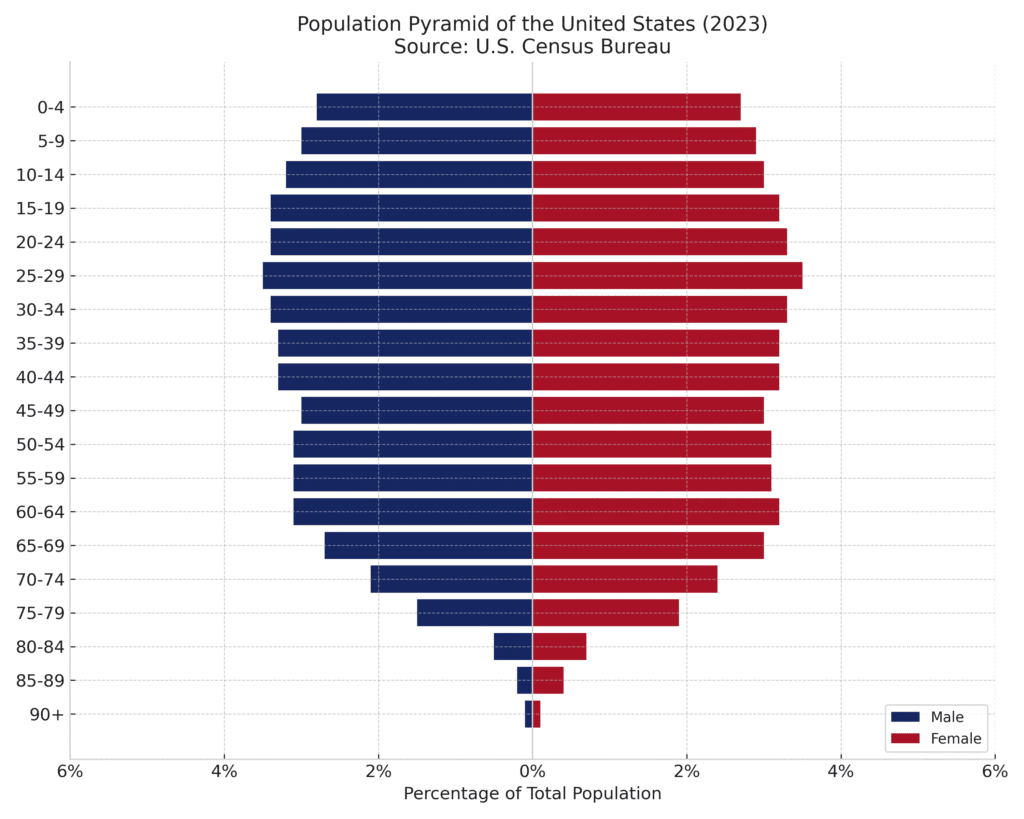
However, the economics of the original program are starting to have some structural challenges that are not easily overcome. Originally, Social Security had 42 workers supporting each retiree. Today, that ratio is closer to 2.7 and falling, a demographic shift that has made the system increasingly unstable [1], especially as the Population pyramid shifts (See Figure 1).
The Math Problem: Pay-As-You-Go and Unfunded Liabilities
Unlike private retirement accounts that accumulate assets over time, Social Security operates as a transfer program. The payroll taxes paid today are not saved or invested for the contributor’s future—they are immediately redistributed to current beneficiaries, this is the Pay-as-you-Go system (often referred to as PAYGO or PAYG).
The key problem with this structure is demographic: as birth rates decline and life expectancy increases, fewer workers are supporting more retirees. This has produced a growing imbalance. According to the Social Security Trustees’ 2024 report, the program faces an unfunded liability of $22.6 trillion over the next 75 years [2].
Unless major changes occur—either through tax increases, benefit reductions, or structural reform—Social Security is projected to exhaust its trust fund by 2033. At that point, benefits would be automatically reduced by an estimated 23% across the board [3]. This would obviously have major, and negative consequences on many Americans that depend on these payments, and likely be seen as a betrayal on commitments made to them for a lifetime of work.
Demographics not on Social Securities Side
As Lifespans increase the U.S. population is getting older and retired citizens continue to increase as a percentage of the population intensifying Social Security’s funding crisis. As of 2024, individuals under 18 comprise about 21.5%, ages 18–44 about 36%, ages 45–64 about 24.6%, and those 65+ around 18% of the total population. [12]
That shrinking working-age cohort (15–64) relative to retirees creates a high dependency ratio. With fewer contributors supporting more beneficiaries, the strain on the system continues to rise. Since Social Security is a Pay as you Go system and not based on investments that have appreciated over time, if you have an imbalance of working age Payers versus older retired beneficiaries the system begins to fall apart economically without restructuring. This is a Worldwide phenomenon as life expectancies continue to increase and countries that have adopted a Pay as you Go system are exposed to demographic shifts that create challenging economics. In general, for these systems to work you must have a wider middle supporting a tapering, and smaller group in retirement.
Figure 1 Source: US Census
Investment Alternative?
So, economically, how does a Privatized system work versus our current Social Security System? To understand the opportunity cost of the current system, consider by comparison a median-income worker contributing the same amount to a private investment account instead of Social Security. The Social Security tax rate is currently 12.4%, split evenly between employee and employer. For a median income of $60,000 (in 2024), that’s $7,440 annually.
Assumptions:
Starting at age 22, retiring at 67
$60,000 annual wage, growing at 1.5% real wage growth
Contributions: 12.4% of wages invested in an S&P 500 index fund
Historical S&P 500 average real return: 7% [4]
Metric
Social Security
Private Investment
Total Contributions (nominal)
$500,000+
$500,000+
Monthly Retirement Income (estimated)
$1,800–$2,000
$6,000–$8,000
Total Lifetime Benefit
~$500,000–$600,000
~$1.5M–$2.5M+
Table 1 Source: Tax Project Estimate Example
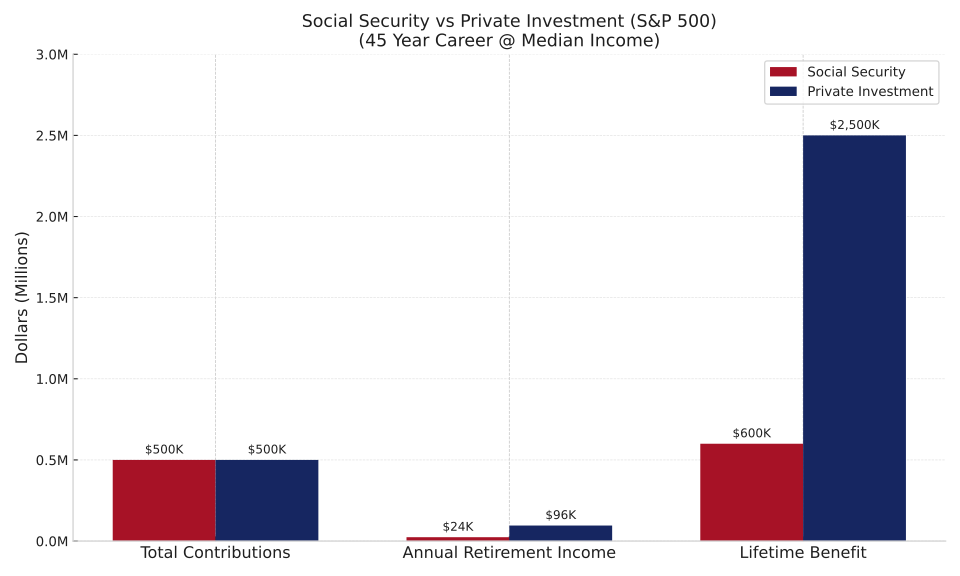
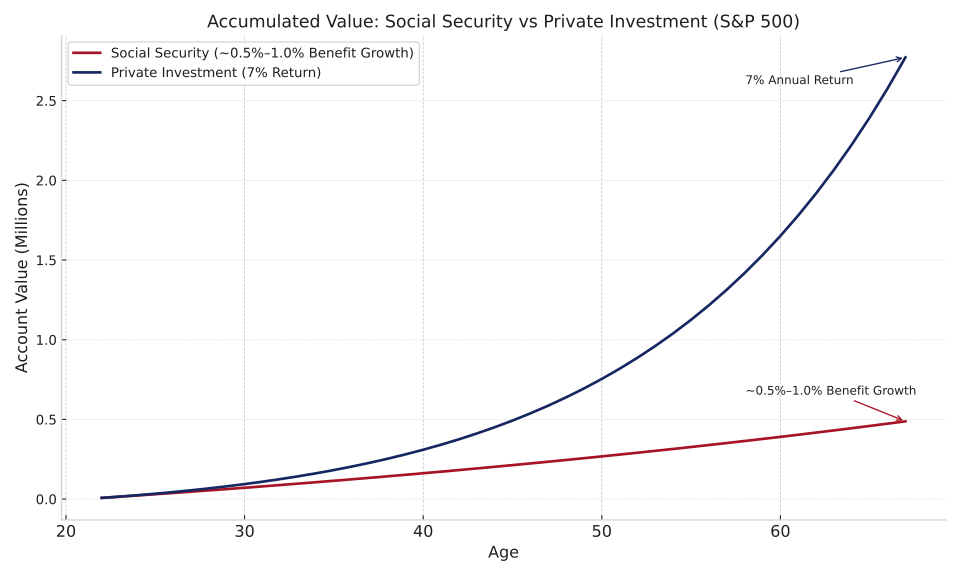
It should be noted, that this is a simple example is using mid range income citizens, and does not model the upper and lower incomes which can have significantly different outcomes. It should also be noted that the Private account is exposed to much higher market risks, than a Government backed account, and there are no guarantees of Market performance, or loss of principle. However, as a base example it is clear that the Private solution substantially outperforms the Social Security program, providing up to 4 times the income (See Figure 2, 3). This obviously could be life changing for many individuals, from barely managing to get by to living a more comfortable life in their retirement.
Comparing Private Investment vs Social Security
Figure 2 Source: Tax Project Example EstimateFigure 3 Source: Tax Project Example Estimate
The compound returns of a private investment account (indexed to the S&P 500) dramatically outpaces the flat benefit structure of Social Security. Even adjusted for inflation and risk, the delta is significant.
This was only an example, your exact numbers will differ based on your income and contributions. If you wish to calculate on your own you may try these resources:
This delta in outcomes, as shown in Figures 2 and 3, exists for a reason. Social Security was not designed as an investment vehicle – it’s a redistributive social insurance scheme. High-income earners subsidize lower-income earners. Healthy workers subsidize disabled ones. Individuals with longer life expectancies (often wealthier, healthier demographics) benefit more than those who die earlier.
This redistribution is intentional. Roughly 20% of Social Security benefits go to survivors and disabled individuals. The rest is retirement support—but even this is progressive: a low-wage worker receives a higher replacement rate (often 90% of their income) than a higher-wage worker (25–40%) [5]. Social Security is not a retirement plan per se, but a tax to create a Social Safety net to distribute money to those in greater need.
Global Comparison of Retirement Benefit Plans
America is not alone in providing Retirement Benefit plans, here is a comparison of the Top 25 OECD countries by GDP Retirement Benefit programs.
Country
Model (Gov’t System)
Mandated Supplemental
Funding Method
Solvency Issues
Return Rate
United States
Public
None (voluntary 401(k) excluded)
PAYG
High
Low
Japan
Public
National Pension + GPIF reserve
PAYG + Asset-Backed
Medium
Medium
Germany
Public
Statutory + Emerging Asset Fund
PAYG + Partial Reserves
Medium
Low
United Kingdom
Public
Auto-Enrolled Private Pensions
PAYG + Mandatory DC
Low
Medium
France
Public
Mandatory Supplementary
PAYG
Medium
Low
Canada
Public
CPP (Asset-Backed, Mandatory)
Asset-Backed
Low
Medium
Italy
Public
None (Voluntary Private Optional)
PAYG
High
Low
South Korea
Public
Basic Pension
PAYG
High
Low
Spain
Public
None (Voluntary Only)
PAYG
High
Low
Australia
Hybrid
Superannuation (Mandatory DC)
Asset-Backed
Low
High
Netherlands
Hybrid
Mandatory Occupational DC
Asset-Backed
Low
High
Mexico
Public
Mandatory AFORE (DC)
Asset-Backed
Medium
Medium
Switzerland
Hybrid
Mandatory Pillar 2 DC
Asset-Backed
Low
Medium
Sweden
Hybrid
Mandatory Premium Pension DC
PAYG + Asset-Backed
Low
High
Poland
Public
Employer PPK (Mandatory Opt-Out)
PAYG + Partial DC
Medium
Low
Belgium
Public
None (Voluntary Private Optional)
PAYG
Medium
Low
Austria
Public
None (Voluntary Private Optional)
PAYG
Medium
Low
Norway
Public
Oil Fund Reserves (Public Use)
PAYG + Sovereign Fund
Low
High
Ireland
Public
None (Auto-enrollment pending)
PAYG
Medium
Low
Denmark
Hybrid
ATP + Occupational Mandatory DC
Asset-Backed
Low
High
Finland
Hybrid
Mandatory Public + Reserve
PAYG + Asset-Backed
Low
Medium
Portugal
Public
None
PAYG
High
Low
Czech Republic
Public
None (Voluntary Private)
PAYG
Medium
Low
Greece
Public
None
PAYG
High
Low
Hungary
Public
None
PAYG
High
Low
Table 2 Source: IMF, Worldbank, SSA, OECD, Mercer CFA Institute
Note that all the Top OECD countries, unlike countries like Chile which are fully privatized, have some sort of either a Public or Hybrid (Public/Private) Retirement Benefit plan. The countries with LOW solvency risk all have some type of Asset Backed solution where investments are made that grow over time, except for Norway which essentially has the same with their National Sovereign Wealth Fund, the largest in the World, contributing instead of individuals. It should also be noted, some what paradoxically, that ALL of the countries that pay High rates of return to their Beneficiaries (highlighted in green on Table 2) ALSO all have LOW Solvency issues, the best of both worlds. Lower financial risks, higher returns using some type of Asset Backed system. In contrast, note the many countries with Public plans with PAYG models that have high HIGH solvency risks, and LOW payouts. The worst of all worlds, and unfortunately that is where America stands today.
Budgetary Impact: Growing Expense, No Asset
From a Federal budget perspective, Social Security is the single largest budget item with $1.4 trillion in outlays in FY 2024, accounting for roughly 20% of total federal spending [8].
Critically, Social Security is not a government asset. It does not generate returns or grow the nation’s wealth—it is a liability that increases over time, as benefit obligations rise with demographics. Unlike a sovereign wealth fund or private asset backed investments, Social Security has no capital base, it is not invested and does not grow in value. It is an ever-growing expense that is a liability for our Government, not a revenue-generating investment.
This funding gap, creates a solvency issue for the fund, and projections already anticipate reduced payouts by 2033 [3]. This will require either new sources of revenue (taxes), reduced payouts, or higher eligibility requirements (higher retirement ages). For many people these are unacceptable outcomes.
Privatization: Arguments Against
Social Security has become a critical component of American lives, and the thought of change is scary. It is meant as a Social Safety Net and anything that minimizes that security, and increases risk is viewed rightly with concern. Critics of privatizing Social Security raise concerns of risk, fairness, and protecting the most vulnerable.
1. Loss of the Redistributive Function
Social Security is not just a retirement program—it’s a progressive, redistributive system that transfers income across generations and income levels.
From higher earners to lower earners (due to progressive benefit formulas)
From healthy individuals to those with disabilities or survivors
Across gender and racial wealth gaps
Privatization, by design, makes benefits directly proportional to contributions and investment returns, which eliminates these transfers. This could weaken the social contract, especially for groups who rely most heavily on the system—such as lower-income workers, women, minorities, and the disabled.
2. Erosion of the Universal Safety Net
The current system provides guaranteed income, indexed to inflation, for life. This protects against:
Longevity risk (outliving one’s assets)
Market risk (mismanagement of assets or retiring into a downturn)
Cognitive decline (mismanaging funds in old age)
Disability (declining or limited physical abilities shorten working career)
Wealth Gap (offset lower income participants with relatively higher benefits than higher income groups)
Security (Income for the life of the beneficiary guaranteed)
Spousal (Income for dependent widowed spouses)
Depending on the implementation, Private accounts would shift this burden to individuals, many of whom may lack financial literacy or stability to manage these risks. Even with lifecycle funds and default allocations, the system would no longer guarantee baseline income, exposing millions to potential poverty in old age.
3. Market Volatility and Distributional Inequality
While long-run market returns are historically strong, retirement outcomes under private accounts would vary significantly based on:
Career timing (Market returns vary considerably based on time period e.g., retiring in 2009 vs. 2021)
Investment choices and fees (Loss of principle, poor investment decisions can greatly effect outcomes)
Economic cycles and policy shocks (Macro economic cycles and events like Covid or Wars can greatly impact returns)
Markets are inherently riskier, and Privatization would transfer this risk from the government to the participant. This also introduces intra-generational disparities – two workers with identical careers and investments could end up with vastly different outcomes. Such disparities undermine the risk-pooling foundation of Social Security.
4. Administrative Complexity and Cost
Privatized systems, especially those with choice, may entail higher a variety of extra costs that would be born by the participant.
While centralized custodial platforms managed by the Government can mitigate this, this can all add costs. Currently, the U.S. lacks the institutional infrastructure to support this function.
Privatization: Arguments For
Proponents of private investment accounts argue that the objections to privatization, while valid, are either addressable through design or outweighed by the substantial gains in individual and National financial outcomes. That privatization can increase the material wealth of the country, and put the Nation on a better fiscal course, and that it matches our countries philosophical principles of liberty and ownership.
1. Higher Long-Term Returns and Quality of Life
S&P 500 index funds have returned 6–7% real annually historically, far outpacing the 0–2% implicit return Social Security provides many younger or higher-income workers.
This delta compounds over decades. A median-income worker could retire with 3x or better lifetime income under private investment—even after inflation dramatically improving the quality of life for some populations.
These higher balances could allow for:
Earlier retirement (retirement is about wealth, not age)
Higher consumption in retirement (being able to afford more of the things that add to a quality life)
Improved generational quality of life (being able to pass wealth between generations instead of take it)
2. Intergenerational Wealth Transfer and Ownership
Social Security benefits terminate at death. There is no residual asset to pass on.
Private accounts create inheritable wealth—allowing families, particularly in lower-wealth communities, to build intergenerational assets and break the cycle of dependency.
3. Promotes Individual Liberty and Economic Agency
Privatization returns control to individuals, allowing them to decide how their retirement assets are invested.
This aligns with broader American values of personal choice, property rights, and economic freedom.
4. Transforms a Fiscal Liability into a National Asset
Social Security is currently a growing budgetary liability, with unfunded liabilities exceeding $22 trillion [21].
Private accounts would instead become national household assets, increasing capital formation, savings rates, and investment capacity -similar to the effect of Australia’s superannuation system, which now manages over $2.5 trillion in assets [22].
5. Mitigated Market Risk with Sound Design
Critics overstate market risk in multi-decade investment horizons. Over any 40-year period in U.S. history, a diversified equity portfolio has never yielded a negative real return and has significantly outperformed Social Security funding.
Risks can be reduced or neutralized via:
Lifecycle/default funds
Mandatory annuitization
Capital buffers
Minimum return guarantees (e.g., 2% real floor)
Subsidization of at-risk groups via general revenues or redistribution of Capital Gains from Privatization
6. Fixes System Insolvency Without Raising Taxes
Privatization bypasses the demographic death spiral of the current pay-as-you-go model.
Instead of higher payroll taxes or benefit cuts, reformers propose transitioning to funded accounts over time, optionally grandfathering current retirees.
Reform shifts the structure from intergenerational transfer to self-funded savings, improving long-term solvency and fairness.
7. Localized Equity Support Through Public Custody Models
Inspired by Sweden’s PPM system, custodial platforms can be public, ensuring fee transparency, fraud protection, and mandated passive allocations.
In the U.S., excess capital gains or fund growth could be redirected toward targeted supports (e.g., low-income workers, disabled populations, disaster relief) without sacrificing long-term solvency.
Comparing Private Investments versus Social Security
Item
Social Security
Private Account
Risk
Guaranteed by Full Faith of US Government and the unlimited ability to Tax.
Exposed to Market, can gain and lose principle, much more volatile.
Guarantees
Fully Guaranteed, but dependent on Government Formula which can change.
No guarantees, based on Market returns. Can lose principle.
Performance
Not invested, based on Social Security formula to contribute. Very Low effective equivalent return.
Equity Market based returns outpace other investments. Much higher historical returns for long term investments.
Equity
You own nothing, at death you can not transfer assets.
Assets are owned by individual, can be transferred to beneficiaries.
Asset or Liability
Liability – Social Security is an expense that each year must be paid from current Taxes to Beneficiaries.
Asset – The Government would have no liability, and the value would become an Asset to the Beneficiary.
Unfunded Liability
As a Liability, shortfalls in revenues versus future payouts become unfunded liabilities
No Liabilities
Generational Wealth
Not an asset, so wealth can not be passed on.
Assets can be passed on, increasing Generational Wealth.
Social Safety Net
Provides Lower Income, and Disabled Citizens a Social Safety Net to provide some income, and potentially higher than their contributions.
Does not natively provide Social Safety Net. May help some at risk with higher incomes, but does not address Low Income or Disability. Programs could be setup to address.
Administration and Regulation
Centrally administered by Government, highly Regulated by Congress
To be determined, but likely a combination of Government regulation and administration in conjunction with Private Enterprises to administer program and set guidelines on acceptable plans to reduce risks.
Fraud & Abuse
Overall low, but significant amounts. From 2015-2022 improper payments of $72 billion. [13]
To be determined, but investment fraud, and abuse happen in our current financial system and this will be no different.
Retirement Age
As a Pay As You Go system, Social Security requires more workers to pay for beneficiaries, putting pressure to keep Retirement ages high especially as the retirees makeup larger portions of population.
Likely a Privatized system would have requirements. However, retirement is NOT about age, it is a about wealth. If you have achieved your asset growth, you could retire early, potentially much earlier than Social Security mandated dates.
Fixed Income
Social Security Provides a Fixed Income guarantee for the lifetime of the beneficiary. This means it can’t go down, but also that it doesn’t go up (there are periodic Cost of Living adjustments, but for the most part it is static).
Private accounts do not have Fixed Income guarantees. If you live longer, or have lost principle you are at higher risk. However, you can also have your principle and assets continue to grow, and have much higher assets and income to draw from.
Did the Trump Administration let the Cat out of the Bag?
While not a formal policy announcement from the Trump Administration, in remarks this past week, current US Treasury Secretary Scott Bessent discussed the idea of private retirement accounts as a solution to long-term fiscal imbalances.
“We’ve allowed Social Security to drift too far from its roots. The average American would be far better off with a real investment account – especially if they own it, can pass it on, and see it grow.” [10]
Treasury Secretary Bessent, a former Chief Investment Officer of Soros Fund Management, noted:
“Social Security could be partially privatized by giving younger workers the option to invest a portion of their payroll tax into low-cost index funds. Over 40 years, the compounding returns would generate far more wealth than the current system, which is essentially insolvent.” [6]
Bessent views private accounts not only as more financially sustainable but also as a path toward wealth-building for younger and disadvantaged Americans who are currently locked into our current Social Security System that is a low-yield, Pay-as-you-go system.
“In a way, it is a back door for privatizing Social Security,” “If, all of a sudden, these accounts grow and you have in the hundreds of thousands of dollars for your retirement, that’s a game changer, too.” [11]
While this topic has been passed around in policy discussions for a long time, privatization has always brought out fears, and opposition.
Conclusion: The Cat May Already Be Out of the Bag
Social Security reform is no longer an ideological debate—it is an actuarial necessity to keep the system solvent. The system’s financial path is unsustainable, and young Americans increasingly question whether they are paying into a program that will exist when they retire.
The Tax Project does not weigh into the debate, just presents facts and data, and hopes that Smarter more informed Citizens help make their choices. To some, the choice maybe obvious, for others the fear and risks of changes outweigh any gains. All have valid concerns and points. What is clear, is that the US Social Security program has structural challenges that won’t be resolved without some types of reform, and that delaying or ignoring the problem has not helped the challenge. There are working models out there, and we believe that Americans when presented with facts and data will always make the best choices. We will always bet on America’s Future.
Emphatically: No, Social Security is not a Ponzi scheme.
Social Security is a legally mandated social insurance program operated by the U.S. federal government. It provides retirement, disability, and survivor benefits to tens of millions of Americans and has been doing so for nearly 90 years. It is administered by the Social Security Administration (SSA), funded primarily through payroll taxes, and governed by a defined benefit formula that is public, regulated, and periodically updated.
By contrast, a Ponzi scheme is an illegal, fraudulent investment operation. It promises outsized returns to earlier investors, not from genuine profits or investment earnings, but from the contributions of newer investors. Ponzi schemes inevitably collapse once new investment slows or stops, revealing no actual value creation.
So by definition, Social Security is not a Ponzi scheme. It is legal. It is transparent (in a formal, institutional sense). And it is backed by the full faith and credit of the United States government.
But if we set aside legal status and moral framing for a moment and look only at structure and mechanics, we find a more complicated truth:
Social Security shares more structural features with a Ponzi scheme than most people realize.
Ponzi Schemes: Mechanics and History
The term “Ponzi scheme” originates from Charles Ponzi, who in 1920 promised 50% returns in 90 days to investors by supposedly arbitraging international reply coupons. In reality, he paid earlier investors with the money collected from newer investors, not from actual profits. Ponzi’s scam collapsed once he could no longer recruit enough new participants to cover the payouts. He was arrested and convicted for fraud.
More recently, Bernie Madoff orchestrated the largest Ponzi scheme in history, defrauding investors of over $65 billion over decades. Again, no legitimate investment activity took place; returns were paid with inflows from new participants.
Key features of a Ponzi scheme:
Pays existing participants using funds from new participants
Does not invest funds to generate independent returns
Promises reliable payouts that appear risk-free
Collapses once new inflows cannot cover existing obligations
Involves deception or concealment
Illegal under several US Statutes
Social Security & Ponzi Schemes: The Parallels
If we take an honest look at Social Security though, for many the similarities may make them feel a little more uncomfortable than we may want to admit. The structure of Social Security has many parallels to a Ponzi scheme when viewed through a functional and financial lens. Like a Ponzi scheme, Social Security operates on a pay-as-you-go basis, where current inflows from active participants are used to fund benefits for earlier ones. Meaning, you need new people paying into the scheme to continue it or it collapses. There is no segregated account or investment portfolio tied to individual contributions, nor is it generating returns greater than payouts. Instead, future payouts are contingent on future tax revenues, not on returns from invested principal. This interdependency, reliance on continuous contributions, and absence of asset-backed funding models place Social Security structurally closer to a redistribution mechanism like a Ponzi scheme than a conventional retirement savings system.
Feature
Ponzi Scheme
Social Security
Pays earlier participants with new inflows
✅
✅
Not backed by invested assets for each participant
✅
✅
Depends on continued participation to sustain payouts
✅
✅
Participants believe they’re getting back what they put in
✅
✅
Disclosure of risk/shortfall is limited or misunderstood
✅
✅
Legal, government-administered
❌
✅
Transparent formulas and actuarial projections
❌
✅
Collapse avoided via taxation, law, or currency issuance
❌
✅
In a private context, a retirement firm that:
Took your contributions,
Didn’t invest them,
Promised future payments from other people’s future contributions,
Lacked sufficient reserves,
And failed to clearly disclose this model
This firm would be investigated and likely prosecuted by the Securities & Exchange Commission (SEC), Department of Justice (DoJ), and state attorneys general. That firm would most likely be considered a Ponzi scheme, and prosecuted as such.
How Social Security Actually Works
Social Security is funded primarily through payroll taxes under the Federal Insurance Contributions Act (FICA). Workers and employers each contribute 6.2% of wages up to a wage cap, while the self-employed pay the full 12.4%. These taxes go directly into the trust funds for Old-Age and Survivors Insurance (OASI) and Disability Insurance (DI).
However, these trust funds do not hold traditional investments. Instead, excess revenues are loaned to the federal government in exchange for special-issue Treasury securities. While these earn interest, they are not market-tradable and do not represent real economic assets that can be liquidated to fund future liabilities without affecting overall federal borrowing needs. Additionally, and materially, these funds do not generate enough gains to pay for existing payouts.
As of the mid-2020s, Social Security’s annual tax revenue is less than its benefit payments. The shortfall is covered by redeeming trust fund securities, but those funds are projected to run out by 2034. After that, benefits can only be paid out of current payroll tax revenues, which are expected to cover about 77% of promised benefits.[3]
This dynamic underscores the pay-as-you-go nature of Social Security. Contrary to the popular belief that one’s payroll contributions are saved and invested for personal retirement, the program relies on continuous contributions from current and future workers to support today’s retirees. In that sense, it is a form of intergenerational wealth transfer that transfers wealth from one generation to the previous generation rather than a self-funded retirement system.
The Transparency Problem
Technically, Social Security is transparent. The SSA publishes annual Trustees Reports detailing projected income, outflows, actuarial assumptions, and trust fund balances. The legal formulas for calculating benefits are public.
But practical transparency is very different from technical transparency.
Most Americans believe Social Security functions like a personal retirement plan — that their taxes are set aside, invested, and paid back to them. The SSA benefit statements reinforce this illusion, showing how much you’ve “paid in” and what you’ll “receive.” There is no plain-language disclaimer stating:
“Your taxes are used immediately to pay current retirees. No funds are saved or invested on your behalf. Your future benefits depend on future workers paying taxes to fund the system.”
By any standard that applies to private finance, fiduciary duty, or consumer protection law, this would be considered not only misleading by omission, but potentially fraudulent. A private institution presenting such a structure—suggesting that individual contributions are saved or invested for the contributor’s benefit, while actually funding current obligations with no individualized reserve—would likely face charges of deceptive practices, material misrepresentation, and regulatory violations under securities and consumer law. [4]
A study by RAND Corporation on public literacy of Social Security found that nearly half of adults earned a D or F on a basic Social Security knowledge quiz demonstrating significant misunderstandings of system mechanics. [1] Though no direct study was found on the public understanding of the Pay as you Go mechanism of Social Security, the government does little to actively dispel the myth that it is acting as a “trust fund.”
The Unfunded Liability: The Numbers Behind the Structure
The most recent Social Security Trustees Report (2025) projects a 75-year unfunded liability of $25.1 trillion in present-value terms [2]. This means that, over the next 75 years, Social Security is projected to pay $25.1 trillion more in benefits than it will collect in dedicated revenue.
By 2034, the combined OASDI trust fund is projected to be exhausted. After that, unless Congress acts, the system will only be able to pay about 77% of scheduled benefits from incoming payroll taxes alone [3].
Social Security began running a cash-flow deficit in 2010. It has been drawing down its trust fund reserves since 2021. The trust fund peaked at around $2.9 trillion and is now declining.
The trust fund itself is not a savings account. It consists of special-issue Treasury securities — effectively an IOU from the government to itself. These securities are redeemed to pay benefits, but when they run out, there is no dedicated asset base.
Why It Matters
Calling Social Security a Ponzi scheme in the strict sense is inaccurate. But calling it entirely different is also misleading.
The difference lies not in structure, but in enforcement power:
The U.S. government can tax future workers
It can borrow in financial markets
It can print money if necessary
These options allow it to postpone collapse indefinitely. But they do not change the basic fact: today’s taxes fund today’s retirees.
If birth rates fall, if wage growth stalls, if demographics worsen, or if political consensus breaks down, the system will require either:
Higher taxes
Lower benefits
Benefit eligibility reforms
Or external financing through debt or inflation
A private scheme operating under these conditions would be criminal. Government operation makes it lawful — but it does not make it financially self-sustaining.
Conclusion
Social Security is not a Ponzi scheme in the legal or criminal sense. It is backed by the full faith and credit of the United States and its unlimited ability to tax and issue money. However, it shares many structural characteristics with Ponzi schemes:
Pay-as-you-go
Intergenerational transfer reliance
Lack of individual funding
Misconceptions about how benefits are financed
It is sustainability is not rooted in economics, but in politics and public trust. Although understanding of how Social Security works, that it functions on many of the same structures of Ponzi Schemes, there is high trust in Social Security if not the full benefits.
The sooner Americans understand the true nature of Social Security — as a government-mandated, intergenerational tax-and-transfer system that acts and behaves very differently than individual retirement plans — the more honest and productive the reform debate will become.
There is a common saying in business, “If it isn’t monitored, then it isn’t managed.” In essence, oversight is crucial for effective management. The Tax Project is dedicated to examining transparency and the responsible use of taxpayer dollars. This article analyzes claims made by an independent source (referred to as “DOGE”) regarding data within the Social Security system. This analysis is provided as an example for how it might be Monitored and Managed, and helped in the placing of the public’s Trust, had it been made public to begin with.
We will caution that the following analysis is based on public statements and data released by DOGE, and their analysis of Social Security. The Tax Project cannot independently verify the validity of this data, and therefore the conclusions presented here should be viewed as an example and not as an expert analysis.
“Sunlight is said to be the best of disinfectants; electric light the most efficient policeman.” Louis D. Brandeis
DOGE Claim
The following analysis provides context for a data release by DOGE, who posted their analysis on the number of individuals marked as “alive” in the Social Security system, categorized by age group (Image Attached). Here is the post:
The Tax Project has included the data, and used OCR, as a way to clarify the analysis, and show that it can be reviewed and verified.
According to the data provided by DOGE, the total number of individuals listed as “alive” in the Social Security system is 398 Million (398,416,213). The Tax Project acknowledges that this data has not been independently verified and presents this analysis as an example of the potential benefits of increased transparency in government data.
A comparative analysis with U.S. Census Bureau population estimates (~341.4 million) suggests a discrepancy of approximately 57 million individuals. Further research is needed to understand the factors contributing to this difference. Potential explanations include differences in data collection methodologies, reporting lags, or the inclusion of non-citizens within the Social Security database.
Age Group Discrepancies
The data also highlights notable figures within specific age groups:
Individuals aged 100 and Over: The dataset indicates that over 20 Million (20,789,524) individuals are within this range. This contrasts with estimates from a Pew Research study, which suggests there are roughly 101,000 Americans aged 100 or older. This would represent roughly 5-6% of US Population over 100, overstating the Pew data by over 200 times (20,000%).
Individuals aged 100-109: The dataset indicates 4 Million (4,734,407) individuals within this age range.
Individuals aged 120-129: According to the provided data, there are 3 Million (3,472,849) individuals listed within this age range. This raises questions, as the oldest verified living human lived to be 122 years old, and the oldest living American lived to 119.
Individuals aged 130 and Over: The dataset indicates that roughly 9 Million ( 8,955,261) individuals are within this range. Given the oldest living American if you combine the 120-129 age group and this 130 and over group that would be over 12 Million individuals in the dataset older than the oldest recorded American.
Anomalies: The data reports 1.3 Million people over age 150, including one individual in the 360-369 age range or roughly 3 times maximum expected lifespan of an individual.
Potential Implications
These discrepancies raise questions about the accuracy and reliability of the data within the Social Security system, and if true erode the public trust. While the data does not directly indicate improper payments, the presence of a significant number of individuals listed in age ranges exceeding known human lifespans warrants further scrutiny. Erroneous data may potentially impact resource allocation and be subject to abuse and mismanagement. Data validation and reconciliation are necessary to ensure funds are properly allocated. Based on the 20 million excess population of 100+ year old persons in the database at the average Social Security annual benefit of $23,700 the potential misallocation could be over $470 Billion a year. While it is highly unlikely that the actual figure of improper payments, if any, is any where near this figure the discrepancies create opportunities for poor outcomes.
Transparency and Data Management
The Tax Project advocates for increased transparency in government data management practices. Making Social Security data more accessible to public scrutiny could potentially facilitate independent verification and improve data quality. Robust data validation processes are essential to ensuring the responsible and productive use of taxpayer dollars. Greater transparency could include:
Regular, independent audits of Social Security data management practices.
The creation of a publicly accessible data portal (while protecting individual privacy) to allow for external analysis.
Improved data documentation and metadata to clarify data collection methodologies and potential limitations.
The Tax Project continues to focus on transparency, and helping the public understand the use of their Tax dollars. We hope that this kind of transparency becomes available in the future so that all Americans can inspect and understand where their money is spent.
As we approach the United States’ 250th Semiquincentennial next year, a monumental shift in our nation’s economic strategy is underway. President Trump’s recent executive order to create a U.S. Sovereign Wealth Fund (SWF) marks a pivotal moment in American financial history[2][4]. At the Tax Project Institute, we have long discussed the potential benefits of a national investment account in the form of a SWF, recognizing its transformative potential for our economy (See our Article on Sovereign Wealth Funds here).
A Sovereign Wealth Fund is a state-owned investment fund that manages a country’s excess reserves, typically derived from natural resource revenues, trade surpluses, or other sources of national wealth. These funds are designed to invest in a diverse range of assets, both domestic and international, to generate returns and support long-term economic objectives. Much like a national investment account, it grows and compounds over time, and as it grows it becomes of source of revenue offsetting the need for things like additional taxes.
The creation of a U.S. SWF is a watershed moment that may be viewed by future generations as one of the most impactful acts in American history, comparable to the Louisiana Purchase, the Emancipation Proclamation, or the New Deal. Just like a savings and investment account, it doesn’t sound or look like much now, but in 50 or 100 years it could be game changing, and looked at in the same way as other major acts. While it won’t immediately solve our national debt issues or eliminate budget deficits, it could be the first step towards putting our country on a more substantial economic footing.
What are they for?
Sovereign Wealth Funds serve various purposes across the globe. Some of the key areas where SWFs are utilized include:
Economic Diversification: SWFs help countries reduce their dependence on a single sector or resource by investing in a wide range of industries and assets.
Intergenerational Savings: They can preserve wealth for future generations, especially in countries with finite natural resources.
Stabilization: SWFs can act as fiscal stabilizers during economic downturns or when commodity prices fluctuate.
Strategic Investments: They allow countries to invest in key industries or technologies that align with national interests.
Infrastructure Development: Many SWFs focus on funding critical infrastructure projects both domestically and internationally.
In short, they are investment accounts run by the country, and the hold the potential to fund significant portions of future expenses, and offset revenue short falls.
What it means for the U.S?
The U.S. SWF has the potential to become the largest in the world, given the size and strength of the American economy. As of 2025, the largest SWF is Norway’s Government Pension Fund Global, with assets under management of $1.78 trillion[6]. The U.S. fund could potentially surpass this figure, leveraging the country’s vast economic resources and global influence.
The implications of a U.S. Sovereign Wealth Fund are far-reaching:
Enhanced Global Economic Influence: A large U.S. SWF would significantly increase America’s economic clout on the world stage, potentially rivaling or surpassing the influence of other major SWFs from countries like China, Norway, and the UAE[6].
Domestic Investment: The fund could be used to finance critical infrastructure projects, support emerging industries, and drive innovation within the United States.
Long-term Fiscal Planning: A well-managed SWF could provide a cushion against economic downturns and help address long-term fiscal challenges.
Wealth Distribution: If structured appropriately, the fund could potentially provide direct benefits to American citizens, similar to Alaska’s Permanent Fund[4].
Strategic Acquisitions: The fund could be used to acquire stakes in strategically important companies or technologies, as hinted at by the potential involvement in TikTok[2][4].
Market Impact: The sheer size of a U.S. SWF could have significant effects on global financial markets, potentially influencing asset prices and investment trends
While not a panacea, a SWF offers significant Economic flexibility at scale to offset and provide services in a number of ways to minimize economic shocks, like the 2008 Great Recession or the COVID pandemic, or offset expenses on long term items like infrastructure, or potential pending large scale changes in the market, like AI offsetting white collar jobs.
Global Context
As we consider the potential of a U.S. Sovereign Wealth Fund, it’s important to look at some of the largest existing SWFs for context:
Country
Fund
Value
Norway
Norway Government Pension Fund Global
$1.78 Trillion
China
China Investment Corporation (CIC)
$1.3 Trillion
Abu Dhabi
Abu Dhabi Investment Authority
$1.05 Trillion
Kuwait
Kuwait Investment Authority
$1 Trillion
Saudi Arabia
Public Investment Fund
$925 Billion [6]
These funds have played crucial roles in their respective countries’ economic strategies, from Norway’s focus on preserving oil wealth for future generations to China’s efforts to diversify its foreign exchange reserves. Given that the US GDP is almost 13 times larger than Norway, you can see the potential size of the fund and the proceeds that it maybe able to throw off. Just doing simple math lets say the US SWF reaches $20 trillion, taking 4% annually from the fund to reinvest on Americans (offset taxes, new infrastructure, services, direct payments, etc.) could lead to $800 billion in annual offsets. Given the unending demands on government budget, this won’t solve our problems, but it can certainly help.
Summary
The creation of a U.S. Sovereign Wealth Fund represents a paradigm shift in how America approaches its economic future. As Treasury Secretary Scott Bessent explained, “It will include a mix of liquid assets and resources that we possess domestically as we aim to make them available for the American populace.”[4] This approach could unlock significant value from government assets and activities that have previously been underutilized.
However, the establishment of such a fund is not without challenges. Proper governance structures, transparency measures, and regulatory frameworks will be crucial to ensure the fund operates in the best interests of the American people. As a 2024 study by the Carnegie Endowment for International Peace warned, without appropriate safeguards, sovereign wealth funds could potentially become “vehicles for corruption, money laundering, and other illegal activities.”[4]
The development of the U.S. SWF over the next year will be a process closely watched by economists, policymakers, and global investors alike. Its potential to reshape America’s economic landscape and global financial influence cannot be overstated. As we celebrate our nation’s 250th anniversary, the creation of this fund may well be remembered as a defining moment in our economic history.
In conclusion, the establishment of a U.S. Sovereign Wealth Fund represents a bold step towards securing America’s economic future. By leveraging our nation’s vast resources and economic power, this fund has the potential to drive innovation, support critical investments, and ensure long-term fiscal stability. As we move forward, it will be essential to strike a balance between ambitious growth and responsible management, ensuring that this new economic tool truly serves the interests of all Americans for generations to come.
Trump’s Tax Plan: Proposals and Potential Outcomes
As the United States transitions from the 2024 election to what the expectations of the incoming administration will do, former President Donald Trump’s tax plan proposals, including the Department of Government Efficiency (DoGE), have garnered significant attention. While these may have been statements during the Campaign or since by President Elect Trump, DoGE, Elon Musk, Vivek Ramaswamy, or other members of the incoming administration what is expected to be part of the incoming administration, many of these proposals are speculative and yet to be formalized as the plan of record, and it is likely even if they do make it to plan they will have significant hurdles in execution. However, with both houses of congress favoring the new administration these proposals, if implemented, could have far-reaching effects on the American economy, individual taxpayers, and businesses. While no one has a crystal ball to know what will be enacted this article aims to provide a comprehensive overview of the most up to date information on Trump’s proposed tax changes and there potential impacts on various economic factors.
Key Components of Trump’s Tax Plan
Individual Tax Reforms
1. Extension of the 2017 Tax Cuts and Jobs Act (TCJA)
What is it?
Keeping current tax cuts in place.
One of the central pillars of Trump’s tax plan is the permanent extension of the individual and estate tax provisions from the 2017 TCJA, which are set to expire at the end of 2025. This extension would maintain the current tax brackets and rates, as well as the increased standard deduction and child tax credit.
Key Points:
Permanently extend individual and estate tax provisions
Maintain current tax brackets, rates, deductions
Potential Outcomes:
Maintaining lower tax rates could provide continued tax relief for many Americans.
The extension could contribute to increased consumer spending and economic growth.
Could lead to a reduction in Federal revenue and an increase in budget deficit if not offset by growth.
The TCJA’s extension could provide stability in tax planning for individuals and businesses. However, the long-term fiscal implications of making these cuts permanent are a subject of debate among economists and policymakers.
2. Tax Exemptions for Specific Income Types
What is it?
Making certain types of income tax-free
Trump has proposed exempting overtime pay, tip income, and Social Security benefits from taxation .
Key Points:
Exempt overtime pay, tip income, and Social Security benefits
Potential Outcomes:
These exemptions could provide tax relief for certain workers, particularly in the service industry and for retirees.
These exemptions will reduce Federal revenue that may not be offset by growth and could potentially complicate the tax code.
These exemptions could provide targeted relief to specific groups of workers, in particular low wage earners, and retirees. However, they may also introduce new complexities into the tax system and reduce overall tax revenue.
3. Child Tax Credit Expansion
What is it?
Bigger tax break for parents
There are indications that Trump is considering expanding the child tax credit to $5,000 per child, a significant increase from the current $2,000.
Key Points:
Increase to $5,000 per child from $2,000
Potential Outcomes:
This expansion could provide substantial financial relief for families with children.
It might encourage long term population growth and support working parents.
It would represent a significant cost to the federal budget.
This proposal could significantly benefit families with children, potentially reducing child poverty rates. However, the fiscal impact of such a large increase in the credit would be substantial.
4. Eliminate Overseas Income Taxation
What is it?
No U.S. taxes for Americans living abroad.
Trump has stated that he would eliminate income taxes on Americans living abroad. During his 2024 presidential campaign, he pledged to end double taxation of overseas Americans . America is the only country that taxes foreign income made abroad.
Key Points:
End income taxes on Americans living abroad
Potential Outcomes:
May encourage some migration, especially for U.S. retirees.
Would eliminate additional sources of US Income.
This proposal would align U.S. tax policy more closely with that of other countries, potentially making it more attractive for Americans to work or retire abroad.
5. Tax-Free Universal Savings Accounts (USAs)
What is it?
New savings accounts with tax benefits.
Trump proposes introducing new savings accounts aimed at increasing and simplify saving for individuals.
Key Points:
Tax-Free Growth: Contributions would grow without being taxed.
Flexible Withdrawals: Penalty-free withdrawals would be allowed at any time.
Annual Contribution Limits: Proposed limits around $10,000 per year .
Simplicity: Aimed at reducing complexity associated with savings accounts.
Encouraging Savings: USAs aim to boost personal savings rates in America.
Potential Outcomes:
Increased savings rates and wealth accumulation among Americans.
Reduced dependence on government programs through enhanced financial security.
6. Lowering Capital Gains and Indexing for Inflation
What is it?
Reduced taxes on investment profits.
Trump has proposed changes to capital gains taxes as part of his campaign.
Key Points:
Lowering Top Rate: Reducing long-term capital gains from 20% to 15%.
Indexing for Inflation: Adjusting purchase prices for inflation when calculating gains.
Possible Outcomes:
More attractive investment environment
Potential economic stimulation
Reduced Federal revenue from capital gains
Reduction in taxation on Wealthier segment of population
These changes aim to make investing more attractive while potentially stimulating economic activity by encouraging more investment. Many consider Capital Gains as a second taxation on money as the initial income to make the investment was already taxed. A reduction in Capital Gains is often seen as a gift to the wealthy as this tax is mostly on the higher end of the income tax bracket and is highly progressive.
Business Tax Reforms
7. Corporate Tax Rate Reduction
What is it?
Lower taxes for businesses.
Trump has proposed lowering the corporate tax rate from the current 21% to 20% or even 15% for companies that produce goods in the United States .
Key Points:
Lower rate Corporate Tax Rate to 20% or 15% for U.S. producers
Potential Outcomes:
A lower corporate tax rate could incentivize businesses to invest and expand operations within the U.S.
It might attract foreign investment and potentially lead to job creation.
Reductions in corporate taxes could lead to some combination of higher profits, lower consumer costs, higher employee wages, or higher investor returns.
Could lead to a reduction in Federal revenue and an increase in budget deficit if not offset by growth.
This proposal aims to enhance the competitiveness of U.S. businesses globally.
8. Repeal of Green Energy Tax Credits
What is it?
Removing tax incentives for clean energy.
Trump has proposed eliminating most of the clean-energy tax credits for businesses and individuals that were enacted under the 2022 Inflation Reduction Act .
Key Points:
Eliminate credits from 2022 Inflation Reduction Act
End Clean Energy subsidies
Potential Outcomes:
This could potentially slow the adoption of renewable energy technology, and impact the companies in this space.
It might reduce government spending in the short term.
Changes could hinder efforts to combat climate change and potentially affect job markets in the green energy sector.
This proposal reflects a shift in energy policy priorities. While it could reduce government spending in the short term, it may have long-term implications for the U.S. energy sector and environmental goals.
9. E Commerce Sales Tax Standardization
What is it?
Unified online sales tax rules.
Tax rates are different across state and local municipalities for online sales. This would create a National framework for online sales tax and simplify multi-state compliance for businesses.
Key Points:
Creates National framework for online sales tax
Simplify multi-state compliance for businesses.
Potential Outcomes:
Potentially increases state and local tax revenue.
Reduces compliance burden for businesses lowering their costs.
Trade, International Tax & Tariffs
10. Universal Import Tariffs
What is it?
Taxes on imported goods
An aspect of Trump’s plan is the proposal to impose a universal baseline tariff of 10% to 20% on all U.S. imports across the board, with a higher 60% tariff on goods imported from China . Whether this is a negotiating tactic to gain leverage over trading partners or a blanket statement is yet to be seen.
Key Points:
10-20% Tariff baseline on all imports
60% Tariff on Chinese goods
Potential Outcomes:
Increased tariffs could potentially protect domestic industries and boost American jobs and manufacturing.
Negotiating leverage that could lead to more fair trade deals with foreign partners.
May lead to higher consumer prices, inflation, and potential retaliation from trading partners which in turn could impact US growth.
The Peterson Institute for International Economics estimates that these tariffs could add $1,700 a year in additional costs for a typical middle-class household .
While tariffs could protect certain domestic industries, they may also lead to higher prices for consumers and potential trade conflicts. The impact on global supply chains and international relations could be significant, and is likely to be challenged by a number of countries and the WTO.
11. Enhanced Border Adjustment Tax (BAT)
What is it?
Tax imports, not exports
Essentially a value added tax (VAT) on imported goods requiring tax code changes, and border enforcement changes to account for the import of goods. Designed to protect domestic production of goods.
Key Points:
Taxes imports while exempting exports.
Possible Outcomes:
Protects domestic production.
Risk of consumer price increases and trade retaliation.
Higher compliance costs for businesses
12. Revocation of Global Tax Agreements
What is it?
Leaving international tax deals
In his first stint as President, Trump has show that he is willing to rock the apple cart and toss out new deals. Whether this is saber rattling to leverage new deals, or there is significant changes to existing trade deals is yet to be seen.
Key Points:
Exit or renegotiate OECD tax frameworks.
Exit or renegotiate individual or existing international trade agreements with various nations.
Shifts from Bi Lateral International tax focus to Sovereign tax focus.
Possible Outcomes:
Greater U.S. control of tax policy.
Potentially more favorable terms for US firms, and trade
Potentially inflationary if retaliatory policies put in place by foreign partners
A common theme under Trump’s proposal is the potential to protect domestic markets and products, and move to more Sovereign trade and tax policies. The net effect is yet to be determined, but is likely to have some inflationary effect, while simultaneously potentially improving existing deals.
Tax System Reform
13. Simplified Tax Filing
What is it?
Easier tax returns
Trump has emphasized simplifying the Federal tax code during his campaign. DOGE has discussed cutting regulations, the number of deductions, and even a flat tax.
Key Points:
Simplified Filing: Trump has proposed making tax filing easier by allowing more taxpayers to file their returns on a single form.
Reducing Deductions/Credits: By reducing deductions and credits, he aims for a less complex code.
Streamlining Business Taxes: Proposals include lowering corporate rates while simplifying business deductions .
Possible Outcomes:
Easier compliance for individuals and businesses.
Reduced costs filing taxes.
Improved tax system transparency
Many administrations have tried to simplify taxes, including making compliance and filing easier and free. While critics may argue that proposals like a flat tax will reduce the burden on the rich, others will call out that such proposals will have a minimum for those with large deductions, including from the ultra wealthy who may have enough deductions to pay zero taxes. Everyone consumer will cheer easier tax filing, and lower costs.
14. Abolishing the IRS for a National Sales Tax
What is it?
Replace income tax with sales tax
This would eliminate the IRS as an organization, and the need to collect income taxes altogether. It would be replaced by a Federal Sales Tax. Some will argue that sales taxes are regressive, so replacing the income tax with a sales tax will be more regressive for those in the lower income bracket. The counter is that the income tax system is already highly progressive and it is likely that higher income segments will continue to consume more and therefore pay higher taxes. This has yet to be determined the net effect of such a proposal.
Key Points:
Replace income tax with a flat-rate sales tax
Simplifies tax system.
Eliminates filing income taxes, and specific deductions
Possible Outcomes:
Potentially regressive impact on low-income households.
Eliminates the zero income tax filers that have offset all their income tax liabilities with write offs
Productivity boosts eliminating income tax filing
Possible implementation challenges.
While a Flat Tax, or “Fair Tax” has been discussed as a simplified income tax proposal for years, this would completely replace the byzantine set of tax code, deductions, and loopholes with a consumption based flat sales tax. It would shift the focus from income to consumption.
15. Revisiting SALT Deduction Limits
What is it?
Changing state and local tax deductions
In his first term this was considered either one of the most brilliant or evil political tax policies of his administration. In effect, wealthy states with high property prices were capped on mortgage deductions for high real estate areas. This in essence became a major change in wealthy coastal cities, and in essence a major tax increase for democratic “blue” states. This would potentially be a reversion to the pre Tax Cut and Jobs Act norm, or something closer.
Key Points:
Adjust or remove $10,000 cap on state and local tax (SALT) deductions.
Eliminate or reduce the focus on high-tax states
Possible Outcomes:
Relief for taxpayers in high-tax states.
Benefits wealthier households disproportionately.
Potential Federal revenue loss, but relief on State and Local Budgets constraint to raise taxes
Critics have pointed out that this tax targeted the wealthy, and blue states, and was in essence a double taxation since many states and local municipalities already have, substantial in some cases, property taxes. Some have pointed to this as supporting the migration from high tax (“Blue”) states to lower tax (“Red”) states. This would move to return closer to pre TCJA tax policies.
16. Revisiting Carried Interest Loophole
What is it?
Changing tax rules for fund managers
Most people will never deal with this, but Hedge Fund and other Investment Managers have “Carried Interest”, meaning they take a percentage of any market gains in the portfolio of investments they manage for customers. While this is part of their “pay, currently it is treated as an investment gain which is taxed as a Capital Gain. This means that they can pay a Capital Gains tax rate of say 20% versus what someone in that tax bracket might pay if it was taxed as ordinary income at say 37%.
Key Points:
Modify or maintain tax treatment of carried interest.
Controversial among policymakers. Technical, it is a capital gain on an investment, but it is also a form of pay/income to the fund managers.
Possible Outcomes:
Potential for small Federal tax gains
Potential benefits for higher tax rates on private equity and hedge fund managers.
This loophole has been criticized for benefiting wealthy investors, escaping their fair share of taxes on an income stream that most tax payers have no access to, and tends to hit the very top end of individual wealth.
17. “Made in America” Tax Credit
What is it?
Tax breaks for U.S. manufacturing
This would incentivize industry to build and source from the United States, potentially producing jobs and higher economic output, and protecting American industries. It could potentially also be inflationary if insourcing costs minus tax credits exceed the cost basis of global competitors.
Key Points:
Tax credits for goods entirely manufactured in the U.S.
Aligns with “America First” agenda to produce more goods and services in America
Possible Outcomes:
Encourages domestic manufacturing.
Risk of global trade conflicts.
Potentially inflationary costs
Another America first proposal that can have both positive domestic production, jobs, and output, as well as negative trade and inflationary outcomes.
18. Full Expensing for Business Investments
What is it?
Immediate tax write-offs for business purchases
Businesses can already write of many business expenses, but this would accelerate the write off. Details are sparse, but this may allow businesses to expand, purchase capital equipment quicker by realizing the economic benefits up front versus say spread over many years.
Key Points:
Permanent or expanded full deduction for capital expenditures.
Part of pro-business policies.
Possible Outcomes:
Increased business investments.
Potential acceleration of capital projects, and equipment and associated economic growth.
Reduction in Federal revenue in the short term, but evens out of the term of investment.
This is a very pro business stance that could spur significant growth and acceleration of capital investments. There would likely be short term Federal revenue fall due to proposals, but those are just typically brought forward on write offs business likely would have received over lifetime of capital expense so it just brings those forward.
19. Broadening Opportunity Zones
What is it?
Expanding tax breaks for investing in poor areas
The government for years has attempted to create “Opportunity zones” where additional tax incentives are available to spur additional investment into typically poor and under invested areas. Trump’s proposals in this area maybe an expansion of such programs.
Key Points:
Expand areas eligible for Opportunity Zone tax incentives.
Attracts investment in underserved areas.
Possible Outcomes:
Increased development in targeted regions.
Risk of gentrification and displacement.
As with all investments, they may improve the areas of investment, but not always of the lives of the people in those areas. In some cases, gentrification or urban renewal can be thought of as helpful, but in some cases it displaces the most needy making it harder or impossible for them to continue to support themselves in the improved areas. However, in general urban renewal is thought of positively, but to critics it has negative effects that disproportionately impact the poor.
20. Tax Incentives for Cryptocurrency Investments
What is it?
Tax breaks for digital currency investments
The details are light but it is clear that the income administration support Crypto currency, believe that it should be well defined and have a lower regulatory touch, and they would like the innovation and assets in the Crypto currency space to occur in the US.
Key Points:
Favorable tax treatment for digital assets/crypto.
Encourage innovation in blockchain technologies.
Regulatory support for digital assets.
Possible Outcomes:
Boost to the digital economy.
Support innovation and transition from Traditional Financial firms (TradFi) to Decentralized Finance (DeFi).
Tax evasion and regulatory concerns.
There is a lot wrapped up into crypto currencies, including the development of a US Central Bank Digital Currency (CBDC), the transition to more modern banking and financial mechanisms, as well as the impact on how the US regulates, manages, monitors, and asserts control over currency and capital including the US long term position as the Worlds Reserve Currency. We don’t know much, but that this administration seems willing to put their toes into the deep end of the pool, whether they jump in or not is to be seen.
Retirement and Savings
21. Retirement Tax Reforms
What is it?
Changes to retirement account rules
These are generally seen as positive helping individuals save more, and potentially earlier. There is likely to be some impact on Federal Revenues, but this is generally seen to help individuals save more of the money they earned to grow and develop over their working careers.
Key Points:
Higher contribution limits for retirement accounts.
Adjust Required Minimum Distribution (RMD) rules for retirees.
Possible Outcomes:
Increased retirement savings.
Longer term stability with more individuals reaching financial freedom and retirement stability.
Some reduction in federal tax revenue.
22. Enhanced Tax-Free Savings Accounts (USAs)
What is it?
New flexible savings accounts
This proposal could enhance savings, and allow folks to develop savings quicker, and minimize the effects of unplanned expenses for the most economically challenged. While critics will say this will disproportionately help wealthier individuals as they have the most money and hence would accrue therefore most of the benefits, this could greatly impact the savings and flexibility of those who are most in danger of severe financial consequences.
Key Points:
Tax Free growth on savings contributions
Flexibility for withdrawals, could be taken penalty free at anytime
Simplified contribution rules, up to $10,000 a year.
Possible Outcomes:
Encourages and promotes savings.
Reduced dependency on government aid.
Potential Federal Revenue impact and trade-offs.
23. Social Security Payroll Tax Deferrals or Cuts
What is it?
Temporary reduction in Social Security taxes
Details are light, but Trump implemented executive orders to defer some Payroll taxes during the COVID pandemic in 2020. He has discussed and may implement some form of Social Security payroll adjustment in the new administration.
Key Points:
Extend payroll tax holidays.
Reduce or eliminate payroll taxes temporarily.
Possible Outcomes:
Short-term relief for workers.
Concerns about Social Security fund sustainability.
Will this be a short term gimmick that will hurt in the long term, or will there be material changes that benefit the worker financially, too early to tell.
Summary
President Trump’s 2024 Tax Plan proposals represent a wide ranging set of policies with far-reaching economic consequences. In a challenging macro environment with Wars in Europe, growing large power tensions with China, large debts, growing deficits, and challenges to the implementation of his proposals make it difficult to predict how they may all play out. While much of the language and proposals maybe bravado and building negotiating leverage, other areas maybe more strategic long term plays against major global rivals including tariffs on China, the worlds manufacturing hub, are likely to be inflationary. While supporters argue these changes will stimulate economic growth to offset expenses, provide relief, and check geopolitical rivals; critics raise concerns about deficits, inflation, and trade wars.
Actual impacts will depend on implementation specifics & economic conditions at enactment including the incoming administrations highly publicized statements from the proposed Department of Government Efficiency (DOGE) to cut Federal spending by $2 trillion. The administration will need to carefully weigh benefits and risks against the long-term consequences. Ultimately balancing competing priorities—growth stimulation vs fiscal responsibility vs geopolitical positioning —will be crucial as discussions progress regarding these significant policy changes affecting the American economy & future stability. At the Tax Project we hope that the new administration will be transparent and continue to make the information available to allow the public to evaluate these changes with unbiased data.
Tax Project Institute is a fiscally sponsored project of MarinLink, a California non-profit corporation exempt from federal tax under section 501(c)(3) of the Internal Revenue Service #20-0879422.