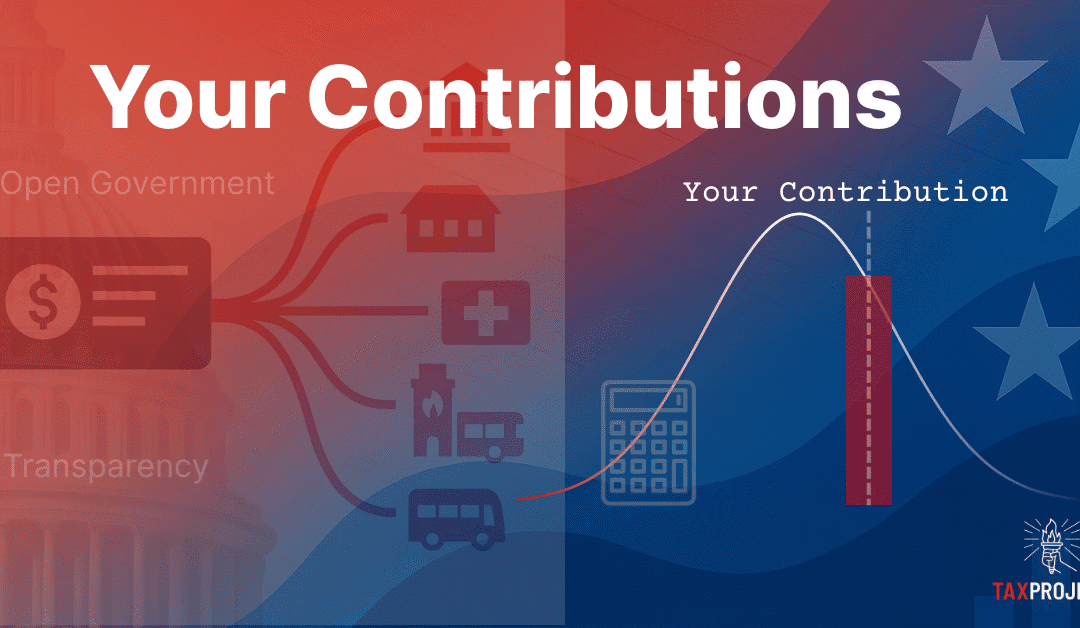
We are pumped up about our new Your Contributions calculator app release, our latest release in the Smarter Citizen tool! Americans work hard, and our society depends on your contributions. Many of the things we take for granted are because of Your Contributions to help build and maintain a strong America. Be proud of all the work you have done for our country, our Your Contributions calculator shows you just how much you contribute to Society. Thank you!!!! We can’t say that word enough, our guess is you’ve never been thanked for your contributions – so we’ll say it again Thank you!!!! We’re committed to helping Citizens understand What they contribute to Society to create a more prosperous country for everyone.
Key Features:
Calculates your All in Contributions(State, Federal, Local, Property, Sales, Gas, Payroll, etc.)
Total over 50 different Taxes you may pay each year
Shows your Tax Freedom Day (How long you contribute to Society each year)
Comparison Chart of Your Contributions versus other Tax Payers
As Citizens, we pay our taxes and contribute to Society each year and each and every day. However, many of us don’t know how much we contribute. Our contributions are everywhere, on our pay checks, Phone bill, Utilities, the Gas Pump, buying Shampoo, Dinner on the town, Airline Tickets, Toll Roads, etc. However, most people don’t really understand their All in Contributions. You may not think about your Contributions this way, but you are literally making contributions all the time. We make that easy to calculate your bespoke Contributions including Charts and Data to help you understand exactly what you contribute to our Society.
Explore Your Contributions today, a free citizen tool, and take one more step to becoming a Smarter Citizen.
Forget fireworks and parades; Tax Freedom Day is not a national holiday. It is a calculated date signifying when Americans, collectively, have earned enough to cover their combined federal, state, and local tax contributions for the year. It marks the day we stop financially supporting the government and start working for ourselves. Taxes are a Civic responsibility to live in our society. Obviously, you are getting paid and paying a smaller percentage of taxes each paycheck and not paying all your taxes for the year up front but thinking about taxes this way helps you conceptualize your taxes in a way you can better judge value.
Imagine waking up on January 1st, eager to tackle the year ahead. You have set your New Year’s goals, and you are ready to go! But hold on – every dollar you earn, every minute you work, comes with a silent shadow: the government’s share of your labor. That is the reality of Tax Freedom Day, a crucial concept that highlights the portion of the year we spend “working” for the government before truly earning for ourselves.
What is Tax Freedom Day?
What does “working for the government” truly mean? Picture your alarm clock. Every dollar you make, starting from January 1st, is subject to taxation. Each paycheck reflects deductions, each purchase carries sales tax, even owning property incurs levies. These combined payments, and more, chip away at your earnings, contributing to the national tax pool.
Think of it this way: every hour you work, every meeting you attend, every product you sell, a portion goes towards government services, infrastructure, and programs. Of course, these contributions are vital, but understanding the extent they impact your personal finances empowers informed discussion and responsible citizenship.
When is Tax Free Day?
Consider the median US income: around $58,084 in 20231. For someone earning this, Tax Freedom Day typically lands in somewhere roughly in April, between the 2nd and 3rd week, this changes based on National Income levels, and Tax Policy. That means for almost four months, every single day you work, for all of the hour of work you put in, each dollar you earn contributes directly to our government. The remaining months, then, represent your “true” earnings, free from taxation, where you begin working for and paying yourself.
How is it Calculated?
The Tax Foundation publishes the Tax Freedom Day and calculates it by adding the total Federal, State, Local, Income, Medicare, and Excise taxes and then dividing them by the nation’s income. However, some states like New York may have Tax Freedom days much later into May, or earlier for states like Alaska based on their Tax Policy and Structure.2So their published date doesn’t necessarily represent your Tax Freedom Day as your salary maybe higher or lower, and you may have other taxes that aren’t included like permits, registrations, tolls, parking fees, etc. and your individual taxes are probably not the nationwide averages. This can vary considerably, high income citizens maybe working till June or later, and low earners may reach their Tax Freedom day in February or March.
Your Tax Freedom Day
Have you ever calculated your own Tax Freedom Day? Does it fall earlier in March or later in May or June? This personalized metric, considering your specific tax liabilities, offers a powerful reflection on your individual financial reality and contributions to our country. When you know your Tax Freedom Day you can make better individual value assessments. Does it feel fair? Are you getting the value you deserve in return for your tax dollars? You know how hard you work, and how long you work. If you are like the average person, and work roughly four months before you start working for yourself, does this feel like a fair reflection of the services that the Government provides? Do you believe you are contributing just the right amount, not enough, and you need to work and contribute more, or do you think it’s too much and it is impinging on your freedoms? This is where transparency becomes crucial.
“The tax is the price of what we pay for civilized society.”
Oliver Wendell Holmes Jr.
You can calculate your own Tax Freedom Day using our free Smarter Citizen app. This informative tool will help you calculate that as well as many of useful statistics to help you understand your Contributions to our Country. Try it here:
Organizations like the Tax Project Institute work tirelessly to demystify our tax system, promoting clarity for ordinary citizens and accountability in how our taxes are used by our government and what you contribute personally. By understanding the complex web of federal, state, and local taxes, we empower citizens to advocate for responsible spending and help them make better decisions on how those align with their own personal priorities. Join the movement for Government transparency! Visit the Tax Project Institute’s website, explore our resources. Donate or Volunteer today!
Together, we can help everyone align their Tax Freedom Day with their values. Remember, understanding your Tax Freedom Day is just the first step. Use it as a springboard to engage in thoughtful discussion, advocate for responsible government spending, and demand the value you deserve for your hard-earned dollars. Informed citizens are the foundation of a strong and just society. Let us work together to make Tax Freedom Day a meaningful marker of fiscal independence and collective progress.
The Rosetta Stone, unearthed in the sands of Egypt in 1799 [1], immediately captivated the world. Its inscription, a single decree meticulously replicated in three scripts – the formal hieroglyphic script of the Egyptian priests, the cursive Demotic script used for everyday Egyptian writing, and the widely understood ancient Greek – held the key to unlocking the enigmatic hieroglyphs that had silenced the history of ancient Egypt for nearly fourteen centuries [2]. The eventual deciphering, primarily through the work of Jean-François Champollion in 1822 [3], forever etched the Rosetta Stone into the annals of Egyptology as the indispensable instrument that opened a vast library of ancient knowledge, granting unprecedented access to millennia of Egyptian history, religion, and culture. This remarkable achievement remains its most celebrated and widely acknowledged legacy.
Beyond a Key
However, to view the Rosetta Stone solely through the lens of linguistic liberation is to overlook another profound layer of its historical significance. The decree inscribed upon its surface, while indeed detailing acts of royal beneficence and the establishment of religious honors for the ruling pharaoh, also provides an invaluable, albeit partial, glimpse into the intricate socio-political and economic realities of ancient Egypt under the rule of the Ptolemaic dynasty. Examining the text with a focused attention on its economic and political implications reveals a world where taxation, regulation, and the strategic manipulation of economic policies were already well-established and keenly utilized tools of governance. This ancient Egyptian practice finds striking echoes in the strategies employed by diverse civilizations across the vast expanse of history, facing remarkably similar challenges in managing their populations and resources [4].
Historical use of Tax Policy
The decree itself, promulgated in the ancient city of Memphis in 196 BCE during the reign of the youthful King Ptolemy V Epiphanes [5], meticulously outlines the various acts of goodwill undertaken by the monarch towards the temples and the general populace. These actions ranged from generous donations of precious metals and vital grains to the embellishment and construction of sacred religious sites. Crucially for our understanding of the era’s economic dynamics, the decree explicitly mentions the royal decision to reduce or entirely abolish specific “dues and taxes existing in Egypt” [6], framing these measures as deliberate attempts to cultivate “happiness” and contentment among the ranks of the military and the broader population. Furthermore, the inscription details the relaxation of the financial burdens imposed upon temple lands and their associated revenues, the significant cancellation of outstanding debts owed to the royal treasury, and the just restoration of properties that had been previously confiscated by the state [7]. The deliberate inclusion of these economic concessions within a public decree intended to garner widespread support strongly suggests that the prevailing economic conditions and their impact on various influential groups were matters of considerable concern and strategic importance for the Ptolemaic administration [8].
The very necessity for such explicit pronouncements of tax relief strongly implies that the pre-existing tax structure was perceived as substantial, if not outright oppressive, by significant segments of Egyptian society [9]. While the precise intricacies of this Ptolemaic tax system are not exhaustively laid out on the surviving fragment of the Rosetta Stone, the repeated reference to a variety of “dues and taxes” strongly indicates the existence of a complex and multifaceted system of levies governing a wide spectrum of economic activities – a hallmark of the centralized administrative systems characteristic of the Hellenistic kingdoms that emerged in the wake of Alexander the Great’s conquests [10]. The notable emphasis placed on alleviating the financial burdens of the temples, which constituted powerful economic and social institutions within ancient Egyptian society, further underscores their crucial role within the Ptolemaic state and the clear strategic value for the ruling dynasty in securing their unwavering loyalty and active support through carefully considered economic concessions [11].
The potential for the existence of harsh or arbitrary tax collection practices during this period can be reasonably inferred from the decree’s explicit pronouncements regarding the cancellation of existing debts and the urgent need for tax relief [12]. The very act of a ruling monarch publicly forgiving substantial debts owed to the crown suggests that these financial obligations were not only widespread but also likely represented a significant burden on a considerable portion of the population, potentially leading to social and economic strain [13]. Historical scholarship focusing on tax collection methodologies in the ancient world, including the Ptolemaic era, provides ample evidence that the process could often be rigorous, demanding, and at times, susceptible to abuses of power, leading to genuine hardship for both individuals and entire communities [14].
Historical Parallels
The Rosetta Stone’s documented use of economic policy being strategically employed as a tool for political management finds resonant parallels across the human history:
Roman: Cura Annonae The Roman state’s policy of ensuring a stable and affordable grain supply, evolving into a free grain dole, served not only as a social welfare program to feed the urban population but also as a critical mechanism for maintaining social order and political stability within the often-volatile capital [15]. (See our article on the Cura Annonae)
Medieval European Royalty: Taxation and Concessions Throughout the medieval period in Europe, monarchs frequently granted tax exemptions and other economic privileges to powerful nobles and the Church in exchange for their loyalty and military support. Conversely, unpopular rulers often faced revolts fueled by perceived unjust or excessive taxation [16].
Colonial: Mercantilist Policies and Control European powers during the mercantilist era utilized complex systems of tariffs, trade regulations, and resource extraction policies in their colonies, primarily aimed at enriching the mother country and maintaining political control over their overseas territories. These policies often created significant economic burdens and resentment among the colonized populations [17].
US: Post-Revolutionary War Tax Policies The early years of the United States were marked by debates over taxation, with events like the Whiskey Rebellion directly stemming from opposition to federal tax policies. The subsequent development of tax laws has consistently reflected political ideologies and attempts to shape economic behavior and social welfare [18].
Modern Welfare States and Progressive Taxation The development of modern welfare states in many Western democracies involves progressive taxation systems designed to redistribute wealth and provide social safety nets. These policies, while intended to reduce inequality and social unrest, are often subjects of intense political debate regarding their economic impact and fairness to different groups [19].
Conclusion
While the Rosetta Stone’s fame as the crucial key that unlocked a long coded language of ancient Egyptian hieroglyphs is undeniably well-deserved and historically significant, its profound importance extends into the realm of civic understanding. For citizens within a democratic framework, such as that of the United States, the lessons gleaned from this ancient decree offer a valuable historical perspective on the enduring relationship between economic policy and politics. Informed citizens, equipped with a strong foundation in Governmental Financial Literacy and an understanding of the historical use (and potential misuse) of taxation and tax policy, play a crucial role in ensuring that the tax contributions within their own society remains fair, reasonable, and effective and not just a tool to placate the masses or suppress or favor a chosen few. By actively engaging with issues, understanding the effect of tax codes, and critically evaluating how policies are applied, citizens can act as a vital check against the potential for favoritism or disfavor, striving for a system where economic policies are implemented fairly and transparently for the benefit of the entire populace. The history of Ptolemaic Egypt, preserved on a 2200 year old stone that unlocked a civilization, thus serve as a timeless reminder of the importance of vigilance and informed participation in shaping the economic and political landscape of a society.
Citations
[1] Parkinson, Richard B. The Rosetta Stone. British Museum Press, 2005, p. 9.
[2] Davies, W. V. Reading the Past: Egyptian Hieroglyphs. British Museum Press, 1987, p. 15.
[3] Pope, Maurice. The Story of Decipherment: From Egyptian Hieroglyphs to Maya Script. Thames & Hudson, 1975, p. 68.
[4] Manning, J. G. Land and Power in Ptolemaic Egypt: The Structure of Land Tenure. Cambridge University Press, 2003, p. 265 (Discusses the centralized economic control in Ptolemaic Egypt).
[5] Budge, E. A. Wallis. The Rosetta Stone. Dover Publications, 1989, p. 15.
[6] Ruffle, John. The Great Belzoni: Archaeologist Extraordinary. Charles Scribner’s Sons, 1977, p. 147. (While not a direct translation, Ruffle discusses the context of tax relief in the decree).
[7] Ibid., p. 148.
[8] Rowlandson, Jane. Land, Women, and Family in Ptolemaic Egypt. Routledge, 1998, p. 31 (Notes the importance of royal decrees in shaping social and economic relations).
[9] Andreau, Jean, and Raymond Descat. The Slave in Antiquity. Cambridge University Press, 2007, p. 112 (Describes the complex tax systems in Hellenistic states).
[10] Lewis, Naphtali. Life in Egypt Under Roman Rule. Oxford University Press, 1983, p. 41 (While focusing on Roman Egypt, it highlights the enduring economic power of temples in the region).
[11] Crawford, Dorothy J. Kerkeosiris: An Egyptian Village in the Ptolemaic Period. Cambridge University Press, 1971, p. 143 (Provides evidence of debt and its management in Ptolemaic Egypt).
[12] Hobson, Brent. Taxation in the Ancient World. Reaktion Books, 2017, p. 78 (Discusses tax collection practices and their impact in various ancient societies, including Egypt).
[13] Rickman, Geoffrey. Corn Supply Under the Roman Empire. Clarendon Press, 1980, p. 1.
[14] Hacker, Jacob S., and Paul Pierson. Winner-Take-All Politics: How Washington Made the Rich Richer–and Turned Its Back on the Middle Class. Simon1 & Schuster, 2010, p. 15 (Analyzes the political dimensions of tax policy in the US).
[15] Garnsey, Peter. Cities, Peasants and Food in Classical Antiquity: Essays in Social and Economic History. Cambridge University Press, 1983, p. 107 (Further details the political implications of the cura annonae).
[16] Bois, Guy. The Crisis of Feudalism: Economy and Society in Eastern Normandy c.1300-1550. Cambridge University Press, 1984, p. 245 (Illustrates the link between taxation and social unrest in medieval Europe).
[17] Blackburn, Robin. The Making of New World Slavery: From the Baroque to the Modern, 1492-1800. Verso Books, 1997, p. 175 (Discusses the economic exploitation inherent in mercantilist colonial policies).
[18] Slaughter, Thomas P. The Whiskey Rebellion: Frontier Epilogue to the American Revolution. Oxford University Press, 1986, p. 3 (Details the political and social context of early US tax resistance).
[19] Lindert, Peter H. Growing Public: Social Spending and Economic Growth Since the Eighteenth Century. Cambridge University Press, 2004,2 p. 115 (Analyzes the political and economic motivations behind the development of welfare states).
The US Tax Code, officially the IRS Internal Revenue Code (IRC), is almost 7000 pages long. Together the IRC along with Federal Tax regulations, and IRS Guidance are a behemoth with over 70,000 pages of rules, regulations, and instructions.1 Imagine reading “War and Peace” … 54 times in a row — that’s the tax regulation for you.2 Reading it cover to cover would take an average person over 2,300 hours—that’s about 98 days of non-stop reading!3
It’s not static either; it changes annually to reflect new laws and adjustments. In 2020 the IRS made more than 4600 changes to the tax code. That’s more than a dozen changes every day for an entire year4.
Components of Tax Regulation and Guidance
IRS Internal Revenue Code (IRC) – This is the actual US Tax code, and represents the core legal framework. The is the smallest component of the Regulation and Guidance.
Treasury Regulations – These are more specific instructions, and they provide instructions on how the Treasury interprets the IRC including examples of specific tax areas and how to apply the IRC. This represents a moderately sized component of the Regulations and Guidance.
IRS Guidance – This is a broad category that encompasses various resources published by the IRS to help taxpayers understand and comply with the tax code. It represents the largest component of the Regulations and Guidance and includes:
Revenue Rulings: Official interpretations of the IRC by the IRS on how the law applies to specific factual situations. (Think of them as Supreme Court decisions interpreting the Constitution).
Revenue Procedures: Statements outlining procedures for taxpayers to follow when dealing with specific tax situations. (Imagine them as IRS regulations implementing the tax code).
Notices: Announcements from the IRS providing information on tax law changes, upcoming deadlines, or other relevant topics.
Publications: Informational guides published by the IRS to explain tax topics in a clear and concise manner.
Tax Simplification
There have been many attempts at simplifying taxes, but for the most part there has been limited relief for Taxpayers. Many of the simplifications passed were about reducing tax brackets and simplifying calculations, but not many things that actually simplified taxes for citizens. There have been calls for solutions like the Flat Tax which would greatly simplify the Tax code by eliminating deductions, and simplifying taxes by requiring everyone to pay a flat fixed rate eliminating many of the complexities of the tax code.
Help is Available
Recognizing the Herculean task facing taxpayers, the IRS offers several resources. From the Free File program5, which provides free tax preparation software to those who qualify, to the Taxpayer Advocate Service for those facing tax problems, help is available. There’s also a plethora of guides and FAQs on the IRS website to illuminate the path through the tax jungle.
A significant portion of the population, about 53% according to recent statistics6, seeks some form of help when filing taxes. This help ranges from using software like TurboTax to hiring professionals.
Despite free resources, many opt for paid services to ensure their taxes are filed correctly. Over one-third of taxpayers pay for tax preparation services7, with costs varying widely depending on the complexity of their tax situation.
For those with limited income, paying for tax help might not be feasible. Fortunately, there are programs like the Volunteer Income Tax Assistance (VITA) and Tax Counseling for the Elderly (TCE), offering free tax help to those who qualify based on income, age, or disability8.
The U.S. Tax Code is indeed vast and ever-changing, making tax season a daunting time for many. While the IRS and government do provide resources to help, the complexity of the system means a significant number of people still seek and pay for professional help. However, there are free alternatives that offer a guiding light through the tax code forest, ensuring that everyone has the opportunity to navigate the intricacies of tax filing without being left in the dark.
Every year, it’s the same frustrating story diving into tax season. Seriously, why can’t the IRS just sort it out for us? Given the rise of AI and tools like ChatGPT, do we really need to fill out endless forms and dig through receipts, especially since many are sent directly by Banks and Employers?
The IRS already knows everything there is to know about our finances, right? Plot twist: our tax system is a maze of deductions, credits, and blind spots where the IRS may not have all the data. Beside being our civic duty and mandated by law, doing our taxes has many perks and pitfalls.
So, what’s the deal with filing taxes? Are all these forms and the giant tax code really necessary? How much time and money are we spending on this, and what’s it costing the economy?
Do We Need to File?
Even though the IRS knows a lot about our financial lives, everyone’s situation is different. Filing taxes lets us tell our side of the story, like any extra money we made or tax breaks we should get which might not have been reported to the IRS.
Forms Galore
Most of us can get away with a 1040EZ, but for the rest of us the IRS has over 800 forms and schedules for every tax situation under the sun. Whether you’ve got a simple paycheck or a bunch of side hustles, there’s a form for that.
Tax Code
The Internal Revenue Code (“Tax Code”) is 6871 pages long, and approximately 75,000 pages including rules, regulations, and instructions2. No wonder tax season feels like a marathon, 75,000 pages lined up end to end is equivalent to the distance of a half marathon, and tax lawyers are expected to be familiar with ALL of it, and technically ignorance of it is no excuse for us either.
Time and Money
Americans spend over 6 billion hours (equivalent to 1 year of work for 3 million people) with a cost of about $34 billion10,11 every year just to file their taxes. To put that into perspective, it is estimated to cost $20 billion to end homelessness in the United States1, or give everyone under the poverty line 4 a $5000 car that could last them 6 years. Americans spent approximately $14 billion on software alone for tax preparation.11
Internal Revenue Service (IRS) Enforcement
The IRS spends approximately $12 billion a year and employs over 79,000 people to process taxes and make sure everyone’s playing by the rules.5
The Economy Feels It, Too
The tax process takes a lot of productive capacity from the country and costs the economy a significant amount of output, around 0.8% to 1% of our National Output12 (Gross Domestic Product or GDP).
Jobs, Jobs, Jobs
The tax prep world is huge, the AICPA estimates there are over 2 million tax professionals in the US (public accounting, private industry, government).6 We’re talking hundreds of thousands of jobs for tax lawyers, consultants, accountants, administration, and techies making tax software.7
Is There A Better Way
A lot could be done to greatly simplify our tax code and reduce or eliminate many of the arcane sections, and in lieu of that make preparation easier. America is home to brilliant technology that brings the knowledge and history of the known universe to our fingertips with tools that mimic human intelligence, and yet here we are. Several countries including Denmark, Sweden, Estonia, and South Korea have automated pre-filled tax submission where filers only need to review and submit. The IRS just rolled out Free File9 to allow online guided tax filing. While not fully pre filled or automated, and not as comprehensive as commercial software it is a step in the right direction. While this may not be of comfort as you file your taxes now, the march of improvement is never ending and eventually we’ll figure this out.
Summary
So, yes our tax code is overly complicated, our systems are not as easy or automated as they could be, and filing taxes feels like a chore we could do without, but until we see these improvements it is our Civic Duty. Taxes are a necessary component to support the services, freedoms and protections we enjoy. As Oliver Wendell Holmes succinctly said, “Taxes are the price we pay for a civilized society.”
Tax Project Institute is a fiscally sponsored project of MarinLink, a California non-profit corporation exempt from federal tax under section 501(c)(3) of the Internal Revenue Service #20-0879422.