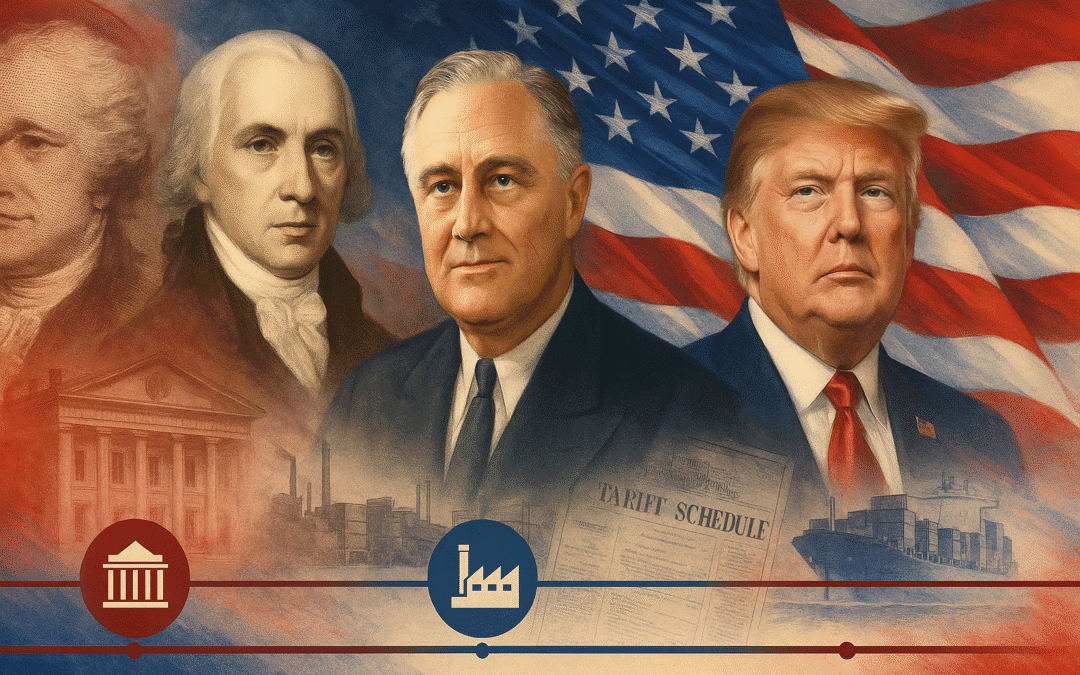
History of US Tariffs: A Timeline

The history of Tariffs is a history of the United States from early trade done by local British and Colonial import/exporters to the uniform standards of the Tariff Act of 1789 introduced by James Madison and advocated and implemented by Alexander Hamilton that became the primary revenue source for the young nation. From Congressional lists and schedules updated every 5-6 years by Congress to the dynamically negotiated agreements done by the Executive branch we have today. From an instrument of revenue to a tool for international trade, geopolitical power, and protection of National interests, Tariffs have been used throughout US History. From the disastrous effects of the Smoot-Hawley act to the triumphs of Post World War II Bretton Woods frameworks leading to our current Global Trade.

1789
Tariff Act of 1789
The first Congressional Statutes on Tariffs
The First Congress establishes tariff duties as the primary federal revenue source. Congress sets detailed product-specific rates, leading to centralized customs collection at major ports.Significance
  • Major source of Revenue for United States
  • Establishes Congressional Authority over Tariffs
  • First attempt to standardize and provide uniformity to Tariffs across Colonies
 Learn More
1828
Tariff of Abominations

Tariff Act of 1828 – a.k.a. Tariff of Abominations – Protective tariffs aimed at Northern industries cause tensions increasing cost of living in the South, leading to the Nullification Crisis when Vice President John Calhoun anonymously penned the Nullification Doctrine which emphasized a state’s right to reject federal laws within its borders and questioned the constitutionality of taxing imports without the explicit goal of raising revenue. Congress still sets rates but political conflicts highlight tariff complexity.

Significance

  • Establishes use of Tariffs as a Protectionism mechanism to protect domestic industry.
  • Establishes Congressional Authority over Tariffs
  • Created Political tension between the winners and losers of any Tariff policy.
  • Some believe set the seeds of Civil War


Learn More

1890
McKinley Tariff Act
McKinley Tariffs of 1890

The McKinley Tariff Act of 1890 was a high protective tariff raising rates on many imports. Congress remains central in setting rates, with protectionism as a goal. Introduces role of Executive Branch.

Significance

  • Introduced the concept of reciprocity, lowering tariffs if other country lowered theirs
  • Introduced role of Executive Branch to manage reciprocity agreements
  • Increased Tariff rates to nearly 50%
  • Caused sharp increase in Goods


Learn More

1894
Wilson-Gorman Tariff Act of 1894

Wilson-Gorman Tariff Act of 1894 attempts reduction of rates on imported goods and introduces a federal income tax. The income tax is struck down by the Supreme Court until it was re introduced after the passage of the 16th Amendment in 1913, reinforcing tariffs role as major revenue in early America.

Significance

  • Reduced tariffs on imported goods, reflecting a shift towards lower tariffs
  • Introduced the concept of Income taxes to offset lower tariff revenue
  • Contributed to the debate on protectionism vs. free trade, impacting economic policy and government revenue sources.


Learn More

1916
Creation of the U.S. Tariff Commission
US Tariff Commission

Creation of the U.S. Tariff Commission: A bipartisan body established to advise Congress with expertise, marking increasing professionalization in tariff policy.

Significance

  • Predecessor to the US International Trade Commission (USITC)
  • Led by Frank Taussig, Harvard Professor
  • Created as part of the Revenue Act of 1916 which introduced Income Taxes
  • Replaced ad hoc lobby driven policies with analytic and scientific studies and recommendations


Learn More

1930
Smoot-Hawley Tariff Act
Smoot Hawley Tariff Act

Smoot-Hawley Tariff Act – further high tariff rates designed to help farmers exacerbate international trade tensions and the Great Depression. Congressional tariff-setting continues but criticism grows.

Significance

  • Started Global Trade War – caused retaliatory tariffs and significantly reduced International trade
  • Considered to contribute to worsening the Great Depression
  • Global trade levels dropped roughly 2/3rds from 1929 to 1934


Learn More

1934
Reciprocal Trade Agreement Act (RCAA)

Reciprocal Trade Agreements Act (RTAA): Congress delegates authority to the president to negotiate bilateral trade agreements and adjust tariffs within limits dynamically. Beginning of executive role in tariff management.

Significance

  • Congressional delegation of bilateral trade agreements to the Executive Branch
  • Allowed President to negotiate +/- 50% of existing Smoot-Hawley Tariff rates
  • Set Reciprocity as fundamental to negotiating Tariffs that US tariff cuts only if US got a cut in return
  • Moved Tariffs from Congressional lists to Executive bargaining
  • Unconditional Multi Lateral Most Favored Nation (MFN) clauses – if you cut Tariff X every country gets the best rate – default multi lateral


Learn More

1948
General Agreement on Tariffs and Trade (GATT)
General Agreement on Tariffs and Trade

GATT (General Agreement on Tariffs and Trade) created a post World War II pact that set the rules for non-discriminatory, tariff-based trade among market economies.

Significance

  • Locked in Most Favored Nation non-discrimination (Article I): any tariff cut for one member extends to all.

  • Created bound tariff schedules (Article II), making cuts durable and harder to reverse.

  • Ran multilateral “rounds” that progressively lowered global tariffs.

  • Established early dispute settlement norms and a rules-based trading system.

  • Laid the institutional foundation for the World Trade Organization (WTO)


Learn More

1974
Trade Act of 1974
Trade Act of 1974

Trade Act of 1974: Expands presidential proclamation powers to modify tariffs without prior congressional approval, reinforcing executive’s flexible role.

Significance

  • Expands Presidential role in modifying tariffs without congressional approval
  • Creates Fast track: Congress sets goals; the President negotiates; Congress takes a simple yes/no vote (no amendments).

  • Lets the U.S. act against countries that don’t play fair – up to and including new tariffs.

  • Creates safeguards to provide temporary relief if imports hurt a U.S. industry.

  • Trade Adjustment Assistance (TAA): Help for workers and firms who lose jobs or business due to imports.

  • Generalized System of Preferences (GSP) cuts or removes tariffs on many goods from developing countries to promote trade.


Learn More

1977
International Emergency Economic Powers Act (IEEPA)
OFAC

IEEPA (International Emergency Economic Powers Act) a 1977 U.S. law that lets the President, after declaring a national emergency tied to a foreign threat, block property and restrict transactions to protect national security, foreign policy, or the economy.

Significance

  • Requires the President to declare a national emergency about a foreign threat.

  • Allows assets to be frozen and block or allow specific transactions (through OFAC).

  • Common used for sanctions to limit trade and finance with certain countries, people, or sectors.

  • Executive branch must report to Congress, and courts can review.

  • Violations can bring heavy fines or jail


Learn More

2018
Modern Trump Tariffs

Modern Trump tariffs: The Executive branch imposes broad tariffs using delegated authority and emergency powers to negotiate reciprocal deals. The deals create leverage for US interests, and represent a shift from multilateral deals to US first agreements.

Significance

  • Broad Tariffs as a negotiating tool in the strong Executive model of negotiation
  • Goal to reset trade expectations with partners where free trade is reciprocal

  • Used in geopolitical great power check to limit economic and military threat of potentially hostile peers

  • Leveraging Emergency Powers (IEEPA) to act on non trade and economic interests like Border Security, and Fentanyl enforcement.


 

Learn More

History of US Tariffs: A Timeline

External Revenue Service

Trump’s Proposed External Revenue Service: A Return to 1913

Former President Donald Trump has recently floated the idea of replacing the Internal Revenue Service (IRS) with an “External Revenue Service” that would eliminate income taxes and instead rely on tariffs and fees imposed on foreign governments. In essence, replace Income Taxes with fees on Foreign trade shifting the burden of taxes on foreign entities instead of inwardly on US citizens. While this proposal is still in its early stages, lacks concrete details, and may never come to fruition it has sparked discussions about potential benefits and drawbacks of such a dramatic shift in U.S. tax policy.

Historical Context

While many will hear about this proposal and think this is a major, if not radical change it’s important to note that Income taxes are a relatively recent development in U.S. history. The Federal Income tax as we know it today was only established in 1913 with the ratification of the 16th Amendment. Prior to this, the U.S. government primarily relied on tariffs and excise taxes for revenue.

Potential Benefits

Proponents of this proposed system argue that it could offer several advantages:

  1. Simplification: Eliminating income taxes could greatly simplify the tax code, potentially reducing compliance costs for individuals and businesses.
  2. Increased competitiveness: By shifting the tax burden to foreign entities, U.S. businesses might become more competitive in the global market.
  3. Strategic leverage: Tariffs and fees on foreign governments could be used as tools in international negotiations and to address trade imbalances.
  4. Encouraging domestic production: Higher costs on imported goods could incentivize domestic manufacturing and reduce reliance on foreign supply chains.
  5. Domestic Job growth: Tariffs can create barriers protecting domestic industries and promoting job growth and potential repatriation of foreign jobs, companies, and manufacturing.
  6. Strategic positioning: As the US has entered a new cold war with China as a near peer competitor, strategic tariffs could serve as an effective check limiting their Economic growth and ability to build military and economic power against the US.

Trade-offs and Challenges

However, this proposed system also presents significant challenges and potential drawbacks:

  1. Revenue stability: Relying primarily on tariffs and foreign fees could make government revenue more volatile and dependent on international trade dynamics.
  2. Consumer costs: Tariffs are ultimately paid by consumers through higher prices on imported goods. This could lead to increased living costs for many Americans.
  3. International relations: Imposing significant tariffs and fees on foreign governments could strain diplomatic relationships and potentially lead to retaliatory measures.
  4. Economic distortions: Tariffs can create market inefficiencies and lead to suboptimal resource allocation. It could potentially cause massive shifts in supply chains and have major ripples in economies throughout the world with a wide range of impacts, and potentially negative consequences for all participants.
  5. Constitutionality: The legality of completely eliminating income taxes and replacing them with an external revenue system would likely face legal challenges.
  6. Potentially Regressive: US Federal Income taxes are highly Progressive with 89% of taxes being paid by the Top 25% of tax payers. Shifting to tariffs for revenue maybe inflationary to goods. While it is likely the higher income individuals consume more, it may be that staples required by all consumers may disproportionately impact those most in need.
  7. Feasibility: While this may sound good on paper, the IRS collects roughly $5 trillion in income tax revenue annually – it may not be economically feasible or possible to collect this from external entities

Tariffs as a Form of Taxation

It’s crucial to understand that tariffs are indeed a form of taxation. While they are imposed on foreign goods and not seen as a direct cost to the consumer, the cost is typically passed on to domestic consumers through higher costs. This means that under the proposed system, Americans would still be paying taxes, albeit indirectly through higher prices on imported goods.

Strategic Considerations

Despite the economic drawbacks, some argue that tariffs can serve strategic purposes beyond revenue generation. In particular, tariffs on goods from near-peer competitors like China could be used as leverage in geopolitical negotiations or to protect sensitive industries as well as check a rising global power who we are currently in a cold conflict with and may potentially be in a hot conflict in the future. However, this approach carries risks of escalating trade tensions and potential economic retaliation.

Conclusion

Trump’s proposed External Revenue Service represents a old, but radical departure from the current U.S. tax system. While it offers potential benefits in terms of simplification and strategic leverage, it also presents significant challenges and economic risks. As with any major policy shift, careful consideration of both short-term and long-term consequences is essential.

It’s important to emphasize that this proposal is still in its early stages and lacks specific details. The feasibility, implementation, and potential impacts of such a system would require extensive study and debate. Furthermore, any major overhaul of the U.S. tax system would likely face significant political and legal hurdles.

As discussions around this proposal continue, it will be crucial to consider not only the economic implications but also the broader impacts on international relations, domestic policy, and the overall well-being of American citizens. Ultimately, any changes to the tax system should aim to balance revenue needs, economic growth, fairness, and strategic interests in an increasingly complex global landscape.

Reference:
[1] https://www.reuters.com/world/us/trump-says-will-create-external-revenue-service-collect-revenue-foreign-sources-2025-01-14/

External Revenue Service

Tax Project Institute

Get the Newsletter

Sign up to get the newsletter