Elon Musk’s DOGE Legacy: A Bold Shift Toward Reform
In a bold and controversial era of American governance, the leadership of Elon Musk at the newly formed Department of Government Efficiency (DOGE) —an informal but widely accepted moniker for his role in reshaping federal oversight and fiscal management—has become synonymous with disruption, reform, and no-holds-barred accountability. Love him or hate him, and there are plenty of both, Musk’s tenure may be remembered as one of the most consequential experiments in modern political and administrative history. His impact reaches far beyond flashy headlines or partisan interpretations: it is a story of technological transformation, fiscal reckoning, radical transparency, and the difficult balance between efficiency and public service.
Elon’s Motivation
As Musk steps away from the Trump administration, many can ponder what would motivate the worlds richest man [9] to take on such a task? To many, Elon Musk is an enigma, and this act only adds to that mystique. Musk, a long time Democrat, having voted for his first Republican in 2022 [8] took an abrupt turn to join the Trump administration. However, politics aside, why would someone that doesn’t need a job or money take on a task that is sure to draw the ire of a sizable portion of the electorate? The criticisms came at great personal costs, including protests, attacks on his companies that directly impacted his net worth (at least for a short period), and consumer pushback on his products. Some may believe that he needed the attention, and ego stroking, while others see it as a self less act of patriotism, someone acting as the adult in the room and making the hard choices that must be made to protect the long term health of the country. Whatever the motivation, this article looks at the legacy of what was accomplished and what he leaves behind.
Technological Overhaul and Accountability
One of Musk’s most immediate and lasting accomplishments was bringing Silicon Valley-style technology, AI and Data Science into the heart of the federal government’s operations. Under his leadership, sprawling bureaucracies that had long lagged behind the private sector were aggressively modernized. Artificial intelligence systems were deployed to streamline everything from fraud detection in benefits programs to auditing federal grants. Musk’s team instituted real-time dashboards across all major agencies, enforcing a level of visibility and data-driven performance management previously unimaginable in Washington [1].
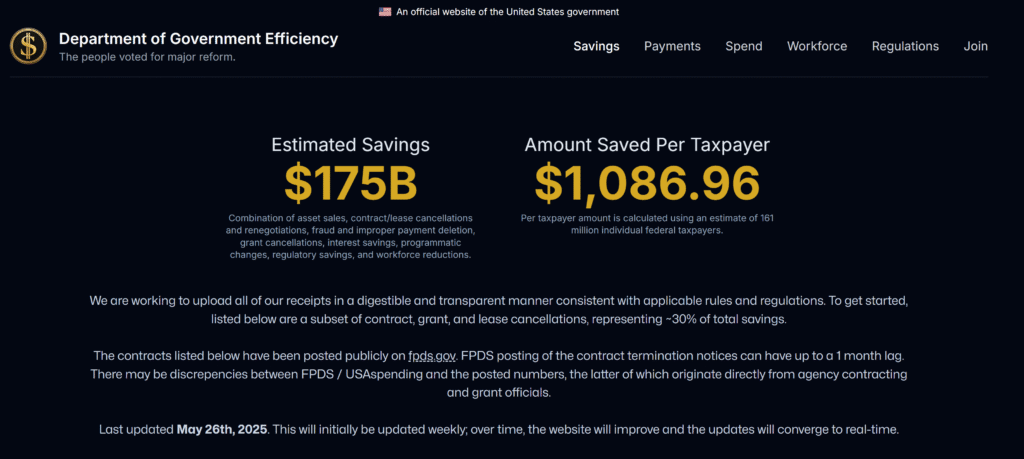
Perhaps the most emblematic achievement of this transformation was Doge.gov, a centralized platform that delivered unprecedented transparency in real-time. The site allowed any American to see federal contracts, grants, property leases, and travel expenses with a level of detail that may previously have required Freedom of Information Act (FOIA) requests. This included line-by-line analysis of project deliverables, contract amendments, vendor histories, and financial benchmarks [2]. He made this available to all, and included API’s a mechanism so that organizations like the Tax Project and other media and research organizations could analyze and build their own applications and conclusions with the newly available data. Regardless of the public’s thoughts on Musk or DOGE, this has been a welcome and commendable addition to Government Transparency and the public discourse. (Check back soon for the Tax Project’s DOGE app release)
The Unmasking of Government Waste
With transparency came revelation—and often disbelief. The audits conducted under Musk’s leadership unearthed hundreds of egregious cases of waste, inefficiency, and fraud. In one widely publicized incident, auditors discovered that over 6,000 people listed as receiving Social Security payments were officially recorded as over 110 years old—with some records dating birth years back to the 1700s [3].
Another case involved foreign entertainers. Data analytics flagged a set of Department of State grants that had inexplicably been issued to individuals labeled as “youth outreach ambassadors.” Further review revealed that a handful of those grants had been awarded to rappers and social media influencers operating out of France, Nigeria, and Brazil, with no evidence of any deliverables tied to U.S. interests [4].
“We found hundreds of millions going to people who don’t exist, and billions going to programs that haven’t been evaluated since fax machines were cutting-edge.”
Elon Musk
In total, the Doge.gov accountability initiative claims over $175 billion in cost savings and waste elimination over a five-year span, largely from program consolidation, fraud recovery, and sunsetting obsolete agencies and functions [2].
Perhaps Musk’s most ambitious—and controversial—goal was to confront America’s unsustainable fiscal trajectory. At the time of his rise, the federal government was running annual deficits approaching $2 trillion, and the national debt had exceeded $36 trillion. His administration implemented sweeping budget reforms, including mandatory zero-based budgeting, independent agency audits, and mandatory five-year cost-benefit reviews for all recurring programs [5].
He also ended the long-criticized “use it or lose it” budgeting practice that encouraged agencies to spend remaining funds at the end of the fiscal year. Instead, agencies that underspent were rewarded with multi-year budgeting flexibility and autonomy in reallocating savings. The impact was staggering. In just four years, the annual federal deficit was reduced by over 50%, and the growth rate of the national debt began to slow for the first time in decades [5].
But these victories came with painful trade-offs. Popular programs in arts, rural development, and public broadcasting faced sweeping cuts. Some veterans’ services were restructured into digital-first platforms, leaving older populations struggling with access. National parks experienced staffing shortages. Rural communities complained of reduced postal delivery and internet infrastructure delays. Public university research grants in non-STEM fields declined by over 40% [6].
Segments of the population that had long relied on these programs were furious. Critics accused Musk of treating the federal government like a tech startup—valuing performance over people, spreadsheets over stories.
His response? “A government that can’t pay its bills is a government that fails everyone.” [7]
A Legacy of Radical Transparency and Debate
Whatever one’s view of Musk’s methods, there is little debate that his time as DOGE left a permanent mark on the U.S. government’s operating culture. Transparency, once a campaign slogan, became structural policy. Every dollar saved by the federal government can now be traced on Doge.gov. Every contract has public deliverables. Every grant has a public-facing evaluation report. Government leases are posted with market comparisons and renewal dates.
He also fundamentally changed how Americans think about governance. Where once the budget was a black box, today there are visualizations, explanations, and performance indicators accessible from a smartphone [2]. His administration forced the American public to confront how little they had known—and how much had been hidden behind procedural complexity and bureaucratic walls.
Still, the country remains deeply divided on whether it was all worth it. Supporters hail Musk as a visionary reformer who saved the republic from fiscal ruin. Detractors argue he gutted the soul of the American social contract in the name of “efficiency.”
But no matter the perspective, Musk’s legacy in DOGE is clear: he dragged the federal government into the 21st century—sometimes kicking and screaming—while forcing a national reckoning with what Americans expect from their government, what they are willing to pay for, and what they can no longer afford to ignore.
[6] Government Accountability Office (GAO), “Impact of Federal Budget Reductions on Service Delivery,” Testimony before the Senate Appropriations Committee, September 2024. https://www.gao.gov/products/gao-24-604t
Understanding how the US tax system works can feel daunting. Many people find the topic complicated, and stressful – mostly around filing and filling out your taxes and the deadlines and threat of penalties and fees. However, taxes are much more than filing, they are what support all the services and functions of government and they have very real impacts on the lives of every American. This guide provides an overview of our Tax the system. It breaks down key components, including the different levels of government involved, types of taxes, and alternative revenue sources.
Why Understanding the US Tax System Matters
Understanding the tax system empowers you to make informed financial decisions. Understanding allows you to participate effectively in civic discussions about. In fact, Americans spend around 13 hours and $290 each year just filling out and filing their taxes each year (1). When you consider that for most Americans their largest purchase in life will be a house, and the 2nd or 3rd largest will be a car or your taxes. Some people spend much more time thinking and researching the car they’ll purchase than their taxes. If you buy a car every 5 years, its like you will spend less time making your purchasing decisions than the 65 hours over the 5 years on average that Americans spend each year on taxes.
Complexity and Three Levels of Government and Taxation
The United States has an extremely complex tax code comprising several volumes of Tax Law with many carve outs, exceptions, deductions, etc. (See our Article on Tax Complexity) Additionally, the US tax system operates on three primary levels: Federal, State, and Local. Each level has its distinct revenue needs and employs various taxation methods, similar but distinct. So for example if you live in California or Florida while your Federal taxes will be the same you may have VERY different tax structures for the state you live in. On top of that there are a slew of taxes in various forms (many indirect) that are passed on to the consumer.
The Federal government relies on several key taxes to fund national programs and services. The Federal tax code is uniform across the country. To get an estimate and see where your tax dollars are spent, get an itemized Federal Tax Receipt from the Tax Project.
Income Tax: This is the largest source of federal revenue. It is levied on individuals’ and corporations’ taxable income. The US employs a progressive income tax system, where higher income levels are taxed at higher rates.
Payroll Taxes: These are the second largest source of federal revenue and fund Social Security and Medicare. They are split between employers and employees.
Corporate Income Tax: Levied on the profits of corporations. The corporate tax rate has varied significantly throughout US history.
Excise Taxes: These are taxes on specific goods, such as alcohol, tobacco, and gasoline.
Estate and Gift Taxes: Applied to large estates passed on after death and significant gifts given during a person’s lifetime.
Interesting Fact: The 16th Amendment to the US Constitution, ratified in 1913, allowed Congress to levy an income tax without apportioning it among the states or based on the Census. This was the beginning of income taxes outside a brief period during the Civil War. It has allowed for the Progressive taxation (i.e. Non Apportioned) system we have today.
State governments use taxes to fund education, infrastructure, healthcare, and public safety. Each state has their own unique tax code.
Sales Tax: This is a percentage of the purchase price applied to most goods and services at the place of purchase. Sales tax rates vary widely among states. Some states, like Oregon, Montana, New Hampshire, and Delaware, have no sales tax.
Income Tax: Many states also levy an individual income tax on top of Federal Income taxes, often based on federal taxable income with some adjustments.
Corporate Income Tax: Similar to the federal level, states tax corporate profits.
Property Tax: While primarily a local tax, states often set guidelines for property tax assessment and administration.
Source: US Census 2022 State Revenue Sources
Local Taxes
Local governments, such as cities, counties, and school districts, rely heavily on property taxes. Each municipality has their own unique tax code.
Property Tax: This tax is based on the assessed value of real estate and is used to fund local schools, fire departments, and other essential services.
Sales Tax: Some localities add their sales tax on top of the state sales tax.
Local Income Tax: A few cities and counties impose a local income tax on residents and those working within their boundaries.
Interesting Fact: Property taxes are a stable revenue source for local governments. They are less susceptible to economic downturns compared to sales or income taxes.
Sources: US Census 2022 Local Revenue Sources
Other Government Taxes (Revenue)
Now it may sound strange, understandably, for your taxes to be described in business terms as revenue, but the government categorizes taxes as revenue. The Government consider all sources of funding Revenue, but only a portion as Taxes. This is because they do collect fees, and other revenue for services rendered like Fishing licenses, or Car registration, Building permits, etc. There are several sources of government revenue funding for public services.
Direct Taxes: These are levied directly on individuals or entities and cannot be shifted to someone else. Examples include income tax, corporate tax, and property tax.
Indirect Taxes: These are initially paid by one entity but can be passed on to the consumer. Sales tax and excise taxes are examples of indirect taxes.
Non-Tax Revenue Sources: Governments have other funding sources that are not considered taxes. These include fees, licenses, and borrowing.
Fees and Charges: These are payments for specific services provided by the government. Examples include park entrance fees, trash collection fees, and tolls.
Licenses and Permits: Governments charge fees for licenses and permits to regulate activities and raise revenue. Examples include driver’s licenses, business licenses, and building permits.
Borrowing: Governments borrow money by issuing bonds to fund projects or cover budget shortfalls. While borrowing is not a tax, it creates an obligation to repay the debt. Much like a loan, the debt is repaid through future tax revenue.
Interesting Fact: A branch of economics known as Keynesian Economics proposes that Government spending can stimulate the economy through increased demand. Borrowing can increase spending to allow for investments in infrastructure and public services. However, not all spending and circumstances lead to positive returns or economic stimulation and excessive borrowing can lead to long-term financial challenges.
Asset Sales: Governments can sell assets, such as land or buildings, to generate revenue. This is typically a one-time source of income.
Indirect Expenses and Hidden Taxes: Beyond explicit taxes, various indirect expenses and hidden taxes can affect individuals and businesses.
Inflation: Inflation erodes the purchasing power of money. This effectively increases the cost of goods and services. Inflation is not a tax per se, however many people consider the rapid expansion of currency a direct cause of dollar devaluation and inflation. Therefore, Government policies can influence inflation rates.
Regulations: Complying with government regulations imposes costs on businesses. These costs are passed on to consumers through higher prices. While not a tax, in essence it creates a cost burden that is often passed to the consumer.
Mandates: The government mandates that businesses provide certain benefits to employees. These include health insurance or paid leave. These costs can translate to lower wages or higher prices.
Opportunity Costs: Resources spent on one activity are not available for another. Government spending decisions involve opportunity costs. Spending on defense means less available for education.
In general, our Government at each level has become very adept at adding Revenue sources in too many ways to count. In these categories above you will find fees that show up everywhere you look. TSA fees added to your airport tickets, Universal Service Fees added to Internet bills, Telecom and 911 Fees added to your phone bill, Renewable Energy Charges on your Energy bill, Public Utility Fees, Waste Management Fees, Hotel Occupancy Fees, Tourism Fees, School Bonds, Fire Districts, Mosquito Abatement, etc. When it comes to revenue generation, our Government has become very innovative. (See our Article on The Art of Taxation)
Interesting Fact: Some Regulatory cost estimates in the US are estimated to be in the trillions of dollars annually. (2)
Potential Reforms
Our tax system continues to evolve in an attempt to address the changing landscape of services and needs of constituents. Here are a number of reforms that are discussed at various degrees of intensity.
Consumption Tax: Replacing the income tax with a consumption tax.
Carbon Tax: Taxing carbon emissions to aimed to address climate change.
Flat Taxes: Fixed rate simple tax for all individuals replacing a number of taxes, reducing complexity, and burden.
Wealth Tax: Taxing the net worth of the wealthiest individuals vs income, especially for those that derive most of their income from investments not salary.
The US Tax System: A Closer Look at Key Taxes
Diving deeper, here is the composition of US revenue and what they include.
Individual Income Tax
The Federal income tax is a progressive system on the income of individual tax payers. Meaning that the tax burden rises with income generally, in essence the more you make the more they take. Income is divided into tax brackets, each with a different tax rate. As income rises, it is taxed at higher rates. (See our Article on Fair Share of taxation and where the income tax burden falls.)
Taxable Income: This is the income subject to tax after deductions and exemptions.
Deductions: These reduce taxable income. Common deductions include the standard deduction, itemized deductions for mortgage interest, charitable contributions, and state and local taxes (SALT).
Tax Credits: These directly reduce the amount of tax owed. Examples include the child tax credit, earned income tax credit, and education credits.
Alternate Minimum Tax (AMT): The AMT is a tax applied to high income earners that serves as a way to ensure that a minimum tax is collected. When your taxes are filed, two separate calculations must be made. The standard tax calculation, whether you itemize or use the EZ form, and your AMT tax. If your AMT tax is higher than your standard tax calculation, you must pay the AMT amount.
Corporate Income Tax
The corporate income tax is levied on the profits of corporations. Taxes on corporations influence business investment and economic growth. The Federal tax rate on corporations in the US is a flat rate 21% and between 23.5% to 23.85% when you include State and Local corporate taxes compared to the OECD Corporate tax rate of 25.6% to 25.8% (3). The effective Corporate tax rate can be significantly lower in the US based on a number of deductions. In 2022 as part of the Inflation Reduction Act a Corporate Alternative Minimum Tax (CAMT) of 15% was imposed.(5) Corporate taxes are the 3rd highest tax revenue source after Individual Income Taxes, and Payroll Taxes. For many countries, including the US and many European nations, these are a lower source of tax revenue. Many consider these mostly pass through costs and they are passed on to the consumer in the form of higher prices, the investor as lower returns, or the employee in lower wages and/or benefits. (4)
Interesting Fact: The Tax Cuts and Jobs Act of 2017 (TCJA) reduced the corporate income tax rate from 35% to 21% bringing the US Corporate tax rate into a more competitive level with OECD countries.(3)
Payroll Taxes: Funding Social Security and Medicare
Payroll taxes are automatic deductions taken from your paycheck by your employer and matched by your employer to fund Social Security and Medicare. Payroll taxes are the 2nd largest source of revenue for the Federal Government. Social Security and Medicare are the two largest, and mandatory, components of the Federal budget expenses.
Social Security: This provides retirement, disability, and survivor benefits. Social Security is taxed at 6.2% each for the employee and employer (12.4% total) up to a maximum of $176,100 as of 2025.
Medicare: This provides health insurance for seniors and some people with disabilities. Medicare is taxed at 1.45% each for the employee and employer (2.9% total) with no maximum. An additional 0.9% increase is added at certain income levels.
Sales Tax: A Consumption-Based Tax
Sales taxes are based on a percentage of the purchase price. They are consumption-based taxes collected by States and Localities. As a consumption tax, the more you consume the higher your sales tax total will be. Consumption taxes are considered to be a regressive tax meaning those with lower incomes pay a high percentage of their income for this tax than those with a higher income, although it is also likely that those with higher incomes consumer more and therefore pay higher sales taxes. Sales taxes are collected at the point of purchase by the end consumer, unlike a Value Added Tax (VAT) often used in Europe and other parts of the world that are taxed at different intermediate stages.
Tax Base: This refers to the goods and services subject to sales tax. In general, most purchased goods and services other than essentials defined under exemptions are taxed.
Exemptions: Some items, such as groceries and prescription drugs, are often exempt from sales tax.
State Controlled Monopolies or Heavy Price Influence
States and Local Municipalities in several states control either outright monopolies where they control the distribution, and regulate the sale, and price of goods and services directly, or heavily influence the prices. Some areas of control/influence:
Alcohol: Several states currently operate and control state run wholesale and distribution of Alcohol within their state.
Cannabis: While still illegally Federally, several states now offer either Medicinal or Recreational state sponsored Cannabis distribution controlled like Alcohol or heavily regulated.
Tobacco: Similar to Cannabis, several states have state controlled distribution or heavily regulated.
Lottery: These are state sponsored lottery gambling that is setup, run and controlled by the States.
Gasoline/Fuel: While most are not directly priced and controlled, several states impose heavy excise takes that influence prices substantially, for example California.
Utilities: Many states either run, or heavily regulate through mechanisms like Public Utility Commissions that set rates and pricing on a number of utilities like Power, Water, and Waste.
Interesting Fact: Excise Gas Tax can add as much as $0.90 to $1.21 per gallon
California Example:
California Excise Tax: $0.596 per gallon
Federal Excise Tax: $0.184 per gallon
State Sales Tax: 2.25% plus applicable district taxes (for gasoline)
Low Carbon Fuel Standard (LCFS): Estimated to add significantly to the price (7)
Cap-and-Trade Program Costs: Also adds to the price (6)
Underground Storage Tank (UST) Fee: $0.02 per gallon
Local Sales Taxes: Vary by jurisdiction
Progressive vs. Regressive Taxes
The discussion on Progressive versus Regressive taxes is a philosophical one based on not what is taxed, or where it something is taxed, but how something is taxed. In general, at the point of tax, the difference between Progressive and Regressive taxes is about whether or not different people charged different rates for the same service. The concept is that those earning more, pay more. Many states, particularly liberal states, have moved to push more and more of the tax burden on wealthier, higher income individuals with the use of Progressive Taxes. This is a Tax Policy area with particularly high debate with many arguing for Progressive Taxation, where a relative few pay a significant portion of the tax burden versus Regressive where everyone pays the same rate but that equates to those earning lower incomes to pay a higher proportion of their incomes versus wealthier individuals. (See our Article on Fair Share to get a more in depth discussion on how these taxes work).
Progressive Taxes: Higher-income earners pay a larger percentage of their income in taxes. The federal income tax is an example.
Regressive Taxes: Lower-income earners pay a larger percentage of their income in taxes. Sales taxes can be regressive, as lower-income individuals spend a larger portion of their income on taxable goods.
Proportional Taxes: Everyone pays the same percentage of their income in taxes.
Conclusion: US Tax System and Civic Duty
The US Tax system has evolved, and will continue to evolve over the life of our country. Taxes are a necessary component of any Government in order to provide all the essential services required by Government for citizens. Through the nature of the US Federated States, and changing service and revenue needs of the country our Tax Policy has evolved into a unique set of policies. When looking at the overall US Tax system, instead of a top down well thought out tax system it may appear as a series of bolt on parts that may not make a lot of sense when looked at as a whole. In California there is a house called the Winchester Mystery house owned by the family that created the Winchester rifle. Sarah Winchester believed that if she stopped building she would die, so additions and construction were continuous which led to an odd byzantine architecture including stairs to nowhere and doors and windows opening to nothing. To an outside observer, the US tax system may appear analogous to the Winchester mystery house. It works, but it doesn’t always look pretty, and it may not always be the most efficient.
The US tax system will likely continue to evolve to address challenges such as the national debt, income inequality, fairness, social welfare, and economic competitiveness. Understanding the US tax system is crucial for every citizen. By learning how taxes work, you can participate in policy debates. You can make informed financial decisions that impact the long term health of our country. The tax system is complex. However, understanding it empowers you to contribute to a more prosperous future.
Tariffs Are Taxes: Their Impact, History, and Economic Consequences
Tariffs, fundamentally, are taxes imposed by a government on imported goods and services, albeit indirect taxes. They serve multiple purposes: protecting domestic industries from foreign competition, generating revenue for the government, and sometimes acting as leverage in trade negotiations. While tariffs can shield local businesses from overseas competitors, they can result in higher prices for consumers with broader economic effects including inflation.
How Tariffs Affect Consumers and Businesses
When tariffs are applied to imported goods, those costs get added to the cost of goods and generally prices increase to maintain profit margins. All taxes are passed off to either the investor (in the form of lower returns), the employee (in the form of lower wages), the consumer (in the form of higher costs), or the owner (in the form of lower profits). As a result, domestic businesses that rely on imported materials or products face higher production costs. These increased costs are frequently passed on to consumers through higher retail prices. For example, a 25% tariff on imported steel leads to increased costs for automobile manufacturers, appliance producers, and construction firms, all of which depend on steel as a raw material. Consumers then pay more for cars, home appliances, and housing due to these higher input costs.
The effects can also ripple through industries that rely on foreign supply chains. If tariffs are placed on Chinese-made semiconductors, American electronics manufacturers may struggle to maintain competitive pricing, leading to reduced consumer demand, potential job losses, and slower economic growth. Tariffs not only affect direct buyers of imported goods but also the broader economy by influencing business investment decisions and supply chain structures.
Current U.S. Tariff Environment
As of early 2025, the United States has imposed significant tariffs on imports from major trading partners. On February 1, 2025, President Trump announced executive orders imposing a 25% tariff on imports from Canada and Mexico and a 10% tariff on imports from China, effective February 4, 2025. These measures were introduced under the rationale of addressing national security concerns, including unlawful migration and fentanyl flows.
These tariffs are expected to increase federal tax revenue by $142 billion in 2025, translating to an additional tax burden of $1,072 per U.S. household. While this may boost government revenues in the short term, economists predict that these tariffs will raise inflation by 0.7% to 1.2% and reduce GDP growth by 0.6 percentage points. Inflationary pressures stemming from tariffs can further erode consumer purchasing power, creating a cycle of higher costs and reduced economic activity.
Tariffs and Inflation: How Prices Rise
Tariffs contribute to inflation by increasing the cost of imported goods, which then pushes domestic producers to raise their prices. This phenomenon, known as “cost-push inflation,” occurs when businesses pass increased costs onto consumers. If a tariff makes imported aluminum more expensive, U.S.-based beverage companies using aluminum cans must pay more, which results in higher prices for drinks like soda and beer.
Additionally, when consumers face higher prices for goods affected by tariffs, they may demand higher wages to maintain their standard of living. This can lead to a wage-price spiral, where rising wages increase production costs, further driving up prices in a self-reinforcing cycle. Historically, such inflationary cycles have been difficult to break and can require significant monetary policy interventions, such as interest rate hikes by the Federal Reserve.
The History of U.S. Tariffs and Taxation
Historically, tariffs were the primary source of Federal revenue in the United States. Between 1798 and 1913, they accounted for anywhere from 50% to 90% of Federal income. For example, in 1865, excise taxes made up about 63% of Federal revenue, while tariffs contributed 25.4%. So in the not too distant past, and for more than half our countries existence, there were no income taxes and most taxes came from tariffs and excise taxes. (See our article on External Revenue Service)
However, with the introduction of the Federal income tax in 1913, reliance on tariffs as a major revenue source declined. Over the past 70 years, tariffs have rarely contributed more than 2% of total federal revenue. In fiscal year 2024, U.S. Customs and Border Protection collected $77 billion in tariffs, which amounted to only 1.57% of total federal revenue.
Comparing Tariffs to Other Forms of Taxation
Unlike income taxes, which are based on earnings, or sales taxes, which apply broadly to consumer purchases, tariffs target specific goods and services entering the country. This selective nature makes tariffs an indirect tax, meaning consumers may not immediately recognize their effects, even though they ultimately bear the cost through higher prices.
For example, a household that buys imported electronics, furniture, or clothing may notice price increases but may not immediately attribute them to tariffs. In contrast, a direct income tax increase is immediately visible in a worker’s paycheck. Because tariffs often function as a hidden tax, their economic impact can be underestimated by the general public.
Recent Tariff Developments and Economic Outlook
With the resurgence of tariffs under the Trump administration, concerns about their long-term economic impact are growing. Analysts predict that the latest tariff measures could strain U.S.-Canada-Mexico trade relations, with potential retaliatory tariffs from affected countries. If Canada and Mexico impose countermeasures, U.S. exporters—especially in agriculture and manufacturing—could face declining international sales.
Additionally, tariffs on China may disrupt global supply chains, increasing costs for U.S. companies that depend on Chinese manufacturing. Businesses may respond by shifting production to other countries, but such transitions take time and can lead to temporary shortages and price volatility.
Conclusion
While tariffs have historically played an essential role in U.S. economic policy, their modern implications highlight the complexity of global trade. While they can protect domestic industries and generate government revenue, they often lead to higher consumer prices, inflation, and strained trade relations. The recent tariffs imposed in 2025 illustrate the careful balancing act policymakers must navigate to safeguard national interests without disrupting economic stability.
Understanding tariffs in the broader context of taxation history and economic policy helps provide a clearer picture of their long-term effects. As tariffs continue to be used as a tool for trade and economic policy, their impact on consumers, businesses, and inflation will remain a critical issue for policymakers and the public alike.
There is a common saying in business, “If it isn’t monitored, then it isn’t managed.” In essence, oversight is crucial for effective management. The Tax Project is dedicated to examining transparency and the responsible use of taxpayer dollars. This article analyzes claims made by an independent source (referred to as “DOGE”) regarding data within the Social Security system. This analysis is provided as an example for how it might be Monitored and Managed, and helped in the placing of the public’s Trust, had it been made public to begin with.
We will caution that the following analysis is based on public statements and data released by DOGE, and their analysis of Social Security. The Tax Project cannot independently verify the validity of this data, and therefore the conclusions presented here should be viewed as an example and not as an expert analysis.
“Sunlight is said to be the best of disinfectants; electric light the most efficient policeman.” Louis D. Brandeis
DOGE Claim
The following analysis provides context for a data release by DOGE, who posted their analysis on the number of individuals marked as “alive” in the Social Security system, categorized by age group (Image Attached). Here is the post:
The Tax Project has included the data, and used OCR, as a way to clarify the analysis, and show that it can be reviewed and verified.
According to the data provided by DOGE, the total number of individuals listed as “alive” in the Social Security system is 398 Million (398,416,213). The Tax Project acknowledges that this data has not been independently verified and presents this analysis as an example of the potential benefits of increased transparency in government data.
A comparative analysis with U.S. Census Bureau population estimates (~341.4 million) suggests a discrepancy of approximately 57 million individuals. Further research is needed to understand the factors contributing to this difference. Potential explanations include differences in data collection methodologies, reporting lags, or the inclusion of non-citizens within the Social Security database.
Age Group Discrepancies
The data also highlights notable figures within specific age groups:
Individuals aged 100 and Over: The dataset indicates that over 20 Million (20,789,524) individuals are within this range. This contrasts with estimates from a Pew Research study, which suggests there are roughly 101,000 Americans aged 100 or older. This would represent roughly 5-6% of US Population over 100, overstating the Pew data by over 200 times (20,000%).
Individuals aged 100-109: The dataset indicates 4 Million (4,734,407) individuals within this age range.
Individuals aged 120-129: According to the provided data, there are 3 Million (3,472,849) individuals listed within this age range. This raises questions, as the oldest verified living human lived to be 122 years old, and the oldest living American lived to 119.
Individuals aged 130 and Over: The dataset indicates that roughly 9 Million ( 8,955,261) individuals are within this range. Given the oldest living American if you combine the 120-129 age group and this 130 and over group that would be over 12 Million individuals in the dataset older than the oldest recorded American.
Anomalies: The data reports 1.3 Million people over age 150, including one individual in the 360-369 age range or roughly 3 times maximum expected lifespan of an individual.
Potential Implications
These discrepancies raise questions about the accuracy and reliability of the data within the Social Security system, and if true erode the public trust. While the data does not directly indicate improper payments, the presence of a significant number of individuals listed in age ranges exceeding known human lifespans warrants further scrutiny. Erroneous data may potentially impact resource allocation and be subject to abuse and mismanagement. Data validation and reconciliation are necessary to ensure funds are properly allocated. Based on the 20 million excess population of 100+ year old persons in the database at the average Social Security annual benefit of $23,700 the potential misallocation could be over $470 Billion a year. While it is highly unlikely that the actual figure of improper payments, if any, is any where near this figure the discrepancies create opportunities for poor outcomes.
Transparency and Data Management
The Tax Project advocates for increased transparency in government data management practices. Making Social Security data more accessible to public scrutiny could potentially facilitate independent verification and improve data quality. Robust data validation processes are essential to ensuring the responsible and productive use of taxpayer dollars. Greater transparency could include:
Regular, independent audits of Social Security data management practices.
The creation of a publicly accessible data portal (while protecting individual privacy) to allow for external analysis.
Improved data documentation and metadata to clarify data collection methodologies and potential limitations.
The Tax Project continues to focus on transparency, and helping the public understand the use of their Tax dollars. We hope that this kind of transparency becomes available in the future so that all Americans can inspect and understand where their money is spent.
The American government’s pursuit of efficiency is a long and winding road, paved with good intentions and often obstructed by bureaucracy, funding battles, and a simple lack of visibility. As documented in our Government Efficiency Timeline, the quest to streamline processes and reduce waste has been a constant throughout our history. The Tax Project Institute, while remaining policy-neutral, strongly supports efforts at transparency and accountability in government, recognizing that sunlight is the best disinfectant.
One of the most significant challenges in evaluating government efficiency initiatives is their inherent lack of visibility. Take, for instance, the recent accusations of transparency against the Department of Government Efficiency (DOGE). This opacity is not unique to DOGE. While many applaud the transactional level detail DOGE is providing (albeit on X , although we are excited to see their Website evolve), which is often much more detail than prior administrations. However, others will point to these being done outside of the blanket approvals of Congress, and while more transactionally transparent, their overall macro aims, goals, directions, and intentions are not.
Many well-intentioned efficiency drives have been bogged down in commissions, buried within lengthy reports, tangled in congressional gridlock, agency bureaucracy, and, ultimately, fall victim to funding cuts, or the slow intentional death by red tape. A disheartening number of these efforts never see the light of day, resulting in wasted resources and missed opportunities. The absence of a national Score Card available to the public, tracking these endeavors further exacerbates the problem. Without a clear record of initiatives launched, progress made (or not made), and obstacles encountered, it is nearly impossible to learn from past experiences or hold individuals accountable.
A Transparent Path Forward: Shining a Light
Given the tools now available to industry, this is where modern technology can offer a powerful solution. While not proposing solutions, the Tax Project Institute believes that leveraging technologies such as blockchain, Hyperledger or Dogecoin’s decentralized Proof-of-Work (PoW) mechanism, could revolutionize the way we track and manage government efficiency initiatives. Imagine a system where each efficiency effort is logged as a transactional entry on an immutable mechanism like Hyperledger or PoW. This would create a transparent and verifiable record of the initiative’s progress that can’t be changed once entered, including:
Task Assignment: Clearly identifying the individuals or teams responsible for specific tasks.
Timestamps: Recording key milestones and deadlines.
Dependencies: Highlighting any prerequisites or related efforts.
Status Tracking: Documenting the current state of the initiative (e.g., “In Progress,” “Completed,” “Stalled,” “Cancelled”).
Workflow: Project level visibility into where in a workstream an initiative stands.
Decisions: A list of decisions that impacted the delivery of the transaction, and who made them.
Justification: For any project that is cancelled, providing documented justification and reasoning for why it was cancelled.
Accountable Persons: For any initiative, who is the person accountable for delivering the result.
Accounting: Accurate accounting of bottom line results of efforts in clear metrics (e.g. Cost savings, Cost Avoidance, Productivity Gains, etc.)
Modernizing Transparency
Such a system would provide a transparent public national record of all intended efforts, allowing anyone to see who was tasked with what, when, how, and whether the effort succeeded or failed. This fosters accountability by making it easy for anyone to independently verify, track progress, and identify bottlenecks. Furthermore, a blockchain-based system would enable a streamlined workflow, ensuring that all stakeholders have access to the same, accurate information. Could America be on the precipice of a major Modernization in efficiency tracking and visibility, will the Technologist Elon Musk usher in a new Era of transparency?
The Tax Project Institute envisions a future where government efficiency initiatives are not shrouded in secrecy but rather are visible, trackable, and accountable. By shining a light on these efforts, we can empower citizens to hold their government accountable and drive meaningful progress towards a more efficient and effective public sector. This is not about pushing specific policies; it is about promoting transparency and providing the tools necessary for informed decision-making.
Tax Project Institute is a fiscally sponsored project of MarinLink, a California non-profit corporation exempt from federal tax under section 501(c)(3) of the Internal Revenue Service #20-0879422.