As of 2:01 am ET, Oct 1, 2025 the Federal Government is “shutdown.” That may sound scary, especially for those who depend on Federal services, however a Federal shutdown is not just an on/off switch. Many parts of the Federal Government, and all State, and Local Government remain open. So basically, a Federal “Shutdown” doesn’t mean the government disappears. It means Congress didn’t pass the annual funding bills (or stop-gap spending measures) on time, so some activities must pause until funding resumes. This happens from time to time and is temporary. This article provides a simple guide to help you understand what continues, what closes, and what runs at reduced service. Where helpful, each item notes whether it’s Mandatory (paid automatically by permanent law), Discretionary (normally needs a yearly appropriation), or Fee-funded/Other (runs on fees or multi-year/no-year funds). For a deeper background on spending types, see our explainer on mandatory vs discretionary vs entitlements, and for how funding normally works, see our Federal Budget process overview.
Guiding Government Principles
Here are the rough guidelines for how the Federal Government operates. About 70% of the budget is mandated by statute (law), and continues automatically. The Discretionary budget is what is in jeopardy during a shutdown, and in general most critical functions are setup to continue.
By law, Federal agencies can’t spend money without an appropriation (Antideficiency Act). Limited exceptions allow operations that protect life and property, fulfill constitutional duties, or are otherwise authorized by law.
Programs with permanent (mandatory) funding, multi-year/no-year money, or legally available fees can generally continue. Each department publishes a “lapse plan” that spells this out.
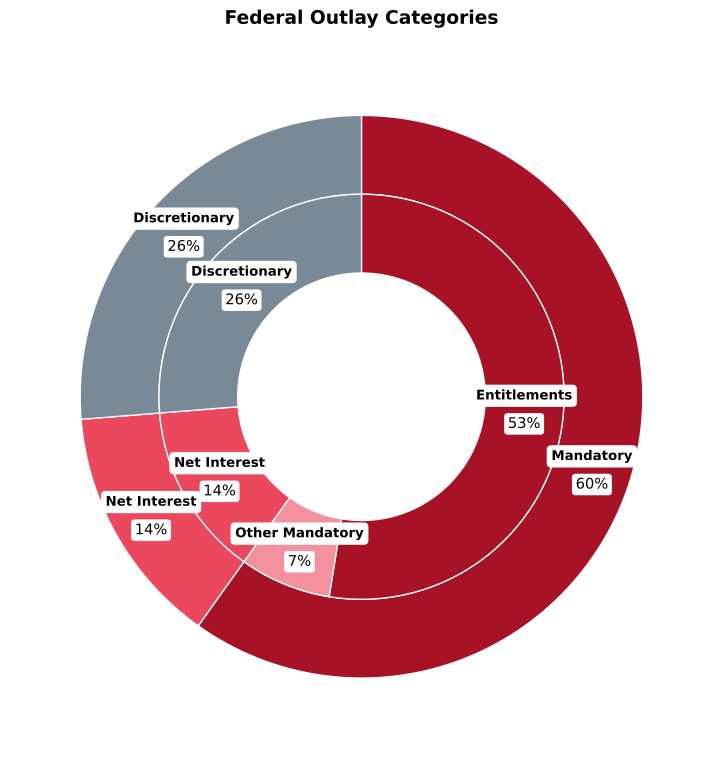
Figure 1 Source: CBO
OPEN (operating normally or near normal)
Social Security, SSI, Medicare, Medicaid, and CHIP (Mandatory)
Monthly benefit payments continue because these programs are funded by permanent law and trust funds, not the annual spending bills at issue. Field offices and call centers may be short-staffed, so expect slower customer service, but checks and covered health services continue. [1][2]
U.S. Postal Service (Fee-funded/Other)
Post offices stay open and mail runs on schedule. USPS finances operations mainly through postage and product revenue rather than annual appropriations. [3]
Air Travel Safety and Security (FAA air traffic control; TSA screening) (Discretionary) (excepted)
Flights continue. Air traffic controllers (Federal Aviation Administration) and Transportation Security Administration screeners work to protect life and property. You may see delays if support staff are furloughed. [4]
U.S. Customs and Border Protection continues inspections and tariff collection, the Federal Emergency Management Agency continues disaster payments, and many U.S. Citizenship and Immigration Services functions continue because they’re fee-funded. [5]
Passports and Visas (Fee-funded/Other)
The Department of State can continue a range of consular services funded by fees. Availability varies by embassy/consulate; plan for backlogs. [6]
Internal Revenue Service(Multi-year funds)
The IRS has multi-year funding under recent law and announced it will continue operations at least through the initial business days of the lapse (filing, refunds, enforcement, and phones). If the lapse is prolonged, watch for updated notices. [7]
Active-duty military continue to report for duty. Certain civilian personnel supporting protection of life/property or critical missions also continue; other civilian roles may be furloughed. Pay may be delayed until Congress acts, but operations (training, deployments, ongoing missions) continue under the Department of Defense’s lapse guidance. [8][9]
Debt Service (Mandatory)
Net Interest payments on the National Debt continue by statute, no risk of default.
PAUSED OR REDUCED (still there, but slower or narrower)
National parks, monuments, and public lands (Discretionary)
Many park units aim to keep basic access to open-air areas (roads, trails, memorials) where it’s safe, sometimes using limited recreation fee balances, while visitor centers, tours, and most programming pause. Conditions vary by park; services like trash, bathrooms, and rescues may be minimal. Check your park’s alerts before traveling. [10]
Economic statistics, many Grants, and routine Federal Agency services (Discretionary)
Non-emergency activity at departments such as Education, Labor, Commerce, Environmental Protection Agency, and Interior often scales down: new grants, routine guidance, some inspections, and many back-office services pause or slow until funding resumes. Each agency posts a contingency (“lapse”) plan with specifics. [11]
SNAP and WIC nutrition programs (Primarily Mandatory)
Supplemental Nutrition Assistance Program (SNAP) benefits are generally issued on schedule due to mandatory funding and advance planning; Special Supplemental Nutrition Program for Women, Infants, and Children (WIC) can rely on limited contingency funds but is more vulnerable in a prolonged lapse. Check the U.S. Department of Agriculture updates for your state. [12]
TANF Assistance (Temporary Assistance for Needy Families) (Mandatory)
TANF is a federally funded, state-run program that provides cash aid and work supports to low-income families with children. In shutdowns, states often continue TANF using prior-year federal funds on hand and state “maintenance-of-effort” dollars, but administrative processes at the federal level can slow and a very long lapse can strain state cash-flow. For current status, check your state human services agency and the federal Office of Family Assistance. [13][14]
Federal courts (Fees/carryover & Discretionary)
Federal courts typically remain open initially using fee balances and carryover funds, then tighten operations if a lapse lasts. Check your district/circuit court’s website for local notices (Administrative Office of the U.S. Courts). (General framework summarized in CRS.) [15]
Federal worker pay and services (Varies by function)
Many “excepted” employees work without pay (back pay typically follows under current law); others are furloughed and stop work. The Office of Personnel Management posts guidance for agencies and employees. [16]
CLOSED (fully halted unless tied to excepted activities)
Activities that rely only on annual discretionary funds and are not excepted
Examples include most routine agency trainings, many museum operations, some research labs, and new grant awards. They pause entirely until funding resumes. For program-by-program detail, consult each agency’s posted plan. [11]
Important context (State and Local Government services)
A federal shutdown is about federal appropriations. State and local governments remain open, and community services like most public schools, city services, state colleges, and local public safety continue to operate. Some state/local programs that depend heavily on federal grants can feel indirect effects if a lapse lasts, but day-to-day state/local government is not shut down by a federal lapse. [17]
Quick reference during Shutdown
Benefits: Social Security, Supplemental Security Income (SSI), Medicare/Medicaid, and Children’s Health Insurance Program (CHIP) continue; expect slower phones/appointments. [1][2]
Travel: Flights, air traffic control (FAA), and airport screening (TSA) continue; build in extra time. [4]
Parks: Assume limited services; check park alerts before you go. [10]
Passports/Visas: Many services continue (fee-funded). Verify appointment status at travel.state.gov. [6]
TANF: Payments commonly continue via state administration and available funds; confirm with your state human services agency. [13][14]
Military/Defense: Operations continue; some civilians furloughed; pay subject to later congressional action. [8][9]
Shutdowns are disruptive, but they end when Congress passes new funding or a short-term extension. Until then, the rules above should help you navigate what’s open, what’s closed, and what’s simply slowed.
When it comes to the Federal budget, several terms are used and it is important to understand what they are in order to know how they are funded, and how they shape the overall Federal budget. So, if you are interested in understanding the Federal budget, understanding these terms is a must. Most federal spending fits into three categories. Understanding how and why these categories work can help you understand the Federal Budget process and what programs keep paying even during funding lapses, why others pause, and where most dollars are actually spent. They can also help you understand what constraints Congress is under, knowing each of these categories will help you understand how little discretion there is in the budget without legal changes. For a high level understanding of these three categories in FY2024: Mandatory Spending programs were a bit over $4.1 trillion (~60%), Discretionary Spending programs about $1.8 trillion (~26%), and Net Interest (i.e. interest paid on the National Debt) about $1.0 trillion (~14%), for roughly $6.8 trillion in total Federal outlays (spending). Net interest is shown as its own category in official presentations. [1][2][3]
What each Category Means
Mandatory Spending: This category of spending, as its name implies, is required by statute (law). Budget items in this category are automatically authorized for funding unless the law is changed. The statute (law) sets which programs are mandatory and the eligibility requirements and formulas for how much is authorized. Mandatory spending was about $4.1T in FY2024—roughly 60% of total outlays. [2][3]
Entitlements: This category is a subset of Mandatory Spending. Entitlements are Mandatory Spending programs that confer a legal right to benefits to citizens, for example: Social Security, Medicare, and Medicaid are Entitlements. Entitlements make up the bulk of Mandatory Spending; Social Security and Medicare alone account for more than half of mandatory outlays. [2]
Net Interest: The interest the U.S. pays on its National Debt. It’s authorized by permanent law (a permanent, indefinite appropriation) [4], which is why many sources describe it as “technically mandatory,” but it is shown as its own category in the budget, separate from both mandatory and discretionary. In FY2024 it was about $1.0 trillion (~14% of total outlays). [1][3]
Discretionary Spending: This is the remaining non-compulsory spending, everything Congress has not defined by statute (law). Short of changing the law on Mandatory Spending programs, this is the part of the budget Congress can adjust annually. Discretionary spending is just over one-quarter of total outlays (~26%). Congress decides discretionary levels each year during the Federal budget process in 12 separate appropriations bills produced by the Appropriations Committees. (See our Article on Federal Budget Process.) [1][5]
Figure 1: Federal Budget Categories FY 2024 Source: CBO
What’s inside each Category
Mandatory Spending
Programs
Description
Entitlement
FY 2024 Budget Amount
% of Total Federal Spending
Social Security (Old-Age, Survivors, and Disability)
Provides benefits to retired workers, the disabled, and their spouses, children, and survivors. Funded by payroll taxes.
Yes
$1.45T
21.4% [2]
Medicare
A federal health insurance program primarily for people age 65 or older and certain younger people with disabilities.
Yes
$0.9T
12.7% [2]
Medicaid and CHIP
A federal-state health care program for low-income and needy individuals, including children, pregnant women, the elderly, and people with disabilities.
Yes
$0.6T
9.1% [2]
Veterans’ disability compensation and pensions
Provides benefits to veterans who have a service-connected disability. Pensions are paid to low-income wartime veterans.
Yes
$0.2T
2.8%
Federal civilian and military retirement
Provides retirement benefits to federal government civilian employees and military personnel, including pensions, disability, and survivor benefits.
No
$0.2T
2.9%
Unemployment Insurance (federal share)
A joint federal-state program that provides temporary, partial wage replacement to unemployed workers.
Yes
$0.03T
0.5%
SNAP and other nutrition programs
Provides benefits to low-income households to supplement their food budgets. Other programs include school lunch, and food assistance for seniors.
The part of tax credits that can be paid as a refund.
Yes
$0.16T
2.4%
Affordable Care Act (a.k.a. Obamacare)
Provides tax credits and other subsidies to help eligible individuals and families afford health insurance.
Yes
$0.11T
1.6%
Farm programs (e.g., crop insurance subsidies)
Provides subsidies and other support to farmers and agricultural producers.
No
$0.03T
0.5%
Other Mandatory Programs
A collection of smaller, non-entitlement mandatory outlays not separately itemized, such as deposit insurance, payments for natural resources, and other government-wide programs.
No
$0.3T
4.1%
Subtotal Mandatory Spending
$4.1T
~60%
Net Interest
Program
Description
FY 2024 Budget Amount
% of Total Federal Spending
Net Interest
Debt Service – Interest payments on US National Debt
$1.0T
~14%
Discretionary Spending
Programs
Description
FY 2024 Budget Amount
% of Total Federal Spending
National Defense
Funds for the Department of Defense (military operations, personnel, weapons procurement, research), and other defense-related activities in other agencies.
$0.9T
~13% [1]
Health and Human Services
Discretionary funds for health research (e.g., NIH), public health, and human service programs, separate from Medicare and Medicaid entitlements.
$0.1T
~2%
Education
Provides funding for federal education initiatives, grants, and programs at all levels.
$0.1T
~1%
Transportation
Supports highway and airport construction, mass transit, and other infrastructure projects (note: highways/aviation have mandatory contract authority, but spend-out is shaped by annual limits).
$0.1T
~1%
Veterans’ Health Care
Funds health care services provided through the Veterans Health Administration (separate from mandatory disability compensation).
$0.1T
~2%
Homeland Security
Funds for agencies responsible for homeland security, including border patrol and immigration enforcement.
$0.06T
~1%
Housing & Urban Development
Public housing, community development, and housing assistance programs.
$0.06T
~1%
Energy & Environment
Department of Energy, Environmental Protection Agency, and other natural resource and environmental programs.
$0.06T
~1%
International Affairs
State Department, USAID, and foreign aid.
$0.06T
~1%
Other Discretionary
Various government agencies and programs, including general government administration, science, and space exploration (e.g., NASA/NSF).
$0.3T
~5%
Subtotal Discretionary
~$1.8T
~26%
Summary
Knowing Federal Budget terms is useful for understanding how and where Federal money is spent. In FY2024 the Federal Government spent ~$6.8 trillion and took in ~$4.9 trillion, with a deficit of ~$1.8 trillion. The majority of the spending goes to Mandatory programs, most of which are Entitlement programs providing services and benefits to citizens. Net interest—about $1.0T—is reported as its own category and paid under permanent law. As the Mandatory components grow, there is less room for Discretionary items that Congress can administer without reductions in mandatory spending, increases in tax revenue, or additional borrowing. When you look at discretionary spending, many people would consider those categories essential – Education, Environment, Transportation, National Defense – core services of government. Understanding these components clarifies the difficult trade-offs between fiscal sustainability and key government services. [1][2][3][4][5]
Citations
[1] Congressional Budget Office (CBO), The Federal Budget in Fiscal Year 2024: Infographic; and Discretionary Spending in FY2024: Infographic (discretionary ≈ $1.8T; composition; total outlays context). [2] CBO, Mandatory Spending in Fiscal Year 2024: An Infographic (mandatory ≈ $4.1T; Social Security + Medicare > half of mandatory). [3] CBO, Monthly Budget Review: Summary for Fiscal Year 2024 (total outlays ≈ $6.8T; net interest ≈ $0.95T, rounded to $1.0T). [4] 31 U.S.C. § 3123, Payment of obligations and interest on the public debt (interest paid under permanent, indefinite appropriation). [5] CBO primers on budget categories and the annual appropriations process (12 appropriations bills produced by the Appropriations Committees).
The terms “surplus”, “deficit” and “debt”, or “National Debt”, are often used at the same time, and sometimes interchangeably, but they represent distinct concepts in government finance. Understanding the difference is crucial for grasping the fiscal health of our nation. This article discusses the differences, helps define them and put them in terms Citizens can use.
What is a Surplus & Deficit?
Imagine your household budget for a given period, say a month. You have money coming in (your income) and money going out (your expenses).
Deficit: If in that period you spend more money than you earn, you have a deficit. You’ve spent more than your current income . For a government, a budget deficit occurs when its total expenditures (spending on programs, services, etc.) exceed its total revenues (money collected from taxes, fees, and other sources) within a specific fiscal year (typically October 1 to September 30 in the U.S.) [3]. That is to say Total Expenses exceed Total Revenue.
Deficit
Inadequacy or insufficiency. “a deficit in revenue.”
The amount by which a sum of money falls short of the required or expected amount; a shortage. “budget deficit.”
Deficiency in amount or quality; a falling short; lack. “a deficit in taxes, revenue, etc.”
Surplus: Conversely, if you earn more money than you spend in a given month, you have a surplus. The government experiences a budget surplus when its revenues exceed its expenditures in a fiscal year. This means that your Total Revenue exceeds your Total Expenses and you have money left over [3].
Surplus
Being more than or in excess of what is needed or required: synonym: superfluous. “surplus revenue.”
Being or constituting a surplus; more than sufficient. “surplus revenues; surplus population; surplus words.”
An amount or quantity in excess of what is needed.
What is a National Debt?
Now, let’s extend that household analogy. If you consistently spend more than you earn each month, you’ll likely need to either a) Reduce Spending, b) Increase Revenue, c) Take from Savings, or d) Borrow money (use credit). Your use of credit might be a credit card, a loan from a bank, or borrowing from friends and family. This accumulated borrowing represents your total debt.
National Debt: The National Debt (or public debt) is the cumulative total of all the money the federal government has borrowed over its entire history to cover past deficits, minus any surpluses [1, 3]. When the government runs a deficit, it has to borrow money, usually by issuing Treasury bonds, bills, and notes. This new borrowing adds to the National Debt. When it runs a surplus, it can use that extra money to pay down a portion of the existing debt, or put into funding other programs and services.
While the US Government has mechanisms that you and I don’t have that make it different than a Credit Card, for our analogy the National Debt accumulates like the total balance on your credit card or loan statement, which reflects all the outstanding purchases (expenses) you’ve made over time and haven’t fully paid off (debt). Every time you have a monthly deficit (spend more than you earn and put it on credit), your overall credit card debt increases.
Debt
Something owed, such as money, goods, or services.”used the proceeds to pay off her debts; a debt of gratitude.”
An obligation or liability to pay or render something to someone else.”students burdened with debt.”
The condition of owing. “a young family always in debt.”
National Debt and Deficits in Context, why does it matter?
For the United States, carrying some debt is nothing new, with rare exception the U.S. has carried debt since its inception [2]. Carrying some debt is normal, and perhaps beneficial – say like a Mortgage and a Credit Card bill you pay each month. However, the scale and trajectory of the US National Debt have dramatically changed over the last few years. The US has had some economic shocks that increased the debt rapidly including the 2008 Great Recession, and the COVID Pandemic. What is different now with our current National Debt is that it is the highest it has ever been ($36.95 Trillion) [10] greater than our entire country’s annual economic output of $29.18 trillion in 2024 (Debt to GDP > 100%) [11]. Troubling is that this is a peace time debt surpassing World War II levels of spending. To some, more concerning is that each year we have a deficit in our budget, now exceeding over a trillion dollars annually, that appears to be a structural shortfall. Meaning, the government’s revenue is consistently below its expenses and commitments that isn’t one time or transient, and must borrow each year to meet its funding needs.
The last time the U.S. federal government ran an annual budget surplus was in 2001 [1, 3]. Since then, the nation has experienced a continuous string of deficits (over 20 years in a row). This persistent pattern isn’t just a result of temporary economic downturns; it’s driven by structural deficits.
Structural deficits refer to a persistent imbalance between government spending and revenues that exists even when the economy is operating at its full potential (i.e., not in a recession, or major economic shock) [1, 3]. These are not caused by the ups and downs of the business cycle but by fundamental, long-term mismatches in revenue and expenses [3]. Key drivers of structural deficits in the U.S. include:
Aging Population: As the population ages, programs like Social Security and Medicare face increasing demands, leading to higher spending. Fewer working-age individuals contribute taxes relative to the growing number of retirees receiving benefits [1].
Rising Healthcare Costs: Healthcare costs consistently outpace economic growth, putting upward pressure on government spending for programs like Medicare and Medicaid [1].
Tax Policies: Decisions to cut tax rates without corresponding spending reductions, or a tax base that doesn’t keep pace with the modern economy, can contribute to insufficient revenue.
Increased Spending Commitments: Long-term commitments to various government programs and services, without sustainable funding mechanisms, create an ongoing gap.
These underlying factors mean that even during periods of economic prosperity, the U.S. government is projected to continue spending more than it collects, contributing to the ever-growing national debt [1].
Are Deficits Bad? What about Interest?
Deficits, and Debt spending are not all bad. Government can step in to “prime the pump” in times of economic turbulence to smooth a business cycle, and some government investments add to overall productivity. However, while sometimes beneficial (e.g., during wars, pandemics, or severe economic crises to stimulate recovery), persistent and large deficits are generally not a good thing because they directly lead to a larger national debt, and a larger national debt brings its own set of challenges:
Increased Interest Payments: Just like you pay interest on your credit card debt, the government must pay interest on the National Debt [8]. As the debt grows, so does the amount of interest the government has to pay. If your credit card balance keeps growing, a larger and larger portion of your monthly payment goes just to interest, leaving less money to pay down the principal or for other essential spending.
Real-World Impact: For the U.S. federal budget, interest payments on the national debt have become one of the fastest-growing “programs” [8]. These payments are mandatory and siphon away funds that could otherwise be used for other programs like education, infrastructure, scientific research, defense, or reducing taxes [8]. In 2024 Interest expenses exceeded $1 trillion dollars, passing the US Military as the 3rd largest expense in the Federal budget [12].
Crowding Out Budget Items: As the Interest payments grow, if they get large enough it puts the government in a difficult situation. If they are unable offset the deficits with more Revenue they may be forced to reduce other programs, or add to the Debt compounding the challenge. This has the effect over time of crowding out other government expenses in order to pay the rising Interest expenses.
Higher Interest Rate Expenses: When the government borrows heavily to finance its deficits, it competes with private businesses for available capital in the financial markets [9]. This increased demand for capital can drive up interest rates from investors who are taking on more risk from a highly leveraged seller. Higher interest rates make it more expensive for the government to borrow money to finance the debt. This leads to increasing Interest expenses. For example if you’re constantly maxing out your credit cards, banks might be less willing to lend you money or increase your interest rate to compensate for their higher risk.
Reduced Fiscal Flexibility: A large and growing national debt limits the government’s ability to respond effectively to future crises (like recessions or natural disasters) or to make necessary investments [8]. With a significant portion of the budget already allocated to interest payments, policymakers have less room to maneuver. If your household expenses match your income, an unexpected medical emergency or job loss can be catastrophic if you have no financial buffer or ability to borrow more without extreme difficulty. This can lead to difficult choices, potentially requiring painful tax increases or spending cuts during times when economic stimulus or social support is most needed [8].
Risk of Fiscal Crisis: In extreme cases, if investors lose confidence in a government’s ability to manage its debt, they may demand much higher interest rates or stop lending altogether. This could lead to a fiscal crisis, where the government struggles to pay its bills, potentially causing economic instability, inflation, and a loss of trust in the nation’s financial system [8]. This situation is unlikely to happen in the US as the Reserve Currency in the World, and backed by the US Governments unlimited ability to tax.
US Advantages: The Reserve Currency and Fiat Money
It’s important to acknowledge that for countries like the United States, whose currency (the U.S. dollar) holds reserve currency status, there’s a unique advantage. As the world’s primary reserve currency, the dollar is widely used in international trade, finance, and as a store of value by central banks globally [5]. This creates a consistently high demand for U.S. Treasury bonds, even amidst large deficits, making it easier and often cheaper for the U.S. government to borrow money [5]. Foreign governments and investors are generally willing to lend to the U.S. at relatively low interest rates because U.S. Treasury securities are considered extremely safe and liquid [5]. However, this ability is not unlimited and we may get to a point where that is tested (See our article Return of the Bond Vigilantes).
Furthermore, because the U.S. government issues its debt in its own fiat currency (a currency not backed by a physical commodity like gold, but by government decree), it theoretically has the ability to “print” more money to pay its debts. This gives it a degree of flexibility that countries borrowing in foreign currencies do not possess [5].
However, most mainstream economists believe that while these factors allow for higher debt levels, they do not negate the long-term risks associated with persistent structural deficits and a continuously rising national debt. Even with the reserve currency advantage and the ability to issue debt in fiat currency, there are still significant potential downsides:
Inflation: While printing money can address debt, doing so excessively without a corresponding increase in goods and services (productivity) can lead to inflation, eroding the purchasing power of the currency [7].
Loss of Confidence: Even for a reserve currency, if debt levels become truly unsustainable or if the government appears unwilling to address its fiscal imbalances, investors could eventually lose confidence, leading to a depreciation of the currency and higher borrowing costs as demand moves away from the dollar.
Intergenerational Equity: Accumulating massive debt effectively transfers the burden of repayment (through future taxes or reduced services) to younger and future generations.
It’s worth noting that a minority school of thought, known as Modern Monetary Theory (MMT), holds a different perspective. MMT proponents argue that a sovereign government, which issues its own fiat currency, is not financially constrained in the same way a household or business is [6]. They contend that such a government can always create enough money to meet its obligations and finance spending, as long as it avoids inflation [6]. From this viewpoint, the primary limit on government spending is the availability of real resources in the economy, not the ability to finance deficits [6]. While MMT has gained some academic traction, its policy prescriptions and core tenets remain largely outside the economic mainstream and are considered outside of the mainstream by most economists, who emphasize the importance of fiscal sustainability and the risks of unchecked government spending and debt [7].
Conclusion
In conclusion, surpluses are annual measures of revenue outpacing expenses, deficits are an annual measure of overspending, and the national debt is the cumulative total of all borrowing less surpluses. Persistent deficits lead to growing debt, which in turn leads to higher interest payments, potential crowding out of private investment, reduced fiscal flexibility, and an increased risk of economic instability. While the U.S. dollar’s reserve currency status and the nature of fiat currency provide certain advantages in managing debt, most economists agree that these do not make the nation immune to the long-term structural problems that large and growing deficits entail [13][14]. Addressing these long-term fiscal challenges requires difficult policy choices to ensure a sustainable economic future.
Taxation lies at the heart of all governments. It funds the services, institutions, and protections that define modern states. However, the question of how to tax fairly, efficiently, and effectively has been debated for centuries, even millennia. Few thinkers have had as profound an influence on this topic as Adam Smith, the 18th-century Scottish economist and moral philosopher whose seminal work, The Wealth of Nations (1776), introduced what are now known as the Four Canons of Taxation[1].
These principles — Equity, Certainty, Convenience, and Economy — continue to shape how modern tax systems are evaluated. In the United States, Smith’s ideas strongly influenced early American leaders including our Founders and remain embedded in the design of the federal tax code.
This article explores Smith’s life and intellectual context, the origin and meaning of the Four Canons, their influence on American political thought, and how the U.S. tax system measures up against these enduring principles.
Adam Smith: Architect of Classical Economics
Adam Smith (1723–1790) was a philosopher and economist born in Kirkcaldy, Scotland. Educated at the University of Glasgow and later Oxford, Smith became a professor of logic and moral philosophy and part of the period known as the Scottish Enlightenment. His early work, The Theory of Moral Sentiments (1759), examined ethics, human behavior, and the moral foundations of society.
But it was his 1776 masterpiece, An Inquiry into the Nature and Causes of the Wealth of Nations, that revolutionized economics[1]. In it, Smith laid the foundations for classical economics, championed free markets, and discussed the role of government. It was in this work that he formulated what are now referred to as the Four Canons of Taxation.
Smith was not an anarchist or anti-tax advocate. He believed that governments had vital roles to play — including defense, justice, education, and infrastructure[1]. To perform these functions, governments required funding. Thus, taxation was necessary, but it had to meet certain standards of fairness, predictability, and efficiency.
The Four Canons of Taxation
1. Equity: Tax According to Ability to Pay
“The subjects of every state ought to contribute towards the support of the government, as nearly as possible, in proportion to their respective abilities; that is, in proportion to the revenue which they respectively enjoy under the protection of the state.”[1]
Adam Smith
Smith’s principle of Equity suggests a proportional tax system. Those who earn more should pay more, not just in absolute terms but potentially in relative terms. This was a precursor to the concept of progressive taxation. Taxation should reflect a taxpayer’s ability to pay without creating undue hardship.
In America, these principles were deeply embedded in our Founders:
“The rich must contribute to the public expense, not only in proportion to their revenue, but something more than in that proportion.”[2]
Thomas Jefferson
“A just proportion of the public burdens should be borne by each individual citizen, according to his ability to contribute.”[3]
Alexander Hamilton
Today, the U.S. tax code uses a progressive income tax, aligning in principle with Smith’s idea of Equity, though debate continues over what constitutes a fair share, and Smith’s specific use of the word Proportion as relative to income versus the progressive system (beyond relative) that we have today.
2. Certainty: Clear and Predictable Obligations
“The tax which each individual is bound to pay ought to be certain, and not arbitrary. The time of payment, the manner of payment, the quantity to be paid, ought all to be clear and plain.”[1]
Adam Smith
Taxes should be transparent and not left to the whims of officials. A predictable and transparent tax system enables individuals and businesses to plan effectively and fosters trust in government.
This view was of “great importance” to our founders, that certainty, fairness, transparency and the ability of citizens to understand their taxes were embedded in our system.
“It is of the greatest importance that the business of revenue should be conducted with the utmost fairness, and that every citizen should understand the nature and extent of the tax to which he is subject.”[4]
Alexander Hamilton
U.S. tax laws today are formally certain, with statutory rates, schedules, and regulations. Every citizen understand their duties, when their taxes are due, and to a large extent how they are formulated. However, the sheer size and complexity of the tax code has been criticized for undermining this canon. The tax system is full of deductions, credits, special carve outs, and ambiguous language, often requiring professional assistance to interpret.
3. Convenience: Taxes Should Be Easy to Pay
“Every tax ought to be levied at the time, or in the manner, in which it is most likely to be convenient for the contributor to pay it.”[1]
Adam Smith
Tax collection should consider the circumstances of taxpayers. For example, collecting income tax via payroll withholding ensures that payment coincides with earnings. Again, our Founders believed in this concept, including Alexander Hamilton, our first Treasury Secretary.
“The mode of collecting taxes ought to be convenient to the people… suited to their habits and circumstances.”[5]
Alexander Hamilton
The U.S. tax system has improved on this front, with withholding the EZ form, e-filing, and installment plans, though filing remains burdensome and costly for many. Unlike many countries, the US Governments lack of a sponsored and free option for all citizens to file, or a pre calculated option for citizens to approve since the vast majority of all information is already known by the IRS has been a topic of debate and impacts this principle.
4. Economy: Minimize Cost of Collection
“Every tax ought to be so contrived as both to take out and to keep out of the pockets of the people as little as possible, over and above what it brings into the public treasury of the state.”[1]
Adam Smith
Smith was concerned not only with the tax burden itself, but with the administrative cost, economic drag, and opportunity for corruption in tax collection. Efficient systems maximize public revenue while minimizing compliance and enforcement costs.
America’s founders were also worried about this as well.
“The expenses of collection should be as little as possible… It is essential that the system of revenue avoid waste, corruption, and unnecessary cost.”[6]
Alexander Hamilton
Today, the IRS’s cost of collection is relatively low compared to many other nations (about 35 cents per $100 collected)[7], but the indirect compliance burden on taxpayers is high — estimated at over $300 billion annually in time and preparation costs[8].
Comparison Table: U.S. Tax System vs. Smith’s Canons
Canon
Smith’s Standard
U.S. Implementation
Assessment
Equity
Taxpayers contribute proportionally according to their ability to pay
Progressive income tax system
America’s Progressive income tax meets the spirit to a large part, if not the direct implementation (Proportional), but other forms of regressive taxes dilute equity
Certainty
Tax obligations must be clear and predictable
Codified tax code, published schedules
The US has one of the more structured Legal Tax Codes in existence, but in practical terms the size and complexity undermines this principle.
Convenience
Payment should align with taxpayer circumstances
Withholding system, online filing, payment plans
The US system attempts to make it easy with e-Filing and EZ returns, but for complex filers it remains burdensome.
Economy
Minimize administrative and compliance cost
IRS efficient at collection; high compliance cost for taxpayers
The US has a fairly Efficient and automated collection system, although some will argue given the size and extent of the IRS [9], but high cost to taxpayers in time and prep
Table 1
Conclusion
Adam Smith’s Four Canons of Taxation remain a gold standard for evaluating any Government fiscal system. They represent not only economic logic but moral reasoning: that government should raise money fairly, predictably, conveniently, and efficiently. Almost 250 years ago, coinciding exactly with the US Semiquincentennial, Adam Smith’s Canons still stand as sound governance for all countries.
Incorporated implicitly into America’s founding philosophy, these canons influenced early debates on taxation and continue to frame modern discussions on tax reform. The U.S. system embodies many of these principles in structure, but often falls short in execution due to complexity, political compromise, and uneven application.
Smith’s legacy is not just a blueprint, but a framework that allows governments and citizens to ask questions: Is our tax system just? Is it efficient? And is it worthy of the public trust?
In that sense, the Four Canons of Taxation are not just economic principles — they are a moral test for government itself.
The Federal government isn’t just a tax collector — it’s the largest redistribution engine in the country for funding to the States.
Each year, trillions of dollars in Federal taxes are collected from across all 50 states. That money is then redistributed through spending on public programs, infrastructure, grants, contracts, aid, and more. Much of that funding is redistributed back to the States.
But who gives the most — and who gets the most back? Is what you give, what you get back?
Today, we’re excited to launch our latest Tax Project Citizen tool, our Fund Flow app — a powerful, interactive tool that makes it easy to explore the financial relationship between each State and the Federal government.
What is Fund Flow?
Fund Flow is a data-driven web app that brings clarity to a complex topic. Using visually rich, interactive charts and maps, you can explore:
Which states are net contributors (giving more than they get)
Which states are net recipients (getting more than they give)
Whether you’re zooming in on your own State or comparing nationwide trends, Fund Flow gives you a clear view of where the money flows.
Why It Matters
This isn’t just about dollars and cents — it’s about understanding how our system works.
Most people don’t realize how much their state sends to Washington D.C. — or how much it gets back. Fund Flow gives everyone the tools to:
Understand where your tax dollars go
Stay informed about how Federal funding is redistributed
See which states benefit the most or least from Federal spending
Engage with real data in a clear, accessible way
Informed citizens are essential to a healthy democracy. By making these financial flows visible, Fund Flow helps you ask better questions, have smarter conversations, and hold decision-makers accountable.
Explore Fund Flow
Try out Fund Flow today! It’s free to use and built for everyone — from citizens and educators to journalists, researchers, and policymakers.
Tax Project Institute is a fiscally sponsored project of MarinLink, a California non-profit corporation exempt from federal tax under section 501(c)(3) of the Internal Revenue Service #20-0879422.