AI and robotics could raise economic output while reducing the need for human labor. If that happens at scale, the US runs into a basic mismatch: much of today’s tax system is tied directly or indirectly to wages. Payroll withholding, wage income, and wage-driven consumer spending form a large part of the revenue “engine.” In a high-automation economy, that engine weakens unless the tax base shifts toward what still scales with output.
The AI transition as envisioned by some will cause massive upheaval to social, and economic systems across the world. Plenty of work must be done to plan for this potential future in developing frameworks to support such a transition. This article covers two things only: (1) the order-of-magnitude scale of UBI and UHI-style programs will require, and (2) the mechanisms government could use to capture enough AI-era productivity to fund them. It does not cover job churn, social stress, or geopolitical spillovers. The aim is to make the dollars concrete and map the major funding options. The intent of this article is not to predict the future, but provide guidance and a framework for what may be required and the scale of various options, and the magnitude of the challenges ahead.
“AI could wipe out half of all entry-level white-collar jobs – and spike unemployment to 10-20% in the next one to five years.”
Dario Amodei, CEO Anthropic
What “UBI” and “UHI” mean in this article
To keep the math understandable, costs are modeled per household (so family members are not counted multiple times).
UBI is treated as a “basic” cash floor, anchored to the real median household income. UHI is treated as a “high” cash floor, anchored to the 90th percentile household income (top 10% threshold). Those are not endorsements of any specific program design. They are benchmarks that help show how quickly the funding problem scales when the target shifts from “basic” to “high.”
Inputs used:
US households: 132,737,146 (2024 ACS). [1]
UBI level: $80,610 (2023 real median household income). [2]
UHI level: $234,900 (2023 household income at the 90th percentile). [3]
FY2024 federal receipts: $4.918 Trillion (for perspective). [4]
Nominal GDP reference: about $29.8 Trillion (Q4 2024 annual rate). [5]
“AI will affect almost 40 percent of jobs around the world, replacing some and complementing others.”
“In advanced economies, about 60 percent of jobs may be impacted by AI.”
IMF [6]
Cost Overview: How big the dollars get, fast
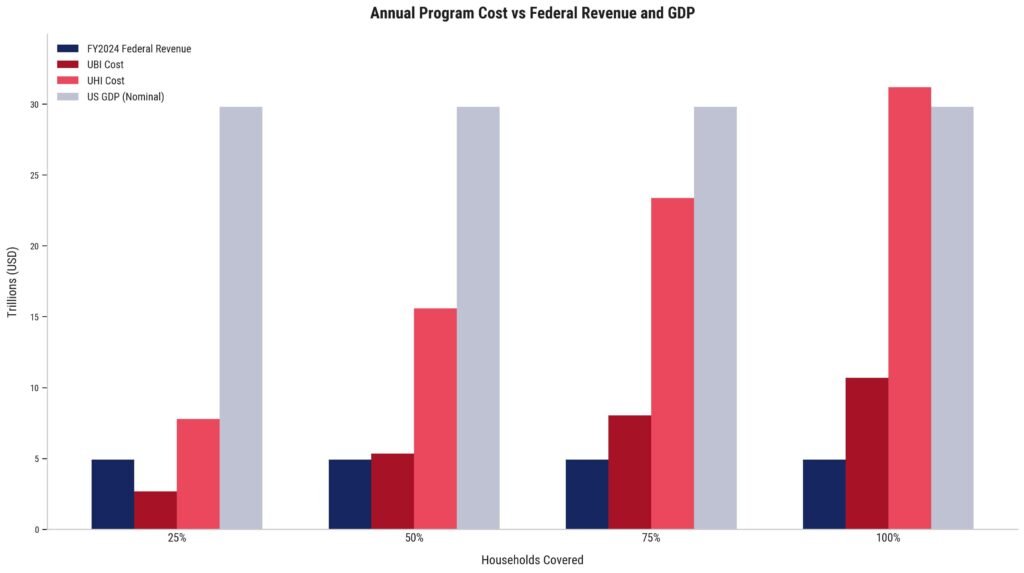
The chart below (Figure 1) shows annual cost if UBI or UHI is paid to 25%, 50%, 75%, or 100% of US households. Coverage is included to show scale and sensitivity. It is not a policy recommendation.
Figure 1 UBI and UHI Scenarios
The chart in figure 1 is used to illustrate a point: a broad UBI quickly becomes comparable in cost to the entire federal government; a “high” UHI level program becomes many times larger. Whatever a future program looks like, the US would be operating at a scale where the funding base and capture method must be designed to support an order of magnitude larger change, and put in place mechanisms to capture the AI transition gains.
What AI Productivity gains would be needed?
The term “Productivity gains” can sound abstract. In simple terms we can discuss the cost required in comparison to the share of the economy it represents.
Using the Gross Domestic Product (GDP) used to represent the Total Economic output of our country as a reference point of roughly $29.8T [5]:
UBI (100% coverage) at $10.7T is roughly 36% of today’s GDP.
UHI (100% coverage) at $31.2T is roughly 105% of today’s GDP.
So if Government wishes to implement UBI/UHI style programs the Economy must grow substantially, and the Government must create a mechanism to reliably capture these productivity gains in order to support the transfers required for these programs.
In other words, in a post AI transition economy – the AI productivity gains and value generated from AI would need to be of an enormous scale, and the collection mechanism would need to capture the value reliably in order for these programs to work.
A practical way to think about it is the “capture rate” for AI Productivity is what share of national output that ends up as public revenue. In FY2024, Federal revenue was $4.918T, which is roughly 16%-17% of GDP depending on the GDP measure used. [4][5] That gives a rough idea of what “normal” looks like today.
“It’ll be 10 times bigger than the Industrial Revolution – and maybe 10 times faster.”
Demis Hassabis, Google DeepMind
Now apply that to our UBI/UHI scenarios:
If public revenue stayed around 17% of GDP, funding a $10.7T UBI would require an economy on the order of $60T+ per year (because 17% of $60T is about $10.2T). That is roughly 2x today’s GDP.
Funding a $31.2T UHI at the same revenue share would imply an economy on the order of $180T+ per year, which is roughly 6x today’s GDP.
Those are not forecasts. They are scale checks. They show that sustaining large transfers requires either:
Much higher Tax Rates
A much larger economy (Meaning AI is going to have to create ALOT of value and productivity gains)
Lower or Narrower benefits than the “all-on” benchmarks used here.
This is why funding design matters as much as growth assumptions. The question becomes: what can the US reliably tax when labor income is no longer the central revenue base and jobs and income are increasingly lost to automation.
Funding: what can are the captures mechanisms in an AI-heavy economy?
Here we look at possible mechanisms that could be put into place in a framework that would capture the AI Productivity and fund the UBI/UHI style programs. In a post AI transition steady state, the most stable funding tends to come from bases that are broad, measurable, and hard to evade. “AI-specific” taxes can contribute, but most are better as supplements than as the backbone.
AI Productivity Capture Mechanisms
Option
What it is (plain definition)
Strengths
Weak points
Best role
A) Labor-Equivalent replacement charge
A fee based on estimated “workers replaced” by automation, meant to mimic the labor tax wedge.
Simple story: replace jobs, contribute.
Hard to define; easy to game; can reduce productivity.
Narrow/targeted use, not backbone.
B) Metered AI usage tax (tokens/compute)
An excise on AI activity (tokens, inference calls, compute-hours).
Measurable upstream; scales with usage.
Proxy for value; encourages offshoring/self-hosting; can slow adoption.
Supplement, best upstream.
C) Broad consumption tax (VAT-style + rebates)
A broad tax on spending, paired with rebates/credits to protect households.
Scales even if wages shrink; hard to avoid.
Politically difficult; regressive if not rebated.
Strong backbone candidate.
D) Capital income taxes
Higher effective taxation of dividends, capital gains, and high-end capital income.
Targets where returns may concentrate.
Volatile and gameable; cycles with markets.
Secondary pillar.
E) Corporate tax redesign
Minimum taxes and base redesign to reduce profit shifting; tax where sales occur.
Targets AI-era margins; reduces base erosion.
Complex; global tax competition.
Core pillar, but not sufficient alone.
F) Rents/royalties on bottlenecks
Tax scarce “rents” (land/location value, energy access, spectrum, possibly compute if scarce).
Efficient and stable; hard to hide.
Some bases may be too small alone; compute scarcity uncertain.
Strong pillar.
G) Citizen dividend fund
Public fund owns a slice of productive assets and pays dividends.
Durable legitimacy; broadens ownership of productivity gains.
Governance risk; takes time to build scale.
Long-run complement to taxes.
H) Debt/deficits (bridge)
Borrow to start programs before the new base is built.
Fast to deploy.
Not stable long-run; interest/credibility limits.
Bridge only.
Which Option?
The Tax Project does not comment on policy recommendations. However, a stable post-transition funding system is unlikely to rest on a single “magic tax.” It is more likely to resemble a stack. Broad consumption-based funding (Option C) is structurally strong because it scales with the economy regardless of labor share. Rent-like taxes (Option F) are also structurally strong because they target bases that cannot be moved offshore easily (land and spectrum are the clearest examples). Corporate redesign and capital income taxes (Options E and D) matter because AI-era gains may concentrate in profits and asset returns, but these are also the most contested and gameable bases, which is why they tend to work best as pillars alongside broader bases.
The AI specific ideas—charging by “labor equivalents (LE) replaced” (Option A) or metering compute/tokens (Option B) – may read well politically, but they struggle as a primary funding backbone. LE charges tend to collapse under definition and when corporations game the system, and usage taxes are proxies that can be arbitraged. This is not to say that corporations are doing anything wrong, they will naturally optimize for their circumstance. These mechanisms may still contribute at the margin, especially if applied upstream where metering is clean, but the heavy lifting usually falls to broad, durable bases and, over time, to ownership structures that turn productivity into dividends (Option G). Whatever is chosen, this will be a tricky path. There are always second order effects, and any tax can potentially harm productivity and the competitiveness of those being taxed, particularly in a global economy.
The Road Ahead: Plan now
If AI and robotics displace labor at scale, as many have predicted, the US cannot assume that today’s labor heavy tax base will keep funding the government it currently has, let alone new multi-trillion-dollar benefit programs in the form of UBI or UHI. The scale shown above implies a hard reality: sustaining UBI or UHI at meaningful coverage requires some combination of (1) a much larger economy, (2) a higher and more durable share of GDP collected as public revenue, and (3) redesigned tax bases that still work when wages are no longer the main revenue collection mechanism.
That redesign cannot be improvised in a crisis. It requires advance planning: defining viable tax bases, building administrative systems that can operate at scale, and establishing rules stable enough to survive political cycles. Even if the transition is slower than expected, the time to build a credible framework is now – these systems and the required legislature will take a good deal of time.
The US Federal budget appears as something Congress actively “sets” each year. In reality, a growing share runs on autopilot – governed by laws passed in prior years and by interest costs tied to past borrowing. That shift matters because it reduces flexibility. When the adjustable slice gets smaller, even well-intentioned efforts to “balance the budget,” “cut waste,” or “fund new priorities” run into a hard constraint: there is less room to move without changing the underlying laws. [1][2]
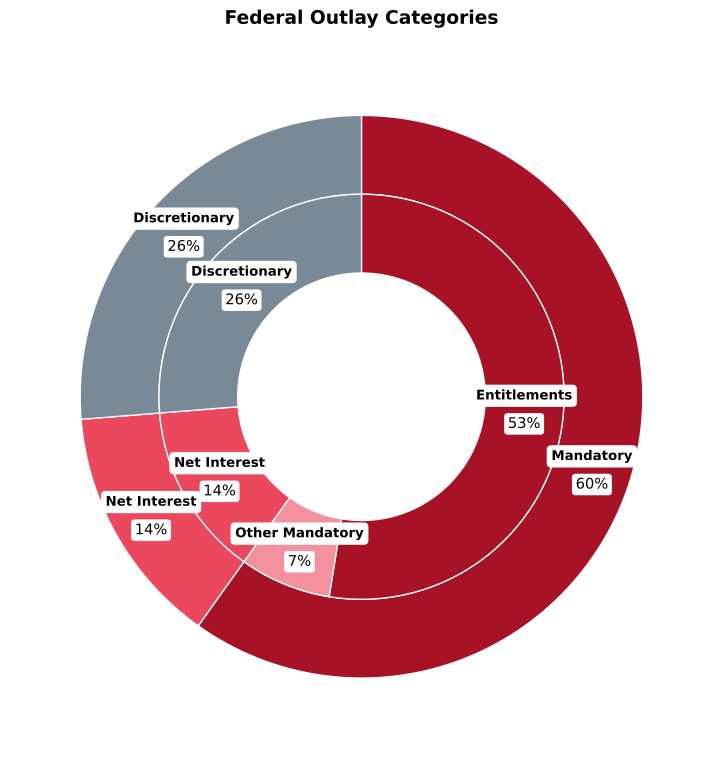
Office of Management and Budget (OMB) historical data shows a long, clear trend: discretionary spending used to represent most Federal outlays (spending) as recently as the 1960s, and today it represents roughly a quarter. [2] Figure 1 illustrates the same core idea: over time, the “annual choice” (a.k.a. Discretionary) portion shrinks while Mandatory spending and Net Interest take up more and more of the total.
Figure 1. Discretionary vs Mandatory & Net Interest (share of total federal outlays).
Figure 1: US Federal Budget Discretionary % Source: OMB
As the Discretionary component of the budget continues to shrink as a percentage of the budget Congress is left with less flexibility, and fewer tools to combat Fiscal challenges. While this was done intentionally in many cases to ensure that funding for critical programs like Social Security, and Medicare are funded, it has the effect of hamstringing the legislative branch in a number of ways.
1) Smaller Steering Wheel
Discretionary spending is the part of the budget Congress decides through the annual appropriations process. It funds many of the visible functions people associate with government: agencies, staffing, operations, contracts, grants, and a wide range of public services. [3]
As discretionary becomes a smaller share of total outlays, the annual appropriations process controls less of the overall budget. Congress is still making choices, but with fewer degrees of freedom – all but roughly one quarter of the budget is on auto pilot before they even start. The practical result is simple: fewer options exist inside the discretionary part of the budget that can be changed quickly without changing the law.
This is the first flexibility problem. Many public debates treat the entire budget as negotiable every year. It is not. A rising share is effectively pre-committed by statute and by the interest payments on our National Debt. [2][3] Because of this there is less room to swing, move budget to areas that may require it without taking on additional debt, and larger budget deficits.
2) “Automatic” but not “Unchangeable”
Mandatory spending runs based on permanent law: eligibility rules, benefit formulas, payment rates, and automatic adjustments. It does not require an annual appropriations vote to continue. [3] These are essentially the auto pilot components of the Federal Budget.
However, Mandatory spending can be changed. The challenge is that it usually requires changing the underlying statute, which often involves complex policy design, distributional tradeoffs, and longer legislative timelines often met with gridlock in our current political environment. That makes it harder to adjust Mandatory programs as a “quick fix” when budget pressure arises.
This creates a mismatch between politics and mechanics: discretionary levels can be adjusted in annual funding bills, while major changes to large mandatory programs, that take up the majority of the budget, typically require separate authorizing legislation and sustained political agreement. [3] This has the practical effect of making most of the budget off limits each year unless there is consensus on changing components of the mandatory budget, which both parties are often hesitant to do.
3) Entitlements Growth
A major reason the autopilot share grows is that many Mandatory programs are built to scale and expand cost automatically. Spending can rise because:
More people become eligible (demographics)
Per-person costs rise (especially in health care)
Benefit formulas and thresholds adjust over time (indexing, inflation)
Refundable credits and income-tested benefits expand and contract with economic conditions [4]
This is not inherently “good” or “bad.” It is what happens when programs are designed to deliver stable benefits based on rules. But it does mean the budget baseline rises even if Congress takes no new action in a given year.
When that baseline grows faster than revenues, pressure concentrates on the smaller discretionary slice. The consequences show up in visible ways: funding fights, recurring rhetoric about “cuts,” and a sense that budgeting is constant crisis management. The underlying driver is often structural: the baseline is doing what the laws tell it to do. [2][4] The challenge is that the Entitlements component of the budget, in particular Health Care, has grown dramatically over the last few decades and is taking an increasingly larger piece of the budget.
4) Net Interest competes with everything else
Net interest is the cost of financing the US National Debt, in other words the interest paid on the National Debt in the form of Treasury securities (net of certain interest income). [3] It is not a program most people interact with directly, but it draws from the same pool of Federal Budget resources.
When debt levels are high and interest rates rise, interest costs can increase even if no benefit is expanded and no agency is funded more. That creates a second flexibility squeeze: interest is effectively a prior obligation. It gets paid first, and it reduces the dollars available for everything else. The US paid over $1 trillion in Interest on our National Debt, more than the entire US Military budget. [5]
This is one reason budget debates can feel increasingly zero-sum. When more of the budget is committed to mandatory programs and interest, the share left for annual choices becomes smaller, and tradeoffs become more challenging. [2][3]
5) Limited Efficiency Drives
Efforts to improve government efficiency, reduce overhead, and cut waste matter. But they run into arithmetic challenge, even if they eliminated the entire Discretionary budget, roughly three quarters of spending would still occur. While this isn’t practical, or likely, it provides perspective on the limitations of any cost cutting efforts, including the most recent DOGE efforts.
When discretionary spending is only roughly a quarter of federal outlays, it limits how large savings can be if reforms stay mostly inside discretionary programs. Even aggressive discretionary cuts face tradeoffs because discretionary spending includes many visible services and operational functions people rely on. [2][3] The discretionary budget includes many things that would probably surprise many citizens that they are discretionary including Education, the Military, Homeland Security, housing assistance, and medical programs like the CDC, and NIH to name just a few.
Meanwhile, the biggest structural drivers of the budget’s composition shift sit mostly in Mandatory programs and Net interest – areas that do not respond to short-term “efficiency” campaigns in the same way. [2][3]
That is why many high-profile cost-cutting efforts generate headlines but produce smaller results than promised: the biggest budget pressures are often located in the portions that require statutory change or longer-term fiscal adjustments.
What this means for citizens watching budget debates
The practical takeaway is straightforward: the annual budget fight is real, but it is increasingly a fight over a smaller share of total federal spending that limits Congressional flexibility. Big claims about “fixing the budget” without addressing larger Mandatory programs and Net Interest costs should be treated with skepticism – not because reform is impossible, but because the control levers are different. [2][3]
A budget with less discretionary share has less flexibility. That makes it harder to:
Respond quickly to new priorities without borrowing and increasing deficits adding to the National Debt
Reduce deficits through easy cuts
Avoid political brinkmanship in appropriations
Hold decision-makers accountable for the full budget (because only part is voted on annually) [2][3]
The budget autopilot challenge is fundamentally a governance challenge: when most spending is determined outside the annual appropriations cycle, meaningful change requires changing the rules – not just negotiating the yearly slice. [3] The growth of Entitlements and Mandatory spending and Interest are putting more an more pressure on the Fiscal Budget each year, leading to annual structural deficits in budget over $1 trillion a year. In FY 2025 the US Federal Budget was $7 trillion on revenue of $5.2 trillion with a $1.8 trillion deficit added to the $38 trillion National Debt. [6] The long term trend is clear, growing Mandatory spending will continue to consume more and more of the budget and lead to increasingly structural deficits which will compound the challenge as interest payments and entitlements continue to grow. Meaningful change will likely require adjustments to Mandatory programs and reduction in annual deficits through spending cuts and/or tax increases. See our article on Ways out of Debt HERE.
See how well you understand the Finances of America. Every American should understand the basic components of how our Government manages the finances of the Country. Only through knowledge are we able to understand the financial state of the country, and thus the health of the country and from this knowledge the ability to make informed decisions.
“Knowledge will forever govern ignorance; and a people who mean to be their own governors must arm themselves with the power which knowledge gives.”
James Madison
Test Government Finance Knowledge
About how much Revenue does the U.S. Federal government collect in a typical recent year?
Order of magnitude: Federal revenues are in the mid single-digit trillions, not billions. For example, in Fiscal year 2024 the federal government collected about $4.9 trillion in revenue. That was just under 20% of U.S. GDP for that year. Learn more: Federal Revenue overview.
Order of magnitude: Federal revenues are in the mid single-digit trillions, not billions. For example, in Fiscal year 2024 the federal government collected about $4.9 trillion in revenue. That was just under 20% of U.S. GDP for that year. Learn more: Federal Revenue overview.
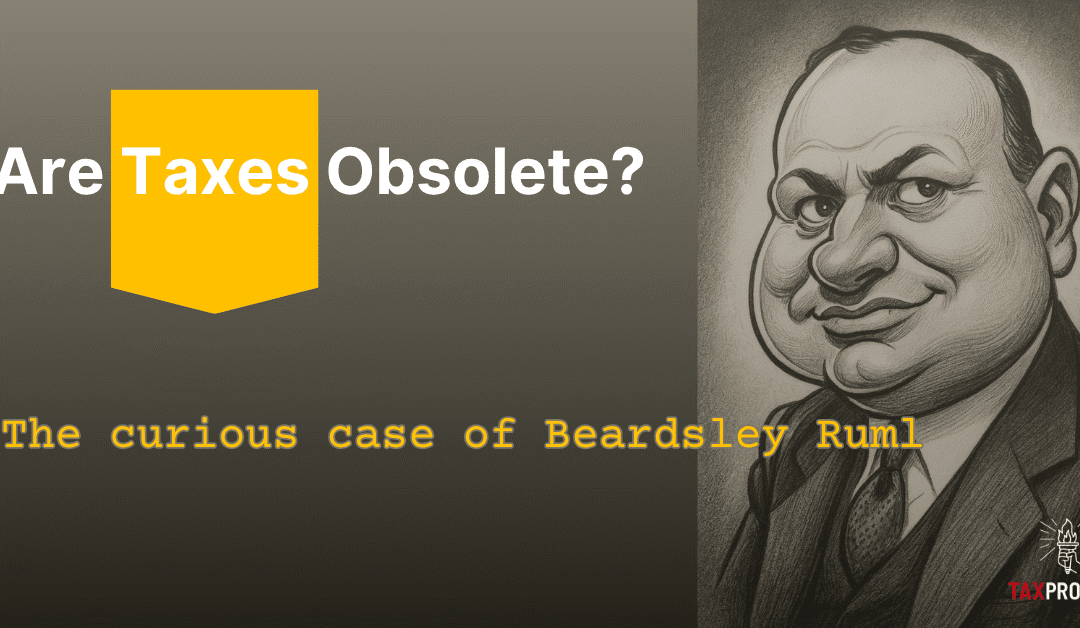
The United States in the mid-1940s, the country had just financed the most expensive and bloody war in history. Something new is occurring: paychecks for the first time begin withholding income tax out of those paychecks as they are earned. The so called “Gold Standard” where Gold backs every dollar as a legal promise is gone for Americans. The Federal Reserve is learning how to steer interest rates for a peacetime economy. Beardsley Ruml, a former Macy’s finance chief turned New York Federal Reserve chair steps into this backdrop and writes an article in the January 1946 American Affairs publication with a simple but provocative statement:
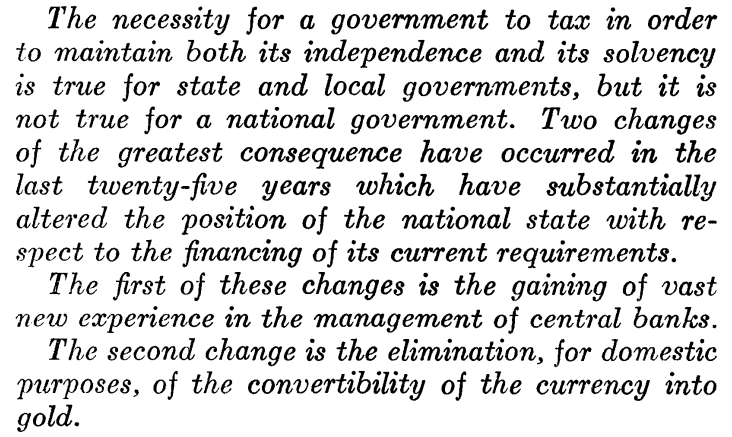
“Taxes for revenue are obsolete.”
Beardsley Ruml
He isn’t trolling – he meant what he said. He’s telling readers that the way money works has changed, and if we keep thinking about Federal taxes like a family checking account, “first earn, then spend”, we misunderstand how money works in a fiat currency not backed by a hard asset (like gold) and what taxes actually do in a monetary system. The government no longer needs to wait for tax revenue to spend. Stop for a second and think about this statement, it is a Matrix like moment where Morpheus asks Neo if he wants the Red Pill or the Blue Pill. The Red Pill represents the truth and how fiat currency actually works, and the Blue Pill represents just ignoring the truth and going back to your comfortable understanding of how money works. A full copy of Ruml’s Thesis can be found here.
Fiat currency is money that is not backed by a physical commodity like gold or silver, but is instead backed by the government that issued it. Its value comes from the public’s trust and the government’s authority, which decrees it as legal tender. Examples of fiat currency include the U.S. Dollar, the European Union’s Euro, and the Japanese yen.
The Backdrop for Ruml’s Thesis
When Beardsley Ruml wrote “Taxes for Revenue Are Obsolete,” he was synthesizing his experiences of how American money actually worked, and the changes going on around him. As a Federal Reserve chair, participant in Bretton Woods, and someone who shaped policy, like Pay as you go payroll, he had a first hand view.
1933–1934: Off domestic gold—constraint shifts inside the border
In the early New Deal years, the U.S. ended domestic gold convertibility and reorganized the gold regime under the Gold Reserve Act. Inside the country, dollars were no longer legally IOUs for a fixed weight of metal. The binding constraint on federal finance began to migrate from gold reserves to inflation, real capacity, and statute (law). Ruml’s essay explicitly ties his thesis to this inconvertible-currency reality: a national state “with a central banking system… [whose] currency is not convertible into any commodity.” [1]
“Final freedom from the domestic money market exists… where [there is] a modern central bank, and [the] currency is… not convertible into gold.” [1]
1942–1943: Pay-as-you-go withholding—taxes become continuous
With wartime employment booming, Ruml helped push paycheck withholding (the Current Tax Payment Act of 1943), turning the income tax from an April settlement into a real-time flow. Withholding didn’t just improve administration; it made taxes a live instrument for managing purchasing power across the year, reinforcing Ruml’s view that taxes should be judged by effects—on prices, distribution, and behavior rather than as a cash bucket to “fund” future outlays (spending). [5]
1944–1946: Bretton Woods and the New York Fed vantage point
As Bretton Woods took shape (par exchange rates, gold convertibility for foreign official holders, capital controls), Ruml was chairman of the New York Fed (wartime through 1946). He watched the Fed support Treasury borrowing for war finance and then toward peacetime normalization. In that setting, Ruml saw operationally how Treasury spending settled through the Federal Reserve, and how taxes and bond sales later lowered purchasing power and supported interest-rate control. He previewed his thesis in a 1945 address and then published the 1946 essay, sharpening the claim that taxes are essential for what they do, not to generate revenue before spending. [1]
“All federal taxes must meet the test of public policy and practical effect.” [1]
1951: The Treasury–Fed Accord—roles clarified
Ruml’s essay was given before the Treasury–Fed Accord, but the Accord (1951) confirmed the institutional direction he was pointing toward: monetary-policy independence to target rates and prices, separate from Treasury’s debt-management imperatives. After pegging wartime yields, the Fed reclaimed the ability to resist fiscal pressure when inflation called for tighter settings—strengthening the case that budgets should be judged by employment, prices, and distribution, not balanced-budget rituals. [3]
Ruml died in 1960, but his logic became even more straightforward after Nixon suspended official dollar–gold convertibility and major currencies moved to floating exchange rates. From then on, the United States was unambiguously a fiat-currency issuer: spending cleared through the Fed first; taxes and bond sales followed to manage inflation, distribution, market structure, and interest rates. Ruml’s once-provocative line read less like heresy and more like a plain description of operations—with the real constraints now fully on inflation, capacity, and institutional credibility. [4]
“The public purpose… should never be obscured in a tax program under the mask of raising revenue.” [1]
So the events and experiences: moving internally away from gold backed assets at home (1933–34), real-time taxation (1943), Fed Monetary Autonomy (1951), and externally away from gold (1971–73) together explain how Ruml could say, without gimmicks, that taxes are essential for what they do: price stability, distribution, behavior, and currency demand—rather than as a prerequisite to spend. He believed the question for any program was:Can the real economy deliver, and how will policy manage the price-and-capacity path along the way?[1][3][4][5]
Follow the dollar: how “mark-up” works
To see understand Ruml’s Thesis more concretely, we can use by example a single payment.
A federal contractor finishes a bridge repair job. Treasury authorizes payment to the contractor. The Federal Reserve, which is the government’s bank, marks up the contractor’s checking account at their commercial bank. Two things happen at once:
The contractor’s deposit goes up (their balance goes up, they have more spendable money).
The contractor’s commercial bank’s reserve balance at the Fed goes up (the bank’s settlement cash).
No one at the IRS had to collect that exact amount yesterday for this payment to clear today. In other words, the government did not have to wait for revenue before spending. The payment clears because the United States operates the dollar system. Once that payment is made, taxes later can remove some of those dollars from private hands; and bond sales can swap some deposits/reserves for Treasury securities to help the Fed keep interest rates where it wants them.
That’s the basics of Ruml’s claim. In a fiat system with a central bank, spending isn’t bottlenecked by prior tax receipts. The real limits are inflation and real capacity – how many workers, machines, homes, kilowatts, and microchips the economy actually has.
“Federal taxes can be made to serve four principal purposes…” [1]
Ruml’s Four Functions for federal taxes then are as follows:
Price stability (control inflation by removing purchasing power when the economy runs hot)
Distribution (redistributing wealth (purchasing power) based on policy)
Behavior/structure (altering behavior with economic incentives e.g. carbon, tobacco, alcohol, etc.)
Currency demand/legitimacy (creating demand for currency by requiring Federal taxes be paid in Dollars)
Questions from Ruml’s thesis
Not only was Ruml’s thesis provocative, if true it brings up a whole set of new questions, and challenges a lot of our notions of money and taxes.
Question: If spending can come before tax revenue, and the government doesn’t need it to spend, why are we paying taxes at all? This is the heart of Ruml’s Thesis, that while the government did not need taxes to allow the government funding to spend, taxes did play an important role. Ruml believed taxes were a way to manage price stability (inflation): they help keep prices in check by reducing purchasing power (demand), they shape who holds purchasing power, and they anchor the currency by requiring dollars to settle tax bills. Without taxes, you could spend for a time but you would lose price stability and the public’s confidence in the stability of the dollar itself.
Question: Why do politicians still ask “How will you pay for it?” if taxes aren’t needed to spend? Because you hit walls long before you “run out of money”:
You can’t print money for Imports. If spending weakens the value of the dollar, import prices jump or supplies dry up. That impacts living standards fast. [18][19][20]
Boom–bust finance. Prolonged easy fiscal + easy money can inflate asset and credit bubbles; when they pop, banks retrench and recessions deepen—costlier than using modest drains (purchasing power reductions) earlier. [9]
Tax-base erosion (seigniorage limit). If people expect rising prices and weak policy response, they flee into hard assets/FX; real tax intake falls just when control is needed (seen in hyperinflations). [16][17]
Real-world choke points. Money doesn’t increase productivity, create nurses, build cars, ports, or grid lines; increasing demand into bottlenecks yields price instability, not output. [10][12][13][14]
Interest-cost feedback. Rate hikes to cool inflation raise government interest bills, shifting income toward bondholders and forcing tougher trade-offs later. [11][9]
Predictable Policy keep costs low. Predictable authorizing/phase-out rules lower risk and support long-term contracts; junk the rules and borrowing costs/investment worsen even before inflation moves. [11][9]
Ruml’s point isn’t spend in excess, it’s that taxes aren’t required to spend. Taxes and pacing are the governors that keep prices stable, protect access to vital imports, prevent financial bubbles, and align demand with what the real economy can actually deliver. [1][2][3][6][7]
Question: Why not just make everyone a billionaire? This is an interesting thought exercise, if everyone was a billionaire would the purchasing power of the currency be the same? Since money is a claim on real output, not actual output (productivity) if everyone was a billionaire most certainly the purchasing power of the fiat currency would be substantially lower. More money without more productivity (nurses, houses, energy, widgets, etc.) brings higher prices (inflation), not greater prosperity. Ruml’s thesis keeps taxes (and other monetary mechanisms to reduce purchasing power) in the toolkit precisely to match purchasing power to capacity.
Japan: Use Case and cautionary tale
Japan is the cleanest real-world test of part of Ruml’s thesis. For decades, Japan’s gross public debt sat well above 200% of GDP—yet long-term interest rates were near zero under Bank of Japan (BOJ) policy. The Yen has had no solvency crisis, of major uncontrolled inflation. That supports Ruml’s point that a nation which issues debt in its own currency faces inflation and capacity constraints more than a “running out of money” constraint [12][13].
However, during the same period shows why Ruml’s mechanics don’t solve the growth problem by themselves:
The “lost decades.” Japan endured a multi decade stretch of weak real growth and disinflation/deflation. Even with easy financing conditions Japan was not able to create growth and productivity improvements or new sectors on their own [14][16].
Balance-sheet hangover. After the 1990s asset bust, households and firms deleveraged for years—private demand stayed weak even when public deficits filled part of the gap.
Wages and demographics. An aging population, shrinking workforce, and corporate practices contributed to sluggish productivity and flat real wages for many workers [14][16].
Foreign Exchange (FX) and imported prices. Episodes of yen weakness raised import costs (notably energy), squeezing households and complicating the path out of very low inflation.
Policy evolution. The BOJ cycled through low rates including zero and even negative interest rates for 8 years!, Quantitative Easing, and yield-curve control, then gradual adjustments. These tools stabilized finance but didn’t create robust growth, reminding us that supply-side capacity (energy, housing, innovation, corporate reform) still determines living standards.
Monetary sovereignty may avoid immediate solvency issues in your own currency, but prosperity still depends on productivity, demographics, and the supply side. The policy art isn’t printing more money; it’s about managing the balance between demand and capacity so money meets output rather than outruns it. [12][14][16]
Where Ruml’s Thesis fails
Ruml presumes monetary sovereignty – you tax and spend in your own currency, with credible institutions, and you don’t owe large amounts in someone else’s money, or require external inputs like energy, food, or other goods and raw materials. It also assumes you don’t outspend the productive capacity of the country. If and when those conditions vanish, significant and detrimental impacts could fall upon the country. There are a number of examples of hyper inflation, that have damaged the economic and well being of countries.
Weimar Republic Germany (1921–23). Huge reparation obligations (external), political fracture, and aggressive central-bank financing into a collapsing anchor produced hyperinflation. The issue wasn’t “deficits” in the abstract; it was external liabilities + institutional breakdown + supply dislocation [18].
Zimbabwe (2000s). Radical output collapse (agriculture and supply chains), governance failures, and money creation against shrinking real capacity drove prices into hyperinflation. Too many nominal claims, too little real output [19].
Sri Lanka (2022). A foreign-currency crisis: depleted FX reserves, weak tax base, and large hard-currency debts. You cannot print your own fiat money when your liabilities are in dollars/euros; the constraint becomes imports and external financing, not domestic “solvency” [20][21][22].
Ruml’s Thesis exists when you issue your own currency, are not dependent on externalities or foreign debt, and spending does not outpace productive capacity and credibility in currency is maintained. Lose those – and inflation, devaluation, and/or default can take the driver’s seat.
How most Economists think about Ruml’s Thesis
Most modern economists agree on the operational basics: in a fiat currency system, the Treasury and central bank can ensure payments clear in the home currency; taxes/bonds then drain purchasing power and help the central bank hit an interest-rate target. That’s not controversial [6].
Where Economists caution starts – real life, not the textbook:
Prices can jump if demand outruns supply. If new spending hits an economy short on cars, nurses, chips, or houses, prices rise. That happened in 2020–22 during the COVID Pandemic: demand recovered while supply was jammed. Changing taxes or budgets is slow, so economists like built-in brakes (automatic stabilizers) and phased rollouts. [6][7][2]
Higher interest rates make debt cost more. The U.S. can always pay in dollars, but when the Fed hikes to fight inflation, the interest bill on government debt climbs. If that bill grows faster than the economy or tax revenue, Congress faces tougher trade-offs. Last year Net Interest on the US National Debt was over $1 trillion. The 1951 Accord exists so the Fed can fight inflation even if it makes borrowing costlier. [3][10][11]
Consumer Sentiment and Beliefs matter. Prices stay more stable when people trust leaders will cool inflation off if needed. If policy looks like “spend without limits,” businesses and workers build in higher inflation into their cost models and pass that along, and it’s harder to bring back down once its gone up.
Not every side effect shows up in the Consumer Price Index (CPI). Inflation can manifest itself in many ways that trickle down to the ordinary consumer in ways that aren’t tracked well by major indexes like the CPI. Big deficits with low rates can push up stock and house prices and widen wealth gaps, even if everyday inflation isn’t high. That can erode support for useful programs. [10]
At full tilt, something has to give. When the economy is already near full capacity, more public spending creates demand that competes with private demand for the same workers, resources, and materials. The result isn’t “no money”; it’s higher prices or shifting resources away from something else. This can be managed with taxes destroying demand, phased timing reducing demand peaks, or adding supply.
America, and most countries are deeply intwined in Global Trade We import energy, food, critical resources, and key parts from a Global Supply chain. If the dollar weakens or suppliers get nervous, import prices rise and shortages can appear. Building domestic capacity (energy, logistics, housing) and self sufficiency can offset that, but it also comes at a cost.
Where Economists actually stand on Ruml’s thesis
Broad agreement on the plumbing: Most economists accept that in a fiat system the government can pay first in its own currency, and that taxes/bonds are tools to manage demand and interest rates. That’s mainstream (see the Bank of England explainer). [6][7]
Support for using deficits in slumps: In recessions or emergencies, many economists favor deficit spending to protect jobs and speed recovery. (Ruml’s taxes aren’t required for spending fits this.) [6][7]
Caution about pushing it too far: Many are wary of treating “spend first” as a green light without a clear plan for inflation, ensuring demand doesn’t outpace supply and productive capacity, and the outside world (Global trade, key economic inputs from outside the U.S.). They stress guardrails, automatic stabilizers, and credible roles for the Fed and Congress (the spirit of the 1951 Accord). [3][10][11]
Split on the stronger claims (often linked to MMT):
Critics say relying mainly on taxes to stop inflation is too slow and political, and they worry about fiscal dominance (pressuring the Fed to accommodate debt). They also flag open-economy risks and asset-price side effects. [9]
Supporters respond that good design (automatic tax/benefit adjusters, phasing, targeted drains) can handle those issues, and that recognizing the fiat mechanics helps us focus on real limits (people, machines, energy) rather than imaginary cash limits. [9]
Economist View Summary:
They mostly agree on the mechanics.
They agree deficits can be useful tools.
They differ on how far you can push spending before you risk inflation, financial stress, or FX problems
They differ on whether taxes can be used quickly and fairly enough to cool inflation off. [6][7][3][10][11][9]
A Ruml-style way to judge any Spending program
The Congressional Budget Office estimates the cost and budget impact of programs. Using a Ruml Thesis style way to evaluate programs might look something like this.
Capacity: Do we have the people, skills, materials, energy, and productive capacity? If not, what’s the plan to expand supply?
Inflation plan: If demand overheats, what automatic brakes kick in—phasing, adjustable credits, temporary surtaxes? [2]
Distribution: Who gets the new purchasing power and who gives something up?
External exposure: Are we import or FX sensitive in the relevant inputs? Do we hold external exposures?
Institutional alignment: Are fiscal choices made with a central bank focused on price stability (the post-1951 lesson)? [3]
Summary: Ruml’s answer to the question
In summary we ask the title question: “Are taxes needed,?” Ruml’s answer—in his own words—is that their revenue role is not the point in a fiat system:
“Taxes for revenue are obsolete.” [1]
They are needed for what they do: to keep prices stable, shape distribution and behavior, and anchor demand for the dollar:
“Federal taxes can be made to serve four principal purposes…” [1]
And the standard for judging them is not myth or ritual but outcomes:
“All federal taxes must meet the test of public policy and practical effect.” [1]
Read that together and you have the summary of his thesis: the United States does not tax so that it can spend; it taxes so that the money it spends produces stable prices, fair distribution, incent certain behaviors, and ensure a credible currency. While his beliefs were provocative at the time, and still controversial, the mechanics of his thesis remain true and you can see his influences in the roots of Neo Chartalism, Functional Finance and all the way to Modern Monetary Theory (MMT) today.
As you grow older, you become more self assured, knowledgeable and more independent – able to make many decisions on your own. At some point in your teenage years, you may come to believe in your infallibility, and how correct you are in all things. As you get older, life has a way of teaching you new lessons, and if we were smart and true to ourselves there were probably lessons that our parents tried to teach us many years before and we were too smart at the time to listen. When you become a parent, you come to realize many more of those lessons after the fact. One big lesson for parents is that you can’t make decisions for your children all of the time, for one they won’t always listen, and two – they need to learn on their own. You try to protect them from the things that will really hurt them or having lasting effects, but sometimes a little blood and skinned knees can be way more instructive than any parental chat.
“When I was a boy of fourteen, my father was so ignorant I could hardly stand to have the old man around. But when I got to be twenty-one, I was astonished at how much the old man had learned in seven years.”
Mark Twain
Wisdom of the Mom: What we can learn from mothers
One lesson we learned, and we didn’t even realize we were being taught, was the “You Slice, You Choose” game. The “game” was simple, usually there was something desirable like a Pie and your mother would designate one person to slice, and another person got to choose which slice to take. Simple, but devious – at first glance without a lot of thought a young lad may think if I get to slice, I can slice a bigger piece of the pie. A wiser, more experienced child will realize that any deviation by the slicer from the center was a gain for them as they would invariably choose the larger slice. Overtime, as everyone knew the game the slices became more and more even, and the “game” self enforced fairness without any policing or intervention from parental units. After a while, you could swear that each slice was done by a computer aided laser in the planning and precision of the pie slice so perfectly even down the middle. Many years later, you marvel at the wisdom of mothers and wonder what other ancient mysteries and riddles could these geniuses have solved if their life mission wasn’t wasted helping you slice pie.
Mom and the Budget
Every year now it seems like the Federal Budget is now in play as a game piece to be negotiated by both parties trying to gain advantage over each other. Even though everyone knows the dates and when the deadline is, it always seems to go right up to the end, and in this case over the deadline. Such is the case in the partisan environment we live in today. However, I’m struck that it’s really nothing more than a high stakes game of “You Slice, You Choose.” That may over simplify it by quite a bit, but the fundamentals are the same.
Pie Analogy
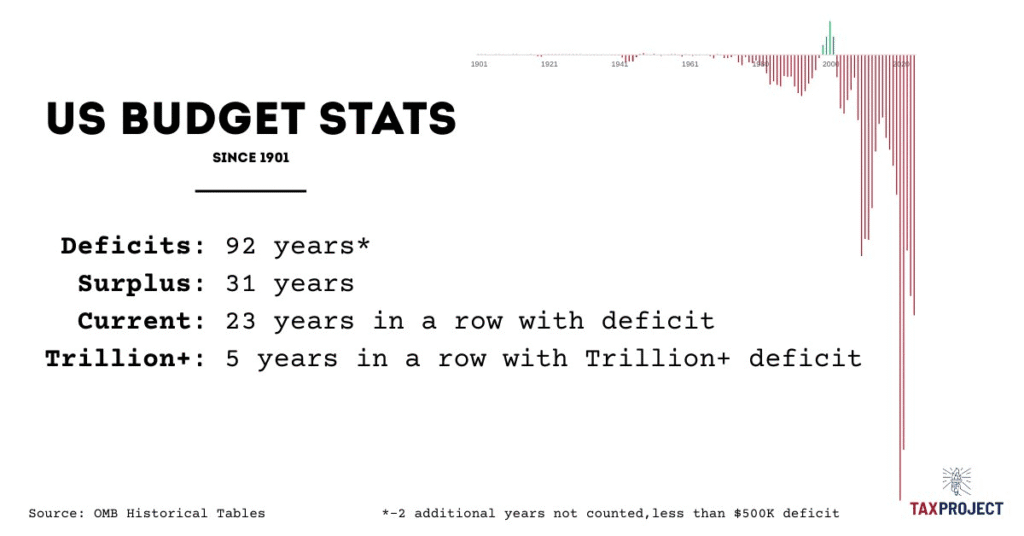
Our Federal Revenue is the ingredients for the pie. Our Federal budget is the size of the pie. Some years the pie will be larger than what you can eat, known as a budget surplus, and you can put some in the fridge for later. Other years you can borrow extra ingredients to have a bigger pie now at the expense of smaller pies in later years, known as a budget deficit. Much like pies in our household, there was never enough. Since 1901 we’ve had 92 years of budget deficits.
Figure 1
Our debt keeps growing, as well as the interest on the debt. Each year eating more and more pie.
Pie Dynamics
Before you even slice the pie, you realize several pie dynamics are at play. The amount of ingredients each year, the more ingredients the bigger the pie – so as Revenue grows, so does the size of the pie. The size of pie we make is dependent on the quantity of ingredients we have, and if we choose to leave some pie for later (surplus), or we decide to borrow ingredients from the future (deficits) with the potential consequence of having to reduce the size of future pies.
Pie Slicing
After you understand the pie dynamics, you can begin the process of slicing. However, before you slice you want to have any idea of how you want to divvy up the pie, and knowing with the Federal Budget almost 3/4’s (74%) of the pie is already gone before you slice it allocated to Mandatory and Net Interest components. The Net interest is all the extra pie we had in previous years. The more we add to the deficit, the larger it get. As it keeps growing, the smaller and smaller the pie available is in the future. Unless new laws are passed, the debate is in the quarter of the pie designated as Discretionary. However, even many of those don’t feel discretionary like National Defense – you could cut it back, but you probably aren’t going to eliminate it.
Figure 2
Pie – Choosing your Slice
So the only thing left is tough choices. Slicing can be a painful process, because when it comes time to choose – you realize that something you may have wanted more of shrunk, and something you wanted less of grew and you are stuck with that choice. Unlike in the family edition of the “You Slice, You Choose” game, both parties participate in the slicing and choosing. There is no self reinforcing fairness mechanism other than the active participation of engaged and informed citizens. This is the game Congress must play each year.
Pie in the Sky
Increasingly, people bring up MMT (Modern Monetary Theory). Using our pie analogy, according to MMT as long as inflation is in check, your pie can be as big as you want it to be. We wish these Economists were available to instruct our parents. Alas, in our household there was no magic infinitely growing pie, just tough choices. Until such time as an infinite pie becomes available, we’ll have to face touch choices as a country.
You Slice, You Choose
Summary
The Federal Budget is much more complicated, and the outcomes and consequences much more serious than a game of “You Slice, You Choose” but the lessons from Mom are none the less instructive. We all have to choose between tough choices, we all have to make reasonable assumptions and trade offs, and create mechanisms for fairness and balance that reinforce themselves automatically and fairly. In the game of life understanding Government Financial Literacy gives us the tools to understand the rules of the game, how to participate, and understand the dynamics, and trade offs that must be made in order for all of us to thrive. We learn many lessons in life, some of them stick with you. Thanks mom, I miss you every day.
Tax Project Institute is a fiscally sponsored project of MarinLink, a California non-profit corporation exempt from federal tax under section 501(c)(3) of the Internal Revenue Service #20-0879422.